

Note:
For those of you just joining, I’m doing NaBloPoMo, or National Blog Posting Month, a challenge to publish 30 blog posts in 30 days. This is my 9th year of participation, and the theme is “What’s already good, and what could be better?” I answer these questions for myself personally and as I see society as a whole, for one topic each day of November.
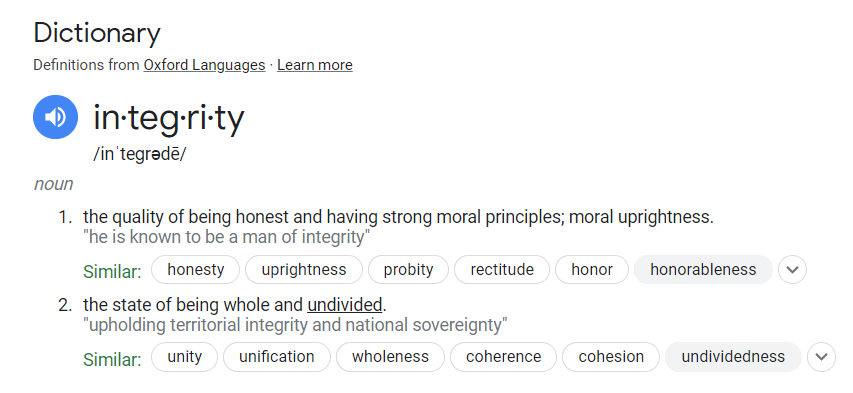
I love how integrity has these two definitions. I think of a person’s integrity more as the second, as one’s character being unassailably indivisible. It means we show up our whole, honest selves everywhere and with everybody, ourselves included.
There is an identity exercise wherein the self is drawn as a flower, and aspects of identity as petals. The flower is modified by reorienting petals depending on the context in which a person finds themselves–most relevant identity markers in front, most protective around the edges–however the person thinks of themselves as that flower in any given environment. I think this is a fantastic analogy for integrity, because it acknowledges that maintaining wholeness does not necessarily require all parts to be equally visible, vulnerable, dominant, or accessible at the same time. I suspect that for many of us, certain petals are kept out, big, and vibrant, with others more tender and close to the center. Roses have guard petals, tough outer layers that protect the inner petals as the whole bloom opens. Many florists remove the guards for aesthetics, but some recommend retaining them, honoring nature’s form and function. Myriad potential comparisons to the human identity flower here tickle my metaphor-loving brain. What would your flower look like? How does it feel?
How do I do integrity well already?
–How does one answer this question without sounding self-righteous and arrogant? I keep thinking I should ask others, “(How) Does Cathy walk her talk?” That is the true test, because self-delusion is real and too often invisible. Walking the talk is how I define integrity, and it is a high value of mine. I think it shows when as a leader, I don’t ask the team to do anything I would not do myself, and I often do whatever I’m asking right alongside everybody.
–I check in often with those who know and observe me. I seek honest feedback and do my best to receive it graciously, so people feel safe to give it.
–I live by a handful of words and ruminate on them daily: present, open, grounded, kind, loving, smart, curious, generous, fun. If you know me and would describe me this way, then I know I’m living into my integrity.
How can I do it better?
–Could I be louder about amplifying my values? Bolder? More assertive and insistent about enrolling others in advancing my just causes? Somehow that feels like showing off, attention seeking, which is not how I think of integrity…
–When I enter situations of ambivalence and conflict, for instance when honesty may rupture relationship, or showing up loving tempts me to withhold honesty, I can slow down and consider, prioritize my values in context, assess risk and harm of each potential action. I think I do this already… At least I practice awareness and acceptance of that discomfort rather than denying or dismissing. I slow down and try not do speak or do irretrievable things impulsively. I can keep practicing this and keep checking in with those in the mud with me.
–I could be clearer and more explicit in times of ambiguity and conflict about which core values I prioritize, what I’m willing to sacrifice, why, and how that informs my decisions and actions. This is transparency and fair process, which are important to me.
What’s already good about our integrity as a society?
National identity and pride. Freedom. Independence. Innovation. Ingenuity. We Americans identify with these values, and despite our many and significant contradictions, I think we exhibit them clearly in many contexts. I hear people from other countries describe how American culture feels liberated/liberating in many ways (though constricting in others). Those contradictions, though, yikes.
In the small ways. I see people trying evey day to live up to/into their ideals. I am very slow these days to call someone out for hypocrisy–I try to imagine their identity flower and assess which petals they’re showing me, and which I think they have tucked away for now. Those ambivalent and conflicting situations happen more often than we may realize, and we literally make tens of thousands of choices each day. Much of our integrity, then, is maybe autopilot? Ooo, fascinating.
How could we do better?
Honesty. It’s okay to be in it for the money, even if your core value is helping people. Just be clear about which of these takes priority, especially when they come into conflict. Make a plan to reorient actions to align as closely as possible as soon as possible, to true core values in the future. Or admit outright that your core values have simply changed. Honesty and integrity go hand in hand in my mind.
Self-compassion. Sometimes it will look on the outside that we have really thrown our values away. For leaders especially, not all aspects of every decision can be disclosed at large. Competing interests and goals scramble our delusions of idealistic, binary, black and white, right and wrong, yes BUT. If we’re really honest, and give ourselves some grace for the hard places we live and work, I think we can find our way more easily to the right, if uncomfortable, next steps.
Psychological Safety. After we have assessed our own morals honestly, drawn our contextual flower as accurately as we can, talked ourselves off the ledge of (or put on some armor to protect against) potential public shaming, and taken some firm, grounded steps forward in our own integrity (tenuous as it may sometimes feel), then we can start to extend these graces to others. Psychological safety in groups spreads more efficiently and effectively if initiated by designated leaders; and any of us can also lead by this example.
It strikes me again now that I did not choose these 30 topics intending for them to overlap so much. Do I just have a dearth of new ideas to express? Or do these concepts/practices intersect so tightly that we simply cannot consider any independently of the others? I think of the human body–we study and practice medicine in quasi-silos: cardiology, pulmonology, infectious disease, endocrinology, orthopaedics, psychiatry, neurology, etc. And yet we all know that none of these systems operates normally with all of the others. I wonder what would occupy each segment of a Venn diagram of any/all of my 30 topics this year? Ooo, that could be fun experiment.
OK on to the next, my friends. It’s late and I’m running out of gas. Accountability tomorrow. Oh yeah, that’s gonna be a good one. 😉
 Healing Through Connection
Pingback: Presence | Healing Through Connection
Pingback: Love | Healing Through Connection
Pingback: What You Call Me Matters–Doesn’t It? | Healing Through Connection