Do you play mahjong? Which version?
Here’s my personal story of this very meaningful game and its heritage in my family.
The Cheng/Hwang/Luus have played mahjong for at least four generations now. The set my grandfather gave to my mother when she left Taiwan for America lives safely in my mountain home, along with the sticks my dad made during grad school. GongGong played regularly; my grandparents hosted many a party in their tiny row home in Tainan over decades, money won and lost with raucus abandon. My own set of the same bright green tiles was a gift from my parents, carried by hand from Hong Kong, when I moved into my house. Growing up I always relished our own mahjong parties that went late into the night, played in the basement on that square table with the soft, light blue bedsheet that allowed for tiles to slide and clink so smoothly. There was tea and dessert, that ASMR of tiles shuffling, and all kinds of laughter, joy, and connection. It was a particular cultural experience that I shared with none of my friends at school, a language nobody in my social circles spoke, something I held with particular pride and exclusivity. MaBa would later play regularly with the eldest members of our community, my Chinese School principal and her husband, the Asian studies professor, until both of these friends’ deaths in the last decade.
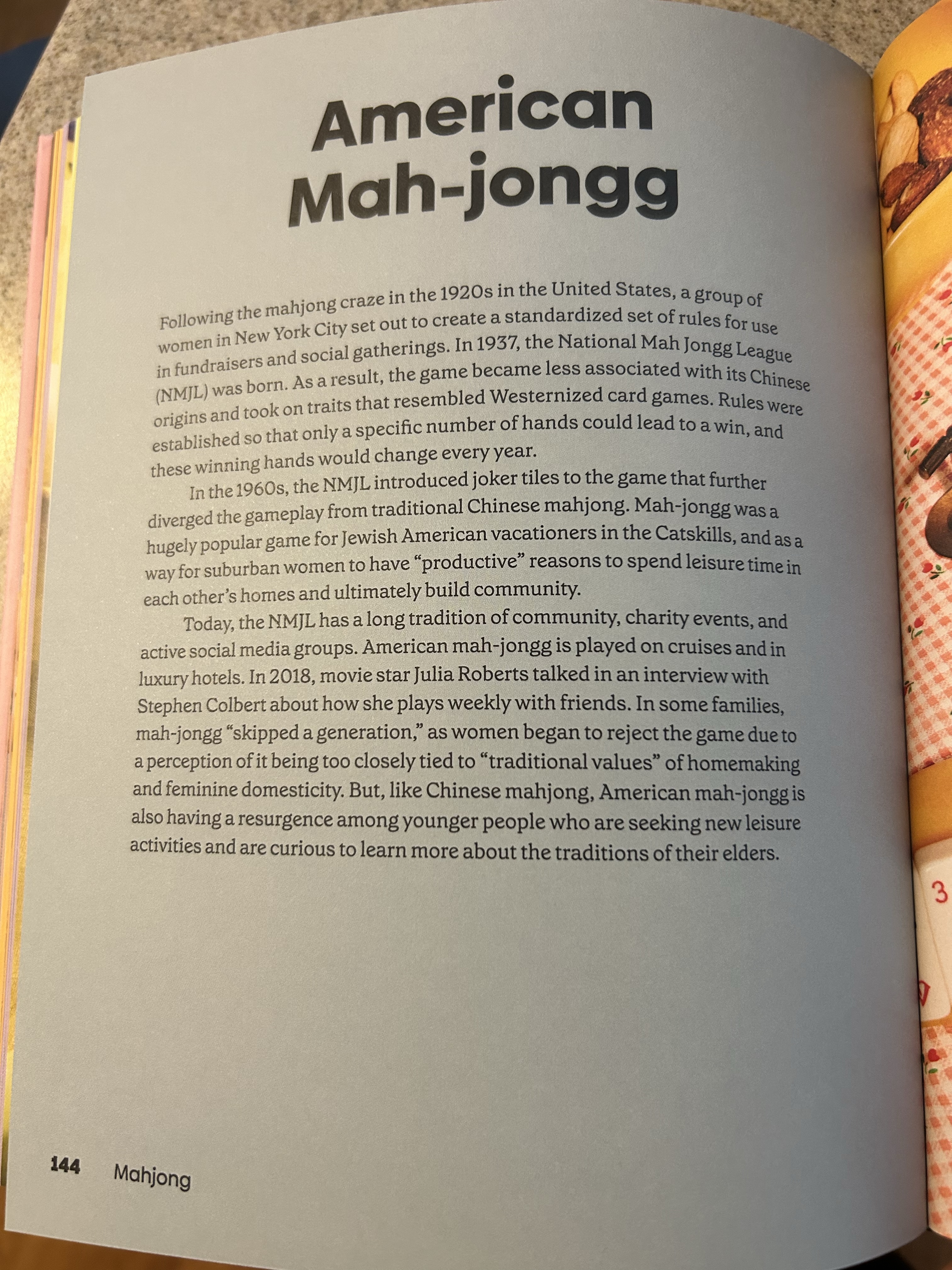
I can’t remember when I learned there was an “American” version of mahjong. I still don’t understand the premise and have almost no interest in learning. That there is a new ‘card’ every year and there are jokers makes no sense to me. Why would anyone want to play another version when the OG is SO FUN?? It’s basically gin with a different set of cards, so it’s easy to pick up. But all of the possible combinations, their meaning, the skill it takes to create them and win BIG–THAT is the challenge that keeps us coming back–and all we have to do is show up to play and learn!
Moving to Chicago made it much easier to find peers who play, especially among moms at the kids’ school that was about 25% Asian students. With different life stories but the same Chinese-American heritage, more or less, we could simply sit down and start a game, already fluent in the jargon, the posture, the movements, the energy of it all. It would not go too far to say mahjong represents a part of our identity, possibly more as second generation Chinese-Americans than for our elders, the actual immigrants. Some of my parents’ contemporaries initiated their future sons- and daughters-in-law at the mahjong table, as both challenge and invitation to weave into the inner family fabric.
My own kids have played since childhood, expertly tutored by Ba, our live family mahjong Wikipedia. He knows all the hands, their names, their point values, and how to make them for the big wins. He keenly scans the table for our discards and knows what we’re trying to make, then decides to help or hinder. I have no such awareness, despite years of attempted attention and discernment. But Daughter has the gift; she can see the multitudes of possibility in her own hand just like Ba and she has won more of our family games than the rest of us combined, unless he’s also at the table.
Daughter and I have now taught multiple friends, hers and mine, together. She has her own set at college and hosts parties complete with feasts of Chinese entrees and desserts, all homemade in her little dorm kitchen. That girl is hard core and I could not be more proud. When both Son and Daughter are home the table is out and ready 24/7, and when GongPo are also here, watch out, it’s a party. I believe I have successfully imparted that proud cultural energy of my childhood to my children, and that makes me happy.
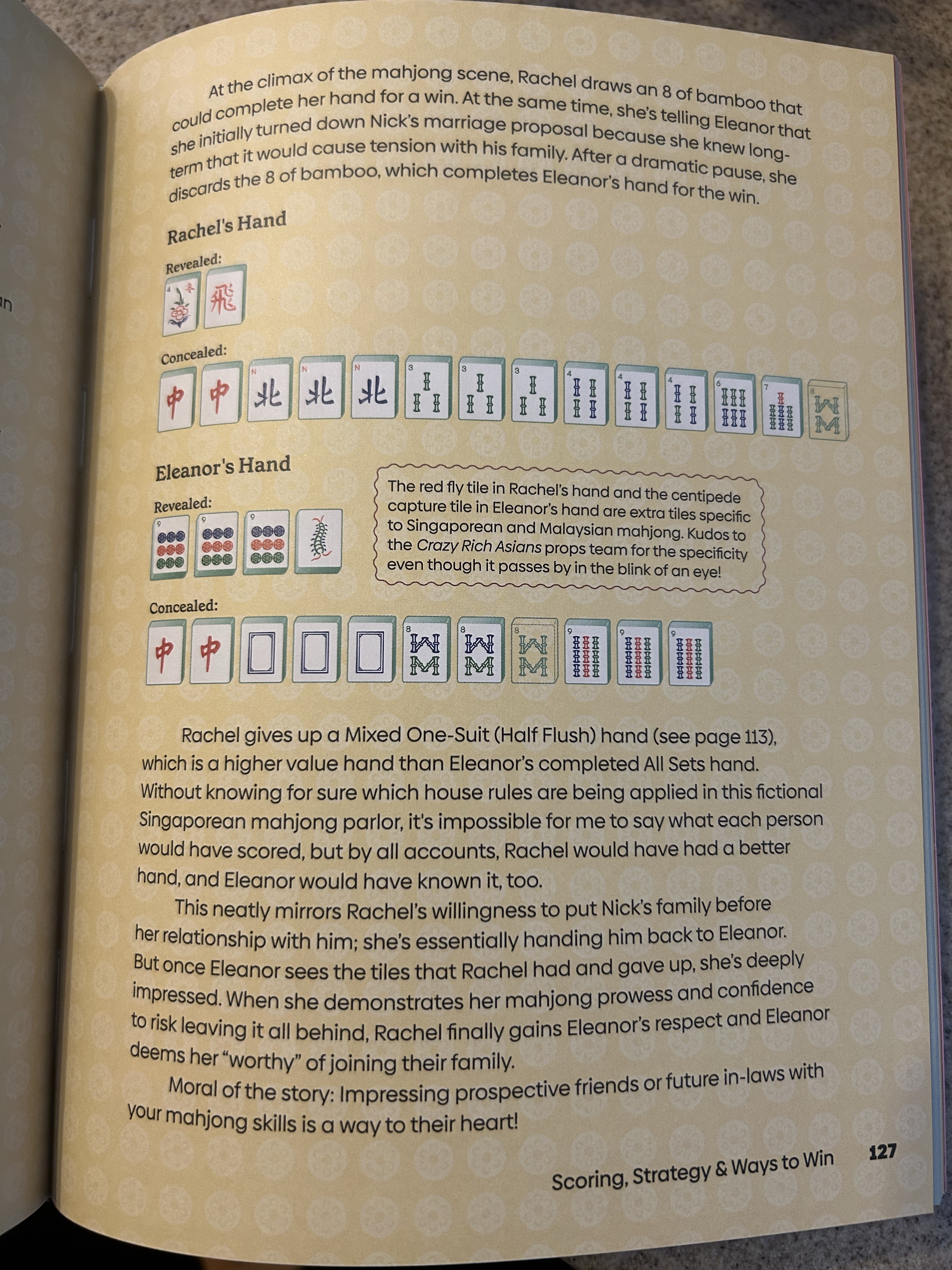
In my lifetime there have been two major motion pictures featuring Chinese people, The Joy Luck Club and Crazy Rich Asians. Both moved me more deeply than I can articulate, and both featured mahjong as a symbol of Chinese culture, identity, and community. I have a hard time imagining how someone who did not grow up in this culture could truly understand how it feels, no matter how studiously or immersively they may try to learn.
But that will never stop me from sharing the joy! I get positively giddy every time I find someone who’s interested and willing to come all the way to the south side to play! I had just invited a new young friend and his fiancee this weekend (they currently play American style), when another friend forwarded a recent New York Times article tagged, “American vs. Chinese Mahjong: Why the Rivalry Is Stirring Controversy”. Controversy, really? That’s clickbait. But some of us do have feelings and opinions about it. From the article:
“Mahjong — or ‘mahj’ to some — has seemingly taken over the country. People are playing at home, in libraries and wine bars, on cruise ships, and by the pool, even in the pool. Last year, Yelp searches for mahjong clubs jumped more than 4,000 percent.
“The craze has been driven largely by the growth of the American version, prompting something of a rift between some loyalists of Chinese and American mahjong.
“Critics have accused a few entrepreneurs of profiting from American mahjong, while disrespecting the game’s cultural heritage. Those detractors have focused on boutique tile sets — often priced around $400 and marketed as “modern” and “refreshed” — which swap out the traditional Chinese characters or designs for Western motifs like cowboy boots and palm trees.
“The sharpest comments have come not from China, where state media has hailed America’s mahjong craze as a model of cultural exchange, but from U.S.-born Asian Americans, some of whom said in interviews that growing up as a minority made them more protective of a heritage they felt was being erased.
“Gathering was, of course, a good thing, but some said they wished there was more curiosity about the people and culture that invented the beloved game.
“’There’s a feeling that this is a game that belongs to my culture,’ said Nicole Wong, an author and founder of The Mahjong Project, which documents the game’s history. ‘But it feels like it’s being suddenly taken away.’”
Yes. “Corrupted” and “appropriated” are words that have come to my mind.
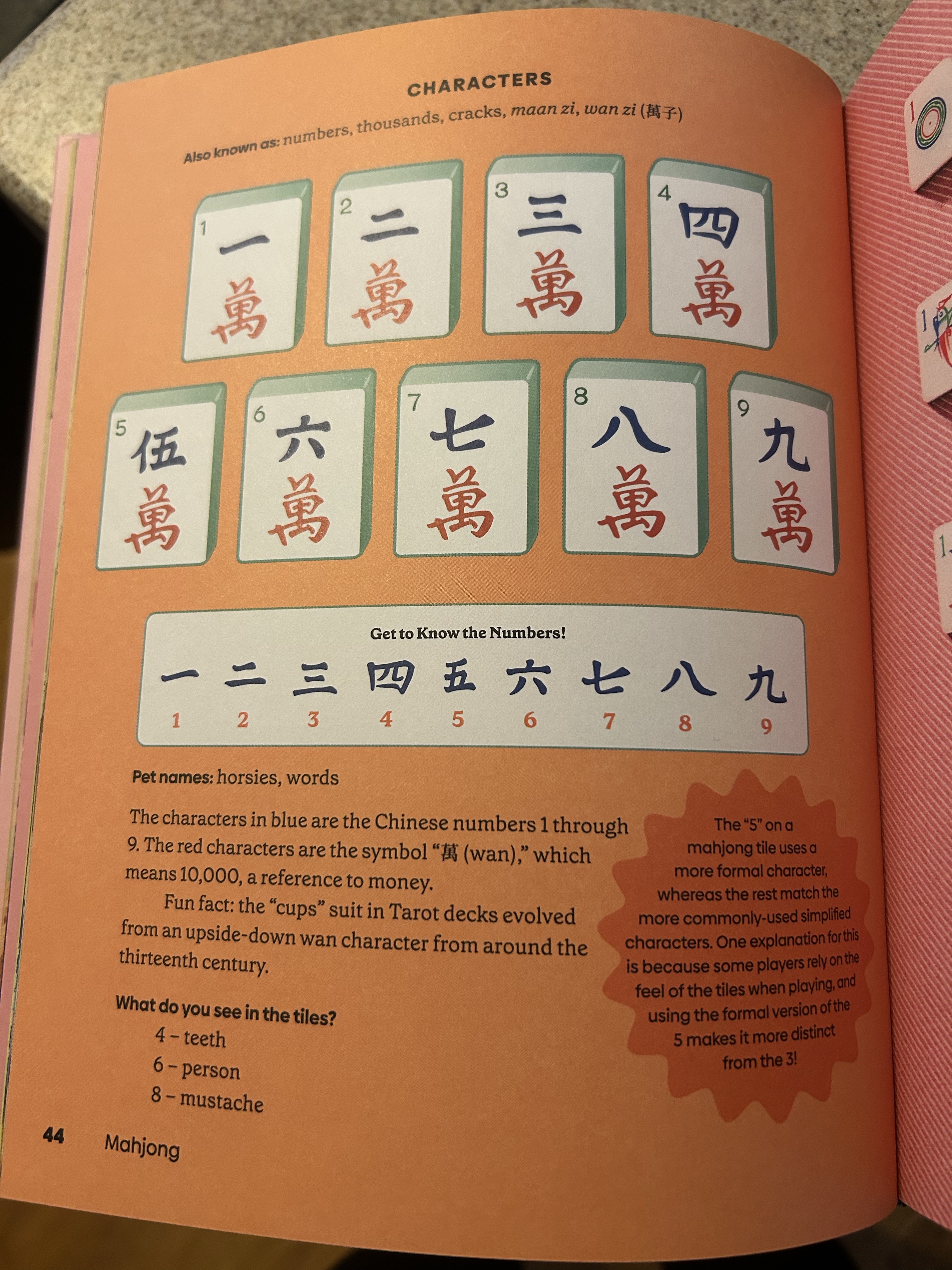
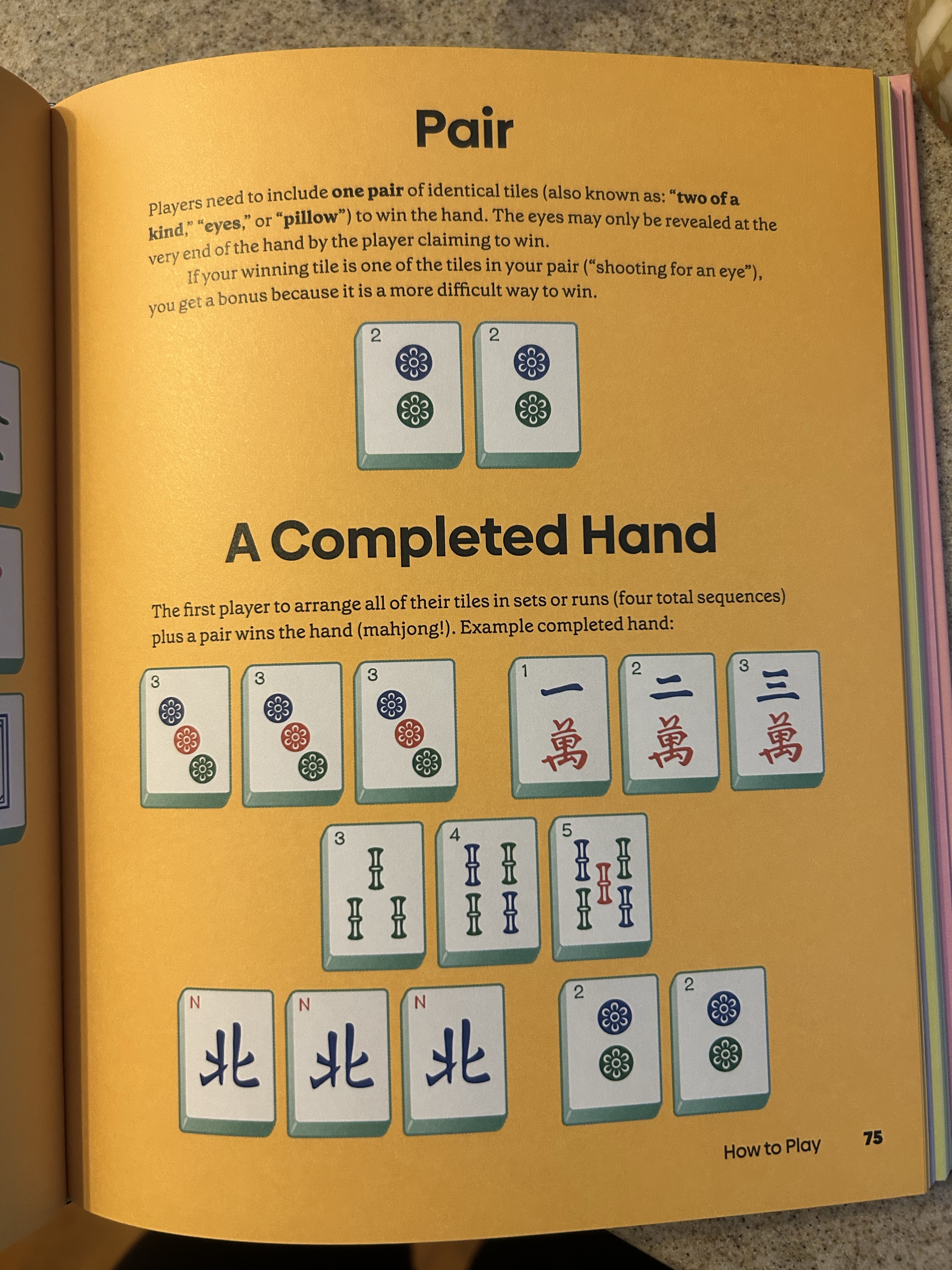
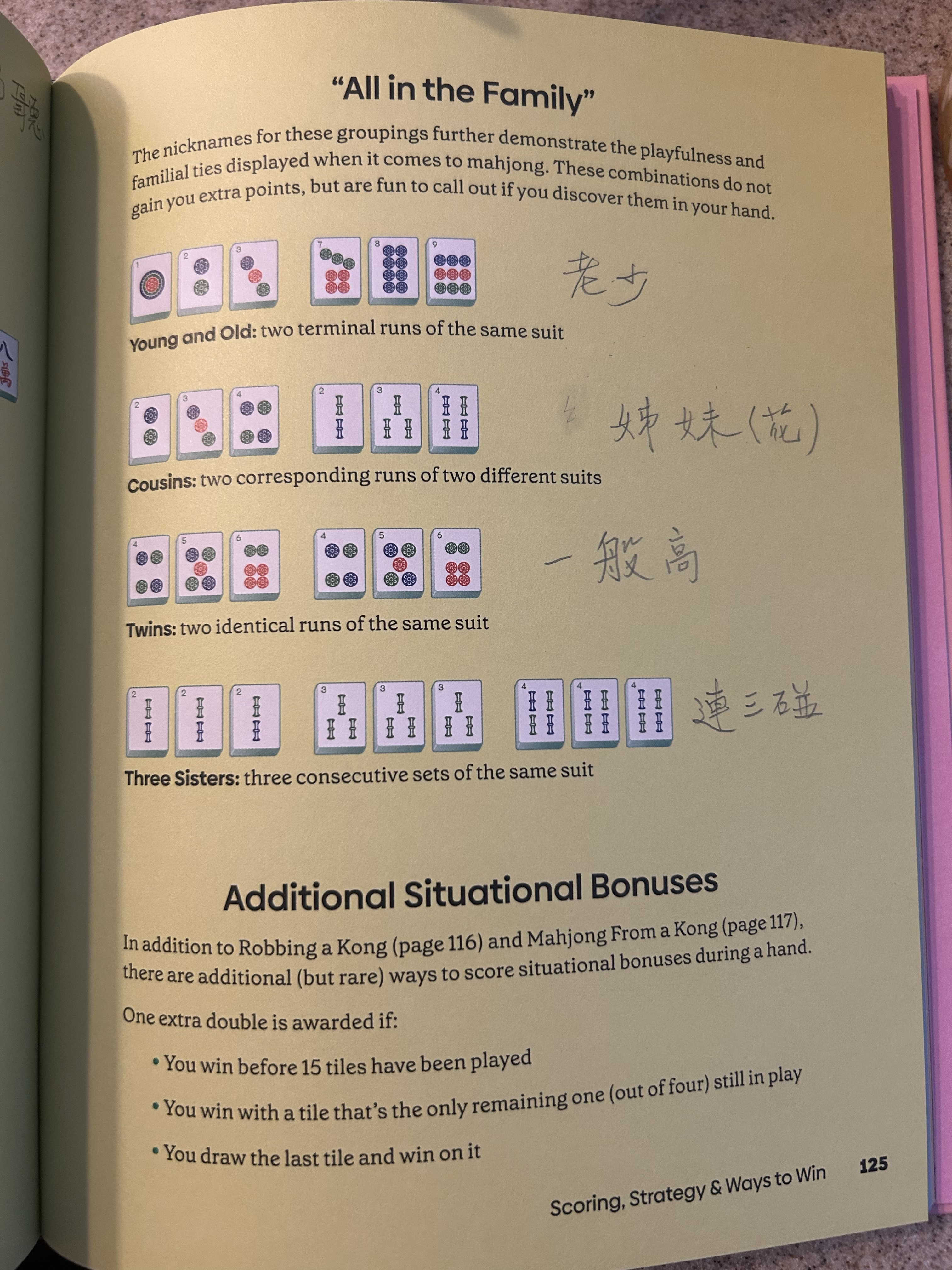
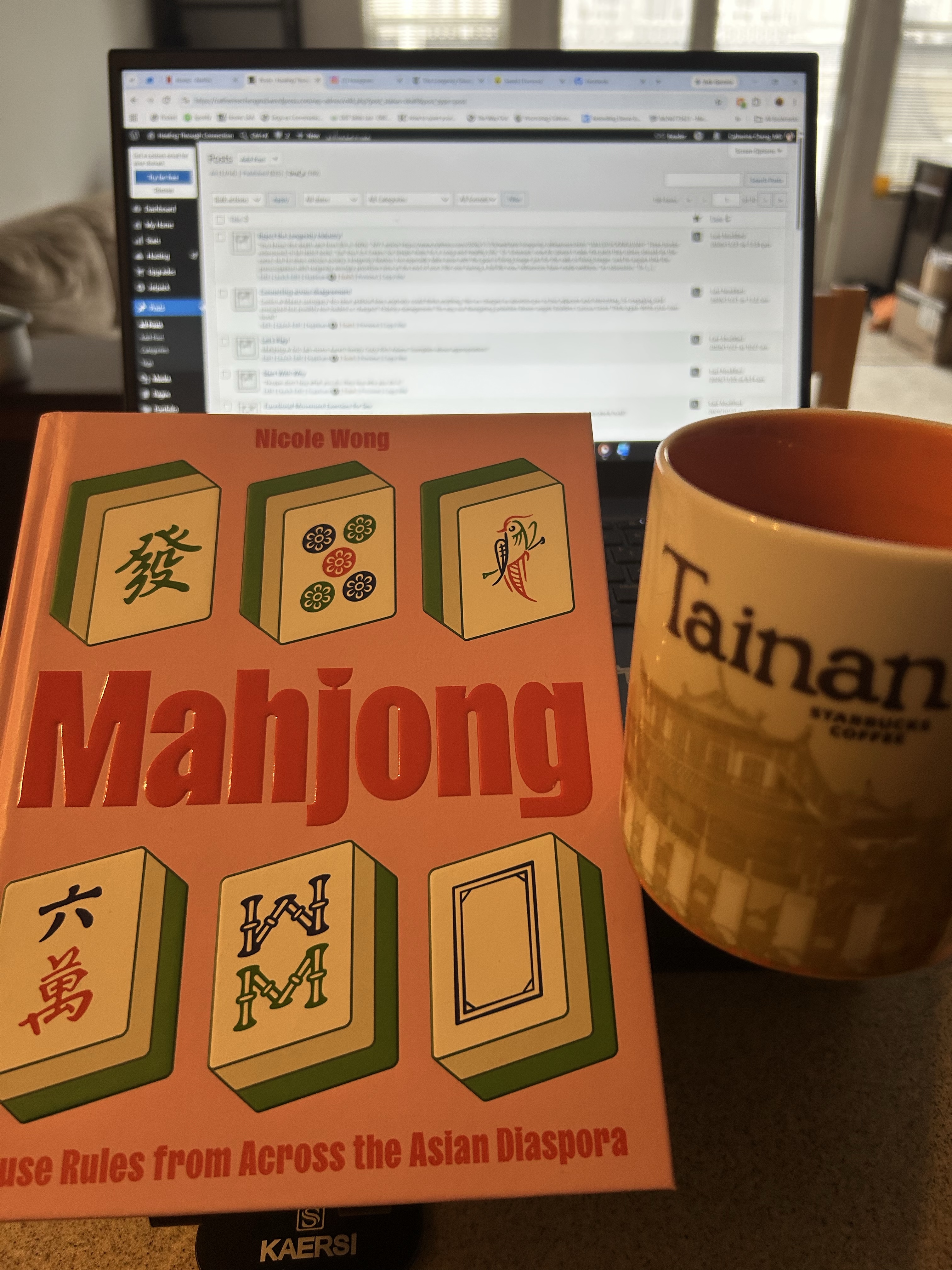
I found Wong’s book, Mahjong: House Rules from Across the Asian Diaspora, a couple years ago while browsing the indie bookshop across from Daughter’s ballet studio. I had looked for years and never found a book in English that housed all of Ba’s knowledge about winning hands and their names. I had tried to write them down myself but could never find a good way to organize or save them (this was before I could easily access a Chinese keyboard on a smartphone). And LO, here they all are in this one volume, clearly explained, along with a history of the game, how it’s played across Asia, and even the advent story of the American version. Even Ba was impressed when he read through it, and I will forever treasure my copy with his annotations in Chinese.
If you are my friend and you want to play (the OG version), call me. If you want to learn and I don’t know you, check out this book! I have included below snapshots of the most meaningful pages to me. Thank you, Nicole Wong, and I hope you’re playing joyfully and often!