“Where does resentment live in your body?”
I thought it was in my gut, maybe somewhere around my liver or gallbladder, but that’s not where I felt it. I rooted around and found it today, somewhere in my chest and limbs, thanks to a beginning embodiment meditation guided by my wonderful new friend and coach Kelly Maher. Not only did I willingly meet my resentment in my body, I had a whole (if brief, thank God) conversation with it, attempting to reconcile its existence despite its apparent detriment to my well-being. Amazing. As the meditation progressed I noticed changes in physical sensations, and thoughts I had met countless times before now occurred in a brand new context of observation and potential understanding.
Kelly says we will likely do some parts and inner child work in the coming weeks. Yikes. And bring it! When the student is ready, the teacher will appear, they say. How funny, it was almost exactly a year ago that I wrote here,
“‘I’ve done all the work I can do with shovels. Now I need drills.’
“Astute and honest friend: ‘Or brushes.'”
In that post I listed books that had advanced my inner work at that time:
“Years ago — The Dark Side of the Light Chasers, Debbie Ford
Why We Love, Helen Fisher
Existential Kink, Carolyn Elliott, PhD
The Body Keeps the Score, Bessel van der Kolk, MD
Romancing the Shadow, Zweig and Wolf
The Self-Led Internal Family Systems Workbook, Tanis Jo Allen, LMSW, ACSW”
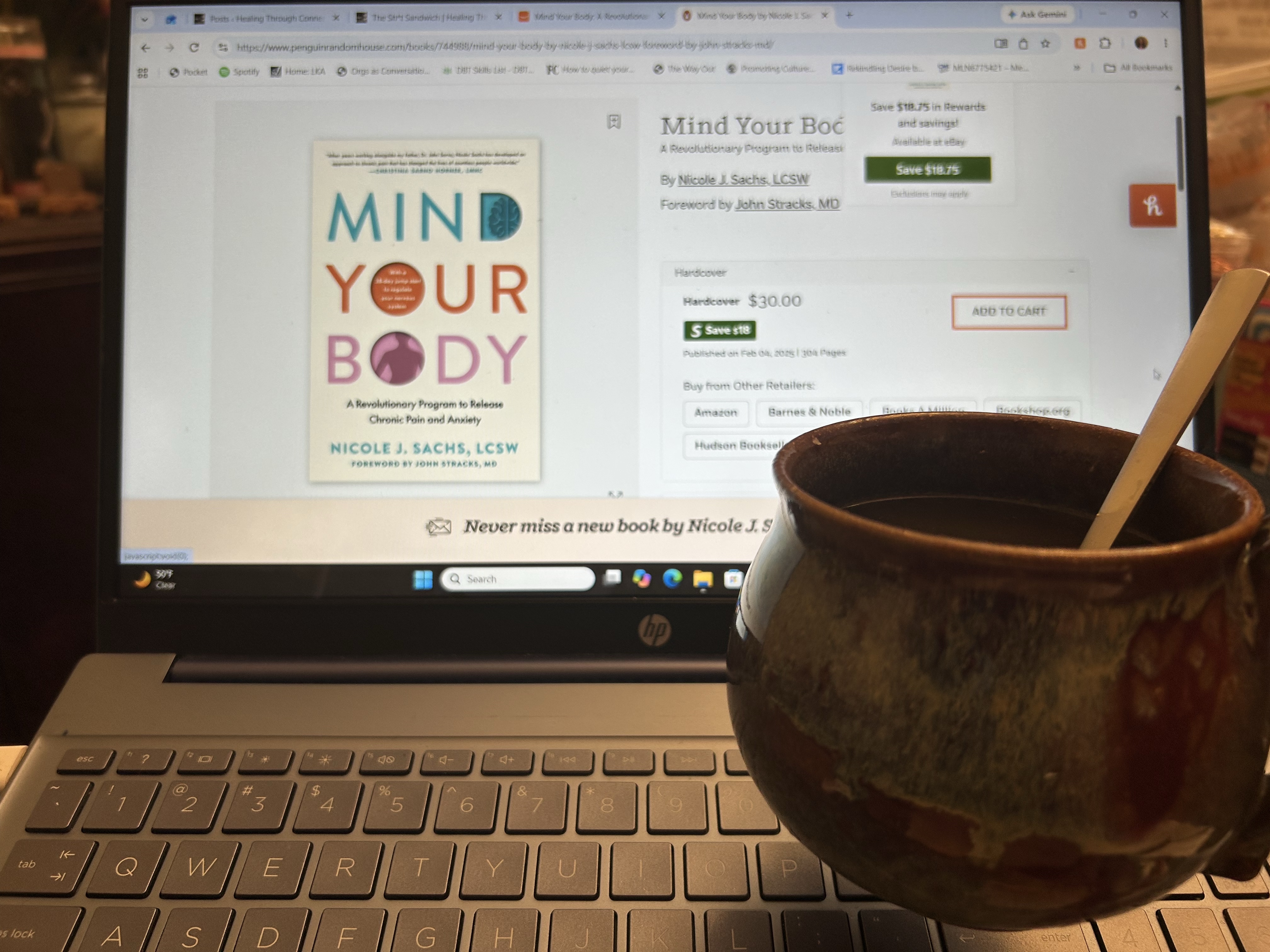
How fascinating when the same ideas recur, but in a slightly different light, with new perspective, for new and continued growth! This year I listened to Mind Your Body by Nichol Sachs, recommended by one of my dietician colleagues when we discussed yet again the things other than hunger that drive humans to eat. I have considered myself a student, but definitely no expert, of mind body medicine for my entire career. The whole concept is so much more mainstream now than 30 years ago, which I celebrate. Sachs writes from decades of psychotherapy experience and introduces her specific journaling method, Journal Speak, to address chronic pain. You can substitute any physical symptom for pain and the method can still apply. I wondered, can you apply it to chronic emotional or mental states? Chronic stories we tell (about resentment, abandonment, etc), chronic bothersome thought patterns? I bought the book in print intending to try the method myself (I write every day anyway), but never got started. I even invited my colleague to do it together as buddies, and still it went nowhere. The pattern I notice here is that I need another human to hold my hand, guiding me and making me feel safe to do this deep, loving, gentle but probing inner work.
Sachs’s book is an easy read/listen. The language is accessible while the content is both academic and applicable in real life. She shares patients’ stories (with permission) and even her own daughter’s ‘testimony’ of the effectiveness of the process.
The mind and body are not separate; I think most of us understand this intuitively, but fail to recognize how the connection manifests, as the signs are myriad and often intersect with co-existing physical problems. But all physical sensations are not only physical in their deep origins, and our nervous system puts distress in bodily places to protect us from threats to our survival, both real and perceived. Mind Your Body can help anyone understand the mind body connection more clearly, demystifying patterns that conventional medicine too often can neither explain nor resolve. The Journal Speak method costs only time and energy and is totally autonomous. Sachs also hosts a podcast and there is a Journal Speak paid membership community where people can connect and share their journeys. I have no financial or other interests in Sachs’s practice or business. I just appreciate her work and know it can help a lot of people.
What are your mind body stories and who understands and validates them?

