Curious by Ian Leslie

Could the antidote to burnout be curiosity?

I had the privilege this week of presenting a wellness talk to the first year physician assistant students at Northwestern. I have given some version of this presentation to medical students, physicians in multiple specialties, various organizations and businesses, and members of federal and state judiciaries over the past decade or so. It would get so boring if I weren’t continuously learning about wellness–what it means and how to approach it–in all domains of life. The best talks are the most interactive because the learning is mutual, thus in-person, small audiences are my favorite.

This time, the talk was about 20% lecture, 80% query and exchange. What do these students already know, and why not start from there? I asked everybody to sit at the front and forewent the microphone. How many had prior jobs and lives before starting PA school? Who has already experienced burnout and what did/does it feel like? How do they already understand the intersections and mutual influences of sleep, exercise, nutrition, stress management, and relationships? How do they already manage stress well, what are their body signs? How do they structure and maintain their support networks? The students already know the answers to prevention and management of burnout. My job as presenter is to help them recognize this existing knowledge and insight, then fuel and fan their self-efficacy and -empowerment, with some key tips and guideposts along the way, by helping them be more self-curious. I already know how this talk could be better next time, and I may get a chance to present soon to some colleagues in pediatrics.

Last night I wrote about engaging with friends in mutual curiosity and possibility. I love that every day I get to do this with patients, too. J has decided he can retire in the coming year. What will he do after that? No idea, he says, but it has to be something that helps other people, we agree without question. He can move forward with both confidence and conviction, even in utter uncertainty. P has achieved her goal weight on Zepbound and we imagine the possibility of tapering off of the medication in another year or so. What will she need to do it with the least possible anxiety? What supports can we place in her environment to maximize her chances of maintaining healthy eating habits thereafter? How can establishing and strengthening a robust exercise program now help with that transition? B used to love getting ready for Thanksgiving–the planning, crafting, cooking, and gathering. She’s a maker at heart, though life has crowded that part of her into a back room over time. How can she carve out some time and space to honor her inner creative? What could that look like?

All of these conversations beckon patients and me to imagine. Starting with and anchoring to what and how we know and understand our values, priorities, and goals, we can cast ourselves into the unknown in joyful fantasy, led by openness and possibility, nonjudgment and creativity, unfettered by convention or ‘shoulds’. Who knows what great new reality the most outlandish idea could lead to, if we only allow the thought experiment for a moment?

Curiosity is the mindset that saves us, that leads us to the actions, behaviors, and connections that change systems.

“If you want to change the world start with yourself.” We are the system.

Curiosity underlies creativity and collaboration, connection and change.

Is there any problem that does not benefit from a curious mindset? How much better could everything be if we put curiosity ahead of expertise, assumptions, standards, protocols, algorithms, and conventions?
How exciting!

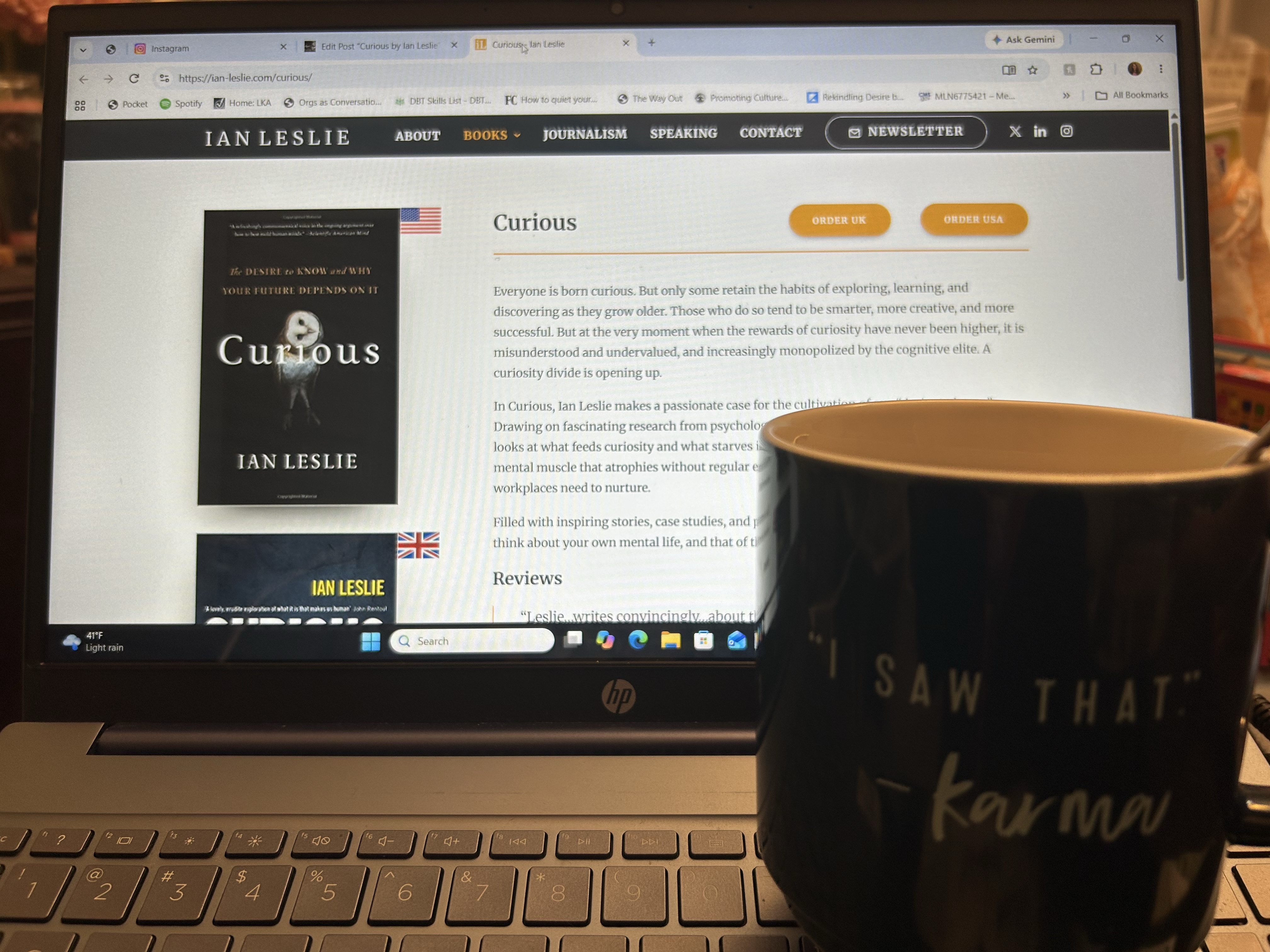
Okay so the book: Curious by Ian Leslie. Highly recommend.
Blurb:
“Everyone is born curious. But only some retain the habits of exploring, learning, and discovering as they grow older. Those who do so tend to be smarter, more creative, and more successful. But at the very moment when the rewards of curiosity have never been higher, it is misunderstood and undervalued, and increasingly monopolized by the cognitive elite. A curiosity divide is opening up.
“In Curious, Ian Leslie makes a passionate case for the cultivation of our “desire to know.” Drawing on fascinating research from psychology, economics, education, and business, Leslie looks at what feeds curiosity and what starves it, and finds surprising answers. Curiosity is a mental muscle that atrophies without regular exercise and a habit that parents, schools, and workplaces need to nurture.
“Filled with inspiring stories, case studies, and practical advice, Curious will change the way you think about your own mental life, and that of those around you.”

Leslie describes three categories of curiosity: diversive (impulse for novelty), epistemic (hunger for knowledge), and empathic (drive to understand and connect with others). OH I just LOVE this! The book takes us from these distinct definitions into how they manifest over a lifespan in education, at work, and in relationships–with self and others. He suggests creative conceptual frameworks and concrete practices to cultivate a more curious, and thus a more interesting and connected, life.

What are you curious about? What will you do with that curiosity today?
Worthy Rivals

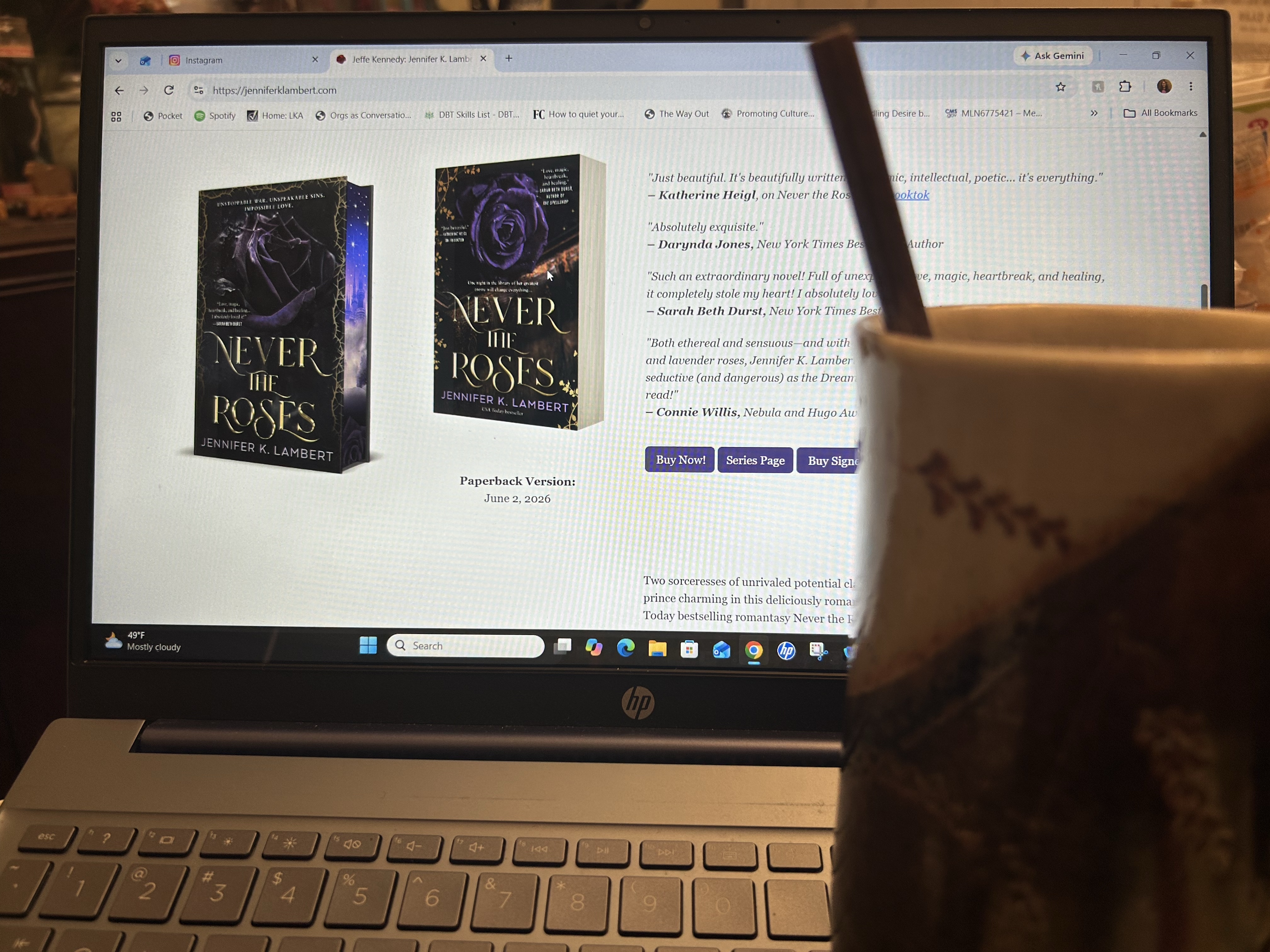
Never the Roses, Jennifer K Lambert

Who pushes you to be better, even if they don’t know or intend it?

Simon Sinek and Adam Grant.
Chris Evert and Martina Navratilova.
Apple and Microsoft.
Michael Jordan and Isiah Thomas.
Christian Dior and Yves Saint Laurent.
The University of Chicago and Northwestern.

Competitors and rivals. Each unique and outstanding in style, substance, and mission, but similar enough to be compared, contrasted, and set at odds. But each half of the pair makes the other better; they keep each other driven to stay in the game. Thus they each spur the other to learn, grow, and evolve. Their respective fields all benefit widely from their public rivalry, elevating standards and aspirations for all: win-win-win.

Oneira and Steranos, the most powerful sorceress and sorcerer, respectively, exemplify this integrated dichotomy in Jennifer K Lambert’s Never the Roses. Pitted against one another for decades of war costing fortunes, lives, and their own consciences, they finally connect in real life (as opposed to ‘remotely’, each locked away in their own respective kingdom directing warfare from afar) when Oneira retires and decides to visit Steranos’s personal library surrepticiously one night, the most serious and skillful oneiromancer who committed one of the gravest atrocities of wartime, pranking her erstwhile nemesis on an impulsive whim. Thus begins a magical slow burn, sensual yet low spice, playful yet tragic love story of two individuals for whom true understanding and full acceptance can only be found in each other. Their knowledge, skill, and power, literally unrivaled by anyone else in the world, makes them the perfect diametrical foes and exquisitely matched lovers and allies.

I adore this story becuase it makes me grateful to have in my life so many intellectual and relational equals. “Iron sharpens iron,” my friend says. When I engage you in wit, query, and debate, when we compare and exchange perspective at the highest levels of curiosity and possibility, OH how my mind positively tingles! My best insights and thought integrations occur during these sparkling conversations and I just cannot get enough. We make each other better in all the most meaningful ways, but most of all we each truly see and feel seen by the other. That sensation de-escalates the nervous system, settles it into a place of safety and acceptance. I’m starting to think there may be no substitute for this singular feeling and the benefits thereof.

How fascinating–the only people I share this relationship with whom I’d actually call rivals are my Red voting friends. Is it semantics? I am weirdly averse to the idea of competition–do I hate losing that much? …Do I meet worthy rivals in the gym? Maybe. Hmmm, this may be worth exploring more. I wonder if I have any other books to reference in the query? Maybe one will come to me by this time tomorrow. Good night, dear readers!

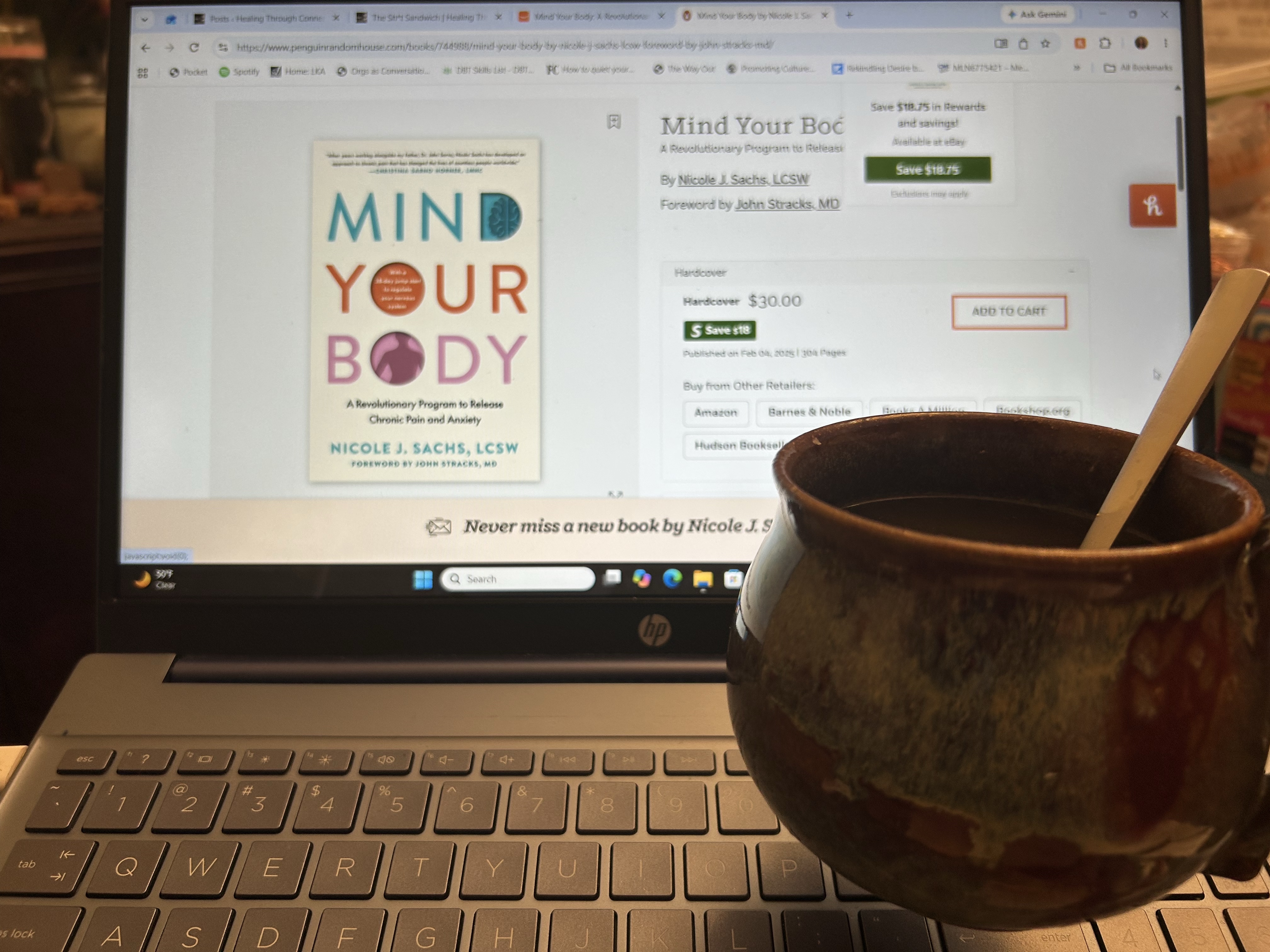
Mind Your Body by Nicole Sachs

“Where does resentment live in your body?”

I thought it was in my gut, maybe somewhere around my liver or gallbladder, but that’s not where I felt it. I rooted around and found it today, somewhere in my chest and limbs, thanks to a beginning embodiment meditation guided by my wonderful new friend and coach Kelly Maher. Not only did I willingly meet my resentment in my body, I had a whole (if brief, thank God) conversation with it, attempting to reconcile its existence despite its apparent detriment to my well-being. Amazing. As the meditation progressed I noticed changes in physical sensations, and thoughts I had met countless times before now occurred in a brand new context of observation and potential understanding.

Kelly says we will likely do some parts and inner child work in the coming weeks. Yikes. And bring it! When the student is ready, the teacher will appear, they say. How funny, it was almost exactly a year ago that I wrote here,
“‘I’ve done all the work I can do with shovels. Now I need drills.’
“Astute and honest friend: ‘Or brushes.'”
In that post I listed books that had advanced my inner work at that time:
“Years ago — The Dark Side of the Light Chasers, Debbie Ford
Why We Love, Helen Fisher
Existential Kink, Carolyn Elliott, PhD
The Body Keeps the Score, Bessel van der Kolk, MD
Romancing the Shadow, Zweig and Wolf
The Self-Led Internal Family Systems Workbook, Tanis Jo Allen, LMSW, ACSW”

How fascinating when the same ideas recur, but in a slightly different light, with new perspective, for new and continued growth! This year I listened to Mind Your Body by Nichol Sachs, recommended by one of my dietician colleagues when we discussed yet again the things other than hunger that drive humans to eat. I have considered myself a student, but definitely no expert, of mind body medicine for my entire career. The whole concept is so much more mainstream now than 30 years ago, which I celebrate. Sachs writes from decades of psychotherapy experience and introduces her specific journaling method, Journal Speak, to address chronic pain. You can substitute any physical symptom for pain and the method can still apply. I wondered, can you apply it to chronic emotional or mental states? Chronic stories we tell (about resentment, abandonment, etc), chronic bothersome thought patterns? I bought the book in print intending to try the method myself (I write every day anyway), but never got started. I even invited my colleague to do it together as buddies, and still it went nowhere. The pattern I notice here is that I need another human to hold my hand, guiding me and making me feel safe to do this deep, loving, gentle but probing inner work.

Sachs’s book is an easy read/listen. The language is accessible while the content is both academic and applicable in real life. She shares patients’ stories (with permission) and even her own daughter’s ‘testimony’ of the effectiveness of the process.

The mind and body are not separate; I think most of us understand this intuitively, but fail to recognize how the connection manifests, as the signs are myriad and often intersect with co-existing physical problems. But all physical sensations are not only physical in their deep origins, and our nervous system puts distress in bodily places to protect us from threats to our survival, both real and perceived. Mind Your Body can help anyone understand the mind body connection more clearly, demystifying patterns that conventional medicine too often can neither explain nor resolve. The Journal Speak method costs only time and energy and is totally autonomous. Sachs also hosts a podcast and there is a Journal Speak paid membership community where people can connect and share their journeys. I have no financial or other interests in Sachs’s practice or business. I just appreciate her work and know it can help a lot of people.

What are your mind body stories and who understands and validates them?