
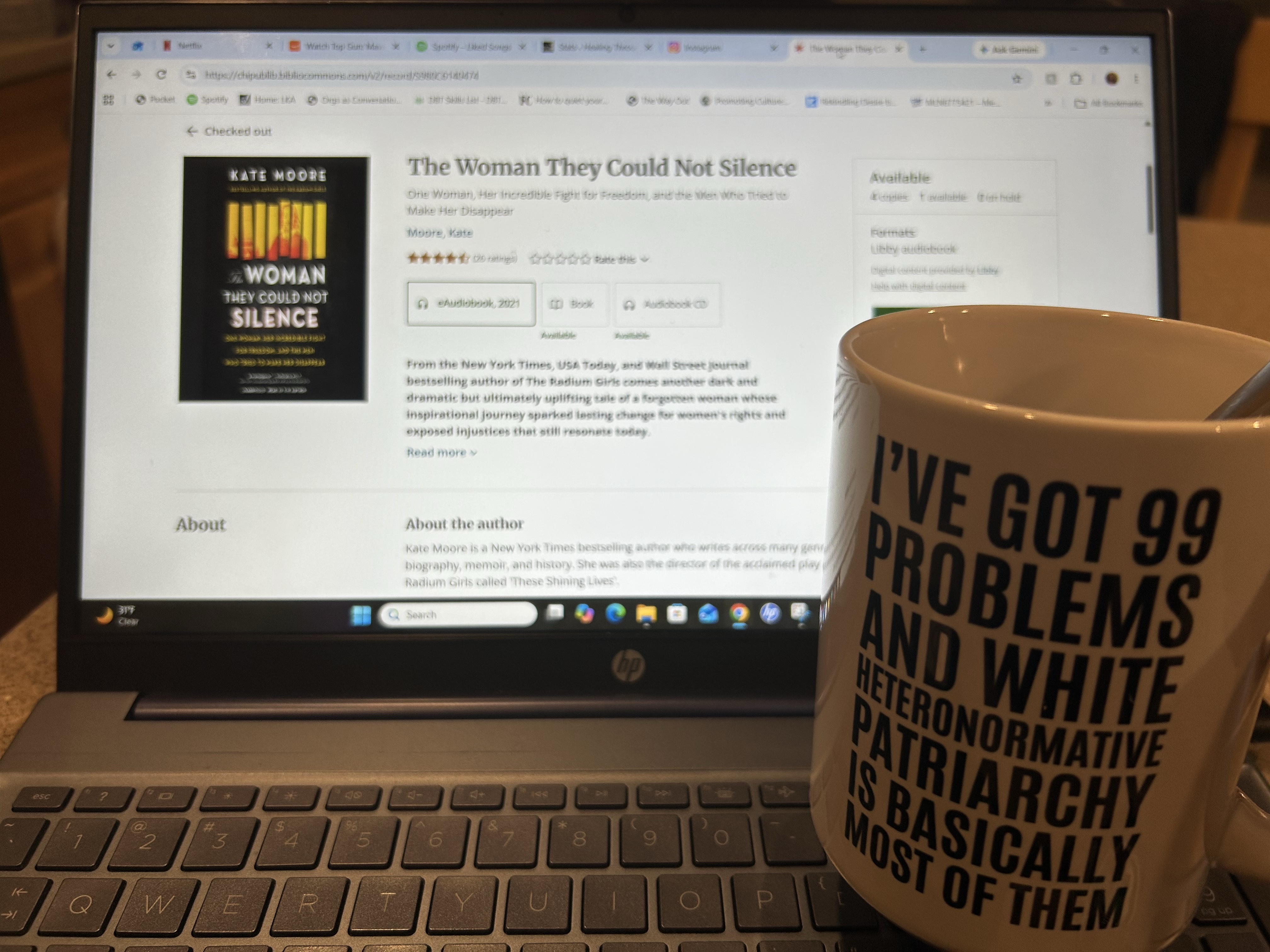
I asked a friend what he’s curious about lately, and he said patriarchy.
What does this word mean to you? What emotions does it evoke and where do you feel it in your body? How interested are you in anyone else’s perspective on it? Whose?
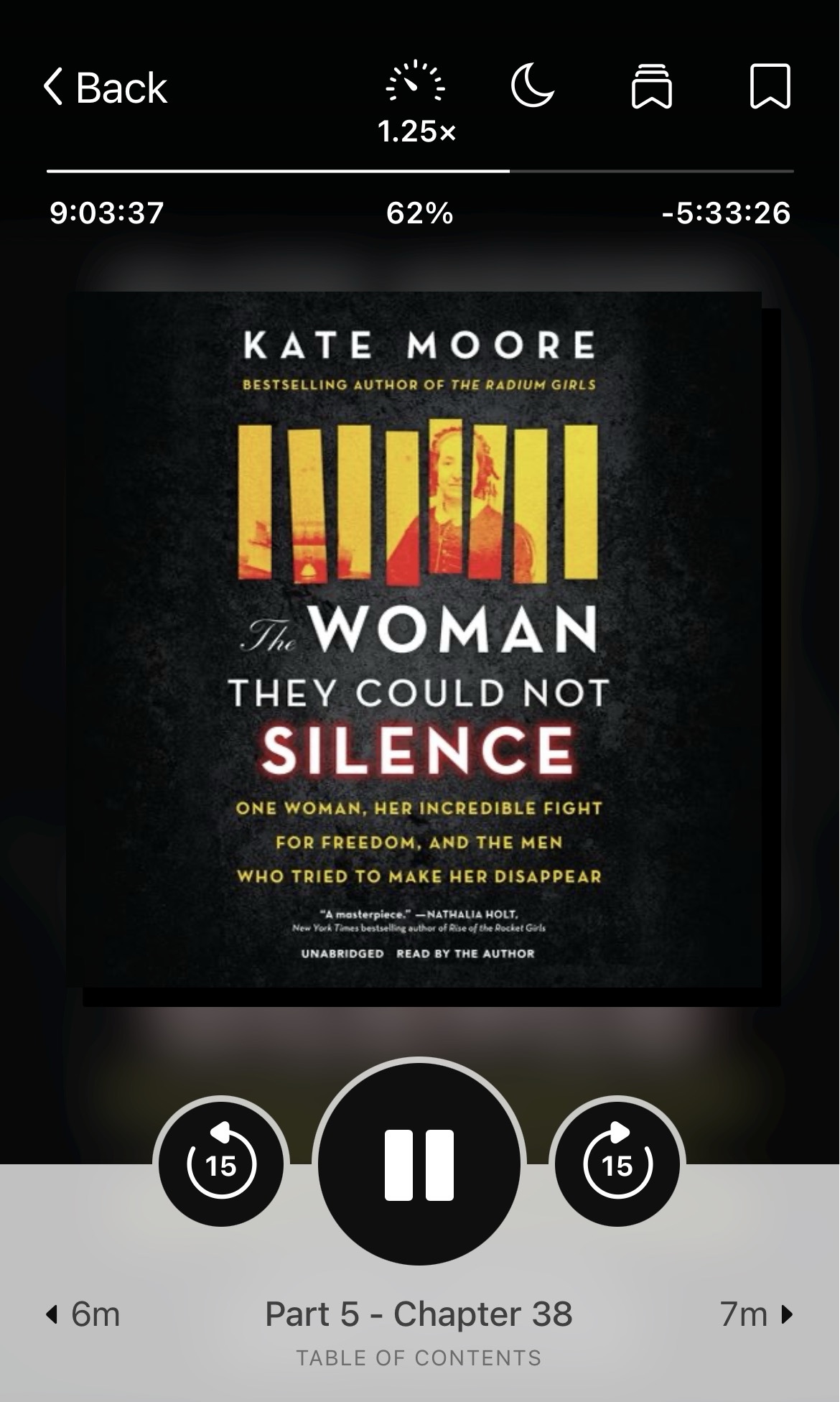
He then told me about a book he just finished, The Woman They Could Not Silence by Kate Moore, which I am now almost 2/3 through myself. Highly recommend; see book jacket blurb below. It’s the real life story of Elizabeth Packard, a preacher’s wife in downstate Illinois around the time of the Civil War whose tyrannical husband committed her to an insane asylum for having her own ideas about religion and spirituality. It’s about her personal fortitude and struggle to sustain justice for not only herself but for all women, and how she advanced that mission.
Friend is curious about women’s perspectives, he says. Hallelujah, let me just appreciate him–a man who wants to know what women think and how we feel? And not so he can overpower or manipulate us, but to understand and connect with us to make the world function better for us all?? Excuse me while my cynical self laughs out loud and cries for joy at the same time. Do you know men like this? Might you actually be one? How can we please help these voices amplify and inspire other men?
Friend is angry about male dominated systems where women are discounted and taken advantage of, overlooked and taken for granted by default. He wishes for more men’s curiosity, empathy, understanding, and solidarity (my words) on behalf of us women–he wishes for more allies.
Turns out I’ve written many times on allyship in the last 11.5 years, and I even compiled past posts on the topic during this 30 day challenge in November 2024.
Two things strike me throughout this biography: 1. Elizabeth Packard’s individual intellect, self-possession, steadfast confidence in her own ethics, and keen relational prowess to navigate her environment and circumstances strategically, and 2. That she had allies the whole way. Her countercurrent ideas were shared by others who advanced them while she was committed. She listened to fellow detainees and earned their trust and respect, rallying them, thus becoming a threat to the status quo and those who benefited from it. Her two eldest sons remained loyal to her despite their father’s attempted indoctrination against her. She was a mother of six, basically abducted from her own home when her youngest was only 18 months old. She didn’t wallow or dissolve into self-pity; she scavenged paper and pen, wrote everything down, and advocated. All while the country tore apart in civil war.
It all just reminds me again that great leaders all share high proficiency in three important fundamental traits/skills, SASREC: Self-Awareness, Self-Regulation, and Effective Communication. Pen mightier than sword, indeed.
The Woman They Could Not Silence is written with engaging prose and moves at a satisfying pace. It’s a long and complex story condensed to the most salient details, presented with the perfect amount of context for us all to relate from the Twenty-First Century to gender relations in 1860. The audibook is read by the author, whose voice and accent make for a pleasant listen.
My many thanks to Friend who rambled on about his curiosity, his solidarity, and his respect for women. I will query him again soon for more book recommendations.
The Woman They Could Not Silence, Kate Moore:
1860: As the clash between the states rolls slowly to a boil, Elizabeth Packard, housewife and mother of six, is facing her own battle. The enemy sits across the table and sleeps in the next room. Her husband of twenty-one years is plotting against her because he feels increasingly threatened – by Elizabeth’s intellect, independence, and unwillingness to stifle her own thoughts. So Theophilus makes a plan to put his wife back in her place. One summer morning, he has her committed to an insane asylum.
The horrific conditions inside the Illinois State Hospital in Jacksonville, Illinois, are overseen by Dr. Andrew McFarland, a man who will prove to be even more dangerous to Elizabeth than her traitorous husband. But most disturbing is that Elizabeth is not the only sane woman confined to the institution. There are many rational women on her ward who tell the same story: they’ve been committed not because they need medical treatment, but to keep them in line – conveniently labeled “crazy” so their voices are ignored.
No one is willing to fight for their freedom and, disenfranchised both by gender and the stigma of their supposed madness, they cannot possibly fight for themselves. But Elizabeth is about to discover that the merit of losing everything is that you then have nothing to lose…
Bestselling author Kate Moore brings her sparkling narrative voice to The Woman They Could Not Silence, an unputdownable story of the forgotten woman who courageously fought for her own freedom – and in so doing freed millions more.
Elizabeth’s refusal to be silenced and her ceaseless quest for justice not only challenged the medical science of the day, and led to a giant leap forward in human rights, it also showcased the most salutary lesson: sometimes, the greatest heroes we have are those inside ourselves.

