I learned to paint persimmons in childhood, long before I had ever seen one in real life or even knew what they were. The teacher painted some fruits hanging from a branch, round orange bulbs with areas of overripe (?rotting) flesh. I was maybe twelve, just copying what the teacher had painted. MaBa recognized it immediately as 柿子 (pronounced shi4 zi). I still had no reference for the object.
Daughter and I ate some fresh persimmons last night, part of our joyful haul from the Chinese grocery store. It occurred to me that I was probably in medical school before I knew that these were the mysterious fruit I painted blindly in childhood. Back then there was no internet to search. We did not own an encyclopedia. Even if we had, my parents didn’t know the name of the fruit in English, so I could not have looked it up. Looking back, how would I have learned the English name for 柿子? Oh I know. I could have called my Chinese School principal and asked her husband, the Asian Studies professor. Today I did the converse, asking Google, “write persimmon in traditional Chinese.”
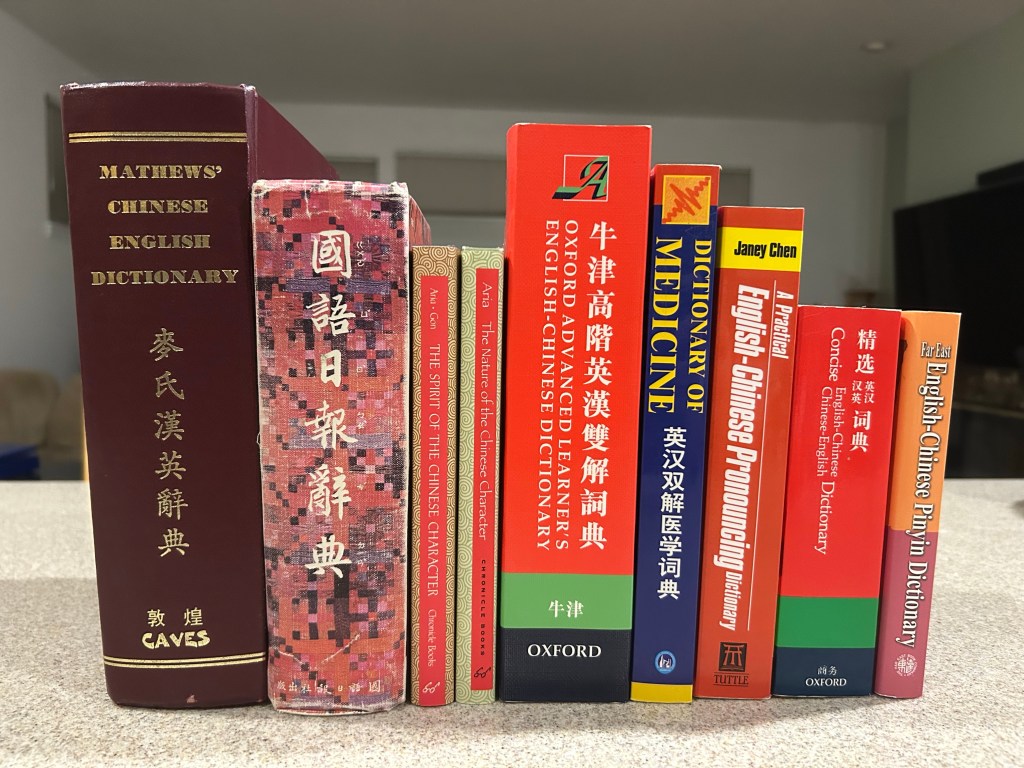
This made me remember learning how to look up words in a Chinese dictionary, one of the most tedious and mindnumbing tasks we were forced to do in Chinese School, and possibly the one I feel most grateful for now. Let me show you!
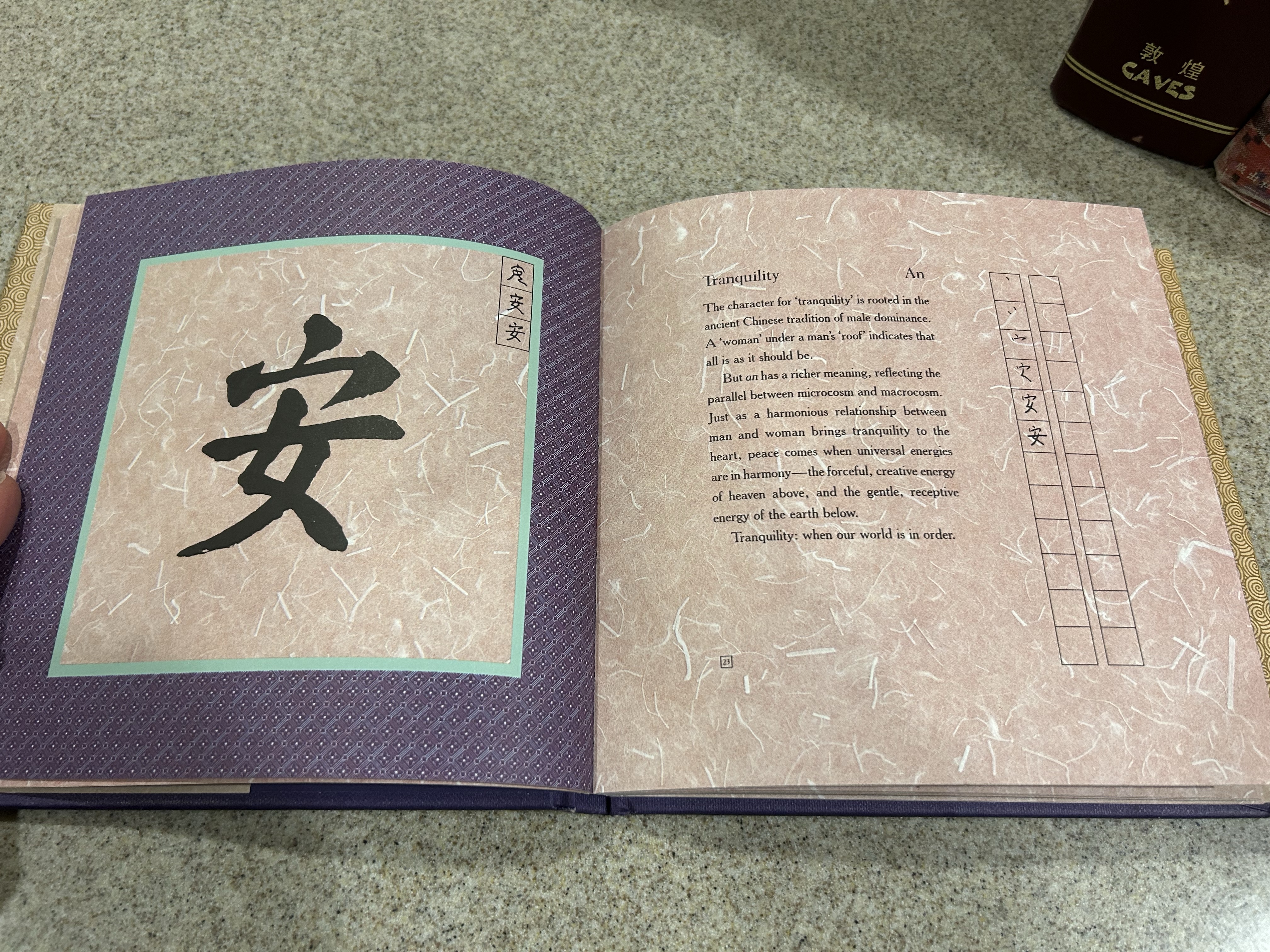
Say you see a word and you don’t know what it means, or how to say it (Chinese words are pictographs; there is no way to ‘sound them out’). First you must know how it’s written, and recognize the radicals of the word–the parts of meaning combined to make up the whole word. The word for peace, 安 ‘an,’ is a roof 宀 over a woman 女.
We look up Chinese words in the dictionary according to the radicals. I started with 女 but didn’t find 安, so I started with 宀 instead. First I had to know how many strokes it takes to write 宀: three 三.
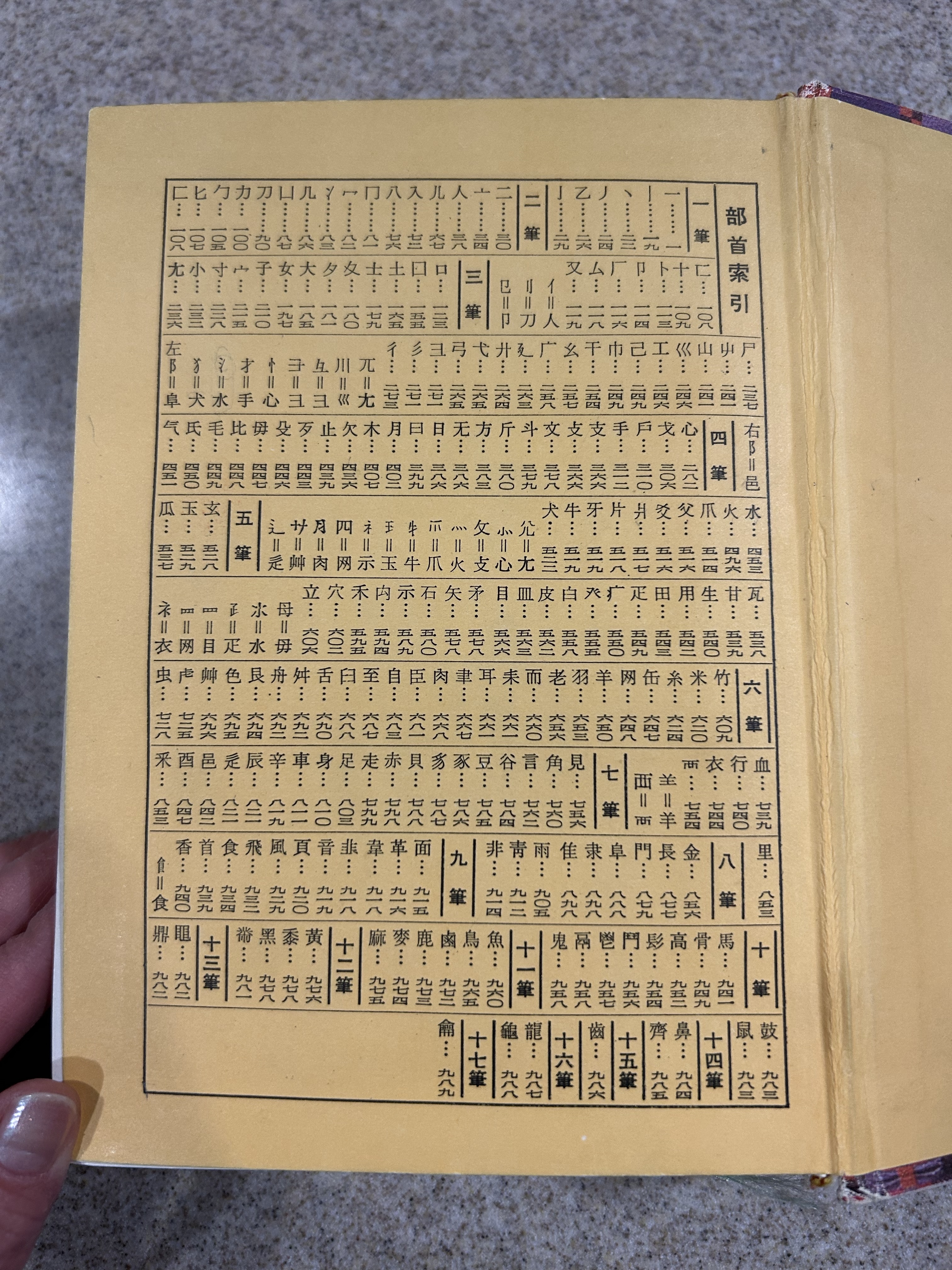
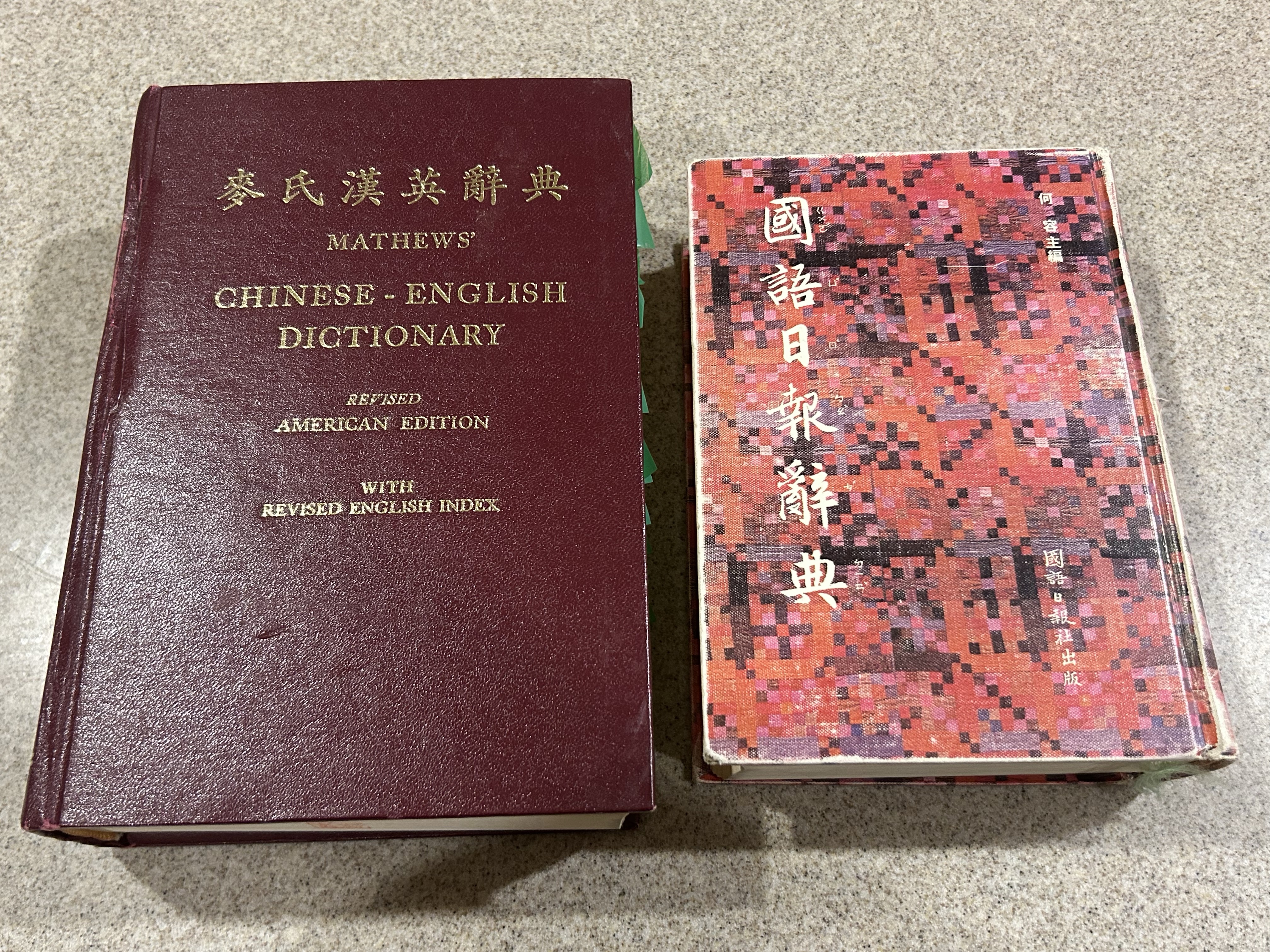
Open the front cover of a Chinese dictionary and you’ll find all the radicals, listed in order of number of written strokes. Find 宀 , the tenth radical to the left of 三, three strokes. See also that 女 is also three strokes, the 8th radical to the left of 三. Chinese books are read right to left, top to bottom. Under 宀 you see 二 一 五, 215: the page where words with that radical start.
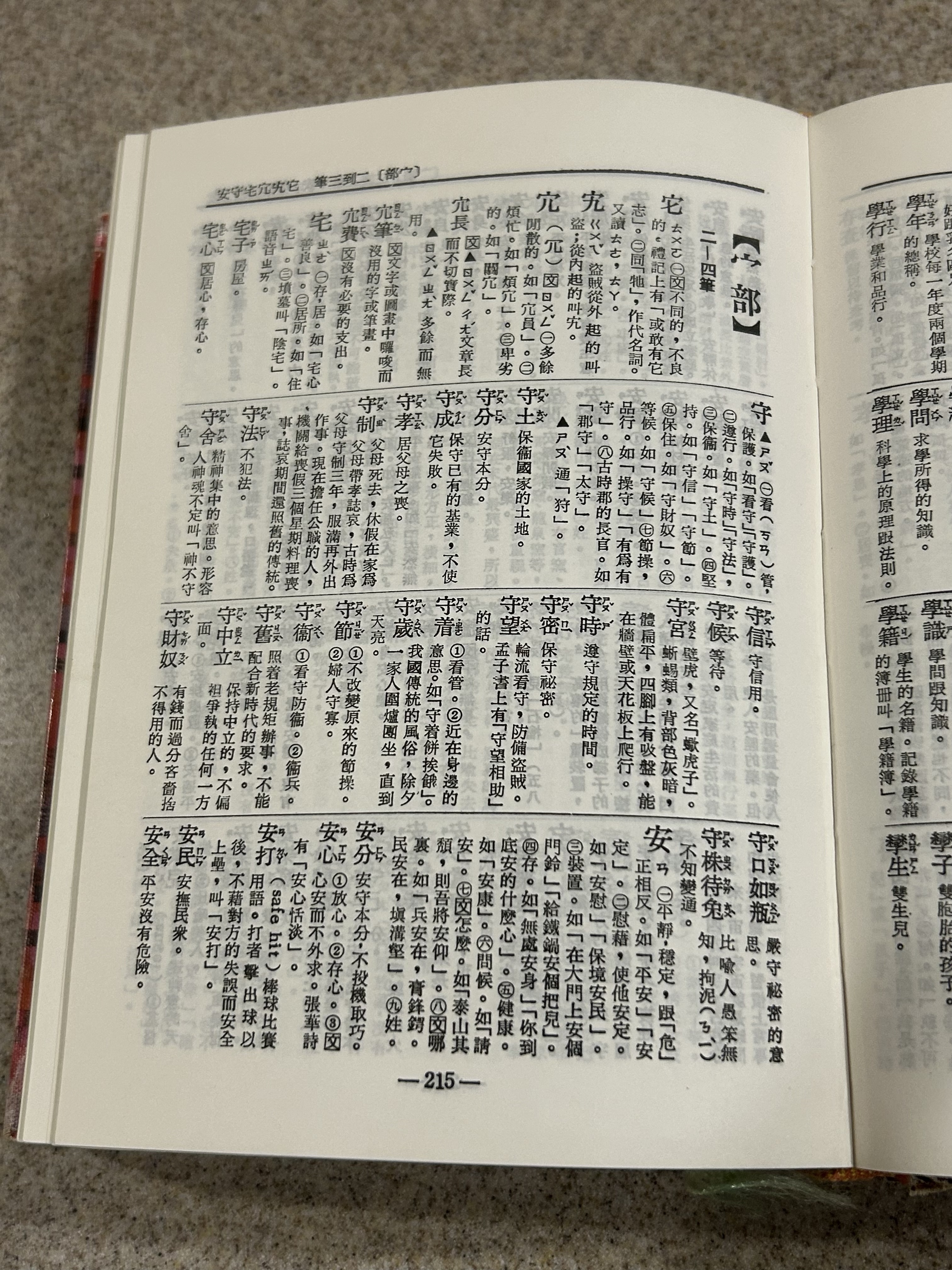
Once here, now I count how many strokes to write the rest of 安, which is 女, which is three strokes. See at the top of the page “二 — 四”, indicating this section contains words written with two to four strokes other than 宀. Can you find 安? It’s at the bottom of the page.
Just underneath is the symbol ㄢ, which is the phonetic symbol for the sound ‘an’. We had to learn this in Chinese School, too. There are 37 sounds, the combinations of which, in addition to vocal tones, make up all Mandarin word sounds. When you look at other word headings on a dictionary page, all starting with the index word, you see these small symbols to the right of each word, along with tone indicators, up (second tone), down-up (third tone), or down (fourth tone). First tone has no notation.
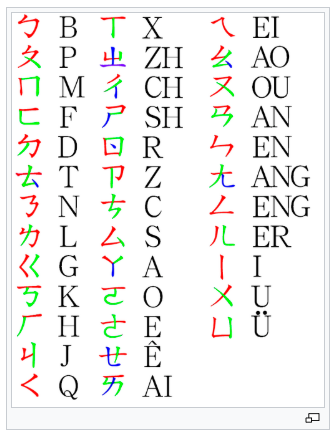
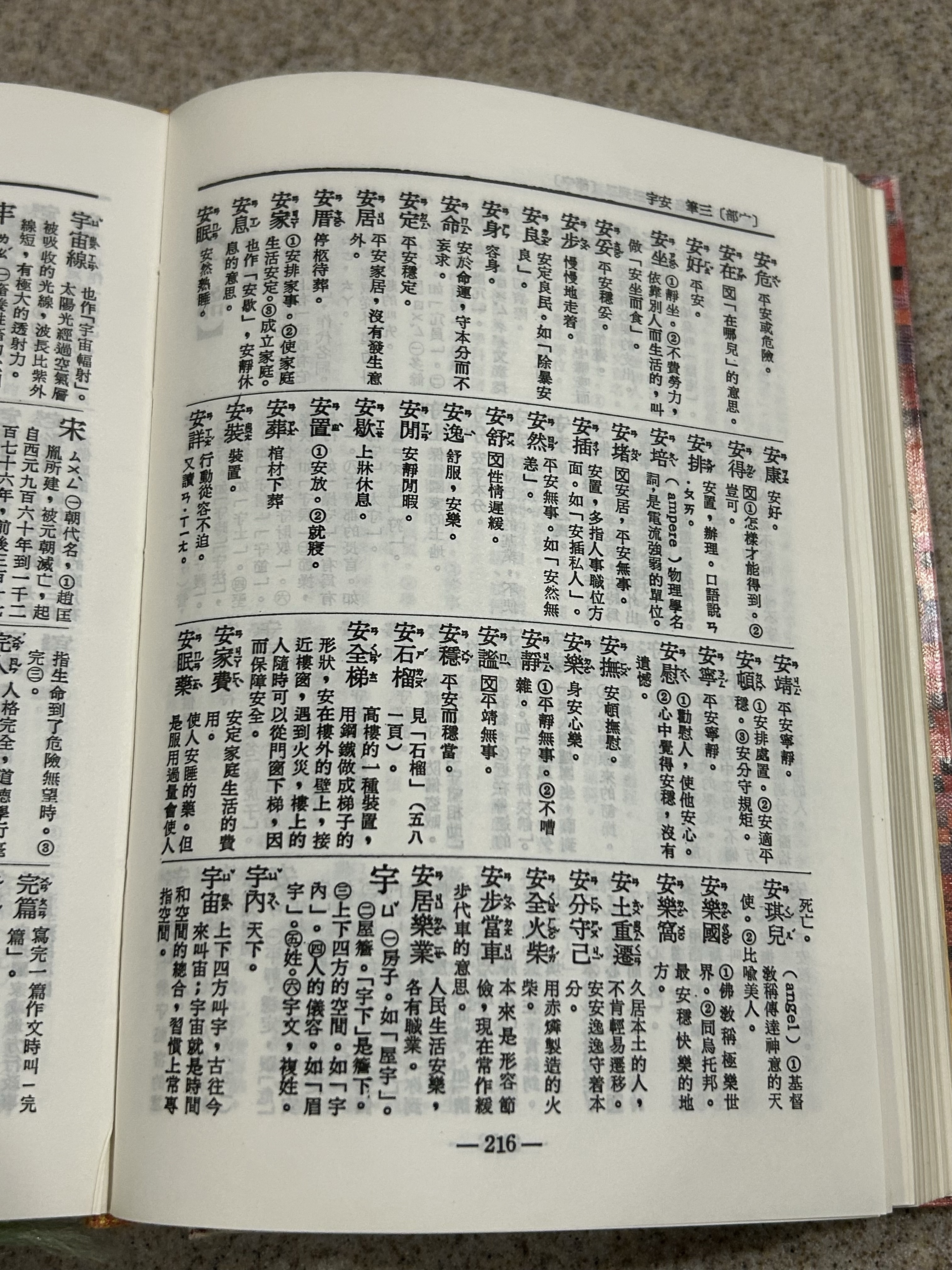
Similar to English dictionaries, uses of each index word are listed subsequently. I don’t know how these phrases are ordered; will have to ask MaBa! At the bottom of the page, where entries for 安 are complete, the dictionary moves on to the next word indexed under the 宀 radical, which has four strokes under 宀. By the ㄩˇ underneath I know how to say this word, but I don’t know what the word means because I am relatively illiterate in Chinese. I recognize about every fifth word, maybe? I think it has something to do with the cardinal directions.
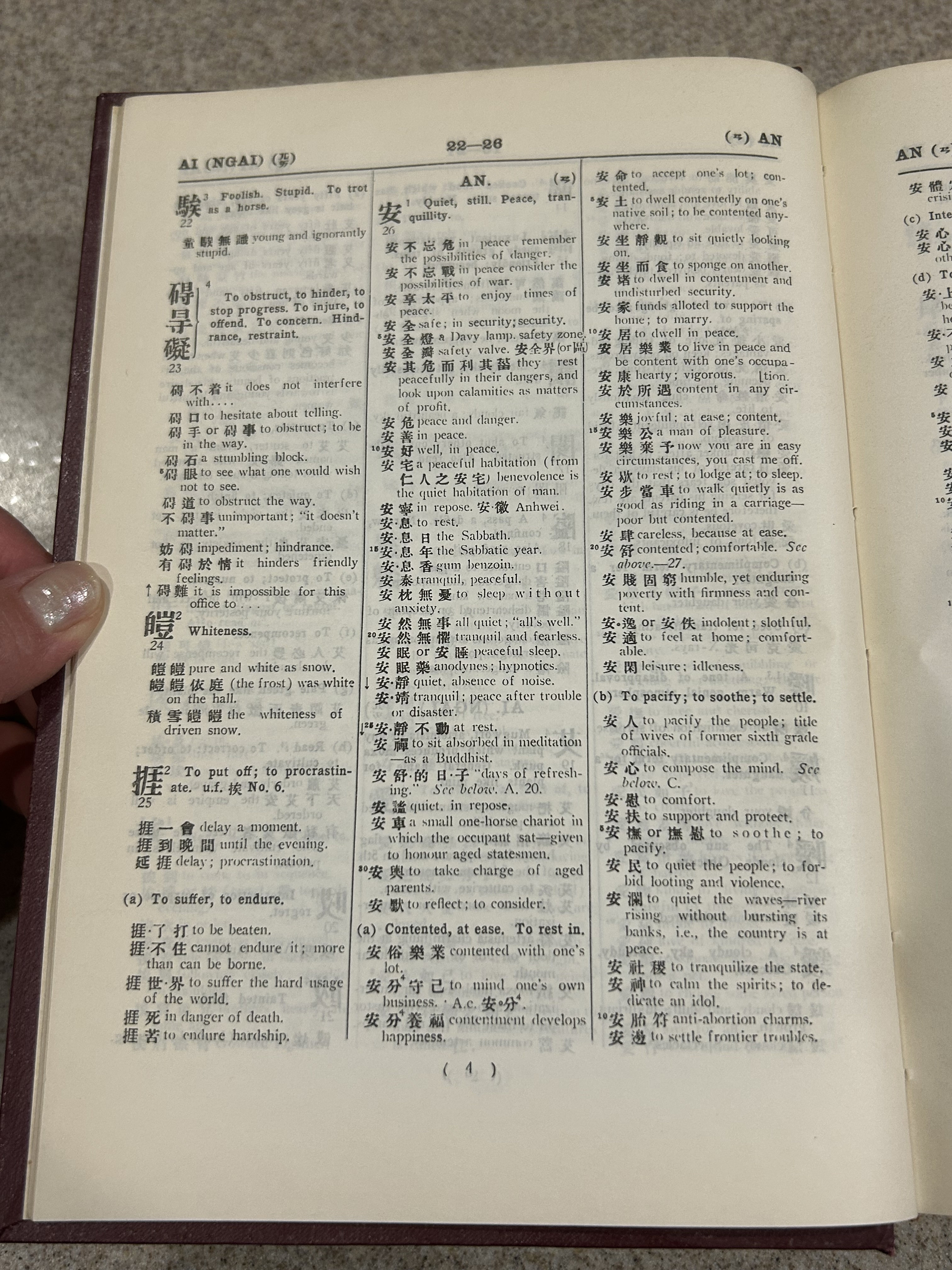
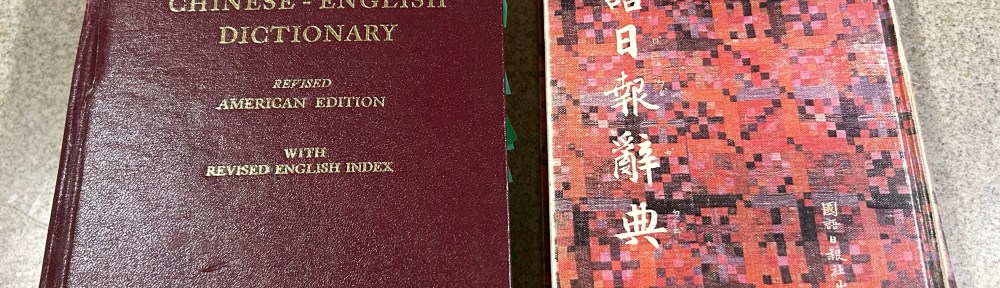
In my Mathews’ Chinese-English dictionary, I look up Chinese words by their phonetics in English alphabetical order of sound. So 安 ‘an’ appears on page 4 of the book. You can see the ㄢ ‘an’ symbol at the top right of the page, indicating that is the sound of the words on this page. The uses of 安 follow, with the Chinese words and the meanings of the phrases, but there are no syllabary indicators here so unless I know the other words already, I cannot know how to say them, and can only guess at their meaning from their radicals.
Isn’t this just amazingly complex and convoluted? I feel smart and proud to still remember how to do this! I am also happy that I can just tap a few words on my phone and Google answers more than what I asked in miliseconds.
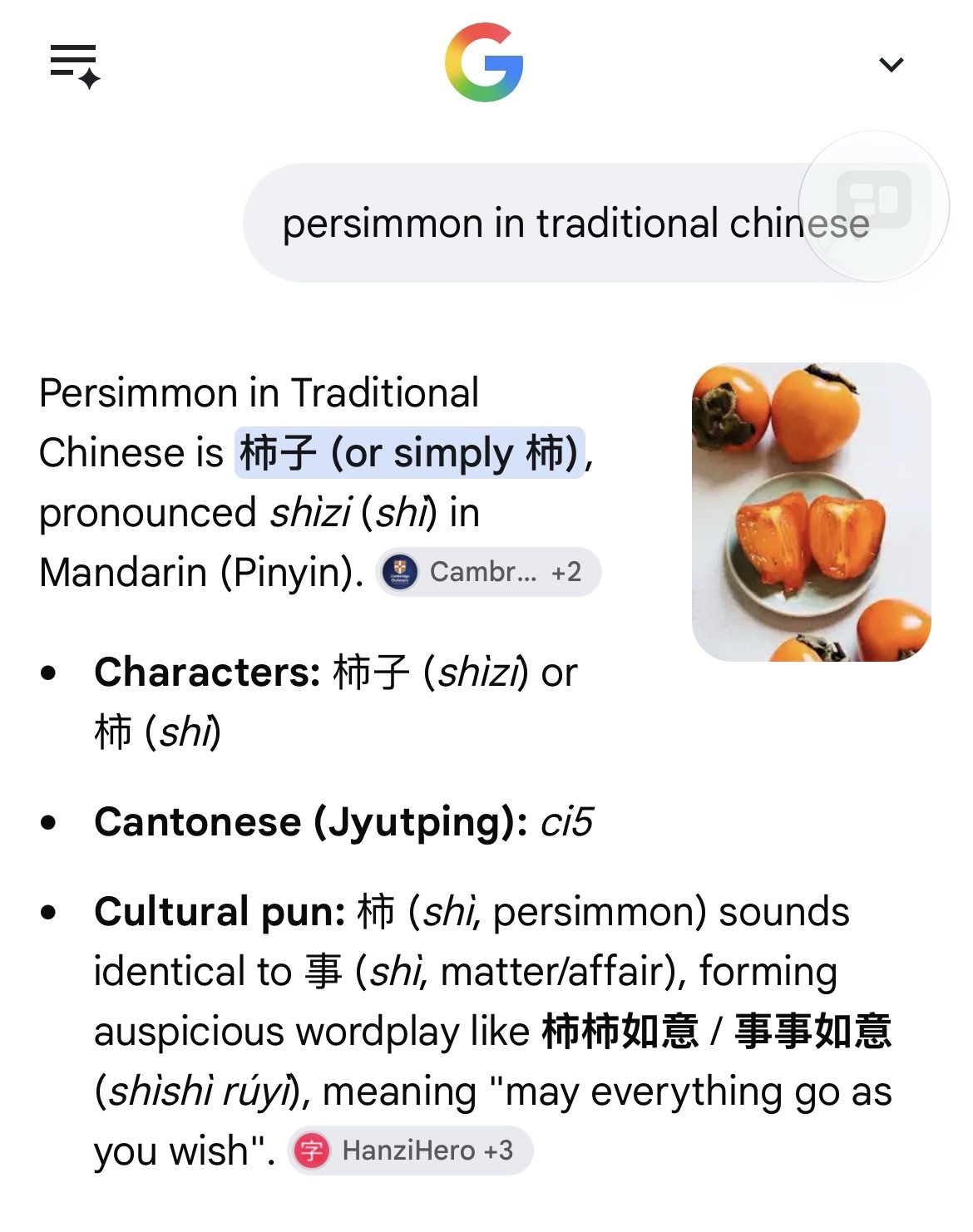
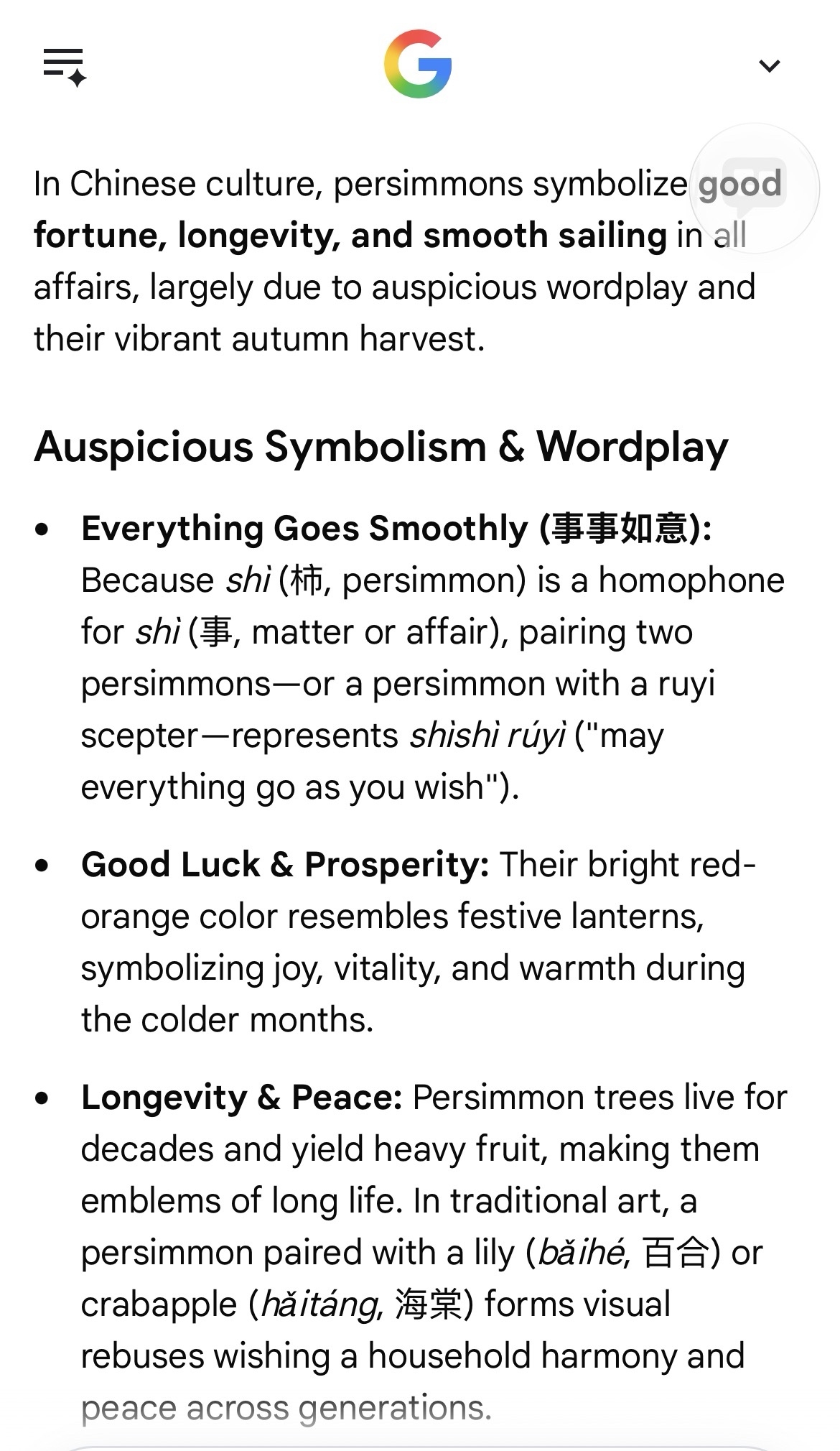
I will keep and treasure these dictionaries until my death and expect my children to do the same! They are relics of an intellectual age of necessity, kind of like stick shift cars. I’m proud to know how to drive those, too.
What a fun, impromptu post for All Things Books! Three more to finish the month, back again tomorrow night!

