Balance

How do you think of balance? In what contexts? What do you picture in your mind? How does it show up in your life? Where do you wish for it?

Chatting with a biology teacher friend last weekend, we agreed that ‘balance’ may generally be perceived as static state–or a goal of such. So to convey the fluidity of nature and the apparently paradoxical concept of stability in constant movement (think of bicycling), we agreed that ‘equilibrium’ may be a more accurate word for what we mean.

I have long thought of balance as a dynamic rather than static state. And now I recognize that it can be both. Of course!

How do I already do balance well?
–Physically, I like doing single leg movements. Squats, dead lifts, hinges. Tree and warrior yoga poses, lunges–I love them all because I feel powerful when I hold them. When I feel particularly confident, I close my eyes for an extra challenge.
–I’m good at letting go unimportant and non-urgent things when life gets chaotic and dense. Hence I live in a relative pigsty, because hello, life is constantly in one state of chaos and wonder or another and housecleaning just does not interest me. I now trust myself, however, to sense the need to reprioritize occasionally, such as clearing off the writing space for a 30 day blogging challenge.
–I allow periods of immersive obsession (eg romance binge [140/180 titles this year], washi art), heavily leaning phases that happily threaten but don’t actually topple life functions. It’s my way of living life on the edge.

How could I do it better?
–Maybe I could tighten my swings, dampen the amplitude of some extreme-ish behaviors, like buying/hoarding books and paper, OH and time spent on social media, definitely yes.
–Tone down, mitigate my agitation at certain things that grate on me, like the brokenness of our healthcare system… get to better equanimity about it…
–This really reminds me of polarity management–Bob Tauber over at Polarity Partnerships gave me such thoughtful and enlightening feedback tonight on that post:
“we suggest referring to poles in a polarity as seemingly opposed (or seemingly antagonistic) because in reality, values, competencies or strategic objectives are always part of an interdependent pair.” So I can monitor how I frame things to be ‘balanced’ in the first place!

How/what does society balance well?

Homeo/allostasis. We haven’t killed ourselves and the planet yet, so there is some kind of balance happening, yes? Some of our systems exist in homeostasis–stable states of being that return to form after a disruption. In his book Master of Change, Brad Stulberg introduces the idea of allostasis, wherein an initially stable state meets disruption and disorder, and instead of reverting to the prior order, evolves to a new, ‘reordered’ state, adapted to consequences of the disruption. I highly recommend the book for its illustrative stories and practical skills for elevating our resilience and joy in an increasingly volatile and uncertain world. So I’d say that homeo- and allostasis already occur, regardless and sometimes in spite of our direct participation in any of it. Do you know anyone who is already aware and in front of the best of these states?

How could we do balance better?

Mindfulness and Acceptance. Ooo, just think if we did mindfulness better, how much more easily we could see with equanimity the possibility in what is, and move more seamlessly toward what could be? We could see where/when/how homeostasis is possible, and when not, respond rather than react, and perceive more options, invent them, co-create them. Progress and conservation relate this way–as change inevitably occurs, we are contantly faced with (invited to) choices in tension to flow with or resist. If we made our choices with clear and acute intention rather than by default, wow, how would that be?

Creativity. We get to invent it!! “Fly as we test, test as we fly,” says NASA. Make the thing knowing it’s imperfect but functional. Anticipate flaws and prepare for consequences, ready the teams to respond. Then launch, monitor, adjust, repeat. Start with pilot, alpha and beta trials, scale iteratively. Life is change; the future is neither known nor guaranteed. Embrace it with the best of our ingenuity!

Collaboration. On a societal level, as each of us processes the violent swings of local and global life individually, balance collapses into oblivion when we only fend for ourselves and ignore one another. Societal balance feels like ‘world peace’–yikes, how trite. I’ll stick with it anyway: Ebbs and flows, scarcity and abundance, mitigated extremes. Horizontal and vertical integration of government and business, public and private, personal and professional participation… Huh.

Ooo, fun. That is not where I thought this would go. I had no idea where it would end, honestly. I’m happy with this. Perspective tomorrow! Good night!

Accountability

What does accountability mean to you? How do you hold it, for yourself and others?

OWN. YOUR. SHIT. No more, no less. The more I think of it, the more I also include fairness and nonjudgment in this concept. At its core, accountability is objective, dispassionate. Ironic, then, that its consistent practice plays a central role in building and maintaining trust, that profound, subjective emotion that can move mountains when strong, and yet can be destroyed in a single breath.

We are almost halfway through the month, friends! Listing my own life practices every day feels like a whole lot of repetitive navel gazing–does it resonate at all? Or are you getting supremely bored? I’m loving it personally, as new insights emerge almost as soon as I sit down each evening, and I see so many nascent and intertwined ideas to develop and expand in the book. Do the societal assessments and admonishments feel pedantic? Redundant and preachy? Oh well, I’m working stuff out here–thanks for joining the ride, and feel free to get off and get back on later, it won’t be like this forever! Okay onward:

How do I already do accountability well?
–I take responsibility. After an initial WTF, ‘you suck’ moment in interpersonal conflict, I am quick to self-assess, ask myself the asshole question, apologize if needed, and make repairs. For operational snags at work I trouble shoot with the team and our collaborative root cause analyses are efficient and effective.
–I invite others to own their stuff, gently. Holding someone accountable is not the same as blaming, shaming, or guilt tripping. The objective is not to make someone ‘feel bad’, but rather to acknowledge and address mistakes and course correct going forward.
–I’m able to separate facts from interpretation, most of the time. Even in the most emotionally charged situations, I’m able to reason through and eventually get to reconciliation.

How could I do better?
–It’s hard to put my finger on it…sometimes I’m in such a rush to take responsibility that I get anxious, almost like it’s a race to blame myself before others can do it–is it virtue signaling? I really do believe, in my thinking brain, what I wrote above. True accountability is not about blame. But my feeling brain may still harbor some false unworthiness that I need to work out?
–I think I can do better at upholding accountability around me. It can be a delicate balance of relationship, task, emotional regulation, and other factors… Sometimes it’s not appropriate to do it in real time, rather people (I) need to cool down, find the loving posture, attitude, and words. This risks missing the opportunity. So I can balance commitment with timing?

How does society do accountability well?

Wheels of Justice. They turn, at least sometimes, if slowly, imperfectly, and incompletely. There are tenacious and resilient people all around working to make visible and accountable that which others would sweep under any rug. Their relentless persistence and infinite mindset truly boggle me, and I bow in admiration.

How could we do better?

Transparency. Political campaign funding. Corporate finance and taxes. Pharmaceutical research. Medical billing. Legal loopholes. We can’t hold anyone accountable if we don’t know who’s doing what. Sunlight is the best disinfectant, as they say–it’s at least a partial truth.

Cull the bureaucracy, grow the manpower. So many systems remind me of the Weasleys’ Burrow, a house built of lopsided additions, ricketty stairs, and hoarded artifacts from divergent historical worlds. FDA drug approval and post market safety monitoring, civil and criminal litigation, employee hiring, promotion, and retention–so much red tape and not enough people who understand and can navigate it–people who do good go overworked and unrecognized and those who do harm fly blithely under the radar, all for far longer than serves us. Like individual people, our organizations and institutions need agility, responsiveness, and adaptiveness to operate optimally in the accelerating complexity of our world. Easier said than done, I know.

What else? How does accountability show up effectively in your life? Where do you really need more? I will revisit this; stay tuned.

Integrity

Note:
For those of you just joining, I’m doing NaBloPoMo, or National Blog Posting Month, a challenge to publish 30 blog posts in 30 days. This is my 9th year of participation, and the theme is “What’s already good, and what could be better?” I answer these questions for myself personally and as I see society as a whole, for one topic each day of November.


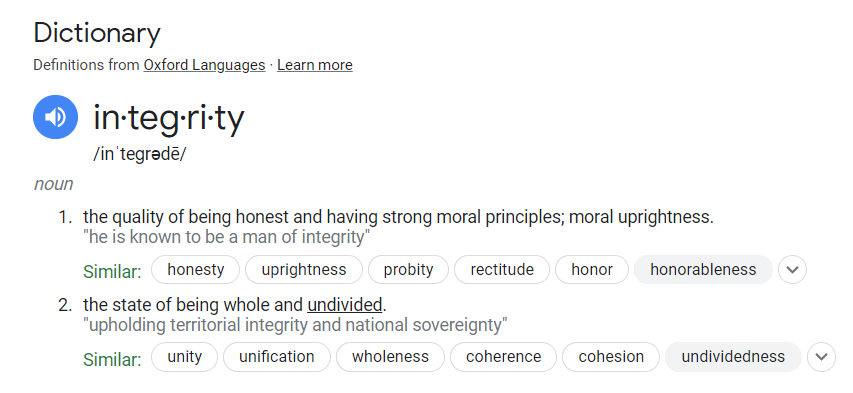
Google search

I love how integrity has these two definitions. I think of a person’s integrity more as the second, as one’s character being unassailably indivisible. It means we show up our whole, honest selves everywhere and with everybody, ourselves included.

There is an identity exercise wherein the self is drawn as a flower, and aspects of identity as petals. The flower is modified by reorienting petals depending on the context in which a person finds themselves–most relevant identity markers in front, most protective around the edges–however the person thinks of themselves as that flower in any given environment. I think this is a fantastic analogy for integrity, because it acknowledges that maintaining wholeness does not necessarily require all parts to be equally visible, vulnerable, dominant, or accessible at the same time. I suspect that for many of us, certain petals are kept out, big, and vibrant, with others more tender and close to the center. Roses have guard petals, tough outer layers that protect the inner petals as the whole bloom opens. Many florists remove the guards for aesthetics, but some recommend retaining them, honoring nature’s form and function. Myriad potential comparisons to the human identity flower here tickle my metaphor-loving brain. What would your flower look like? How does it feel?

How do I do integrity well already?
–How does one answer this question without sounding self-righteous and arrogant? I keep thinking I should ask others, “(How) Does Cathy walk her talk?” That is the true test, because self-delusion is real and too often invisible. Walking the talk is how I define integrity, and it is a high value of mine. I think it shows when as a leader, I don’t ask the team to do anything I would not do myself, and I often do whatever I’m asking right alongside everybody.
–I check in often with those who know and observe me. I seek honest feedback and do my best to receive it graciously, so people feel safe to give it.
–I live by a handful of words and ruminate on them daily: present, open, grounded, kind, loving, smart, curious, generous, fun. If you know me and would describe me this way, then I know I’m living into my integrity.

How can I do it better?
–Could I be louder about amplifying my values? Bolder? More assertive and insistent about enrolling others in advancing my just causes? Somehow that feels like showing off, attention seeking, which is not how I think of integrity…
–When I enter situations of ambivalence and conflict, for instance when honesty may rupture relationship, or showing up loving tempts me to withhold honesty, I can slow down and consider, prioritize my values in context, assess risk and harm of each potential action. I think I do this already… At least I practice awareness and acceptance of that discomfort rather than denying or dismissing. I slow down and try not do speak or do irretrievable things impulsively. I can keep practicing this and keep checking in with those in the mud with me.
–I could be clearer and more explicit in times of ambiguity and conflict about which core values I prioritize, what I’m willing to sacrifice, why, and how that informs my decisions and actions. This is transparency and fair process, which are important to me.

What’s already good about our integrity as a society?

National identity and pride. Freedom. Independence. Innovation. Ingenuity. We Americans identify with these values, and despite our many and significant contradictions, I think we exhibit them clearly in many contexts. I hear people from other countries describe how American culture feels liberated/liberating in many ways (though constricting in others). Those contradictions, though, yikes.

In the small ways. I see people trying evey day to live up to/into their ideals. I am very slow these days to call someone out for hypocrisy–I try to imagine their identity flower and assess which petals they’re showing me, and which I think they have tucked away for now. Those ambivalent and conflicting situations happen more often than we may realize, and we literally make tens of thousands of choices each day. Much of our integrity, then, is maybe autopilot? Ooo, fascinating.

How could we do better?

Honesty. It’s okay to be in it for the money, even if your core value is helping people. Just be clear about which of these takes priority, especially when they come into conflict. Make a plan to reorient actions to align as closely as possible as soon as possible, to true core values in the future. Or admit outright that your core values have simply changed. Honesty and integrity go hand in hand in my mind.

Self-compassion. Sometimes it will look on the outside that we have really thrown our values away. For leaders especially, not all aspects of every decision can be disclosed at large. Competing interests and goals scramble our delusions of idealistic, binary, black and white, right and wrong, yes BUT. If we’re really honest, and give ourselves some grace for the hard places we live and work, I think we can find our way more easily to the right, if uncomfortable, next steps.

Psychological Safety. After we have assessed our own morals honestly, drawn our contextual flower as accurately as we can, talked ourselves off the ledge of (or put on some armor to protect against) potential public shaming, and taken some firm, grounded steps forward in our own integrity (tenuous as it may sometimes feel), then we can start to extend these graces to others. Psychological safety in groups spreads more efficiently and effectively if initiated by designated leaders; and any of us can also lead by this example.

It strikes me again now that I did not choose these 30 topics intending for them to overlap so much. Do I just have a dearth of new ideas to express? Or do these concepts/practices intersect so tightly that we simply cannot consider any independently of the others? I think of the human body–we study and practice medicine in quasi-silos: cardiology, pulmonology, infectious disease, endocrinology, orthopaedics, psychiatry, neurology, etc. And yet we all know that none of these systems operates normally with all of the others. I wonder what would occupy each segment of a Venn diagram of any/all of my 30 topics this year? Ooo, that could be fun experiment.

OK on to the next, my friends. It’s late and I’m running out of gas. Accountability tomorrow. Oh yeah, that’s gonna be a good one. 😉