
Strong and Soft: Integrating Our Masculine and Feminine Selves

How do you see and experience your masculine and feminine sides?
Consider your strengths and vulnerabilities–how do you relate them, if at all, to gendered aspects of your personality, behavior, and biases? How would others answer these questions about you?

I’ve thought about this idea sporadically for many years, from writing my residency application essay to interacting with fellow physicians in different specialities, to caring for patients in corporate leadership roles grappling with gender stereotypes and biases. It’s complex and fascinating, intuitive and also worth parsing intellectually. The language can be so charged that having a truly open and curious, non-judgmental and exploratory conversation about it is often challenging. Many thanks to my friends who engage and exchange with me so willingly and generously.

This post will live in the questions more than seek answers. I intend to describe and explore, and invite you to do the same. As I consider what to include here, I feel open, calm, welcoming, warm and giddy with potential connection. I wish for a convening, not just of people–readers of this blog–but of the diverse aspects within any one of us. I hold space for fluid and dynamic integration, for easy flow of energy in an infinite, three-dimensional loop of experience that adapts to context, needs, and goals for individuals and collectives alike.

Does this description feel feminine to you? It does to me, and it aligns with how feminine, or yin 陰 energy is often described. The other night as I discussed non-adversarial advocacy with dear friends, I felt the energy of proactivity, purpose, mission, and leadership–what many would align with masculine, or yang 陽 traits. When I think of me at my best, I strive for ‘Strong Back, Soft Front,” integrating these apparently opposing or dissonant vibrations into something coherent, adaptive, and beneficial for myself, my relationships and my contributions to spaces I inhabit.
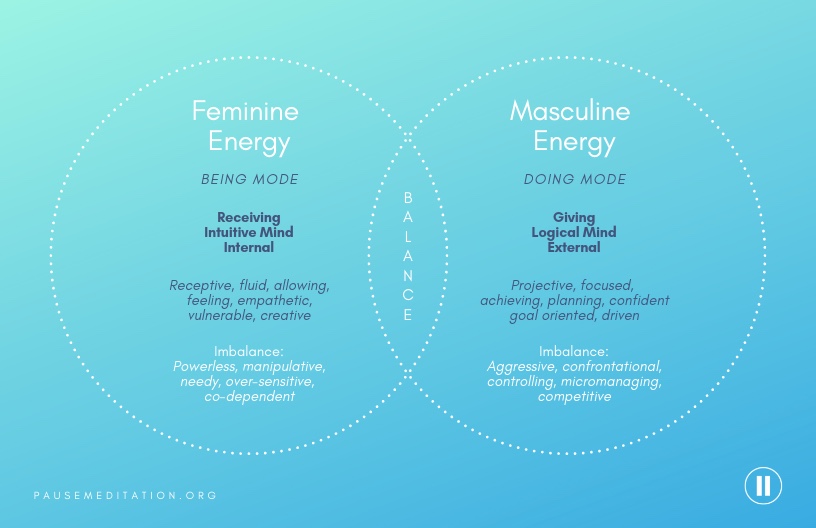
From PauseMeditation.org

If we define masculine and feminine as ‘energies,’ then I think we can agree that all humans, regardless of gender, possess both. They manifest in infinite combinations depending on myriad factors. Both energies serve us, and their healthy integration elevates our relationships and effectiveness exponentially, compared to when they are imbalanced.

In the graphic above, add ‘dominating,’ ‘homophobic,’ and ‘misogynist’, and ‘hyper-‘ to ‘competitive’ on the list of words describing Masculine Imbalance. Consider both men and women who exhibit these traits, yourself included, and the contexts in which they occur. In my residency essay I explicitly stated my awareness of medicine as a male-dominated profession, and that I wanted to avoid exhibiting negative male traits as I navigated my career, while also standing up for my own beliefs and ideas. I also intended not to let my naturally caring and agreeable nature be taken advantage of.
Now look at the descriptors of Feminine Imbalance, and think of when/where in your life you observe these traits in yourself and others. If we are honest, I think we can recognize parts of ourselves in all of these words, in certain contexts and relationships.

These traits and their integration are especially important to me in leadership. The best leaders do the inner work to integrate both receptive and assertive, nurturing and directive, caring and accountable, soft and strong aspects of themselves, so they may manifest all of it in cohesive and holistic presence for the benefit of all. These leaders are both attuned (feminine) and differentiated (masculine): They sense the emotions and needs of those they lead and still maintain focus and direction to move us together from the front. For an excellent discussion of an example from fiction, watch Cinema Therapy’s episode, Aragorn vs. Toxic Masculinity. It’s an excellent twenty minutes to spend.

From Verywell Mind, “How to Harness Yin and Yang for Mental Peace and Clarity“, which I also recommend reading:

“What Are Yin and Yang?

“These forces are complementary and present in all phenomena. In some situations, one force might be more dominant. However, this balance may shift depending on what is needed at the given moment.

  • Yin: Yin is characterized as negative, passive, and feminine. It represents the energy of the Earth and moon. It is often described as receptive, dark, cool, soft, still, and contemplative.  
  • Yang“: Yang is portrayed as positive, active, and masculine. It represents the energy of the sun. It is often described as energetic, expansive, and warm.

“It is important to remember that while the yin and yang (are) opposite of one another, it does not mean they are oppositional or in conflict. Instead, they can be thought of as balancing energies that complement one another.”

Where do our masculine and feminine traits and presence serve us well? Where are they a liability? How is this a function of how we balance (or don’t) the energies we manifest? When I need to stand firm and call BS, I can do it lovingly, from a place of caring–attuned differentiation–balanced masculinity. This is different from and related to differentiated attunement, where I am open and receptive to others while also maintaining my own separate, independent identity–balanced femininity.

Whether we describe these energies, traits, and tendencies as masculine/feminine, yin/yang, or in other terms altogether, my wish is for us all to be more aware of and intentional about the energies we maintain, emit, and absorb from one another. I wish for us to practice Strong Back, Soft Front. May we all Attune and Differentiate. Consider thinking Both AND when presented with any dichotomy. Integrate the polarities, seek the win-win.

I intend to write more about masculine/feminine, male/female dynamic and relationship. It’s so interesting and also fraught; I look forward to the challenge of expressing the nuances and complexities clearly and invitingly. Let’s see how it goes!

Happy Sunday, all.

Self-Compassion

“I have found in my research that the biggest reason people aren’t more self-compassionate is that they are afraid they’ll become self-indulgent. They believe self-criticism is what keeps them in line. Most peole have gotten it wrong because our culture says being hard on yourself is the way to be.” —Kristin Neff

“Talk to yourself as you would someone you love.” —Brene Brown

I’m tired tonight, y’all. And this is a big topic. So I give myself permission to stay in the shallows for this post–no deep explorations and hours spent searching citations. Just some honest reflections and aspirations. To learn more about self-compassion and evidence for its benefits, visit Kristin Neff’s website and check out her book, Self-Compassion: The Proven Power of Being Kind to Yourself. From her website page on the definition of self-compassion:

“Self-compassion involves acting the same way towards yourself when you are having a difficult time, fail, or notice something you don’t like about yourself. Instead of just ignoring your pain with a “stiff upper lip” mentality, you stop to tell yourself “this is really difficult right now,” how can I comfort and care for myself in this moment?”

What’s already good in my self-compassion practice?
–I no longer call myself names. I own that I sometimes say and do thoughtless, inconsiderate, obtuse, and bitchy things. But I don’t label myself with these adjectives. I no longer say things like “I’m being a bitch,” or, “Oh my god, I’m so stupid.” I make clear on my social media accounts that ad hominem is unwelcome. There is also no place for it in my own head.
–I avoid self-indulgence by maintaining compassionate accountability to myself. This overlaps with (encompasses, maybe?) practices in honesty, mindfulness, integrity, forgiveness, judgment, and commitment, all topics to be addressed this month–everything is connected.
–Upholding my own self-compassion helps me maintain my growth mindset. While I allow myself to identify with fixed traits such as ‘smart,’ ‘creative,’ or ‘badass,’ I can hold these labels loosely and also allow for wild imperfection and failure–for myself to be human in all of my smart, creative, and badass endeavors. I am freed to be both wholly all of these things and more, and also a perpetual work in progress.

How could my self-compassion practice be better?
–Explore more the paradoxical polarity of enough and not enough–I am enough as is, and I am also always improving–so what do enough and not enough actually mean? “You are perfect, …and you have a lot work to do,” I read years ago. Love it. Makes to total intuitive sense, and I want to live into it more deeply.
–Look for the still insidious ways self-criticism appears, and hold it with kindness. I know there’s a lot there in my body image, especially as aging accelerates. And when I find self-loathing and -judgment, I can practice my compassion on that, rather than meta-judgment of the judgment, which doesn’t help anyone. I bet I could query arenas where I feel like an imposter; that’s probably pretty good fodder.

How does our society do self-compassion well already?

Awareness. Authors like Kristin Neff, Brene Brown, Tara Brach, Richard Rohr, and the Dalai Lama bring self-compassion concepts from esoteric academic and spiritual theory to practical life skills. Their books, articles, podcasts, interviews, and websites offer the lay public copious access to all things self-care, connection, and inner peace. Communities of folks seeking comfort and connection form, mindful presence ensues, and good things happen all around. Like mindfulness, self-compassion is making its way into mainstream consciousness as something to develop rather than to shun and dismiss.

How could we do it better?

Normalize it. The distinction between self-compassion and self-indulgence still needs reinforcement. Being kind to onself in a moment or period of hardship does not mean shirking responsibility, is not a character flaw, and does not lead to a future of fruitless debauchery. Allowing health habits to loosen a little in the midst of life chaos does not warrant harsh self-recrimination. The practice of imagining a friend going through the same challenges and what we would say to them, then saying that to ourselves, really helps here. Oh and we should say those things to our friends out loud, too.

Strengthen Accountability. Even if we succeed in distinguishing the above, I think people still need reassurance that we won’t all become listless moochers just looking for excuses and free rides for everything. As an aside, what is with that cultural fear of ours, anyway? By accountability I don’t mean punishment or shame. I mean owning our mistakes and the impact we have on others, standing convicted not in public opinion but in our core values. Accountability and self-compassion together help us present ‘strong back, soft front’ to ourselves, developing both intrinsic strength and courage as well as openness and vulnerability. Ultimately, the best outcome is that we then present this way to others, offering kindness and also holding them humanely accountable, and our connections and communities tighten in love.

Amplify the Benefits. When we see someone we care about lambasting themselves, we can help. As we show more loving kindness to ourselves, we are more willing and likely to do the same for others. Mercy, grace, empathy, tenderness–can we look individually and collectively inward and see the rewards of offering these to ourselves, and then to one another? It doesn’t take much to imagine, does it? We can start one on one, with people we care most about, whom we truly love. Then we can extend it to strangers, then to members of out-groups whom we may initially and automatically judge harshly by way of stereotype and prejudice. Strong self-compassion practice can translate to recognition of every person’s innate humanity, reframing even our most destructive behaviors in humane rather than dehumanizing light. “The smart, creative, wildly imperfect badass in me sees the smart, creative, wildly imperfect badass in you.” It all starts with healthy relationship to self.

So was this even coherent? Good night, all, I’m going to bed. Back tomorrow on polarity management, woohooooooo, that’ll be fun.