Exponential Risk

NaBloPoMo 2020 – Today’s Lesson

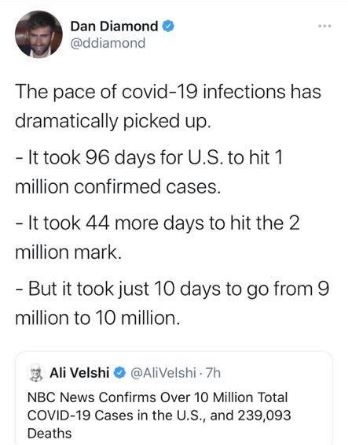
Things are looking really bad again, folks.  Illinois saw more than 10,000 new COVID cases for the fourth day in a row.  Between the first and third weeks of October, COVID inpatient census rose 500% in one metropolitan hospital system, and it’s still climbing.  At this rate, we may run out of ICU beds by Thanksgiving.

I had more calls today about COVID (symptoms and/or exposures) than any day since the pandemic started.  Every call takes time to explain the profound importance of distancing, masking, and minimizing contacts, then the logistics of quarantine, testing, and contact tracing.  It’s totally straight forward in some ways, and completely convoluted in others. 

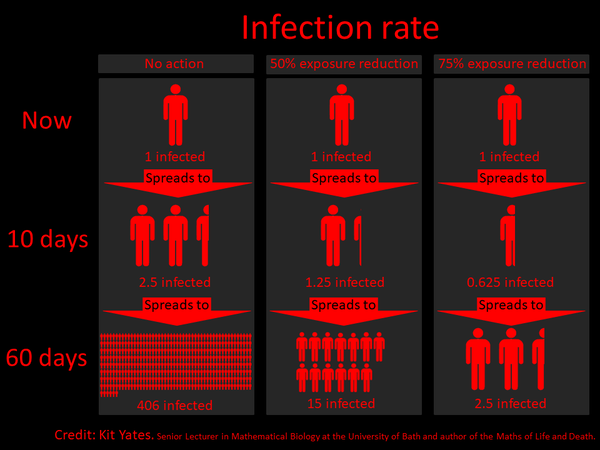
With rapidly escalating disease prevalence, every unmasked contact with a non-household (or ‘pod’) member carries exponential risk.  You breathe on me, I breathe on you.  We have now exposed each other to everybody we have each contacted in the past 14 days—we have merged our bubbles irrevocably in this one encounter, endangering everyone in each bubble and all of their extended contacts.  It cannot be undone.  This is the nature of a pandemic. 

I understand how hard it all is—how inconvenient, fatiguing, disruptive, and maddening.  Our masking and distancing, missing friends and activities, restricting our kids’ social lives, is all immediately and concretely costly to us, and only distantly and abstractly beneficial to others (and us).  Still, it is what we can do to slow the spread of a deadly virus that has infected more than 10 million Americans, and will have killed more than 240,000 of us by tomorrow.

Avoid these 9 pitfalls to stay safe.

If you want to pod, follow this guide closely. 

We can stop all paths of the virus through us.  But it takes all of us.
Affective Polarization

NaBloPoMo 2020 – Today’s Lesson

How fun when learning occurs in clusters.  I linked to a recent Hidden Brain podast on my November 4 post.  It was the first time I had heard the term ‘affective polarization.’  Basically it means that we define and dislike people by only knowing their political party affiliation.  Today I listened to a series of theological essays addressing the same issue, from a Christian perspective.  I can’t wait to learn more.

Increasingly, we judge and relate to one another based on this one factor, which may or may not be important to how we define ourselves.  Apparently it’s a pretty new phenomenon, and escalating fast (surprise). 

The podcast discusses how we feel as and about people who are deeply involved in politics or not, and how that affects our attitudes and decisions about which relationships to enter, whom to hire, where to live, etc.  The essays explain further that it has to do with in- and out-group (tribal) identity, self-esteem, and meaning.  In 21st Century American culture, our politics identify us more than they used to—it has replaced religion in this way, perhaps.  But, he posits, while we have cultivated religious attitudes and practices “from dogmatism and fundamentalism toward a faith that is more tolerant, inclusive, peaceable and generous,” not so for politics.  Partisans on both sides are basically fundamentalists, and that carries important implications for violence— the new holy wars.

This may all seem rather alarmist.  But I bet anyone who hears the podcast or reads the articles will recognize and relate to much of their content.  The best outcome from consumption of these pieces will be a little more awareness, and a desire to monitor and modify how we relate, for the better.  Let’s get to it, shall we?

For Real — Go High

NaBloPoMo 2020 – Today’s Lesson

Four years ago I started experiencing contempt from some people.  “Trumped That Bitch” and other pejoratives reverberated.  Daughter asked earnestly if we, natural born citizens, would be deported.  Random people asked me if I speak English, and people who look like me all across the country were yelled at, by total strangers, to go back to China.  We have been verbally and physically assaulted with escalating frequency since then.

Today, my phone vibrated with celebratory text threads.  Friend Unicorn labelled the experience a collective catharsis.  That made me consider… “I hope we can be less vindictive than the other side was last time,” I replied.  Friend Pegasus wrote back, “I believe we will be because the person leading will promote it.”  Exactly.  Leaders set the example.  Character really matters.  My friends and I feel soothed already, like we can finally take a breath and a pee break, refreshed for the next leg on the race toward progress.  Kamala Harris’s and Joe Biden’s speeches tonight further lifted our hopes and enthusiasm for healing and reconciliation.

I thought of my conservative friends throughout the day and evening, wondering how they’re doing.  I checked in with a few.  Some expressed disappointment and grief.  I can relate.  I also remember worrying about and praying for the Obamas’ safety immediately after the Grant Park celebration in 2008, and still do today.  Flashes of fear for Biden’s and especially Harris’s safety flared tonight. 

74 days until transfer of power.  Will it be peaceful?  I believe we each have more agency over this than we think.  Ignore agitators—give them no platform.  Amplify and uplift the peacemakers.  We’ve got serious work to do, together.  Stay focused; allow no distractions.  Go High—really—for all our sakes.