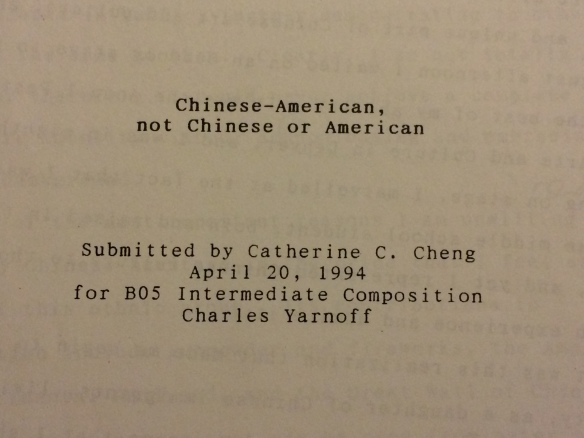
In college I had the privilege to learn from Professor Charles Yarnoff. Mrs. Summers taught me to write in my sophomore year of high school, but Professor Yarnoff took it to a whole new level. I think he would say I’m still too wordy, but hey, it’s my style. I didn’t know at the time, but the essay I wrote on growing up Chinese in America would become a recurrent touchstone for me over the years—including now.
My cross-cultural education commenced early—I remember going to a friend’s house for a playdate in first grade. I started to take off my shoes and she looked at me strangely. Apparently her family wore shoes at home. I looked at her strangely. Over the years, I learned to pay attention to how my American friends did things. I tried to follow suit and not appear ignorant. When they came over, I found myself explaining to them how we did things in my house. I considered myself very Chinese.
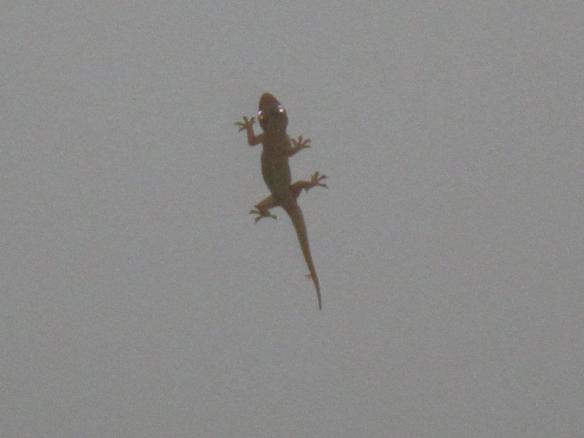
Then our family went to Taiwan in 1985, and I found out how American I was. We visited my grandparents in Tainan, who still lived in the homes where my parents grew up. That is where I learned that some people simply live with occasional ants and salamanders climbing the walls. At first it was gross, then intriguing, and then, okay, that’s just how it is. In my aunt’s modern apartment building, there was one drain for the whole bathroom floor, rather than just for the shower area. You just stood on a wet floor until you were all done in there and it would dry off eventually. That was a lot harder to abide than bi hu, or ‘wall tiger’ amphibians, for some reason.
At that time, my twelve year-old world view was pretty narrow. I thought it was an interesting trip. I liked some parts and definitely not others, and I was very happy to be back in the States where everything was normal. I Judged America as clearly better than Taiwan—more advanced, cleaner, and with superior plumbing.
Since then I have Journeyed a little more. In 1999 I went back to Taiwan on vacation, the first time since 1985. I got to visit Taiwan National University Hospital in Taipei. I felt surprised at how modern it was—like I could easily have put on a white coat and cared for patients there myself. Then my grandmother became ill and I flew back again in 2000. She was admitted to the teaching hospital in Taichung. She was already intubated when I arrived, but still awake and in the room she shared with another patient. I was shocked—intubated patients in the US are almost always sedated, and transferred to private rooms in the intensive care unit. She was soon transferred to the ICU, where we were given a shopping list. While the staff settled her into her room, which resembled more of a sterile alcove with a bed to me, we the family walked across the street to the medical supply store to buy the towels, feeding tubes, syringes, and other items they would need for her care. I remember thinking, You have got to be kidding me—seriously? But I was with my mom and aunts, who reminded me that this was not America, and things worked very differently there. They were patient with my young adult, young physician, American disdain.
Each day for lunch, we ate at a little hole in the wall, Tsai Duo Duo (Food Much Much). It’s still one of my favorite places to eat, ever. It was always crowded with people, in typical Asian fashion. The two-level food console astounded me—laden with a hot food assortment so vast, it would take me a month or two to sample it all. It was like the entire Whole Foods eatery packed into eight square feet. We each picked up a small paper box, filled it, weighed, paid, and scrounged for seating. When we finished, we dumped leftovers in one big waste basket, boxes in another. My aunts told me that at the end of each day, the food waste was taken to local farms to feed the pigs. How brilliant! I thought. It made me reconsider my assumption that everything worked better in the US.
In the summer of 2006 I went back to Taiwan yet again. This time my parents had their own place there, and everybody was healthy. I gave a presentation on womens’ health (in Chinese—I was so proud of myself), and we got to see some historical sites in Tainan. One night from my parents’ high rise, I heard music coming from the street. It sounded like an ice cream truck—at 9pm. It was the garbage truck. My mom scurried to the kitchen, where she opened the freezer and pulled out a small, securely tied plastic bag. It was their organic food waste for the week. She explained that in that hot, humid climate, keeping organic waste out would wreak after a day or two, so people kept it cold. Everybody brought their trash to the collector when they heard the familiar music. The singing truck reminded me of that Monty Python scene—“Bring out your dead!” Once again I was struck by how humans adapt to different circumstances, and how differently people live in other places.
The point of all this is that I think access to multiple, different points of view helps us understand one another more easily—if we let it. I suppose it could just as easily make us more narrow and judgmental—“I don’t like this (you), it’s (you’re) not like what I know (me). I don’t know how it (you) will change my way of life, it (you) scares me, and I don’t like it (you) even more.”
I find most of my well-traveled friends to be more open-minded and non-Judgmental. The world can only get more connected, integrated, and small from now on. The more readily we can see the similarities between us, the more willing we are to embrace one another, the better off we will all be. I need to travel more!


 Healing Through Connection