Calling All Depolarizers!  Part 1:  Who Are They (We)?

Whom in your circles would you identify as depolarizers, political or otherwise, either naturally and/or by effortful intention? 

What makes them so, and how do you think they would respond to a call to communion with fellow depolarizers?  What would that call even sound like?

How much do you see yourself as a depolarizer?

We could consider ‘boundary spanner’ as a synonym to ‘depolarizer.’  These people see and understand, at least partially, more than one side of an issue or conflict.  More importantly, they respect and value each perspective.  They listen empathetically, validate our feelings, and express (or at least seek) understanding, even if they disagree with our beliefs or positions.  Talking to them, we feel seen, heard, understood, and accepted—even loved.  Our breathing slows, our muscles relax.  What happens next is the best part—we ourselves may become more likely to also listen, empathize, understand, and validate opinions or experiences other than our own.  And voilà, we de-escalate, and the distance between us diminishes.

Effective depolarizers practice three key skills:

  1. Self-awareness: Of their own biases, triggers, core values, tendencies in conversation and groups, etc. They own these traits/patterns, and acknowledge them freely, visibly, without judgement or shame. They understand how these traits may skew their perspectives.
  2. Self-regulation: They manage their own personality traits and biases, set and maintain healthy boundaries, attune to their own needs and honor them, also out loud and visibly. They monitor the heat and tension of interactions in service of maintaining healthy relationship and personal integrity at the same time.
  3. They ask excellent questions, based on deep listening and sincere curiosity, and that are meant to deepen/broaden/add texture to conversation in relationship and connection. Their questions defuse and disarm, and invite calmer, more thoughtful reflection and engagement.

Hostage negotiators deploy these skills with precision in very high stakes encounters.  Then again, so do effective divorce mediators, middle school teachers, and parents of toddlers and adolescents, no?

So really, don’t we all have a little depolarizer in us somewhere? Do we not all have the innate capacity to relate to all other humans, to connect, through our shared needs and experiences? It is not that depolarizers have no convictions, are wishy-washy on issues, and can just be swayed from one side to another and back again. It’s that they (we) do not constantly need to be right, to convince everybody to see the world as we do, to persuade or convert. We advance our causes in various ways, not the least of which is enrolling others by way of coalition building around shared interests and goals. Depolarizers amplify connections rather than sow divisions. We focus more on growing ‘us’ than demonizing ‘them’.

So what keeps our inner depolarizer in the closet when it comes to sensitive topics like abortion, immigration, religion, and politics in general?  Or in family conflict and workplace politics?  I posit that it has, at least partially, to do with two levels of psychological safety: intrinsic and extrinsic.  More on these ideas in the next two posts!

I See Myself In You

“I can’t imagine…”

“I can’t understand…”

“I can’t relate…”

“I would never…”

When you think or say these phrases, what is the context?  What message are you harboring, or trying to convey—connection or distance, or something else? 

Can you truly not imagine, understand, or relate?  What if you tried harder (or at all)?  How would it affect you if you could imagine, understand, and relate, or if you would ever, under certain circumstances?  How would this altered relationship to the situation (and person) feel?

I have written before about what happened when I said, “I can’t imagine” to a black classmate.  It was humbling.  I submit that we could all humble ourselves a little more these days.

Sylvan Dale Guest Ranch, Loveland, Colorado

My last pre-pandemic solo trip was to Loveland, Colorado, for the last retreat of Leading Organizations to Health, Cohort 11.  It feels cosmically fitting for my first solo trip since COVID to be a return for the first in person LOH alumni gathering in this time, last weekend.  OMG, friends, it was the next best thing to going home.  Other than our leaders, I had only met my fellow alums over Zoom these last two years.  And now I have 8 amazing new friends.  Though separated by occupation, specialty, generation, and geography, we all speak fluently the as yet rare and reverent language of relationship-centered leadership.  This is my tribe.

We start our sessions with poems.  Please Call Me By My True Names by Thich Nhat Hanh spoke deeply to me, especially these lines:

I am the twelve year-old girl, refugee in a small boat,

who throws herself into the ocean after being raped by a sea pirate,

and I am the pirate, my heart not yet capable of seeing and loving.

Whoa.

I have written on this blog many times about seeking, honoring, and really exercising our shared humanity —35 posts appear when I search the site for the phrase.  Even since I started blogging 7 years ago, though, it feels ever more urgent that we practice this every day.

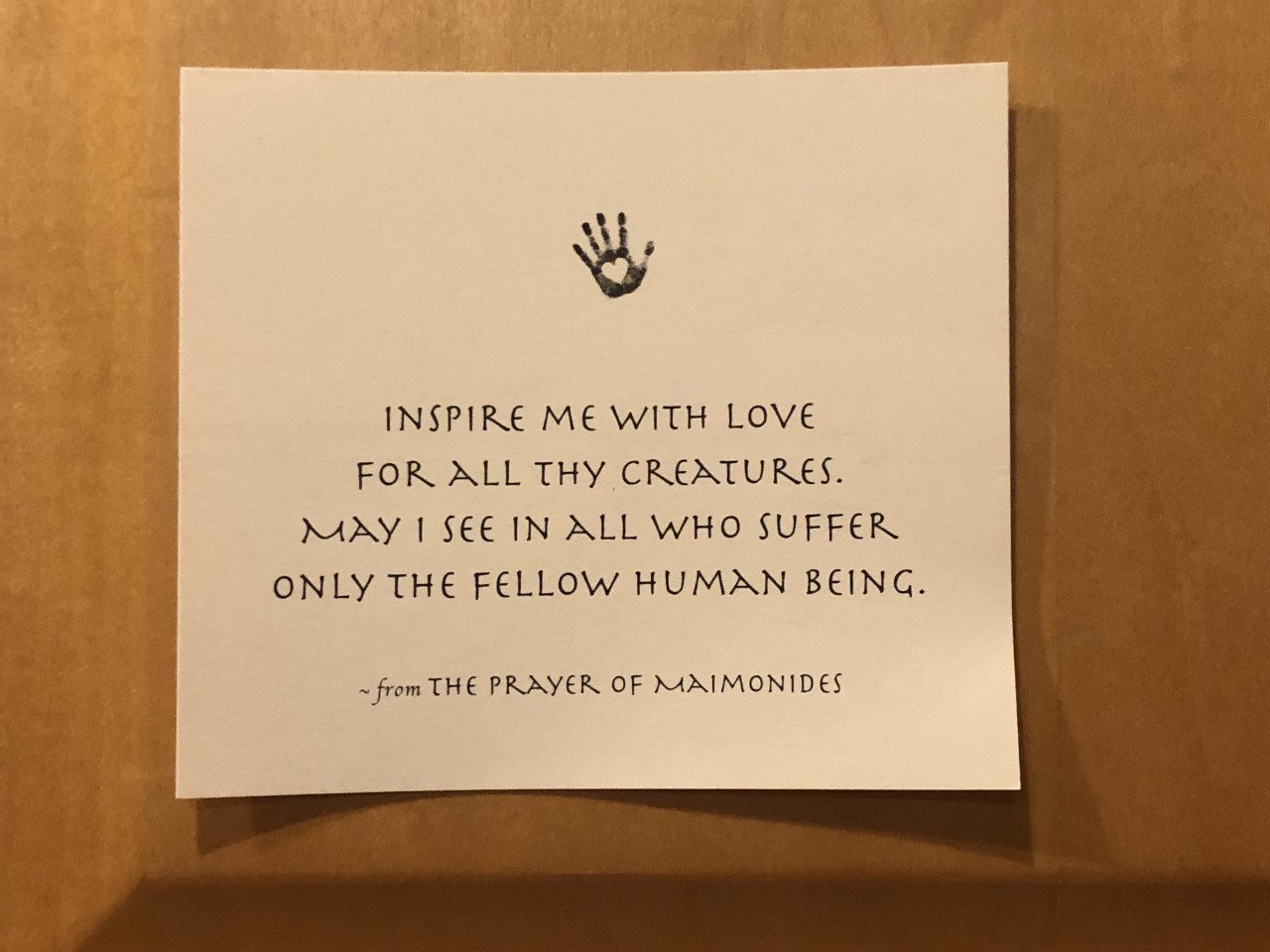
This card hangs on my kitchen cabinet.

This week my good friend Donna asked me to re-articulate my Why.  Again, I’m sure it was cosmic inspiration that moved her.  Have I ever written my Why statement here?  It was ‘to optimize relationships with and between all people I meet.’  And by optimize I meant to make more understanding, more connecting, and more meaningful.  Today, I think I have to be much more specific:  

My Why is to help us all see at least a part of ourselves in every person we meet. 

I intend to practice and model this first myself—to really internalize the truth that I am myself and also every other soul—that we are all born with the same needs, the same aspirations, the same set of possibilities.  Each of our unique, complex constellations of birth circumstance lottery, serial life experiences, and intrinsic wiring shapes us in ways we can only partially understand in our thinking brains.  What we have not the capacity to think or speak, often can only be felt.  And when we contact another soul who has also felt what we feel, or who can imagine, understand, or relate in some way, WOW, how healing is that?  I bet we can all recall at least a few instances when those deep, meaningful connections occurred across apparently wide gaps of background, class, or other social construct.  And why do we remember?  Because we were moved, alerted, and maybe a little alarmed?  Or maybe we have forgotten, because to come too close to someone’s experience that makes us uncomfortable can trigger a distancing reflex—self-image-protecting, perhaps.

In recent years I have internalized the admonishment to never say, or really even think, “What is wrong with you?”  Rather, I remind myself to ask, “What happened to you?”  In every context, this one switch opens the door to curiosity, imagination, understanding, relationship, and connection.  It allows space for our deeply shared humanity to surface and teach me what I need to know, or at least to prompt humility ahead of blind judgment and dismissal.  Substitute “them” for “you” in these sentences, and see how easily and willingly we throw away whole groups of people with our in- and out-group identities and ideologies.

May we all see a part of ourselves in every person we meet, especially the ones who make us say, “I can’t imagine, I can’t understand, I can’t relate, and I would never…”  Let that seeing move us to put down our judgments and take up empathy, compassion, and connection instead.  We will all be better for it.

The One and the Many

How do you change your words or message depending on your audience?

Weeks ago I read an article sharply criticizing public health messaging throughout the pandemic, and took a hard look at my own communication over the past year.  A year ago I wrote a series of posts on COVID, which were generally well received.  I have consistently taken a very conservative approach to mitigation, admonishing people to avoid gatherings and travel, mask up, and be patient.  In my public messaging, I have not directly addressed the mental, emotional, economic, and social costs of all of these measures. 

But what about in my private conversations?  How are they/am I different?

I thought of two groups with whom I interact:  Those whom I know personally, who trust me, and who think similarly to me, and those whom I don’t know, who may not trust me, and who think/believe differently from how I do.  Okay so six groups, not two—and they can overlap—I have patients who trust me and think very differently—but I think my messaging generally takes one of two approaches depending on my audience.  And in the end, I think it comes down to trust.

The One

When speaking to one person whom I know, or someone who agrees with me, two assumptions are at play: 1) they trust me, and 2) I trust that they trust me.  It sounds semantic, but I think it matters.

In this situation, I’m probably much more willing to admit uncertainty, and to ‘negotiate’ my position because I trust that my counterpart understands and respects my concerns.  So I’m willing to show vulnerability in my expertise because I trust that they know I will incorporate new information and update my recommendations.  I also trust them to know that it’s not because I’m stupid or gullible or on some kind of power trip—we’re all just learning and trying to balance everything that matters in a rock vs hard place situation.  When engaging in mutually trusting conversation, even in disagreement, openness, curiosity, and ambivalence can be taken as humility and seeking truth rather than weakness and lack of conviction, and both parties may be more likely to walk away with broader, more nuanced perspectives.  And best of all, the relationship can be strengthened, allowing for continued engagement, learning, and growth.

The Many

Posting to the blog or on Facebook, I think I run a much higher risk of being misunderstood.  I am responsible for providing clear and concise context for any expression or opinion.  My audience is diverse, and depending on any reader’s mood or context themselves, my words may be interpreted very differently one day or one moment to the next—and I have no control over that.  Do they trust me?  Can I trust them to assume my humility and good intentions?  Unclear.

In this space, depending on my mood, perhaps, I may feel defensive, and/or a deep desire to prove myself right.  I may be much less willing to admit to gaps in my knowledge or flaws in my reasoning, for fear that my expertise will be wholly discounted if one aspect of my interpretations or recommendations is imperfect.  If I assume my audience does not trust me, then I’m less likely to trust them to receive my intended message, to take my advice, and achieve my primary goals.  I get preachy, narrowing my perspective and failing to see more than my own point of view.  I ask fewer questions—that is always a red flag.  I make more assumptions, defensiveness increases, and my mind closes further.  It’s an emotional hijack of sorts, resulting in further disconnect and polarization.  Yikes.

Or maybe, just because I don’t know how my message will be perceived, I qualify and hedge, and lob ideas much more passively, inadvertently conveying that I don’t really believe what I’m saying, that I’m actually not trustworthy, just wishy-washy. 

So what should I do?

I think one solution is mindful attunement and differentiation.  As a communicator in relationship of any kind, but especially when I’m the expert, it is my responsibility to manage this dynamic polarity intentionally.  Face to face, I can make sure the other person feels seen and heard, by asking more questions, paraphrasing, reflecting their values and goals back to them.  When writing for an audience I cannot see or hear, I can respectfully acknowledge opposing opinions and their validity, before presenting my own arguments.  Above all, I can hold a larger space for everyone’s values, concerns, and objectives.  I see you.  Please see me.  What do we both care about?  What trade-offs are we willing and not willing to make to achieve our shared goals?

Results from my Think Again quiz, March, 2021

Adam Grant’s new book, Think Again, will be my personal and professional bible for a while, I think.  Its central tenets are intellectual humility and cognitive flexibility.  I may speak and write like a preacher about things that matter deeply to me.  But I will strive to think more like a scientist, seeking truth and connection above winning arguments and/or proving other people wrong.

In the end, as I practice myself, I will observe and apply these principles in other arenas.  Can we keep attunement and differentiation in mind when we hear leaders and politicians speak?  When a constituency is diverse, and an issue complex, can/should we expect a public figure/expression to convey nuance in generalized statements?  I say yes, absolutely.  I think we should hold leaders, as ourselves, to a much higher standard for acknowledging complexity and uncertainty.  Oversimplified sound bites divide and incite, and we should all reject them, strongly.  We can address complexity and uncertainty without inciting mass panic if our statements also clearly convey conviction to core values, and what we are for more than what we are against. 

We can all/each elevate the quality of both private and public discourse if we help one another feel connected throughout.  That means earning trust, and there is no substitute for the work it takes to do this.