The more I think about it and talk to thoughtful friends, the more I find uncertainty and lack of control at the foundation of the majority of stress and suffering I observe in our fellow humans.
In terms of health, more and more information from commercial blood tests and imaging can be known, but the utility and predictive value of all that extra information is still too often unclear. And so we spiral, worrying about the uncertain future and looking for more tests and the latest ‘hacks’ to ensure the outcomes we want. Capitalist Medicine, as I think of it, preys on our worries, offering test after test without regard to sensitivity, specificity, or predictive value. Too often there is zero clinical consultation before or after people fork over hundreds or thousands of dollars, with minimal explanations for the meaning of ‘green’ or ‘red’ range results. Overloaded and burned out physicians get inundated with messages from worried patients; precious time, energy, and resources are thus expended for unclear and sparse benefit. In time some of these tests, applied specifically and with strong evidence, may help a lot of people. What do we do in the meantime?
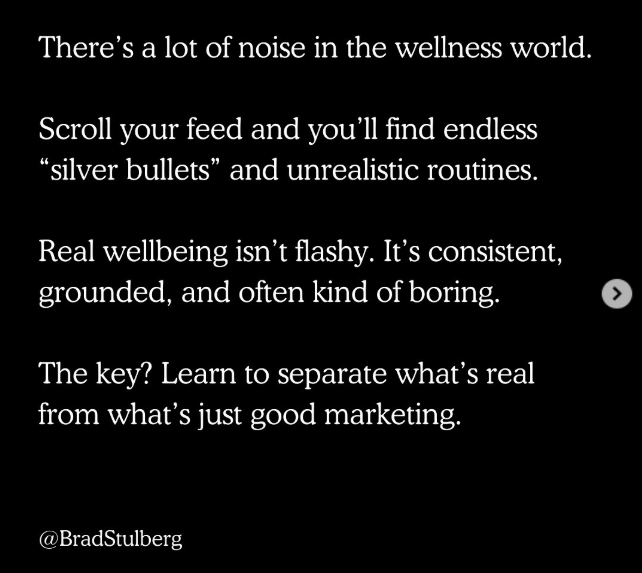
Follow Brad Stulberg for evidence-based and practical advice on cutting through hype and sticking to what works. Focus on the basics: Sleep, exercise, nutrition, stress management, and relationships. I emphasize relationships because it’s more complex than we want to admit, especially relationship with self, which is basically self-awareness and self-regulation.
What if we’re already great at sleep, exercise, nutrition, and self-regulation, and we’re still anxious, still ruminating more than is helpful on a future that we ultimately cannot control? How do we get to peace with what is, and stop over-worrying about what could be negative, revel more in what is and could be positive? For more and more of us, life feels VUCA: Volatile, Uncertain, Complex, and Ambiguous. Naturally then, we seek stability, certainty, simplicity, and clarity–we grasp at what comforts–even if it’s false. So how do we get to real, true peace with it all?
That’s the inner work, my friends. It’s different and unique for each of us. Whether it’s family of origin stuff (for so many of us), other trauma, or something else (many somethings!), our patterns of anxiety and compensatory attitude and behavior don’t come from nowhere. And we all learn to carry our anxiety, trauma, etc. in our own dys/functional ways. Look at us, getting through life, getting sh*t done, holding it together the best we can! Good on us, FFS!
My wish for us all is that at the end of our lives, whenever and however it happens, we can each feel vastly more peaceful than regretful. That in those last ten minutes, we can look back and feel satisfied that we lived according to our values, spent our time, energy, and resources on worthy causes and connections, and can leave this mortal life with serenity. I have written before that in order to die at peace, I need to live in peace. That means living as comfortably as possible with uncertainty and lack of control, because that is what life is. I don’t mean that we should never feel anxiety, never acknowledge adversity, lose a little hope sometimes, and rail at what enrages us. I want for us to embrace all of it, allow the intense and difficult feelings, move through them (or let them move through us), with the confidence that we can handle it all, get to the other side of anything, and even gain a little wisdom in the process. I think it’s this confidence and security in ourselves and our connections (because we all need help, whether we admit it or not) that helps us make relative peace with uncertainty and lack of control.
Talk therapy Somatic psychotherapy Meditation of any kind Breathwork Martial arts Prayer Spiritual discernment Mindfulness practice Medication Music Creativity Bibliotherapy Walkabout What else?
I wrote to a patient recently, “I will continue to look for ways to ease your worry.” This is my work. Every conversation informs and educates me on new possibilities, other ways I can help. We go together, my patients, friends, and I, exploring and co-creating according to our values, goals, and aspirations. I do my best not to judge anyone’s anxiety and worry, even as I observe the suffering it causes. We all have our own unique burdens to carry in this life. Whatever we can do to lighten one another’s loads, let’s find a way to do it, yes?
It’s November of the hardest year in my recent professional memory, and the escalating stress levels I witness every day show no signs of abating. My patients are sleeping poorly, gaining weight, and their blood pressure continues to rise. They miss quality time with loved ones and rethink their life paths more seriously now than ever. Strangers on the street seem increasingly confrontational. The world is once again embroiled in war and violence. Our stress management skills are called forth, no question.
I attended the second ever Harvard Medical School coaching conference in the spring of 2009, where I met Benjamin Zander and The Art of Possibilitybecame my personal development bible. Roz Zander, co-author, former wife, and decades long collaborator to Ben Zander, died suddenly this year. I hope my writing and impact may honor her, as these 14 years of my inner and outer work, sparked by the Zanders at that meeting, made me a better person that I would otherwise have been, founded on the practices in their book.
**Deep breath**
It’s been at least a decade, and I still ask patients to assess work stress in terms of threat and challenge. Threat stress–basically fight or flight–is physiologically taxing, meant to last seconds (not years), and costs us our health if prolonged. Challenge stress is activating, productive, and beneficial. I also query about personal fulfillment from work–meaning. We can tolerate very high levels of stress, even prolonged threat, if it’s worth it to us.
Parenting may be a better example than work. When we fear for our children’s well being, and even their lives in crises, how do we manage that? Is there any worse threat? We’d all rather it be ourselves suffering than our kids, right? How do we cope when we have no control?
At the risk of sounding arrogant, I feel very confident in my stress management skills. This is not to say I don’t experience severe stress or feel its consequences. I just move through it much more easily and with a lot less suffering now than in the past. I feel a lot less threat than challenge. Briefly, the practices: —Breathe. Ever since my first medical assistant posted “TAKE A DEEP BREATH” at my workspace, I have appreciated the calming effect of one deep breath, physically and psychologically. We can breathe ourselves through childbirth, injury, emotional trauma, and myriad other urgent and emergent situations. Deep breathing stimulates the de-escalating parasympathetic (rest and digest) nervous system, balancing the autonomic hijack mediated by the sympathetic system. I breathe along with patients when I listen to their lungs. I inhale deeply when listening to books, and during strenuous exercise. It is my central grounding practice. —Accept. “It is what it is.” This has nothing to do with how I feel about it. But the sooner I separate what is from what I want it to be, the less I suffer. Obviously I find this much easier to do for things I care less about. But even for big things, like the state of our healthcare system, the brokenness of our government, and my estimate of the ultimate demise of humanity (I think five more generations, give or take), just being with what is, as a first step to figuring out what to do next, helps me suffer a lot less. —Withhold judgment. I’m really good now at not jumping to conclusions and not making sweeping judgments about people based on limited information. I am able to separate judgment of actions from people’s character and humanity. If you’re screaming at my team and me, you are clearly unwell. We can hold you accountable to your actions and still show you compassion and respect. I don’t have to think you’re a bad person. This way, I don’t take your negative actions personally, and I can stay calm and even. —Get help. I ask every patient every year about their emotional support network, because it matters. Mine is phenomenal and I could not be more grateful. But I only know they are so because I call on them enough and they on me. Rarely I am disappointed, and I learn to turn elsewhere. I cannot overstate the profound importance of tribe and connection. It is my raison d’etre. —Move. When daughter was admitted to the hospital and I stayed with her there, I made sure to get on the ellipitical each day that week. When I go too many days without movement, I get edgy and stuck in my thoughts. My stress is exponentially more manageable if I protect my workouts, which I have now done for many years. —Attune and differentiate. My greatest stressors involve other people. Friction, tension, grating, colliding, etc. Since my LOH leadership training helped me articulate these complementary concepts, I recognize now that attuning/aligning with others, as well as differentiating and standing firm in my own core values and practices are equally important and fluid in their dynamics. Feeling out that optimal integration in any given interaction is rewarding in itself, and the outcomes are always better when I attend to both, knowing that I am showing up true to myself. What more can I ask of me?
So what could be better? Anything, really. For the rest of my life, new stressors will continually emerge. In his book Master of Change, Brad Stulberg quotes a statistic that in an average adult life, we will experience 34 major disruption events, which works out to about one every 18 months. Sounds about right to me! So I can expect to be challenged and trained in all of these skills and more, usque ad mortem. I only hope I can keep learning, applying, improving, and growing. Bring it.
—
I feel less harshly about our collective, societal stress management skills and outcomes than I do about our obessions and ironies with exercise and nutrition. Really, I think everybody’s doing the best they can, with the skills they have, in the circumstances of their lives at any given time. I just wish our environments didn’t create and perpetuate so many of our stressors in the first place.
So what’s already good? —Potential. We are all surrounded by one another. So every encounter, any time, any place, is an opportunity to do people-ing better. In any given relationship, if anyone is willing at all, there is always the chance for repair after rupture. Humans are innate learners; we can continually acquire the skills to stop impaling ourselves with the second arrow of suffering, after the arrows of pain hit us in daily life. We can even hold one another up and heal our injuries together. —Books, teachers, resources. Those aisles and shelves of stress management books really are dense, and I can say with conviction from first hand consumption that the knowledge and potential benefit living in those pages is immense. For those with the bandwidth to actively seek, consume, digest, and apply, lives can be transformed, especially if shared, discussed, and practiced together. –Sometimes it really doesn’t take much. Your friend calls to check on you. A stranger helpsy you carry your groceries. When we say ‘it’s the little things,’ we speak truth. Small acts of kindness and incidental connections will not solve our hardest problems, but we must not underestimate their profound potential to help, and for that help to amplify in unexpectedly large ways. What’s more, both the helper and the helped benefit from the encounter.
What could be better? –Teach it explicitly. There is a movement afoot among Dialectical Behavior (T)herapists to formally incorporate stress management skills into school curriculum. DBT organizes life skills around four central pillars: Mindfulness, Emotional Regulation, Distress Tolerance, and Interpersonal Effectiveness. Within each module are sets of practices, many with campy acronyms to help us remember. I refer patients to the DBT skills website often, not just to help them cope better themselves, but to help them model better coping skills to their children, direct reports, and leaders. Simply having the confidence that we can handle whatever comes our way, because we know what to do, decreases stress exponentially. What if we learn these skills in childhood, before the chaos of adolescence and serial tumult that is adulting? Can you imagine? –Relational Leadership Training and Valuation. Leadership done well is a practice in empathic, compassionate, accountable, and transparent stewardship. It is a way of being and doing, one that requires high level self-awareness and self-regulation, and excellent attunement and communication skills. Right now I think leadership training focuses a lot on transactional communication, superficial team dynamics, and not enough on building leaders’ stewardship mindset and deeper relational skills. We should require evidence of these skills for promotion and provide communal support and feedback to strengthen their practice. This would reduce overall stress in organizations by building cultures of empathy, compassion, accountability, and transparency from the top. Workers’ stress, in my observation, stems in large part from toxic cultures set by relationally inept leaders.
So, another plot twist, but maybe not really. My solution to stress management optimization is relationship-centered: first relationship with self, then between self and others, and then between/among those who know us, by way of example setting.
Stress is complex. Its optimal management is a lifelong practice. It’s never too late to start, and no skills practice is too small or wasted.
“The only way out is through. The best way through is together.” I think that applies here.



 Healing Through Connection