#AtoZChallenge: Kindness and Kickassery

kick ass be kind

Image courtesy of Facebook/Pinterest.

I love this meme because of the unexpected juxtaposition of Kindness and Kickassery.  There aren’t many great ‘K’ words, but these are definitely my favorite. But what does it mean?  How can we apply this wonderful combination of words in everyday life?  My daughter gave me some ideas recently.  She has been interested in Japanese culture for a while, and recently got into the Inuyasha comic series.  I asked her why she likes it so much.  She said it’s helping her feel more brave, and that she likes the heroine, Kagome, because she’s “tough and kind.”  She is willing to go through hardships to help the other protagonist, Inuyasha.  That’s it!  Kindness and Kickassery!

We talked about some movie characters she also likes (I like them, too): Black Widow from the Marvel movies, and Ilsa Faust from Mission Impossible: Rogue Nation.  We decided we thought they, too, were “tough and kind.”  We admire their Kickass fighting skills, their ability to hold their own among the boys, and their dedication to mission, as well as their ability to connect to other characters on an emotional level.  As I think about it I can’t say that kindness is their chief strength, but I can still apply this mantra to my own life.

Kick Ass simply means do it like you mean it. No holding back, be your badass self.  No apologies.  Because Kickass, and its cousin Badass, are the antitheses of Half-ass.

Kindness means do it in the service of treating others well, of holding them up—no matter who they are, no matter what you’re doing, no matter how hard.

So in a way, it’s the perfect combination. Because Kickass by itself has potential to harm—if we do things thoughtlessly, brazenly, and without regard to other people’s feelings.  Combined with Kindness, though, we are grounded in, once again, our connections with others.  Kindness channels our Kickass energy always in a positive direction.  Sometimes we may worry that being Kind will lead to others taking advantage of us.  But just picture it: Kindness with the force of a no-holds-barred-I-got-this-just-stand-aside-and-let-me-work-here-please attitude carries weight.  This kind of robust confidence, rooted in doing the right thing, commands respect and deference from would-be naysayers.

So let’s all try to practice some Kickass Kindness,eh?

#AtoZChallenge: Journey More, Judge Less

photo (2)

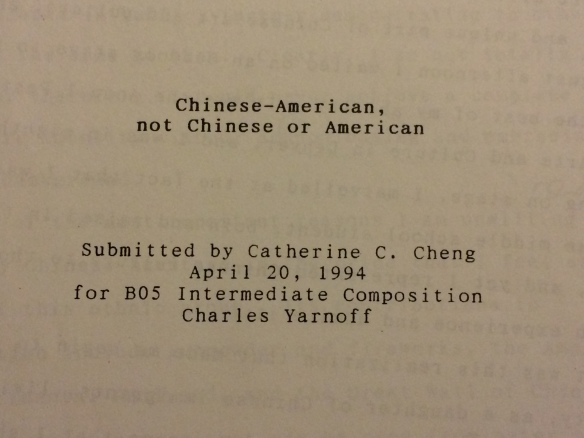
In college I had the privilege to learn from Professor Charles Yarnoff.  Mrs. Summers taught me to write in my sophomore year of high school, but Professor Yarnoff took it to a whole new level.  I think he would say I’m still too wordy, but hey, it’s my style.  I didn’t know at the time, but the essay I wrote on growing up Chinese in America would become a recurrent touchstone for me over the years—including now.

My cross-cultural education commenced early—I remember going to a friend’s house for a playdate in first grade.  I started to take off my shoes and she looked at me strangely.  Apparently her family wore shoes at home.  I looked at her strangely.  Over the years, I learned to pay attention to how my American friends did things.  I tried to follow suit and not appear ignorant.  When they came over, I found myself explaining to them how we did things in my house.  I considered myself very Chinese.

Then our family went to Taiwan in 1985, and I found out how American I was.  We visited my grandparents in Tainan, who still lived in the homes where my parents grew up.  That is where I learned that some people simply live with occasional ants and salamanders climbing the walls.  At first it was gross, then intriguing, and then, okay, that’s just how it is.  In my aunt’s modern apartment building, there was one drain for the whole bathroom floor, rather than just for the shower area.  You just stood on a wet floor until you were all done in there and it would dry off eventually.  That was a lot harder to abide than bi hu, or ‘wall tiger’ amphibians, for some reason.

bi hu 2011


At that time, my twelve year-old world view was pretty narrow.  I thought it was an interesting trip.  I liked some parts and definitely not others, and I was very happy to be back in the States where everything was normal.  I Judged America as clearly better than Taiwan—more advanced, cleaner, and with superior plumbing.

Since then I have Journeyed a little more.  In 1999 I went back to Taiwan on vacation, the first time since 1985. I got to visit Taiwan National University Hospital in Taipei.  I felt surprised at how modern it was—like I could easily have put on a white coat and cared for patients there myself.  Then my grandmother became ill and I flew back again in 2000.  She was admitted to the teaching hospital in Taichung.  She was already intubated when I arrived, but still awake and in the room she shared with another patient.  I was shocked—intubated patients in the US are almost always sedated, and transferred to private rooms in the intensive care unit.  She was soon transferred to the ICU, where we were given a shopping list.  While the staff settled her into her room, which resembled more of a sterile alcove with a bed to me, we the family walked across the street to the medical supply store to buy the towels, feeding tubes, syringes, and other items they would need for her care.  I remember thinking, You have got to be kidding me—seriously?  But I was with my mom and aunts, who reminded me that this was not America, and things worked very differently there.  They were patient with my young adult, young physician, American disdain.

Each day for lunch, we ate at a little hole in the wall, Tsai Duo Duo (Food Much Much).  It’s still one of my favorite places to eat, ever.  It was always crowded with people, in typical Asian fashion.  The two-level food console astounded me—laden with a hot food assortment so vast, it would take me a month or two to sample it all.  It was like the entire Whole Foods eatery packed into eight square feet.  We each picked up a small paper box, filled it, weighed, paid, and scrounged for seating.  When we finished, we dumped leftovers in one big waste basket, boxes in another.  My aunts told me that at the end of each day, the food waste was taken to local farms to feed the pigs.  How brilliant! I thought.  It made me reconsider my assumption that everything worked better in the US.

In the summer of 2006 I went back to Taiwan yet again.  This time my parents had their own place there, and everybody was healthy.  I gave a presentation on womens’ health (in Chinese—I was so proud of myself), and we got to see some historical sites in Tainan.  One night from my parents’ high rise, I heard music coming from the street.  It sounded like an ice cream truck—at 9pm.  It was the garbage truck.  My mom scurried to the kitchen, where she opened the freezer and pulled out a small, securely tied plastic bag.  It was their organic food waste for the week.  She explained that in that hot, humid climate, keeping organic waste out would wreak after a day or two, so people kept it cold.  Everybody brought their trash to the collector when they heard the familiar music.  The singing truck reminded me of that Monty Python scene—“Bring out your dead!”  Once again I was struck by how humans adapt to different circumstances, and how differently people live in other places.

The point of all this is that I think access to multiple, different points of view helps us understand one another more easily—if we let it.  I suppose it could just as easily make us more narrow and judgmental—“I don’t like this (you), it’s (you’re) not like what I know (me).  I don’t know how it (you) will change my way of life, it (you) scares me, and I don’t like it (you) even more.”

I find most of my well-traveled friends to be more open-minded and non-Judgmental.  The world can only get more connected, integrated, and small from now on.  The more readily we can see the similarities between us, the more willing we are to embrace one another, the better off we will all be.  I need to travel more!

#AtoZChallenge: Inspire. Imagine. Integrate.

Inspire.

Dictionary.com:  To inhale.

Breathing: We can’t live without it (duh)!  But we take it for granted, or at least I do, until I can’t do it very well, like when I have a cold.  Oh, how I appreciate clear nasal passages and an airway free of mucus during those times!  But let’s take a closer look at Inspiration, the function of breathing in.

During the in-breath, the diaphragm contracts.  The chest inflates.  To do it fully we must sit or stand up straight.  The spine elongates, the sternum lifts, and the ribs spread, to accommodate three dimensions of filling capacity.  Negative pressure sucks in not only air, but venous blood, returning it to the heart.  Inspiration, then, constitutes expansion, loading, and readying for the next phase in a beautifully rhythmic, life-sustaining cycle.  It is necessary and automatic.

Dictionary.com:  To fill with an animating, quickening, or exalting influence.

How and when are we Inspired?  What then, do we do with our bodies?  We breathe deep, straighten our posture.  We feel steady and resilient, and we get to work.  We discover previously dormant or untapped creativity, and gears start turning.  Ideas flow; actions flow; we flow.  In addition to expansion, loading, and priming, Inspiration stimulates openness, Inclusion, and possibility.  We can move Infinitely farther, faster, higher, and stronger with Inspiration than without it.  Inspiration Ignites.  And, under the right conditions, I would argue it is also necessary and automatic.


Imagine.

Fueled by Inspiration, fully oxygenated and standing tall, we can then truly start to Innovate.  We can ask questions that might otherwise seem too hard:

  • What would I do if I knew I could not fail (cliché, I know, but bear with me here)?
  • If I fail, how could that actually be cool?
  • If we collaborated rather than competed, what more could we accomplish?
  • What is the greatest good that could come of this Idea, how far could it actually get?
  • How does this relate to everything else that I am about and that I do?
  • How could I make this a win-win?
  • What needs to happen in order for this to really take off?
  • What if they’re not just fantasies, after all?

How Infinite is human Imagination?


Integrate.

Ironically, Inspiration and Imagination can feel Intimidating.  Too often we are held back by thoughts that resemble humility, such as, “Who am I to challenge the status quo,” and, “I’m only one person, what do I know?  The people in charge must know what they’re doing, I should trust their leadership.”  Or maybe it’s fear?  In a world that operates too often on an assumption of scarcity, we may mistakenly believe that our Ideas and Innovations might threaten others, and rocking the boat can have unInvited consequences.  Or, maybe, we simply cannot yet believe in our own greatness.

New Ideas and Innovations do not necessarily negate those that came before them.  Indeed, their evolution often depends on previous Iterations.  There is no need to disavow or Invalidate anything already existing in order to bring forth something Inventive.  Intoned with respect and proper deference, the new may be Integrated with the old—synergized.

If we can hold Inviolable our core connections, common humanity, and love, just think of how we could advance our world with Intense and unInhibited brilliance!