
Uncertainty and Lack of Control

The more I think about it and talk to thoughtful friends, the more I find uncertainty and lack of control at the foundation of the majority of stress and suffering I observe in our fellow humans.

In terms of health, more and more information from commercial blood tests and imaging can be known, but the utility and predictive value of all that extra information is still too often unclear. And so we spiral, worrying about the uncertain future and looking for more tests and the latest ‘hacks’ to ensure the outcomes we want. Capitalist Medicine, as I think of it, preys on our worries, offering test after test without regard to sensitivity, specificity, or predictive value. Too often there is zero clinical consultation before or after people fork over hundreds or thousands of dollars, with minimal explanations for the meaning of ‘green’ or ‘red’ range results. Overloaded and burned out physicians get inundated with messages from worried patients; precious time, energy, and resources are thus expended for unclear and sparse benefit. In time some of these tests, applied specifically and with strong evidence, may help a lot of people. What do we do in the meantime?
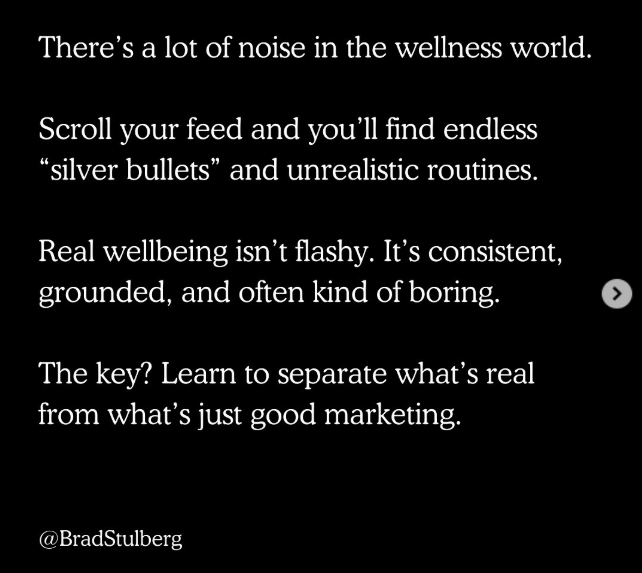
@bradstulberg
Author of Master of Change

Follow Brad Stulberg for evidence-based and practical advice on cutting through hype and sticking to what works. Focus on the basics: Sleep, exercise, nutrition, stress management, and relationships. I emphasize relationships because it’s more complex than we want to admit, especially relationship with self, which is basically self-awareness and self-regulation.

What if we’re already great at sleep, exercise, nutrition, and self-regulation, and we’re still anxious, still ruminating more than is helpful on a future that we ultimately cannot control? How do we get to peace with what is, and stop over-worrying about what could be negative, revel more in what is and could be positive? For more and more of us, life feels VUCA: Volatile, Uncertain, Complex, and Ambiguous. Naturally then, we seek stability, certainty, simplicity, and clarity–we grasp at what comforts–even if it’s false. So how do we get to real, true peace with it all?

That’s the inner work, my friends. It’s different and unique for each of us. Whether it’s family of origin stuff (for so many of us), other trauma, or something else (many somethings!), our patterns of anxiety and compensatory attitude and behavior don’t come from nowhere. And we all learn to carry our anxiety, trauma, etc. in our own dys/functional ways. Look at us, getting through life, getting sh*t done, holding it together the best we can! Good on us, FFS!

My wish for us all is that at the end of our lives, whenever and however it happens, we can each feel vastly more peaceful than regretful. That in those last ten minutes, we can look back and feel satisfied that we lived according to our values, spent our time, energy, and resources on worthy causes and connections, and can leave this mortal life with serenity. I have written before that in order to die at peace, I need to live in peace. That means living as comfortably as possible with uncertainty and lack of control, because that is what life is. I don’t mean that we should never feel anxiety, never acknowledge adversity, lose a little hope sometimes, and rail at what enrages us. I want for us to embrace all of it, allow the intense and difficult feelings, move through them (or let them move through us), with the confidence that we can handle it all, get to the other side of anything, and even gain a little wisdom in the process. I think it’s this confidence and security in ourselves and our connections (because we all need help, whether we admit it or not) that helps us make relative peace with uncertainty and lack of control.

Talk therapy
Somatic psychotherapy
Meditation of any kind
Breathwork
Martial arts
Prayer
Spiritual discernment
Mindfulness practice
Medication
Music
Creativity
Bibliotherapy
Walkabout
What else?

I wrote to a patient recently, “I will continue to look for ways to ease your worry.” This is my work. Every conversation informs and educates me on new possibilities, other ways I can help. We go together, my patients, friends, and I, exploring and co-creating according to our values, goals, and aspirations. I do my best not to judge anyone’s anxiety and worry, even as I observe the suffering it causes.
We all have our own unique burdens to carry in this life. Whatever we can do to lighten one another’s loads, let’s find a way to do it, yes?

The Reward of Continuous Consolidation

I’ still got it!

I have not studied or spoken about burnout in some years now. So I was a bit nervous when my colleague referred an organization to me to talk through their workforce’s experience of it now. The introductory call went swimmingly, three of us women leaders connecting around both challenges and the emergent possibilities.

As I wrote my follow up email (below), it struck me how the past ten years of learning, integrating, and application have coalesced solidly, and I can easily pull on the knowledge and expertise ad hoc. Wow, how rewarding. I document here for myself, so please feel no need to read it all.

I wish you all this firm, ongoing consolidation of experience, learning, and connection. We really just never know when, where, and how we can help one another. I hope you are offered the opportunity often, and that you may take advantage of the chance to connect in service.

——————————

Dear (Leader Woman #1),

Thank you and (Leader Woman #2) so much for the call today!  I had so much fun thinking through the conundrums—your organization is definitely not alone!

I will forgo reiterating how I understand the challenges, and just list the ideas and resources that came to mind.

These notes are as much for my own future use (in case we end up doing anything together) as for you all.

  1. Goals and trade-offs.  Analogy to adult children and aging parents. Different stakeholders will have different goals, and to maintain healthy relationship we must disclose and negotiate—preferably early and often, and ongoing.  What goals can we agree on, and then what are we each/all willing and not willing to do to achieve?
  2. Appreciative inquiry and motivational interviewing:  to query members of the group, start with what’s good, what we want to keep.  What makes you want to be here, what do you get out of it, how are your relationships great, how is the work meaningful to you?  Get people to tell stories, get specific, describe how it feels in their bodies, and how it relates to their core values, personalities, etc.  If engagement is low, ask how it could be just a little better, what needs to happen?  Encourage people to get personal, to do their own inner exploration. Too often when we are unhappy and burned out, we don’t attend to what’s good and how to leverage or expand it.
  3. Intrinsic motivation:  When we do things for ourselves, aligned with our own goals and values, we are much more engaged.  Drive by Daniel Pink describes this phenomenon, as well as how organizations can maximize it for workers.
  4. Managing Transitions by William and Susan Bridges.  Determine what has ended and let people grieve it.  Shepard them (and ourselves) through the middle space post-loss and pre-new norm.  Engage people in the co-creation, or at least be transparent and reassuring about the plan/map
  5. Polarity Management by Barry Johnson and Navigating Polarities by Emerson and Lewis.  The company is Polarity Partnerships.  I have not worked with them directly, but I have received permission from them to share their proprietary framework in my writing and publication.  I learned about them in my leadership training, and I use this framework all the time in both professional and personal perspective taking.
  6. Honesty, sincerity, empathy, compassion, and accountability.  These are core requirements of leaders when initiating conversations meant to help those they lead in any project—to win hearts and engage minds.  Unless leaders can fake it well and indefinitely (in which case you might as well care, right?), workers can sense when they are not the priority.  Based on all of my study, it’s when we care for our people that we meet our goals–it’s the only way to get everybody rowing together, with their backs into it—because they are in it for both themselves and for one another.  I couldn’t think of him during our call but Simon Sinek is my hero for this concept.  His books Start With Why and Leaders Eat Last are consistent repeat listens for me. 
  7. Give and Take by Adam Grant dovetails well with Drive, addressing not just burnout but the benefits and costs of competition, etc.  
  8. Generational communication and mutual learning.  I am 51, Chinese-American, and a mom.  Most of my patients are white men within ten years of my age.  I no longer teach medical students or residents, so my exposure to younger folks is limited at work.  But I joined a gym where most of my now friends are about 20 years younger than me.  I am fascinated, lifted, and considered wise. 😜 My point here:  It will be fantastic if the elder leaders in any organization can shift from seeing their juniors as lazy and gritless (which is the traditional attitude since forever) to fresh and innovative, and full of new potential.  We elders do well when we own our strengths and wisdom, imparting them kindly and in service of developing our juniors, rather than lording it over them and making them feel small.  We can engage and engender trust and respect, thereby more effectively calling forth effort, loyalty, engagement, creativity, and quality work.  It’s about relationship and psychological safety—interpersonal effectiveness and leading by example.
  9. Embrace the discomfort of feedback.  Do not take it personally. Look for patterns (and if the issue is a person, address that person kindly and compassionately).  See it both objectively and subjectively, from the perspective of those giving it.  Find the nuggets of truth in every response and address those.
  10. My favorite book of all time is The Art of Possibility by B and RS Zander.  Each chapter title is a catch phrase that reminds us how to show up our Central Selves (essentially collaborative) rather than our Calculating Selves (socialized to be competitive–these are my own oversimplifications), to ourselves and one another.  I use these phrases every day in leadership, doctoring, parenting, friending, and writing.

We are all human, emotional beings with the capacity for logic and reason—but we think we are the converse.  So when we rationalize something one way and others do it differently, we think we are reasonable and they are irrational.  The truth is that we all have our own priorities and mental mapping systems, many of which we are not even consciously aware of ourselves.  So the more we can approach one another (and ourselves) with humility and curiosity, the more we can connect and co-create easily and effectively.

Both Bridges and Johnson offer services that may be relevant and helpful to your organization.  

Please find attached the slide deck of my most recent presentation to judges of the US 7th Circuit Court.

Here are a few blog posts that came to mind during our conversation today:

  1. Inclusive Leadership
  2. Attune and Attend
  3. A5R:  Attune, Attend, Assess, Adjust, Adapt, Repeat

I’m happy to reconnect whenever you think I can be of more help.

Best wishes to you both and your whole organization!
Peace–
Cathy Cheng

Confidence and Humility

Mt. Tabor Park, Portland, Oregon, April 2025

Notes from a lunch conversation with dear friends:

Which is the thing and which is the modifier?

If I had to choose, I’d choose confident humility ahead of humble confidence.

But we don’t have to choose; they are both the noun and the modifier.
No more false dichotomy thinking!

And yet the distinction can be useful.
Depends on context, no?
They can switch and be fluid in real time.

Me in the room with a old white guy patients.
Power dynamics at play.
Relational reciprocity or not, friendly until not, ?undetected landmines.

One goal and its self talk:
Inspire confidence with competence.
Bring what ya got.
Boobs out.
I got this.
I care about you.
You are not allowed to abuse me or my team.
Respect is a requirement to be in this practice.
We will own our shit and you will own yours.