I am a general internist in Chicago, Illinois, mother of two, almost native Coloradan, and Northwestern alum. I want to leave the world better for my having lived, by cultivating the best possible relationships between all who know me, and all whom I influence. Join me on this crazy, idealistic, fascinating journey! Look for new posts on the 10th, 20th, and 30th of each month.
Opinions posted here are entirely my own, and in no way reflect the opinions or policies of my employer.
Whom in your circles would you identify as depolarizers, political or otherwise, either naturally and/or by effortful intention?
What makes them so, and how do you think they would respond to a call to communion with fellow depolarizers? What would that call even sound like?
How much do you see yourself as a depolarizer?
We could consider ‘boundary spanner’ as a synonym to ‘depolarizer.’ These people see and understand, at least partially, more than one side of an issue or conflict. More importantly, they respect and value each perspective. They listen empathetically, validate our feelings, and express (or at least seek) understanding, even if they disagree with our beliefs or positions. Talking to them, we feel seen, heard, understood, and accepted—even loved. Our breathing slows, our muscles relax. What happens next is the best part—we ourselves may become more likely to also listen, empathize, understand, and validate opinions or experiences other than our own. And voilà, we de-escalate, and the distance between us diminishes.
Effective depolarizers practice three key skills:
Self-awareness: Of their own biases, triggers, core values, tendencies in conversation and groups, etc. They own these traits/patterns, and acknowledge them freely, visibly, without judgement or shame. They understand how these traits may skew their perspectives.
Self-regulation: They manage their own personality traits and biases, set and maintain healthy boundaries, attune to their own needs and honor them, also out loud and visibly. They monitor the heat and tension of interactions in service of maintaining healthy relationship and personal integrity at the same time.
They ask excellent questions, based on deep listening and sincere curiosity, and that are meant to deepen/broaden/add texture to conversation in relationship and connection. Their questions defuse and disarm, and invite calmer, more thoughtful reflection and engagement.
Hostage negotiators deploy these skills with precision in very high stakes encounters. Then again, so do effective divorce mediators, middle school teachers, and parents of toddlers and adolescents, no?
So really, don’t we all have a little depolarizer in us somewhere? Do we not all have the innate capacity to relate to all other humans, to connect, through our shared needs and experiences? It is not that depolarizers have no convictions, are wishy-washy on issues, and can just be swayed from one side to another and back again. It’s that they (we) do not constantly need to be right, to convince everybody to see the world as we do, to persuade or convert. We advance our causes in various ways, not the least of which is enrolling others by way of coalition building around shared interests and goals. Depolarizers amplify connections rather than sow divisions. We focus more on growing ‘us’ than demonizing ‘them’.
So what keeps our inner depolarizer in the closet when it comes to sensitive topics like abortion, immigration, religion, and politics in general? Or in family conflict and workplace politics? I posit that it has, at least partially, to do with two levels of psychological safety: intrinsic and extrinsic. More on these ideas in the next two posts!
“My name is Dr. Roy Guerrero. I am a board certified pediatrician and I was present at Uvalde Memorial Hospital the day of the massacre on May 24th, 2022 at Robb Elementary School. I was called here today as a witness. But I showed up because I am a doctor. Because how many years ago I swore an oath — An oath to do no harm.
After witnessing first hand the carnage in my hometown of Uvalde, to stay silent would have betrayed that oath. Inaction is harm. Passivity is harm. Delay is harm. So here I am. Not to plead, not to beg or to convince you of anything. But to do my job. And hope that by doing so it inspires the members of this House to do theirs.
I have lived in Uvalde my whole life. In fact, I attended Robb Elementary School myself as a kid. As often is the case with us grown ups, we remember a lot of the good and not so much of the bad. So I don’t recall homework or spelling bees, I remember how much I loved going to school and what a joyful time it was.
Back then we were able to run between classrooms with ease to visit our friends. And I remember the way the cafeteria smelled lunchtime on Hamburger Thursdays.
It was right around lunchtime on a Tuesday that a gunman entered the school through the main door without restriction, massacred 19 students and two teachers and changed the way every student at Robb and their families will remember that school, forever.
I doubt they’ll remember the smell of the cafeteria or the laughter ringing in the hallways. Instead they’ll be haunted by the memory of screams and bloodshed, panic and chaos. Police shouting, parents wailing. I know I will never forget what I saw that day.
For me, that day started like any typical Tuesday at our Pediatric clinic – moms calling for coughs, boogers, sports physicals – right before the summer rush. School was out in two days then summer camps would guarantee some grazes and ankle sprains. Injuries that could be patched up and fixed with a Mickey Mouse sticker as a reward.
Then at 12:30 business as usual stopped and with it my heart. A colleague from a San Antonio trauma center texted me a message: ‘Why are the pediatric surgeons and anesthesiologists on call for a mass shooting in Uvalde?’
I raced to the hospital to find parents outside yelling children’s names in desperation and sobbing as they begged for any news related to their child. Those mother’s cries I will never get out of my head.
As I entered the chaos of the ER, the first casualty I came across was Miah Cerrillo. She was sitting in the hallway. Her face was still, still clearly in shock, but her whole body was shaking from the adrenaline coursing through it. The white Lilo and Stitch shirt she wore was covered in blood and her shoulder was bleeding from a shrapnel injury.
Sweet Miah. I’ve known her my whole life. As a baby she survived major liver surgeries against all odds. And once again she’s here. As a survivor. Inspiring us with her story today and her bravery.
When I saw Miah sitting there, I remembered having seen her parents outside. So after quickly examining two other patients of mine in the hallway with minor injuries, I raced outside to let them know Miah was alive. I wasn’t ready for their next urgent and desperate question: ‘Where’s Elena?’
Elena, is Miah’s 8-year-old sister who was also at Robb at the time of the shooting. I had heard from some nurses that there were “two dead children” who had been moved to the surgical area of the hospital. As I made my way there, I prayed that I wouldn’t find her.
I didn’t find Elena, but what I did find was something no prayer will ever relieve.
Two children, whose bodies had been so pulverized by the bullets fired at them, decapitated, whose flesh had been so ripped apart, that the only clue as to their identities was the blood spattered cartoon clothes still clinging to them. Clinging for life and finding none.
I could only hope these two bodies were a tragic exception to the list of survivors. But as I waited there with my fellow Uvalde doctors, nurses, first responders and hospital staff for other casualties we hoped to save, they never arrived. All that remained was the bodies of 17 more children and the two teachers who cared for them, who dedicated their careers to nurturing and respecting the awesome potential of every single one. Just as we doctors do.
I’ll tell you why I became a pediatrician. Because I knew that children were the best patients. They accept the situation as it’s explained to them. You don’t have to coax them into changing their lifestyles in order to get better or plead them to modify their behavior as you do with adults.
No matter how hard you try to help an adult, their path to healing is always determined by how willing they are to take action. Adults are stubborn. We’re resistant to change even when the change will make things better for ourselves. But especially when we think we’re immune to the fallout.
Why else would there have been such little progress made in Congress to stop gun violence?
Innocent children all over the country today are dead because laws and policy allows people to buy weapons before they’re legally even old enough to buy a pack of beer. They are dead because restrictions have been allowed to lapse. They’re dead because there are no rules about where guns are kept. Because no one is paying attention to who is buying them.
The thing I can’t figure out is whether our politicians are failing us out of stubbornness, passivity or both.
I said before that as grown ups we have a convenient habit of remembering the good and forgetting the bad. Never more so than when it comes to our guns. Once the blood is rinsed away from the bodies of our loved ones, and scrubbed off the floors or the schools and supermarkets and churches, the carnage from each scene is erased from our collective conscience and we return once again to nostalgia.
To the rose tinted view of our second amendment as a perfect instrument of American life, no matter how many lives are lost.
I chose to be a pediatrician. I chose to take care of children. Keeping them safe from preventable diseases I can do. Keeping them safe from bacteria and brittle bones I can do. But making sure our children are safe from guns, that’s the job of our politicians and leaders.
In this case, you are the doctors and our country is the patient. We are lying on the operating table, riddled with bullets like the children of Robb Elementary and so many other schools. We are bleeding out and you are not there.
My oath as a doctor means that I signed up to save lives. I do my job. And I guess it turns out that I am here to plead. To beg. To please, please do yours.”
You never know when creativity will strike or, more importantly, be called forth.
This weekend I’ve been feeling particularly melancholy, what with, you know, the world.
Thankfully Dan Rather et al over at Steady send a weekly email entitled “Smile for a Saturday”. I needed a smile this morning, so I opened it and watched a video of Brazilian pianist Elaine Rodriguez conducting an impromptu performance in flexibility and good humor, when one of her piano pedals malfunctions. I learned a bit about the literal mechanics of moving pianos; but more importantly, I saw how expertise, humility, and connection can save us in adversity.
While crew rushed to change pianos on stage, Ms. Rodriguez spoke to the audience. She explained what was happening, got help, and continued to play music that did not require the pedal while she and the audience waited. She chose pieces that sounded appropriate for the circumstances. She looked into the audience and made eye contact, engaging them throughout. She gave everybody, including me, the sense that we were all in it together. Nobody knew what would happen next, how long it would take, and how the evening would turn out. But I’d bet money that every person was glued to their seat, happily in it for the duration.
“We get to invent it!” This may be one of my favorite sentences, and I have exclaimed it more often in the past two years than possibly in my whole life. We thought we could not include telehealth in regular medical schedules. We thought teams always had to meet in person, in the office, all the time to function. We thought executives’ work necessarily required them to travel internationally over 50% of the time to lead effectively. Maybe so, and maybe not. COVID forced us all to reassess our default assumptions and practices. Some served us well and proved their value through lockdown and beyond. Some not so much, and now we get to invent how to be and do differently. Faced with adversity, we can play different songs.
My nascent idea and title for this post had just formed when YouTube autoplay began the next video, of Ben Folds composing a new song, on stage at the Kennedy Center for the Performing Arts in 2017. Friends, you’ gotta watch this!! He literally invents a song and leads the National Symphony Orchestra through its impromptu performance, beginning to end, in ten minutes. Stop reading now and watch, and let’s debrief below, shall we? I’ll wait. 😉
See if you agree that this improvisation parallels our pandemic experience:
A Minor Key
First, the MC accepts an audience suggestion of A minor as the key for the piece. Minor keys have a somber and ominous feel compared to major keys. They grab my attention, make me slow down, listen more slowly and mindfully. This makes sense because most music we hear is composed in major keys; it’s the default. Okay, now I’m prepared for the Darth Vader theme (in case you’re wondering about the difference between major and minor keys, hear the Imperial March in a major key, and Chariots of Fire in minor). This is the first constraint placed on Folds’s new composition: Invent a song that everybody expects to sound solemn, foreboding, and sad. Stay home. Wear a mask. Curtail your travel. No more team lunches, boondoggles, water cooler chit chat. Stress, stress, stress. A minor sounds like the right key for inventing a song in the Age of COVID.
Upbeat!
Next, the MC asks the audience what tempo they want to hear, ballad or upbeat? Immediate and loud spontaneous consensus: “Upbeat!” What a fantastic challenge, how will this work? As leaders, culture and morale start with us. We get to choose how we show up, no matter the circumstances. Maybe this correlates with taking a minor key and making an upbeat song—knowing to start slowly, from a serious, thoughtful place, AND choosing to uplift. Minor key does not necessarily make a song sad, plodding, or a slog. Rather, it makes our upbeat-ness necessarily more intentional. To see and amplify the positive in a negative situation does not mean ignoring, repressing, or dismissing the bad. It means accepting and embracing it, naming it, navigating it, making the most of all that is, and then moving forward with it all, in concert. This is what leaders are called to do.
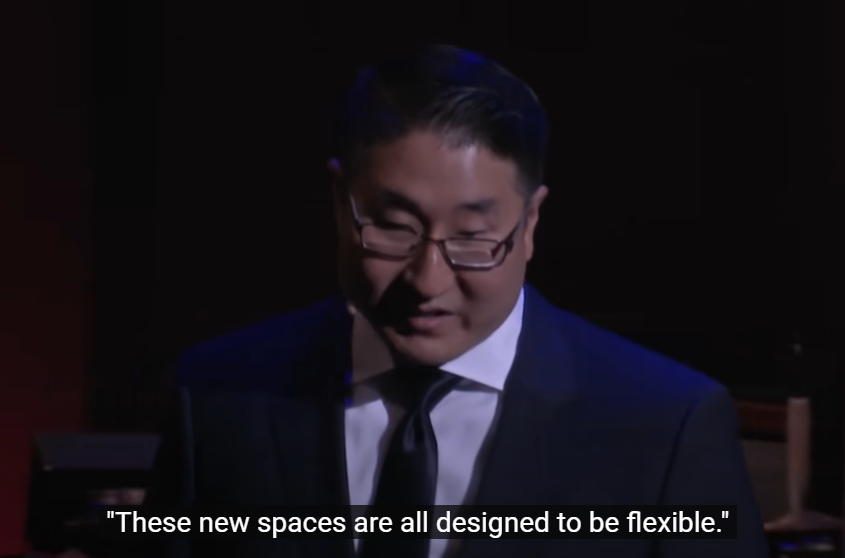
“These New Spaces Are All Designed to Be Flexible.”
The MC asks for a ‘an interesting sentence’ from the program book, perhaps as the unifying theme for the upbeat song in A minor—the mission, purpose, direction—the cause. I kid you not, this is the sentence that emerged. How cosmically prescient, this video, I have goosebumps.
“We Get to Invent It!” In the wake of Battleship COVID, we now get to design our spaces to be flexible—all spaces! That includes physical work spaces, spaces in our own minds for how and what to be, and spaces between us in relationship, whether at home, in college dorms, at work, at the grocery store, at concerts, or in traffic—everywhere, all the time!
Folds sits at the piano and starts noodling. He smiles. You can imagine his integrated brain gears turning, changing position while staying in contact, engaged and rotating for optimal efficiency and torque. He hits a little rut and resets, still smiling. He knows exactly what he’s doing, understands and embraces the process of creation, the necessary messiness and disorganization of initiating something meaningful. He also has no idea what he’s doing; the product is not yet formed. He is inventing in real time. Isn’t that what we are all doing now? What expertise and skill sets can we ground ourselves in, as individuals and collaborative (or competitive!) teams, that give us the confidence to invent? How do we orient ourselves for maximal power to accomplish our goals?
Think and tinker. Use your knowledge, expound on theory, do the thought experiments. Then take the experiments from thought to piano, to conversation, to teamwork. Try stuff out. Pilot–thoughtfully. Exercise both humility and confidence at once: Go all in, get all out quickly if it doesn’t work, repeat.
Collaborate
Over the next several minutes he tinkers with baseline, progression, melody. He starts sounding out with the cellos, then winds, then violins, violas, and finally basses and drums. At each stage, he invents something, tries it, integrates with the previous section, and assesses. Does it work? “…Just to make sure I don’t suck…sorry, this takes a second to create a whole song.” The song evolves in front of our eyes and ears, passing through organic adjustments of timing, notes, combinations of sounds and participation. “…Let’s hear it all together, make sure it’s not crazy…” The orchestra conductor follows attentively, providing seamless ancillary direction and guidance to the group.
Is this not what any team in transition needs? Leaders recognize material constraints and requirements: A minor key, upbeat tempo, These New Spaces Are All Designed to Be Flexible. They take the first steps, feeling things out, listening. They check in with the team at all levels—how does it sound for this group? What about when we add other groups? How’s the harmony? Is it working for the whole? If not, what do we need to change?
Revel in the Awesomeness
The performance climaxes after all parts have rehearsed, integrated, and repeated. Folks are comfortable in their brand new learned nerve pathways. Now they get to really play together, to have fun, improvise, and enjoy their accomplishment. What would happen if we celebrated our successes, even the smallest ones, more often and loudly (“fivetissimo”)?
—
It occurs to me here that this performance works because of certain fundamental premises: 1) Everybody agrees to participate, and to follow Ben Folds’s lead. 2) Everybody speaks the same language. Real time communication occurs cleanly and efficiently, with immediate feedback. 3) The leader trusts the team to do what they do best, giving appropriate instruction according to roles. 4) The task is brief, the goal is clear and simple, and the leader takes responsibility for the end product.
This video is neither a perfect nor a complete metaphor for creating optimal post-COVID environments and relationships. Still, it inspires and activates me. It provokes thought and creativity, and spurs me to enroll others in new ideas, experimentation, and shared accountability for our collective outcomes.
Really, if you have not already watched, please take ten minutes. You can even just listen. I bet you won’t regret it, and it may even inspire you.


 Healing Through Connection