
I See Myself In You

“I can’t imagine…”

“I can’t understand…”

“I can’t relate…”

“I would never…”

When you think or say these phrases, what is the context?  What message are you harboring, or trying to convey—connection or distance, or something else? 

Can you truly not imagine, understand, or relate?  What if you tried harder (or at all)?  How would it affect you if you could imagine, understand, and relate, or if you would ever, under certain circumstances?  How would this altered relationship to the situation (and person) feel?

I have written before about what happened when I said, “I can’t imagine” to a black classmate.  It was humbling.  I submit that we could all humble ourselves a little more these days.

Sylvan Dale Guest Ranch, Loveland, Colorado

My last pre-pandemic solo trip was to Loveland, Colorado, for the last retreat of Leading Organizations to Health, Cohort 11.  It feels cosmically fitting for my first solo trip since COVID to be a return for the first in person LOH alumni gathering in this time, last weekend.  OMG, friends, it was the next best thing to going home.  Other than our leaders, I had only met my fellow alums over Zoom these last two years.  And now I have 8 amazing new friends.  Though separated by occupation, specialty, generation, and geography, we all speak fluently the as yet rare and reverent language of relationship-centered leadership.  This is my tribe.

We start our sessions with poems.  Please Call Me By My True Names by Thich Nhat Hanh spoke deeply to me, especially these lines:

I am the twelve year-old girl, refugee in a small boat,

who throws herself into the ocean after being raped by a sea pirate,

and I am the pirate, my heart not yet capable of seeing and loving.

Whoa.

I have written on this blog many times about seeking, honoring, and really exercising our shared humanity —35 posts appear when I search the site for the phrase.  Even since I started blogging 7 years ago, though, it feels ever more urgent that we practice this every day.
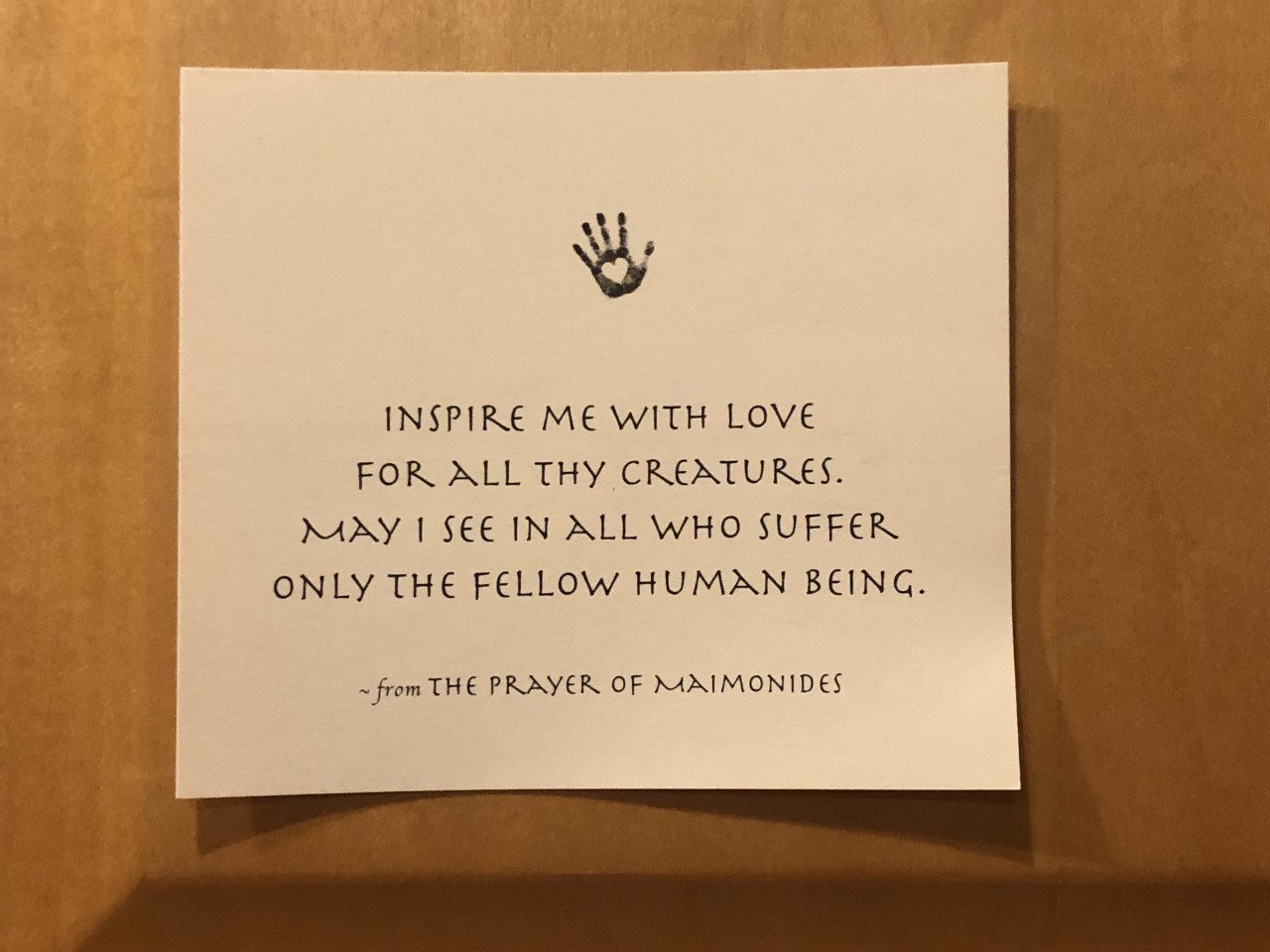
This card hangs on my kitchen cabinet.

This week my good friend Donna asked me to re-articulate my Why.  Again, I’m sure it was cosmic inspiration that moved her.  Have I ever written my Why statement here?  It was ‘to optimize relationships with and between all people I meet.’  And by optimize I meant to make more understanding, more connecting, and more meaningful.  Today, I think I have to be much more specific:  

My Why is to help us all see at least a part of ourselves in every person we meet. 

I intend to practice and model this first myself—to really internalize the truth that I am myself and also every other soul—that we are all born with the same needs, the same aspirations, the same set of possibilities.  Each of our unique, complex constellations of birth circumstance lottery, serial life experiences, and intrinsic wiring shapes us in ways we can only partially understand in our thinking brains.  What we have not the capacity to think or speak, often can only be felt.  And when we contact another soul who has also felt what we feel, or who can imagine, understand, or relate in some way, WOW, how healing is that?  I bet we can all recall at least a few instances when those deep, meaningful connections occurred across apparently wide gaps of background, class, or other social construct.  And why do we remember?  Because we were moved, alerted, and maybe a little alarmed?  Or maybe we have forgotten, because to come too close to someone’s experience that makes us uncomfortable can trigger a distancing reflex—self-image-protecting, perhaps.

In recent years I have internalized the admonishment to never say, or really even think, “What is wrong with you?”  Rather, I remind myself to ask, “What happened to you?”  In every context, this one switch opens the door to curiosity, imagination, understanding, relationship, and connection.  It allows space for our deeply shared humanity to surface and teach me what I need to know, or at least to prompt humility ahead of blind judgment and dismissal.  Substitute “them” for “you” in these sentences, and see how easily and willingly we throw away whole groups of people with our in- and out-group identities and ideologies.

May we all see a part of ourselves in every person we meet, especially the ones who make us say, “I can’t imagine, I can’t understand, I can’t relate, and I would never…”  Let that seeing move us to put down our judgments and take up empathy, compassion, and connection instead.  We will all be better for it.
The Optimistic Nihilist

“The death rate from life is 100%,” my very wise patient once said.

No matter what, you and I will eventually die. 

Humans, as a species, will also die, I’m convinced.  I’ve said it before:  We are the pathogen.

I believe the current vector of collective human action points squarely toward self-induced extinction.  I’m also convinced we’ll take a good many other species with us before we’re through.  But Earth herself will outlive us, and thrive in our absence.  …Unless we figure out a better balance with nature, within and around us, as individuals and as intersecting collectives, before our spectacular self-destruction.

So assuming and accepting that our taxonomic lifespan is finite, I propose to embrace a beautiful and exhilarating paradox: As individuals at any given time, in any given place or situation, none of what we do may matter at all, and it all matters like life or death. Everything about our survival depends on how we relate—to ourselves, one another, our environment, our times—everything! How can I, myself, bend the arc of the moral universe toward justice? I grab it when it swings my way, and hang on with all my might—in all that I do. I call on my friends to grab on, too. Iterative, incremental change, a fraction of a degree at a time, nudges the vector’s direction toward something better. As I imagine sailors know: a small shift in tack here and now translates to a very different destination over a long enough distance and time. What might it look like? I think it has to be better polar reconciliation–letting go either/or and embracing both/all/and: Purpose and profit, humility and recognition, freedom and responsibility, diversity and inclusion, individual and collective health and well-being.

Every day we live is another day closer to our eventual demise.  And every day we wake, we have so many breaths, encounters, and opportunities with which to shift the vector, to bend that arc.

Until such time as humanity actually succeeds in killing ourselves, and I really think we will, we still have a chance.  We can still work to be our best, most creative, generative, communal, and symbiotic selves.

Onward, friends, ODOMOBaaT!

https://www.reddit.com/r/wholesomememes/comments/8nm4zs/nobody_gives_a_shit/

On the Shoulders of Others

I had some original thoughts this week, my friends. A few were quite profound and moving. But I am too tired to expound on any of them in time to post. So I will share here the words of two of my favorite writers, as they express similar ideas eloquently and effectively.

The world is driven too much right now by cortisol and dopamine–threat and addiction, respectively, in a nutshell. We need more serotonin (joy, well-being, confidence), and especially more oxytocin (love, connection).

Watch Simon Sinek’s talk on EDSOC: Endorphins, Dopamine, Serotonin, Oxytocin, and Cortisol. He speaks in terms of companies; but expand the application to your own life–your family, your community, your school–any tribe in which you claim membership.

How do you lead, even without a designated title?

The anecdote below is attributed to Elizabeth Gilbert, as shared by my friend on Facebook. I have not vetted it, though it sounds like EG’s voice. If she is not the author, and you know who it is, please correct me. Regardless, I wholeheartedly endorse the sentiment.

What will you do differently when you claim you rightful place as ‘the light’?

Some years ago, I was stuck on a crosstown bus in New York City during rush hour. Traffic was barely moving. The bus was filled with cold, tired people who were deeply irritated with one another, with the world itself. Two men barked at each other about a shove that might or might not have been intentional. A pregnant woman got on, and nobody offered her a seat. Rage was in the air; no mercy would be found here.

But as the bus approached Seventh Avenue, the driver got on the intercom.”Folks,” he said, “I know you have had a rough day and you are frustrated. I can’t do anything about the weather or traffic, but here is what I can do. As each one of you gets off the bus, I will reach out my hand to you. As you walk by, drop your troubles into the palm of my hand, okay? Don’t take your problems home to your families tonight, just leave them with me. My route goes right by the Hudson River, and when I drive by there later, I will open the window and throw your troubles in the water.”

It was as if a spell had lifted. Everyone burst out laughing. Faces gleamed with surprised delight. People who had been pretending for the past hour not to notice each other’s existence were suddenly grinning at each other like, is this guy serious?Oh, he was serious.

At the next stop, just as promised, the driver reached out his hand, palm up, and waited. One by one, all the exiting commuters placed their hand just above his and mimed the gesture of dropping something into his palm. Some people laughed as they did this, some teared up but everyone did it. The driver repeated the same lovely ritual at the next stop, too. And the next. All the way to the river.

We live in a hard world, my friends. Sometimes it is extra difficult to be a human being. Sometimes you have a bad day. Sometimes you have a bad day that lasts for several years. You struggle and fail. You lose jobs, money, friends, faith, and love. You witness horrible events unfolding in the news, and you become fearful and withdrawn. There are times when everything seems cloaked in darkness. You long for the light but don’t know where to find it.

But what if you are the light? What if you are the very agent of illumination that a dark situation begs for?. That’s what this bus driver taught me, that anyone can be the light, at any moment. This guy wasn’t some big power player. He wasn’t a spiritual leader. He wasn’t some media-savvy influencer. He was a bus driver, one of society’s most invisible workers. But he possessed real power, and he used it beautifully for our benefit.

When life feels especially grim, or when I feel particularly powerless in the face of the world’s troubles, I think of this man and ask myself, What can I do, right now, to be the light? Of course, I can’t personally end all wars, or solve global warming, or transform vexing people into entirely different creatures. I definitely can’t control traffic. But I do have some influence on everyone I brush up against, even if we never speak or learn each other’s name.

No matter who you are, or where you are, or how mundane or tough your situation may seem, I believe you can illuminate your world. In fact, I believe this is the only way the world will ever be illuminated, one bright act of grace at a time, all the way to the river.

I’m slowly cultivating a friendship with a lovely couple in Appalachia, an hour at a time, once a month, over Zoom. Jay and I met in Ozan Varol‘s now defunct online Inner Circle. We three, Jay, Janet, and I, meet on video to exchange ideas and opinions from different positions on political, racial, national, and generational spectra. We agreed wholeheartedly today that bridging the world’s divides begins with conversations like ours, between engaged individuals, founded on mutual respect, curiosity, and patience. Healing Through Connection, indeed.

Onward, friends, ODOMOBaaT.