

The Status of Women, 1999-2019

IMG_1282

What happens for men when women speak Feminism?

I intend to ask this question to more men in my life from now on.  What do you hear as Feminism?  Where do you think it comes from?  What do you think women are trying to accomplish by talking about equity and representation?  What moves a man to ally with women in this movement?  What keeps him from doing so?  What are the risks, costs, and benefits for us all when he does and does not?
AP QUICK HITS THE 99ERS S SOC FILE USA CA

Women in Sports

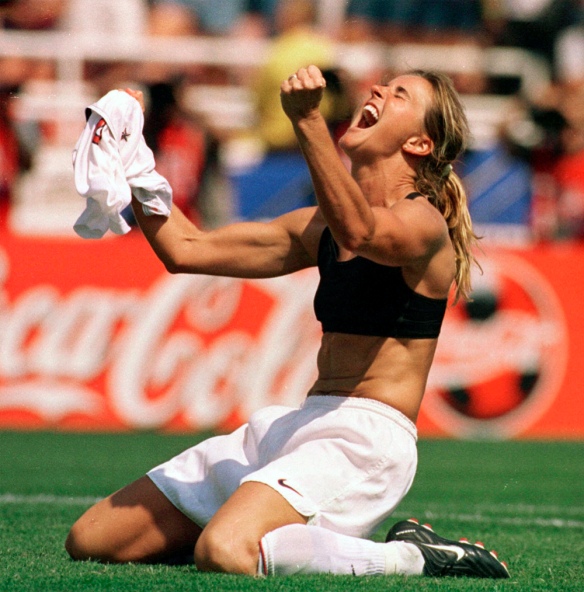
The US Women have just won their fourth World Cup Soccer title, kicking balls and ass, I like to say.  What an accomplishment, and how far they’ve come since winning the first ever Women’s World Cup in 1991, the year I graduated high school.  I don’t follow soccer, but as an American woman, this victory carries meaning for me.  At halftime this morning I read about Brandi Chastain, the 1999 US World Cup champion midfielder who famously, spontaneously, took off her jersey in unadulterated celebration after firing the winning penalty kick in double overtime against China to win it all.  The New York Times featured her story yesterday, commenting on the evolution of our perceptions and treatment of female athletes over these 20 years:

In that pivotal moment of arrival for women’s team sports in the United States and around the world, viewers saw Chastain removing her jersey and twirling it like a lariat, spinning around and falling to her knees, pumping her arms in exultant triumph. What resulted was perhaps the most iconic photograph ever taken of a female athlete, a depiction of pure spontaneous joy.

It was a moment of freedom and liberation, Marlene Bjornsrud, a longtime women’s coach and an influential sports executive, once told me. She called it a “casting off the burden of everything that kept us down and said, ‘You can’t do that because you are a woman.’ It was a moment that screamed, ‘Yes, I can.’”

Title IX was signed into law by President Nixon in 1972, one year before I was born.  So I took it for granted that girls could play sports just like boys in school—not every sport, but most.  I also took for granted the inherent assumptions about women in athletics—that we cannot be as fast, as strong, or as competitive as men.  I have so much more appreciation now for icons like Billy Jean King, Martina Navratilova, and Pat Summitt. I think about the WNBA, and women coaching in the NBA, NHL, and NFL, and I marvel at how far we have come.  Take a look at this timeline of women’s sports in the US to get a fuller perspective.  I know many will say we have a long way yet to go.  But today, let us joyfully celebrate all that we have accomplished already.  Wahoo!! [fist bump and dancing woman emojis]
 

Ortho women residents 1999-2013 jbjs jan 2012

Journal of Bone and Joint Surgery, January 2012

Women at Work

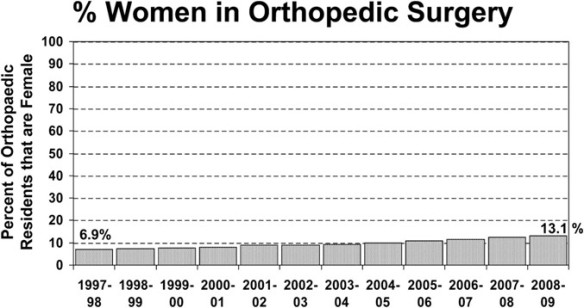
I’m thinking about the culture of orthopaedic surgery.  In the twenty years since I graduated from medical school, I see more and more women in this field (as well as other surgical specialties), which makes me proud.  While women comprise only 5% of practicing orthopaedic surgeons, 15% of American orthopaedic residents are now women, which is roughly double the percentage in 1999.  But what’s it like to be a woman in orthopaedics?  How do these women present, perhaps differently, at work compared to in their personal lives?  Is it truly safe for them to be themselves as surgeons?  The American Orthopaedic Association held their annual meeting recently.  My orthopod friend returned from the conference and commented that the rare women leaders in his field seem ‘fierce’ and ‘tough’—but in a good way?  It struck him to wonder if they are just like that in general, or do they have to be that way to navigate their male-dominated specialty.  He wondered how they would be seen if they displayed sensitivity and emotion, “because a man can be seen as sensitive and kind” and not only does it cost him nothing, his social status is likely to be elevated because of it.  My friend was not sure this is the case for his female colleagues, and he seemed both empathetic and powerless at the idea.  Looks like gender parity may take a bit longer in medicine than in sports.

At work in general, women’s status varies considerably.  But research points to common issues such a 22% pay gap and too few women in leadership (5% of US corporate CEOs), though these are improving.  One need not look far for abundant evidence that having more women on the corporate team improves earnings and morale.  Much is also written on strategies for improving gender equity at work.  Two of my favorites are exit interviews and work-life balance initiatives for all employees, not just women.  But as I wrote last week, it’s not just about including women as participants in the workforce.  It’s about truly appreciating the diversity of experience, biology, and contribution that women bring to any group they serve.

 

561204_3707569082371_72213499_n

Women and Men

There is no way I can do justice to this topic in the remainder of this post.  So let me just share some ideas and resources I will continue to explore in the months and years to come.

I asked at the beginning what happens for men when women speak Feminism.  A corollary question is what happens for all of us when we hear the words ‘toxic masculinity’?  My guess is men get defensive and women get aggressive.  Personally I love the phrase because it’s so incisively descriptive.  But it can also be a flashpoint phrase, one that immediately incites conflict and emotional hijack.  Let me be clear: toxic masculinity does not imply that men and manhood are toxic by nature.  Quite the contrary, the phrase refers to a culture of expectations of men that is just as toxic for men as it is for women.  Male surgeons may well benefit from being sensitive and kind, but not too much so, lest they be seen as weak.  This is a vast oversimplification, by the way; the history and complexity of toxic masculinity are explored articulately here.

Readers of this blog know how much I love Brené Brown.  Her explanations of how shame (where toxic masculinity is born) manifests and organizes around gender—and why it is toxic for both men and women–are the most poignant and real.  Read her first hand comments to Ms. magazine here, and a stay-at-home dad writer’s interpretation of them here.  If you seek a nonjudgmental, objective, and real-life exploration of the complex dynamics between men and women, read The Gifts of Imperfection and Daring Greatly.  Sister (she’s not old enough to be Aunt) Brené’s books are the most accessible form of evidence-based, all-around relationship advice I have ever read, and I’m so grateful for her.  From the Ms. Interview:

What role do you think vulnerability played in the #MeToo movement?

Know what I love about the #MeToo movement?—and, me too—I thought until I was 25 or 30, that sexual harassment was just the price of entry.  The greatest casualty of trauma is the ability to be vulnerable. So this #MeToo movement is re-defining and re-claiming vulnerability, and putting vulnerability in the context it belongs in, which is power and courage. 

 What gives you hope?

The thing that scares me about the world today is the same thing that gives me hope. I believe we’re witnessing white male power over. It’s making its last stand right now. And it’s scary because last stands are dangerous, and people get very backed into a corner. I think this is the last stand, and that we’re going to see a shift, mercifully, from white male power to inclusive power with it too. And I think from that paradigm, we can do anything, change anything, and be anything. 

And it’s not just women who can claim agency against misogyny and sexism.  Men who identify as feminists serve as allies for gender equity and respect.  But men can also help themselves and each other break free from the restraints of machismo and chauvinism.  Movements like The Good Men Project and Evryman give men a forum for honest, vulnerable emotional expression and connection.  Just like women surgeons and corporate executives, all men need inclusive spaces where they can feel true belonging, where they are free to be all of themselves—hard emotions and all—for all our sakes.

Men I admire in this space include Nate Green, Ozan Varol, and David Brooks.

* * * * *

To lift my spirits here at the end of this long post, I’m listening to a song on repeat: Woman, Amen by Dierks Bentley.  It’s such a shining anthem of a man’s unabashed love and appreciation for his partner.  I can also imagine modifying the lyrics and hearing Faith Hill singing about her man Tim McGraw.

Thanks for reading to the end, friends.

Our relationships kill us or save us, and we really need to be better at taking care of each other, locally and globally.  We, men and women alike, are all in this together, inextricably, in sickness and in health, forever.

Only Love can save us.  Let’s get on it.


Inclusion and Belonging

IMG_0927

What do diversity and inclusion mean to you these days?

Honestly for me, they mean different things depending on the context in which I think about them.  Cathy the Cynic thinks diversity initiatives too often feel trendy and superficial, like a knee-jerk response to the social pressure to check a box.  Cathy the Optimist believes that those who direct such initiatives honestly see the communal value in a truly diverse and inclusive work environment.

A wise friend recently pointed out to me that inclusion can be a challenge even in a homogeneous group.  “You could have 25 white men in a room and everybody may not feel included.”  So, he said, perhaps we should work on inclusion first, and diversity will come more naturally as a result.  Brilliant!  If we make it safe for everybody to be themselves, no matter who they are, then they feel free to bring their best, authentic selves—it’s a win-win for each individual and the organization.  An inclusive work culture supports and values each person for their unique contributions.  In such an environment, diversity is achieved because people value their differences as much as their similarities.  They live in curiosity and awe, always in a learning stance.  Inclusive cultures seek more perspectives, experiences, expertise, and backgrounds—they cultivate depth and breadth in the humanity of their workforce.  People from divergent walks of life seek to join such cultures, drawn to vibrant cohesion, synergy, and creativity.

This idea marinated in my mind for some weeks until an article from the Wharton School of Business crossed one of my online feeds last Thursday.  It says diversity and inclusion are not enough; we need to cultivate a sense of belonging in our workplaces.  The article quotes Sam Lalanne, a senior vice president of Global Diversity and Talent Management at Citigroup:  “…whereas diversity often gets linked to numbers and percentages, belonging ‘is about how you feel’ when you’re at work. ‘Do you feel valued? Do you feel like you should be there? Do you feel that your insights, commentary and perspectives matter?’”

“Rebekah Bastian, a vice president of culture and community at Zillow Group, said that the superior business outcomes often associated with having diverse teams can’t be achieved without a sense of belonging. It’s not enough to simply include people at the table, she said, but to ‘amplify everyone’s voices, clear barriers … and appreciate each other for our unique backgrounds.’ Both she and Lalanne said that a sense of belonging means that people can bring their full selves to work, and not feel like they’re a different person there than at home.”

A different person.  So what I described above as inclusion is really what these leaders define as belonging.  We want each person to feel they belong in the work tribe, that their presence and contributions are valuable and worthy, as themselves.  When we include, from our hearts, each person in their wholeness, only then will they truly belong.  And that is the sweet spot where teams thrive.

So what do we do?  How do we create such loving cultures of true belonging?  According to panelists quoted in the Wharton article (and we all know this), it comes from the top:  “Lalanne also commented on the importance of ‘tone at the top’ toward fostering a sense of belonging. ‘Our CEO, Mike Corbat, has really pushed us on our diversity, inclusion and belonging agendas. And it really comes from, what does he preach, what comes out of his mouth, how does he execute against the things that we see around us.’”  Simon Sinek calls us to live our values with clarity, consistency, and discipline.  So if you’re a leader who talks about diversity and inclusion, about belonging, then we workers have to see you, to feel you, living these values out loud and in front of us.

Belonging is more about how we are toward each other than how we act or what we do, which is inclusion.  This is the key to successful ‘diversity and inclusion’ initiatives—they must be sincere.  Humans are intuitively social animals.  We smell insincerity and reject it, because it is unsafe.  We cannot trust it.

A garden of belonging must be grown organically.  There are no shortcuts.  It takes time, and the gardener must tend it regularly.  Young seedlings require protection from weather and predators.  She must bring in pollinators and other helpers—one person cannot do it all.  So we can all pick up a trowel and participate.  We look to our leaders to set the path, and when we see the shining hope of our collective destination we follow willingly, eagerly, and together.

There Is a Good “I” in TEAM

IMG_1167

The joke goes like this:  “There’s no ‘I’ in team… Yes there is; it’s hidden in the A-hole.”  The point of the joke is valid:  Self-absorbed and self-serving individuals make bad teammates.

Yes, AND:  There must be certain kinds of I’s on any good team:  Each of us must have a uniquely contributory identity and role in order for our team to function well.  Diversity—of experience, ideas, and perspective—is always the strength of a good team.  Homogeneity leads to extinction in nature.

Also, we all have to get in the same boat and row in the same direction—each of us I’s must join wholly in the We in order for Us to accomplish anything meaningful.  It is the balance of the Good I and TEAM that determines an organization’s success.

The Good I:  Self-differentiation

We all recognize the kind ofI” who makes team life miserable—that person who’s always competing, always one up-ing us, constantly reminding us how great they are, wondering why we don’t notice.  But then there are the I’s whom we respect.  They exude a quiet confidence, speak their truth with grace.  We seek their opinion even, or especially, when we know it will differ from our own.  Anyone on the team could be either of these people: captain, quarterback, goalie, setter, relay anchor, department chair, CEO, professor, senior resident, intern, president.  Standing out for the sake of lording power over others, or advancing one’s own interests at others’ expense, is the “hidden I” in the A-hole.  This is the bad I.

The ability to stand up and out for our core values and integrity, even in the face of anxiety and external pressure to conform, however, is the Good I; it is an expression of self-differentiation.  To do this well, and to contribute to the team as a creative individual, requires self-awareness, emotional and social intelligence, and self-regulation.  In order to self-differentiate effectively, we must work on ourselves, not just promote ourselves.  It’s not about getting what’s ours in a world of scarcity; it’s about owning our talents and claiming our agency to make a unique and meaningful contribution to the whole.

TEAM: Attunement

If all we ever do is work on ourselves, however, without looking up and around, we may disregard important relationships.  I may have an important contribution to make.  But if I cannot communicate my ideas in a way that you understand, or if I come off as condescending, arrogant, dismissive, aggressive, or otherwise unpleasant, I undermine my own effectiveness, and stymie forward progress of the team.

The ability to withhold judgment, seek understanding of and from others, and recognize their unique and important contributions, is the art of attunement.  Simply, it is the practice of awareness and constructive responsiveness to others.  When I am attuned, I know when I need to set context before pitching my idea.  I observe my colleagues’ posture, body language, tone of voice, and facial expressions.  I query for (mis)understanding.  I hold space for open dialogue, debate, and idea exchange.  This kind of resonance, when successful, facilitates the wave propagation of teamwork, and advances objectives faster and more efficiently with the synergy of morale.

Some might see self-differentiation and attunement as opposed or dichotomous—you can or should be one or the other.  Rather, we should consider them as complementary and counterbalancing.  We should each pursue proficiency and mastery of both skill sets, and practice them as both individuals and as whole teams.  I can be both a self-differentiated and attuned leader of my department.  My department can be both a self-differentiated and attuned member of my organization.  My organization can be both a self-differentiated and attuned member of our profession or industry.  And we can all, individuals and organizations alike, be both self-differentiated and attuned members of society at large.

TEAMS get things done when we well-self-differentiated I’s attune to one another and march together on our shared mission—regardless of the size, mission, or make-up of our teams.  Every successful team is made up of individuals who claim their unique strengths, and then direct those strengths in service of the greater good, the overarching intention of the We.

Such harmonious and resonant balance is the quintessential win-win.