The Beauty of Repeating Patterns

IMG_0685

Last week I wrote about our stories and how they perpetuate despite their dysfunction.  Tonight I consider patterns and how they also resist change—for better and for worse.

We had a wedding in the family recently.  Aunts, uncles, and cousins flew in from all over the country to attend and celebrate.  I have graduated to the parents’ generation at most weddings now; it feels strange and natural at the same time.  ‘Kids’ these days do things very differently in some ways (everything was online—no paper!), and exactly the same in others (there was a beautiful dress, an aisle, rings, kissing, and I saw her wear something blue).  Sitting with my fellow zhang bei (elder generation), I recalled when each of us got married, all on the order of 15-20+ years ago.  Like the happy couple, we were all young, most of us were thinner, and we had darker hair.  Our Chineseness and its influence on nuptial activities felt a little heavier than for the next generation, and yet that cultural heritage still shines through today—that makes me proud.

How will the new couple choreograph their marriage dance?  When the rest of us started out, could we have predicted our tangoes to look and feel how they do today?  Part of me says yes, absolutely—just look at how our parents boogied—we humans learn by mimicking.  Just imagine your spouse’s father dancing with your own mother, or some other familial counterpart pairing, and you probably see something resembling your own relationship.  Psychology research tells us that our stories and patterns of relating form very early in life, and persist for decades.  We carry the lessons, traditions, and burdens of our families of origin in our neurons and even our DNA—we cannot escape them.

Not that we need to or should.  Each of us is the product of all the atomic, molecular, cellular, interpersonal, and interstellar interfaces that created and continue to recreate us, in an infinite and complex web of moments and contexts.  It’s really quite beautiful, when I stop to think about it.  We can hear echoes of our ancestors in our children.  We pass on core values and family traditions with tribal pride, maintain bonds that hold us up through adversity, and anchor to relationships of identity and belonging.   We can also choose to forge new paths for discovery and growth, diverging from generations of redundant dysfunction and suffering.  Through iterative tribal mergers our children inherit all that came before them—the good and the bad—and the universe both differentiates and unifies with each succeeding generation, with every single individual.

Each dandelion seed is a miniature version of the whole flower itself.  Each human family is a subset of the family of humanity.  We are all uniquely ourselves, and we also belong wholly to one another.

Nothing stays the same for long.  And some things never change.

It’s just a thing of beauty, no?

This Is My Hogwarts

Sylvan Dale Lodge

My friends, I belong.  This weekend marked the beginning of a ten month training program in communication, leadership, connection, and creativity.  9 of us made it to Colorado after the bomb cyclone (Patrick, we missed you—can’t wait to meet you in May!) to launch Cohort 11 of Leading Organizations to Health (LOH).  Our teachers, Tony Suchman and Diane Rawlins, led us through three days of introspection, skills acquisition and practice, and formation in community.  It all happened at the Sylvan Dale Guest Ranch in Loveland, surrounded by mountains, river, wildlife, and a rich history of family and hospitality.

We are training in relationship-centered care and administration, helping one another embody our best relationship tendencies, so we may help our organizations function at higher levels of connection and effectiveness.  It’s too exciting!

I walked into the lodge at Sylvan Dale, saw the vaulted ceiling with the icicle lights, and immediately thought of Hogwarts.  I came to this place, called by something to the Why of my soul, to be with others like me.  We are here to train, to hone our skills for good.  Within the first session I realized I can totally be myself in this crowd.  Here, I’m no longer a lone voice focused on relationships ahead of everything else, no longer the only one who cannot help seeing how the nature of our relationships permeates every interaction, every decision—and how we recreate them in every moment.  No more self-editing and explaining, tip-toeing around what matters most to me.  I can fully inhabit my relationship convictions here, in this space and among these new friends.  I feel an ease of purpose and values in this group that I come to, like a deep well, to fill my bucket and irrigate my garden of personal and professional growth.  Here, I am not a black sheep.

I now have 9 new people-nodes to connect and integrate into my existing relationship webs—a new and emerging system.  We share stories with common themes, new insights, and mutual support.  These ten months we will form and evolve as individuals as well as a community.  It’s a type of love, really…  At least that’s how it feels to me.  Hooray!


Thank you, Mr. Zander

Zander Cheng

Dear Mr. Zander, I met you almost 10 years ago and you transformed my life.

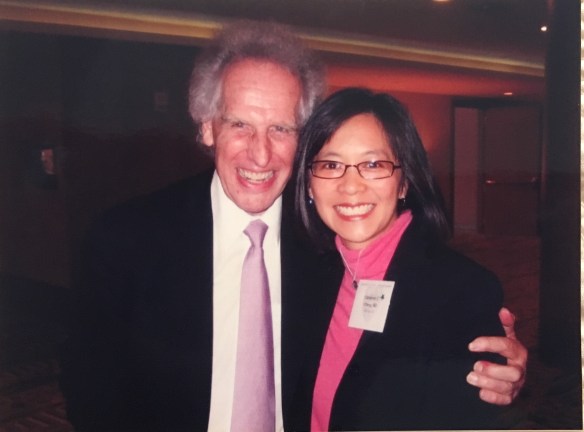
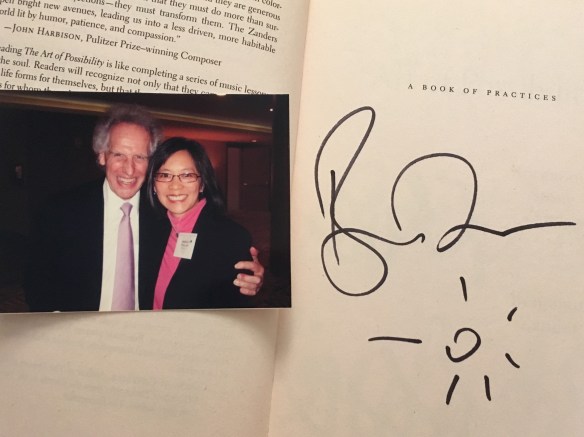
You and Ms. Zander gave the keynote address at the second ever Harvard conference on coaching in healthcare.  I was one of only a handful of physicians in attendance.  You discussed the central tenets of your book, The Art of Possibility.  I could not wait to get my copy signed, and you also graciously agreed to a photo.  I have since read and listened to your book at least a dozen times, and every time I gain something new and relevant.  The names of the practices ring in my consciousness on a regular basis:  Give the A, Rule #6, Be a Contribution, Lead From Any Chair, and Be the Board.  I describe the practices and their benefits, still, to anyone who will listen.

Zander book sig

Back in 2015 I boldly contacted the Boston Philharmonic to see if you could speak at the American College of Physicians Illinois Chapter Meeting.  You actually spoke to me on the phone and considered coming!  I was honored.  Though it did not work out (I knew it was the longest of long shots), it amazed me that someone as sought after as you would personally take a phone call from a random, unknown doctor in Chicago.  Later that year, when I attended the Harvard Writers conference (the birthplace of this blog), I had the honor of observing a master class where I witnessed you love some young musicians into their best selves.  They believed in themselves because you saw them, loved them, and believed in them.  That is the best thing any teacher can do for a student.

Throughout these last ten years, I have continued to seek, study, and attempt to apply learnings from authors, teachers, and mentors like you, people who see the world as broken as it is, and also the hope of humanity’s strengths and connections.  There is no shortage of people trying to help us all be better, for ourselves and one another, and no more urgent time or need for this teaching than now.  I count myself beyond fortunate to have benefited from your influence and inspiration so early in my life and career, to have you as my model.  No doubt I am only one of thousands, if not tens (hundreds?) of thousands, whose lives you have transformed for the better.  I wish you an ever broader and higher platform from which to reach countless more people and organizations.  I wish you peace, health, and joy in all your endeavors and relationships.

Please know how much you have meant to so many.

Sincerely,

Catherine Cheng, MD