
Mindfulness

Photo by Lyra Luu, Schalenbrunnen im Botanischen Garten, Munich, June 2023

I count 47 posts on this blog when I search ‘mindfulness.’ I talk about it almost every day with patients. Of all self-care practices I have acquired over the years, I think this is the most useful. Funny how I did not list it in the stress management post this month? Maybe because I see mindfulness as a way of being more than something I do? It really does bring me peace, for which I am both grateful and proud, as I have trained long to gain its benefits.

If you’re not yet familiar, I recommend starting at www.mindful.org. From their site:

“What is mindfulness?

“Mindfulness is the basic human ability to be fully present, aware of where we are and what we’re doing, and not overly reactive or overwhelmed by what’s going on around us.

“While mindfulness is something we all naturally possess, it’s more readily available to us when we practice on a daily basis.

“Whenever you bring awareness to what you’re directly experiencing via your senses, or to your state of mind via your thoughts and emotions, you’re being mindful. And there’s growing research showing that when you train your brain to be mindful, you’re actually remodeling the physical structure of your brain.”

Ok so, how do I already do mindfulness well?
–I have a strong informal practice. Often and at any given moment, I drop (or rise) easily into awareness of my environment, the people around me and their signals, and my own physical, mental, and emotional sensations. Even when it’s uncomfortable or painful, I can hold it loosely, with openness and curiosity. I wonder how many times a day I say or think, “Huh,” “What is up with that,” and “How fascinating”? This leads me often to novel questions, which I then express to others, engaging in unexpected ways, which is almost always more rewarding that I anticipate.
–My practice helps me be present to others as they need me. When I attend to what is, resisting the pull toward what I want or what I think should be, I can empathize, validate, and reflect with others, rather than go straight to problem solving, which is seldom what people want or need.
–Mindfulness makes me a more sensitive and agile speaker. As words and expressions form in my head and exit my mouth, I monitor their intent and impact in real time. I speak quickly and at times with sharpness and irreverence, but more often with kindness and passion, and rarely without thought to every word. Is that mindfulness or conscientiousness? Probably something mutually entwined?
–I lead by example. People say they feel peaceful around me, that I have a calming effect. I attribute this to my ability to be with whatever is, in the moment, without (or with minimal) judgment, together with others.

How could my mindfulness practice be better?
–I could establish a formal sitting practice. A daily session of breath and awareness, a mental discipline to quiet the monkey mind, to strengthen my parasympathetic nervous system, would likely make me healthier in all domains. I’m just not quite moved yet to commit. But maybe if it helps my writing…
–I could read more of the masters’ works: Jon Kabat-Zinn, Thich Naht Hanh, Sharon Salzberg, Pema Chodron. Then I’d be more knowledgeable, could maybe explain it better to people whom I think could benefit. ..and if it helps my writing…
–Overall I’m pretty satisfied with current state. I faced trials of the last several years with relative equanimity, and the challenges themselves strengthened my practice. I trust myself to know when I need to do more, because I’m mindful enough already to notice.

What’s already good about our collective mindfulness?

Awareness. John Kabat-Zinn developed Mindfulness-Based Stress Reduction (MBSR) as a meditative therapy method for stress management in 1979. I learned nothing about it in medical school or residency. I’d say the first ten years of my career, mind-body medicine was still considered fringy; colleagues would stare blankly or even roll their eyes when I talked about it. Today mindfulness and other techniques of meditation and mind-body practices live in the mainstream, their benefits available to everybody, and fewer people feel self-conscious about participating.

Language. “Be with what is.” “Hold the space.” “Withhold judgment.” “Breathwork.” One could say that mindfulness lingo has infiltrated our general vernacular. Good. These concise phrases can moor us to a mindset of alert and relaxed presence, which makes us calmer, less impulsive, more attuned, and healthier. Words matter; the more we can use them for mutual de-escalation and connection, the better.

Connection. As mindfulness gains awareness and its expressions spread, fellow practitioners can connect more easily in any forum. They become magnets for yet others, and communities form around this attentive way of being which, nourished by strong ties, makes us better leaders by example wherever we go, to whomever we encounter. Jeez, I’m making it sound like a cult.

How could we do better together?

Teach Mindfulness In School. Mindfulness skills are life skills. Learning breath work, body awareness, and mental discipline in iterative, age appropriate ways prepares children and adolescents to tolerate and navigate an ever accelerating world of volatile change and chaos. It would be easy to incorporate skills practice into play, sports, and academics at all stages of brain and social development.

Incorporate Mindfulness Into Leadership Training. Thinking of leaders you admire, what qualities and behaviors make them great? Mine give me their full attention, make me feel seen, heard, and understood. They emote relatably, easily, and appropriately, and also carry themselves with steady, unflappable confidence. They name what is with clarity, desireable and/or not, and hold it peacefully while working consistently for change and improvement. They are honest. Thus they attract and inspire followers rather than coercing them. Healthy mindfulness skills and practice amplify and maximize relational leadership strengths by grounding leaders in self-awareness and self-regulation as foundation for outward action.

Just writing about mindfulness lowers my respiratory rate and helps me attune to myself and my surroundings better. I feel gratitude and peace, confident in my ability to face and manage whatever comes around the corner, satisfied that I have lived the present moment to its fullest. I have very little to regret if I can keep this up.

Acceptance Is Not Always Joyous, Turns Out

*Cosmic laughter* and some tears… HOW FASCINATING!

I wrote my last post on the liberation of acceptance in a state of sincere joy and revelation; I still stand by the whole piece. And, the last ten days have humbled me with my own premise. I have struggled for a good 20 years to negotiate, reconcile, and yes, accept, certain hard realities in my life. Looking back, I’ve come a long way, suffering much less now from self-induced frustration and rage than at the turn of the millenium. Ten days ago I honestly thought I had come to that joyous place of whole-hearted acceptance and creativity, looking ahead and feeling ready to charge forward and invent my new way of being and doing.

And I was ready–in my thinking mind. This happens sometimes, that I understand a concept in my newly evolved, analytical brain, express it eloquently in words, and think I’m done (see ‘self-delusion’ in the last post). I can observe patterns and understand logically that certain things will not change. I can create strategies to suffer less by changing my rational expectations. I can plan to take alternative action in the future when I encounter typical and recurrent friction. I can think my way to practical solutions and cognitive peace.

I don’t realize the gap. Then my feeling mind catches up and catches me off guard, knocking me on my ass for a while. Turns out acceptance occurs in layers.

“When I accept the thing, I can put it down, let it be.” Writing this, I had forgotten that while carrying the intellectual burden of the thing I don’t accept, I hold with it an unrealistic hope, an emotional investment, in the thing being other than it is. The latter is not rational; it’s qualitative, limbic, and drives my thoughts and behavior from a place that has no capacity for language. So when I truly, honestly put the thing down, I experience a deep and ineffable sense of grief at letting go–abandoning–my sentimental hope and investment, unrealistic as they were.

I even wrote about it! “Anger, jealousy, self-loathing, grief, sadness, conflict, …: Allow it.” This is where the cosmic laughter chortles now–allowing grief and sadness means feeling them, DUH! Seriously, is avoidance of that discomfort the basis for all of my non-acceptance this whole time? I’m not sure, but even if it is, I don’t judge myself for it. Discomfort aversion is a fundamental survival reflex, the impulse for which originates in deeper, even more primitive parts of the brain than the limbic system. And I imagine that the epiphany I describe in this post is still nowhere near the last stop on my train ride of self-discovery and -education. It’s an important waystation, though.

This past week I hunckered down, allowing the grief and sadness more openly, with more vulnerability. It felt like wallowing for a bit, if I’m honest. I journaled rivers of ink, forsaking my intended blogging schedule. I did a lot of escape and comfort reading (YAY, smutty romance!). I attended to the hard feelings gently, embracing them (at times as if I were hugging a cactus, but still). And it helped. The sadness and discomfort dissipated, and I soon felt lightness and relief, if not quite joy, on this side of it.

I sense now a slow shift, a reorientation. I am able today, at least partially, to show up differently to my reality, which feels new and different from even two weeks ago: less heavy, more fluid and flexible. I carry fewer rocks in my emotional rucksack now; made a cairn with them these last days. And yeah, I can feel some joy coming on.

Silly Dopey Giddy Mountain Driving

I’m not drunk, I promise–not on alcohol, anyway–just sheer joy.

“Accelerate through the turn.”

Hugh the genius British boy and I stood chatting in the Brain Bowl teacher’s little office just off the high school library. Looking back, Hugh knew more about physics then, as a 15 year-old, than most of us will know in our lifetimes. But he did not yet know how to drive. He asserted that while driving, one should be able to accelerate through a turn and not have to slow down. I remember this conversation so clearly because it demonstrated to me how for some things (so many, I know now), we just cannot truly know until we do.

Fast forward to my college years. One spring weekend my friends and I had nothing better to do, so we stood in line outside the parking lot at Dyche Stadium, where Ford Motor Company had set up a driving course. We three piled into a bronze sedan with helmets and an instructor, and took turns maneuvering the car through various straights and curves marked with orange cones (think Mythbusters, but without the explosions). My trial was significantly slower, ‘conservative,’ according to the instuctor (stated with a hint of disappointment?), compared to my friends’. I wished for a second chance, for no other reason than to practice again ‘accelerating through the turn.’ Before we started, the one thing I remember hearing was that you can press the gas after you feel the weight transfer. EUREKA! Decelerate on the approach, and when you feel pressure shift to the outside butt cheek, you can gun it! Hugh was right. Centrifugal force and body awareness at work!

Ever since then I have loved driving winding, curvy, hairpin turns. I’m convinced that I’m also a more fuel efficient driver, because I only brake as much as I need to not skid, then speed up more easily from a higher RPM, minimizing momentum loss. I had figured out on my own how to hug the tangent of the inside curve, which allows me to hold the steering wheel smooth and steady throughout a turn, rather than overturning and having to correct over and over. On every bend, I blissfully chase that perfect energy and arc conservation!

Up here in the Rocky Mountains, it’s Hairpin Heaven. And there are bonuses, too: sparse traffic, and friendly drivers who wave! Motoring all through Summit County today, listening to my favorite music, I wore the silliest, dopeyest, most giddy smile–my facial muscles almost cramped, it was so constant–I just could not help myself. I waved at construction workers, pedestrians, other drivers, and they all waved back (except for the young man who did not let me merge–he avoided eye contact–must not be from around here).

It’s my happiest place on earth. I relish every moment–it’s the only place where I’m excited to get up early in the morning, just to spend more waking hours here! So I just had to write about it, document the joy. I sincerely hope you all may enjoy this kind of deep delight wherever you are today!

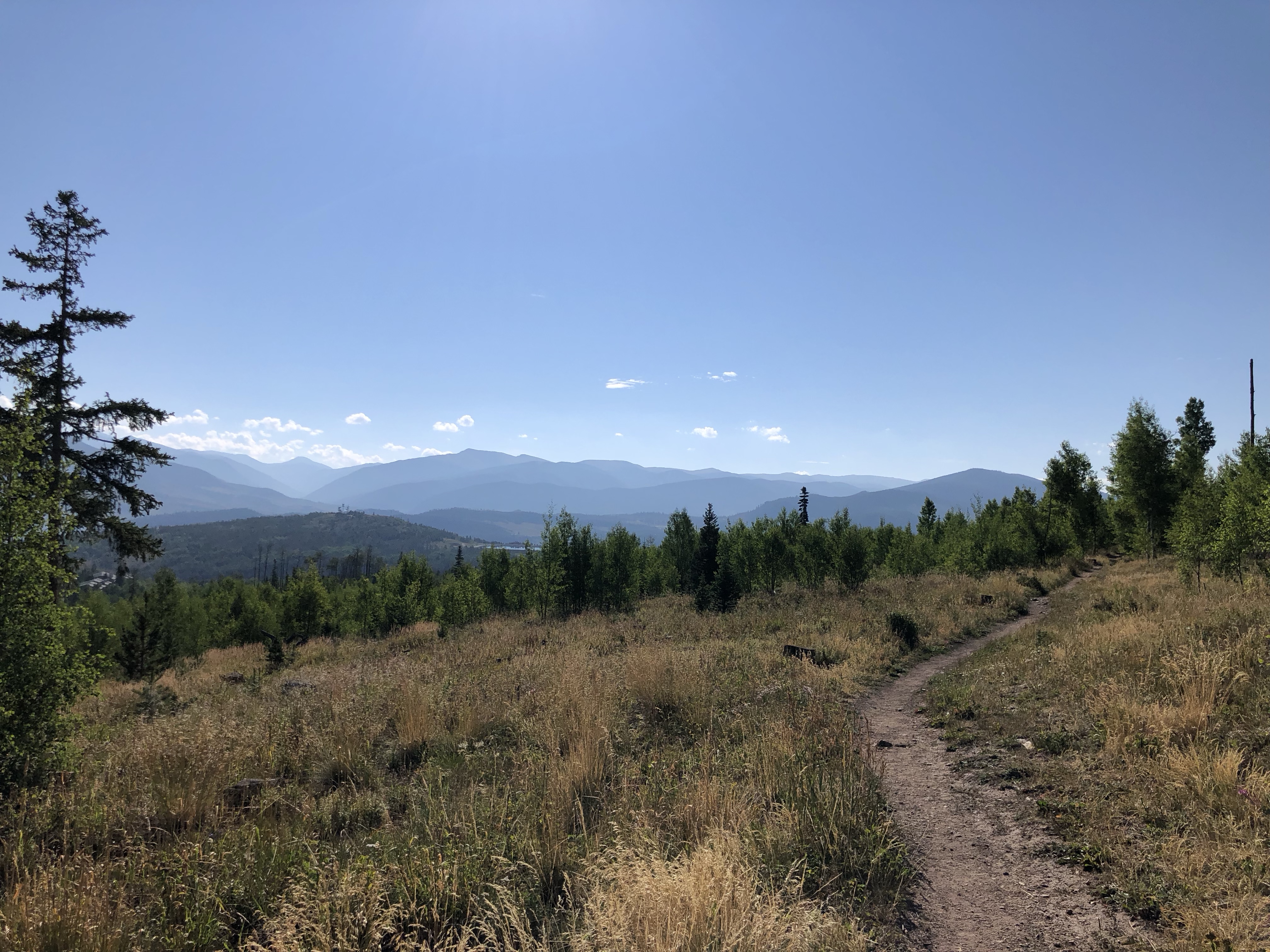
Dillon Reservoir, from Old Dillon Reservoir Trail
Dillon Reservoir, from Meadow Loop and Ridge Trail
Creek Trail, Buffalo Mountain