Things We Take for Granted

BVF ben downhill

NaBloPoMo 2018:  What I’m Learning

When I’m sick the sinus congestion often resists the efficacy of all medication.  I lie awake at night mouth breathing, almost choking every time I have to swallow my own secretions.  Those are the times I really appreciate when I’m well.  The past year, even though I am mostly recovered from knee surgery, I’m still always aware of my one-sided non-normalcy.  When I do my single leg exercises, it’s staggering how I can just do it on the right, and on the left I honestly struggle, as if I could never do some of these things before.  This morning, driving the kids to school and then myself to work navigating slush, sleet, poor visibility, and the inevitably slower traffic, I was grateful that I could simply push the ‘SNOW’ button on my center console and suddenly I had a 4-wheel drive.  You can actually feel the incremental increase in stability and traction—amazing!  Thank you, my engineer friends and family!

Last night was the first real snow of the season in Chicago.  Part of me still hates living here—I absolutely abhor the weather.  But today I found myself grateful more than annoyed.  My kids are old enough to get themselves out of bed, dress, groom, and feed themselves.  We all leave together, and though that morning time in the car can be groggy and silent, it’s still time together.  I drive a car I really like to a job I really love, where I work with a team of generous, funny, kind, and collaborative people.  I have this really warm Land’s End parka with the big, foofy faux fur hood, and I can walk from the parking garage to the office in total comfort on most cold days.

I have job security, health insurance, a great house (with reliable heat and running water, a home gym, and plenty of space for us all to both spread out and gather together), more books than I can read (right now), two healthy parents, a boatload of amazing friends, a universe of information at my fingertips, digital connections with people all over the planet whenever I want, and a phone that takes and sends pictures, for crying out loud.  I don’t have a formal gratitude practice right now, but holy cow, this is a lot to be thankful for.

Not sure what makes me think of the things we take for granted:  Our health, the people in our lives, our homes, our livelihoods.  Think of the thousands of people devastated by wildfires all over the west this year.  In the blink of an eye, imagine all your possessions and the physical spaces of so many cherished memories—all memories themselves.  Imagine your sister, daughter, son, nephew, best friend–missing.  When did you last see them, talk to them?  What transpired between you?  Imagine going about your life, assuming you can handle flu if you get it, then an hour later feeling like you’ve been hit by a truck, then dying of flu a week later.

I’m not trying to be dark or macabre here.  I’m just noticing how much I have, and how much I don’t truly appreciate it most of the time.  I try to be present to the kids as much as possible, engage fully when they talk to me (and fail more than I want to admit).  I really notice their smiles and laughter.  I look through my Facebook feed for pictures of friends and their kids.  I stop to admire flower buds every day in the spring, and bugs on the sidewalk.  I have gotten better at seeing the trees turn gradually green in May and golden in October.  I see pictures of the kids as toddlers and it feels like a hundred years ago and just yesterday, all at the same time.  And don’t even get me started on photos from high school, college, and med school—OMG we were kids!

Another day tomorrow.  Who knows what will happen, how my life could be turned upside down or inside out?  Or not?  Will it feel mundane or miraculous?  I’m learning—reminded, really—that most days, I get to decide.  That’s pretty groovy, I say.
Rally

DSC_0598

NaBloPoMo 2018:  What I’m Learning

In my first practice it was common for whole families to be my patients.  Grandparents, parents, children, grandchildren, cousins, and other webbed relations.  My fondest memories of those years revolve around witnessing the love, tension, and ultimate cohesion of these complex units of humanity.

One day Grandma came for a routine follow up visit.  We reviewed her blood pressure, glucose, and cholesterol numbers.  She wanted to lose some weight.  Everything was stable, but something seemed off.  I could not put my finger on it, and when I asked if everything was okay she said yes.  This scenario repeated maybe once or twice more over some months, and slowly we agreed she was depressed, though I’m not sure if I ever used that word.  There was no trigger, no event.  She had not had a history of depression.  She was just down, she did not know why, and she could not make it go away.

Grandma came from a culture and a generation that did not feel comfortable doing talk therapy.  She was also reticent to take prescription anti-depressants, even if they might help her feel better.  But she was happy to see me more regularly, just so I could keep track of her medical problems and make sure she was okay.  We reviewed the same list each time: fatigue, low mood, anhedonia.  No suicidality, biometrics stable.

Sometimes I would also see Son, Daughter-in-law, or Granddaughter.  I would ask them how Grandma was doing.  They never used the word ‘depressed,’ but they described how she was ‘kind of down,’ ‘sad,’ ‘going through a hard time.’  And then they would tell me what they were doing about it.  Someone would always be at Grandma’s house, keeping her company.  Sister would invite her out to lunch.  Granddaughter would take her out shopping.  Everybody attended to her just a little more, rallying around her, and nobody ever talked about why.

Grandma herself rallied, and her depression lifted over time.  In Chinese the expression for this is equivalent to having ‘walked out’ of it, like depression is a long tunnel in the mountain.  What a privilege to bear witness to this phenomenon—the family saw Grandma walking in a dark place, and they moved in a little closer, each with their own candle, lamp, or torch.  They helped light her way, and they all walked out with her together.

I had a shit day today, mostly of my own making.  Cramming in too many things, all scheduled too close together, trying to do too much, falling down on multiple levels, and adversely affecting multiple people around me.  I almost bailed on a chance to be with an amazing group of people tonight, out of exhaustion and self-loathing.  But these were my friends and I had not seen many of them in several months.  I felt quite listless at the beginning of dinner, not unlike I imagine Grandma felt.  But as I communed with my tribe, reconnected, and met a new friend, I started to feel better.  The yummy duck helped, too.  They could intuit a shadow on me.  And with gentleness and respect for boundaries, my friends rallied around me.  It was not pity or sympathy.  It was genuine empathy and wishes for my well-being.  So I rallied, too.

Things feel overwhelming more often now than before.  The anger, bickering, blaming, and self-righteousness I see, hear, and feel all around (and within) me really gets under my skin—ha, literally, I guess.  I know this will never be a permanent state; I will feel better tomorrow.  It’s also an interesting opportunity to observe how I’m walking the self-care talk—including the self-compassion part.  Fascinating.

Well friends, that’s what’s on my mind tonight.  My patients save me by teaching me.

I’m going to bed.  So I can rally some more tomorrow, and maybe help someone else do the same.

Who’s On Your Pit Crew?


Who helps you succeed?

Who checks in with you regularly and gives you feedback on your performance?

Who rushes to your side when you need help?

Who can tell not only when you have a lugnut loose but also how to help you tighten it again?

Who is on your pit crew?

I can’t remember the first time I started using this analogy.  I do recall, of course, it came about in a patient encounter.  For a long time now I have consistently asked patients about their emotional support networks, their connections.  As I get older, I feel increasingly aware of and grateful for all the people at every phase of life who have helped me learn, improve, succeed, and become.  Nobody succeeds alone—really, all but a rare few of us can even survive alone.

My friend Jeremy Topin, a critical care physician, husband, and dad, writes a heartfelt and honest blog about life as all these things—because he is at once all of them and more—there is no way to truly separate one role from another in life.  His recent post on depression among physicians reminded me of the pit crew idea.  Medical culture does not encourage pit crews for its workers.  It’s evolving, painfully slowly, and I hope to have a hand in that evolution.  But for now, far too many physicians and other caregivers suffer burnout, depression, anxiety, and other work-related heaviness in silence, and it can cost us our lives.

Thankfully, many of us have intact and well-functioning pit crews.  46% of physician respondents to the most recent Medscape survey reported talking to friends and family as a coping mechanism, second only to exercise, and right above sleep.  I count my trainer, my therapist, my life coach, and my Counsel of Wisdom, my closest friends, as my core crew.  I have become more and more open about having a therapist and a coach—ya gotta walk the talk if you’re going to be credible about your work.

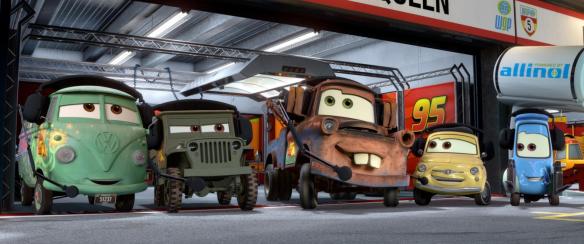
Full disclosure, I am not a car racing fan.  Pretty much all I know about pit crews is from Disney’s “Cars” and admiring Lightning McQueens’ motley one.  But that’s how it happens, right?  We acquire and accumulate relationships and connections along the winding way in life.  Who knows when or where it might happen?  I met mine in school, in the exam room, at meetings, and I was introduced by mutual acquaintances.

As I consider further, though, having a pit crew is only part of the success story.  Research shows us time and again that serving on someone else’s pit crew fulfills a profound human need, also.  I suggest works by Adam Grant and Kelly McGonigal if you wish to read more about this.  But maybe you don’t need to read or hear the research evidence to understand this concept?  How does helping others help you?  On whose pit crew do you serve?  To whose Lightning McQueen are you Mater or Luigi?

If your pit crew is sparse, people who study and do this work recommend finding something meaningful or someone you love to serve.  It could be something simple and non-committal, like serving at a soup kitchen or collecting winter coats for shelters.  It could be reading or playing piano at a senior center.  Or it could be mentoring a junior colleague over many months or years.

Imagine a music teacher who accompanies her cello student at recitals.  She plays piano, fingers and hands moving lightly and nimbly over the keys as her protégé plays her heart out during each performance.  I went to my son’s school this afternoon for a music concert, where this pit crew idea struck me again.  I don’t know if the accompanists were the performers’ teachers, but that’s how I saw them, as they were all clearly middle aged adults playing alongside teenagers—surely they had some wisdom to impart in this relationship?  It occurred to me that ‘accompanist’ may not fully accredit these adults’ roles in the kids’ lives.  The music they contributed not only supported the students’ performances.  These adults integrated their music making with the primary performers’, lifting it beyond where it could go alone.  They contributed their own advanced skills and supportive presence to help these young people succeed.  It was a team effort.  And that’s the point, I think.

How widely could we apply this pit crew metaphor?  How does it resonate with you today?  How else is your life like a racecar driver’s?  What’s exhilarating about it?  How is it faster and more intense than other drivers’?  Is that okay with you?  How much longer can you sustain this work, and what do you need to maintain the joy and reward?

Lastly, what did you think of this post?  It’s much more stream of consciousness and impromptu than I’m used to.  I’m trying to get more efficient with my time—three hours per post finishing at 2am on a weeknight is no longer an option.  Your feedback is welcome!

One more weekly post and then the 30 day marathon that is NaBloPoMo, my friends!  Woo hoooooo, ONWARD!