Debate Prep

DSC_0096

Debate Prep

NaBloPoMo 2018:  What I’m Learning

Families gathering for Thanksgiving present a perfect opportunity to practice some excellent communication skills.  How we each show up—generous, combative, kind, resentful, curious, or judgmental—will determine our experience and that of those around us.

For this post, I refer to a short, accessible list of tips for conducting ourselves optimally among friends and family with whom we disagree.  It’s from The American Interest in February 2016, “The Seven Habits of Highly Depolarizing People” by David Blankenhorn.  I recently joined an organization he founded, Better Angels, “a bipartisan citizen’s movement to unify our divided nation.”  I list here his 7 habits and my interpretation thereof.

1.      Criticize from within.  “In other words, criticize the other—whether person, group, or society—on the basis of something you have in common.”  This is where DB invokes Abraham Lincoln’s reference to “the better angels of our nature” in his first Inaugural address.  Honestly I don’t know what he means here, but I have decided to take it as a recommendation to find common ground.  For instance, maybe we can all agree that our current healthcare system is deeply flawed and needs reform, and start our debate there.

2.      Look for goods in conflict.  Rather than accepting any false dichotomy of all good and right (your position) versus all bad and wrong (my position), which is the definition of polarizing, we can look for what’s good and right on both sides.  As a progressive, my opinions and positions revolve around inclusion, equality, and lifting up the oppressed.  I imagine my conservative friends’ chief concerns are individual autonomy, personal responsibility, and preservation of traditions.  If we withhold our usual default judgments of one another, we can recognize the importance of each and all of these core values.  We can also hold space for how they sometimes compete and conflict.

3.      Count higher than two.  Again, away with the false dichotomies and binary, all-or-nothing thinking.  We can do better than oversimplified arguments like single payer versus free market healthcare, or “You want a capitalist free for all” versus “You want to strangle us all with regulations.”  This point feels like a natural progression from the first two.  If we can first agree on some common perspectives, and allow that the ‘other side’ has at least one valid point of view, then we may be more likely to look together toward a more nuanced conversation/negotiation about potential solutions.

4.      Doubt.  This one is about humility.  We must practice holding space for the possibility that we don’t know everything, that we could be wrong about something, or a lot of things.  This is admitting that we each always have something to learn, and we may need to evolve and adapt our position based on some new learning.  “Doubt—the concern that my views may not be entirely correct—is the true friend of wisdom and (along with empathy, to which it’s related) the greatest enemy of polarization…  Doubt often supports true convictions based on realistic foundations, just as doubtlessness is nearly always an intellectual disability, a form of blindness.”

5.      Specify.  Avoid and shun overgeneralization.  Blankenhorn invites us to consider four ways to do this.

a.      Practice a “persistent skepticism about categories.”  Left and Right, Conservative and Liberal, even Republican and Democrat—avoid labeling as if all members of each of these categories or groups are carbon copies of all others.  “It’s… worth remembering that, in many cases, creative and categorical thinking are at odds with each other.”  Think about your friends who listen to both country and hip hop music, or those who are socially liberal and fiscally conservative.  Pigeonholing serves nobody.

b.      Consider each issue separately and on its own terms.  Avoid applying broad and heavy ideological frameworks to topics like healthcare, gun violence, immigration, or LGBTQ rights.  Again, this practice depends on the other habits: finding common ground, counting higher than two.

c.      Privilege the specific assertion (including the empirically valid generalization) over the general assertion.  To me this means evidence.  It means objective data; we must find facts that we agree to be demonstrably true, on which we agree to found our debate.  We are allowed to have and state our opinions, but we must acknowledge that they are opinions and not necessarily empiric truth.

d.      Rely first and foremost on inductive reasoning.  [Deductive reasoning works from the more general to the more specific…Inductive reasoning works the other way, moving from specific observations to broader generalizations and theories.]  This method of thinking and speaking, I think, may be less susceptible to bias, especially if we try our best to be objective in our observations.  It is the difference between “you have a fever, severe fatigue, and body aches that started all of a sudden; you were recently in close contact with someone eventually diagnosed with influenza, and you were not vaccinated—you probably have flu” and “flu is going around, you feel sick, you must have the flu.”

In general these practices are extremely difficult, and require significant attention and effort.  In the face of relationships with emotional baggage, raised armor, and close quarters, they feel that much more challenging and impossible.

6.      Qualify (in most cases).  Allow for our statements and assertions to be less definitive, more nuanced.  This is a corollary to practicing doubt.  Prepare to hold space for exceptions, to discuss how one size of anything really does not fit all, and things are never as simple and clear-cut as we would like.  “Of course, in today’s world of dueling talking points and partisan political warfare, qualifying—in the sense modifying or limiting, often by giving exceptions—is frequently treated as a sign of insufficient zeal and perhaps even wimpiness.  But for the serious mind, the opposite is true.  To qualify is to demonstrate competence.  And for the highly depolarizing person, to err is human; to qualify, to divine.”

7.      Keep the conversation going.  Relationships live and die by communication.  Communication is complex and difficult.  If we are to save and nurture our families and democracy, we must exert the energy to speak kindly, listen for understanding, seek shared goals, and see one another as fellow worthy humans rather than abstract enemies.  Avoidance may keep things quiet, but it does not facilitate true peace.  Engagement does not necessarily mandate confrontation.  We must learn to do this better.

I return to this list often, and find myself straying from the practices in my everyday thoughts and interactions.  Right now I’m really working on not calling people names in my head, so I’m less likely to do it out loud or on social media.  This is what I expect of visitors to my Facebook page, so I feel obligated to walk the talk.  Some days I fail—the plane goes down in crimson flames of ad hominem contempt and rage.  Nobody’s perfect.  So that’s why lists are helpful.  Should we expect to uphold all seven habits equally well all the time?  No.  And our families, communities, and country will be better for our honest efforts anyway.


It Must Be True Because…

Spider web South Shore 8-23-14

NaBloPoMo 2018:  What I’m Learning

Funny how fear crops up sometimes.  It’s especially distressing when you fear your own ‘team.’  But we are here to learn and grow, so we step forward. My point in this post is to practice critical appraisal of research data before accepting or integrating it; especially if I am biased toward it.

BI fox news worse 2012

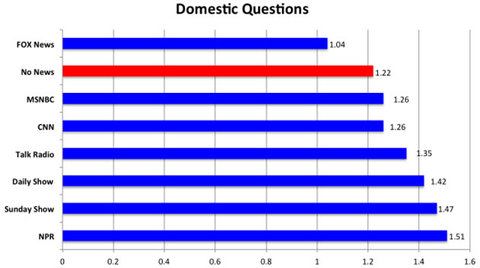
A fellow progressive Facebook group member posted this photo with a message of glee and encouraging everybody to disseminate.  I admit I also initially felt justified and righteous when I saw it.  But something kept me from sharing on my own page.  I should do this more often, perhaps—let something marinate for 24 hours before sharing, just to make sure it’s really something I want to engage with.  I ended up commenting that I think we should be careful about disseminating this kind of oversimplified graphic, as the data may not justify the claim.  I await the angry backlash.

After reading the article in Business Insider from whence the figure came, I had more questions than answers.  What are  Farleigh Dickinson University and Public Mind, anyway?  “Researchers asked 1,185 random nationwide respondents what news sources they had consumed in the past week and then asked them questions about events in the U.S. and abroad.”  What were the questions?  How were they chosen, and how do we know they represent broader knowledge of current events?  “With all else being equal, people who watched no news were expected to answer 1.28 [out of 5] correctly; those watching only Sunday morning shows figured at 1.52; those watching only ‘The Daily Show figured at 1.60; and those just listening to NPR were expected to correctly answer 1.97 [out of 4—why the ask one less for this?] international questions.”  Are these differences statistically significant?  And regardless, if the best we can do is answer less than 40% of domestic questions correctly, yikes.  How do we know this actually represents the population?  How does this data compare to similar research findings, maybe ones published in higher caliber, peer-reviewed journals?

The Business Insider article did link to the study report it referenced. I consider this to be a sign of responsible journalism—I look for it in the publications I read—access to the primary literature, so I can dissect and interpret ‘data’ for myself.  Turns out the study was a follow up in 2012 of an initial survey done in 2011 that reported similar findings.  The specific questions and statistical methods are included, as well as discussion of the results.  And while it’s not as rigorous as I am used to reading in peer-reviewed scientific journals, with sections for abstract, background, hypothesis, methods, results, discussion, and conclusion, I could follow the language and rationale of the authors, for the most part. I think they could have done a better job making a distinction between correlation and causation.  I also wished for a discussion addressing implications of the data and recommendations for further study.

Interestingly, I found a Forbes article entitled, “A Rigorous Scientific Look Into the ‘Fox News Effect.’”  I thought it was going to answer all of the questions I asked above.  It started out appropriately skeptical:

In 2012, a Fairleigh Dickinson University survey reported that Fox News viewers were less informed about current events than people who didn’t follow the news at all. The survey had asked current events questions like “Which party has the most seats in the House of Representatives?” and also asked what source of news people followed. The Fox viewers’ current events scores were in the basement. This finding was immediately trumpeted by the liberal media—by Fox, not so much—and has since become known as the Fox News effect. It conjures the image of Fox News as a black hole that sucks facts out of viewers’ heads.

I got excited when I read:

I have done similar surveys, both of current events and more general knowledge. In my research too, Fox News viewers scored the lowest of over 30 popular news sources (though Fox viewers did at least score better than those saying they didn’t follow the news). The chart’s horizontal black lines with tick marks indicate the margins of statistical error. Last Week Tonight with John Oliver, a news satire, had the best-informed viewers.

Turns out the rigor of this scientific look at the FDU data amounted to not much more than pointing out that correlation does not prove causation.  The author, William Poundstone, is a prolific non-fiction author and biographer of Carl Sagan, so I imagine he has formidable expertise parsing research data, though I don’t see any published research or surveys of his own.

In the end I’m satisfied, because I have done my homework on this topic.  I feel righteous again because, this time, I extricated myself from ‘liberal lemming’ (is that a thing? If not then I just coined it) mindset…  But it took some time.  And writing about it has cost me some psychic energy for organization and expression.

As I write this it occurs to me that it would be much more time efficient to just not believe anything I see or hear on any media platform—just be skeptical about everything and leave it at that.  Huh…  Nope.  That feels too much like willful blindness, which does not align with my core values.  It’s worth taking several minutes sometimes and disengagement, to verify the quality of what I take in on a daily basis.  I hereby commit to making this a regular practice.  I’ll let you know when I find anything really worthy of integration and dissemination.


Diversify Your Network

DSC_0505

NaBloPoMo 2018:  What I’m Learning

Are you friends with a plumber?  My friend Dennis is, or was, as of c.1997.  I forget his friend’s name, let’s call him Frank; they knew each other in high school.  Dennis and I were both medical students when I met Frank.  Looking back he must have thought I was a little strange.  I asked what he did for a living, and when he told me he was a plumber I interrogated him, hard.  “What’s that like?  How do you train, is there a school (I was a straight-through biology pre-med who knew next to nothing about trade schools)?  What are your hours like, are there days when you don’t work?  How do you figure out what the problem is?”  I was just so curious—I had never met anyone who did that kind of work, and it was so different from anything I knew.  He didn’t talk to me for long.  We were at Dennis’s birthday party and Frank quickly found other friends to connect with.

I’m so grateful to work in medicine, where I get to meet people from all walks of life every day.  In the exam room I have met coders, lawyers, teachers, construction workers, professional dog walkers, stylists, food critics, financial columnists, hedge fund managers, engineers, HR directors, leadership coaches, musicians, and myriad others…but I can’t remember any plumbers.  I love when I have time to ask, “What’s that like?” and “What do you spend your days doing?”  I always learn something new, and the best days are when I find some parallel between our work lives.  My husband the orthopaedic surgeon remembers patients by their x-rays.  I remember them by their social histories.

The Harvard Business Review sent an article to my inbox today entitled, “How to Diversity Your Professional Network.”  It cites studies that show “people who are connected across heterogeneous groups and who have more-diverse contacts come up with more creative ideas and original solutions.”  Reading it triggered an avalanche of memories and cognitive dot-connecting, hence my story about Frank.

First, I’m reminded of my first coaching call after accepting my new role at work.  Coach Christine asked about my ‘allies,’ the people whose counsel I value and who will hold me up and accountable through the growth process and pains that are leadership.  She pointed out that allies are not always people who agree with me.  They can be my challengers, my opposition, my rivals.  Through them, I am forced to grapple with my own integrity; they serve as the crucible for my values.  This idea helps me stay open to people whom I might otherwise dismiss.  Diversify.

Second, I remembered of The Big Sort, by Bill Bishop.  It’s thick with data and research, but the part that struck me hardest was the idea that our ideology becomes more extreme when we spend time with like-minded people.  I suppose you might think, well yeah, duh.  But when you consider how this affects decision making on the individual, community, and policy levels, it’s a little scary.  In his description of research by Cass Sunstein and colleagues, Conor Friedersdorf writes:

But for all the benefits of agreement, solidarity, and spending time with like-minded people, there is compelling evidence of a big cost: the likeminded make us more confident that we know everything and more set and extreme in our views. And that makes groups of like-minded people more prone to groupthink, more vulnerable to fallacies, and less circumspect and moderate in irreversible decisions they make.

Groupthink.  That reminded me of Originals by Adam Grant, a book I have listened to at least twice now.  As I have thought incessantly about culture and how to nurture a healthy one where I work, Grant’s advice on hiring for contribution rather than fit holds my feet to the fire:

Emphasizing cultural fit leads you to bring in a bunch of people who think in similar ways to your existing employees. There’s evidence that once a company goes public, those that hire on cultural fit actually grow more slowly because they struggle to innovate and change. It’s wiser to follow the example from the design firm IDEO, and hire on cultural contribution. Instead of looking for people who fit the culture, ask what’s missing from your culture, and select people who can bring that to the table.

So what does all this mean?  I have decided to take it as validation of my curiosity and desire to learn as much as I can from a vast array of different people.  Whether I know them socially or professionally, whether our diversity is race, culture, politics, religion, or music preference, there is always something that connects us.  The search and exploration are what make life colorful and fun.

I wonder whom I’ll get to meet tomorrow?