Up and Accountable, You Hold Me

NaBloPoMo 2020 – Today’s Lesson

What if Yoda sang love songs?  Does it not brighten your day just thinking about it?

Who holds you up?  Who holds you accountable?  Do they do it with love?  If you’re lucky like me and the same people do all three, you possess a rare gift.  I learned this again today and the realization sustained me, even through some hard conversations and decisions.

* * * * *

“I feel like garbage after I talk to her,” a friend told me today.  We commiserated around our mutual acquaintance, Dolores*.  Dolores constantly focuses on the negative—how we could always do this or that better, how this or that thing is never right.  She nit-picks and dissects.  It’s hard to be around Dolores; her positive to negative interaction ratio is 0 to infinity—or at least it feels that way. 

We like Apollo* better.   He consistently notices and shows us the good we do.  He points out our strengths to others.  And it’s not lip service—he truly sees, appreciates, and acknowledges how we contribute—we feel his sincerity and gratitude.  His ratio approaches 5 to 1, which is an important sign (driver?) of healthy relationships.

And Apollo’s 1’s, what are those about?  He tests us, makes us uncomfortable sometimes.  We clash with him sometimes on how to walk the talk, on the methods we choose to manifest our mission.  But because our relationships are healthy, because we know our ties are stronger than our tensions, we can negotiate in good faith.  We challenge one another to live up to our ideals—to defend our methods–we hold each other accountable, and we all benefit.

Like I said, lucky.

*not their real names

Exponential Risk

NaBloPoMo 2020 – Today’s Lesson

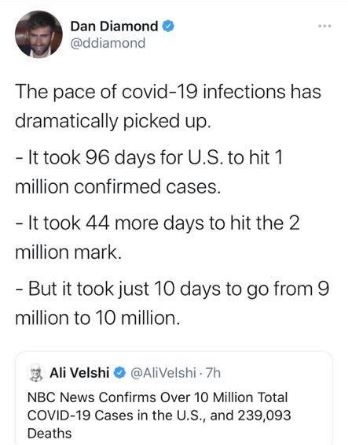
Things are looking really bad again, folks.  Illinois saw more than 10,000 new COVID cases for the fourth day in a row.  Between the first and third weeks of October, COVID inpatient census rose 500% in one metropolitan hospital system, and it’s still climbing.  At this rate, we may run out of ICU beds by Thanksgiving.

I had more calls today about COVID (symptoms and/or exposures) than any day since the pandemic started.  Every call takes time to explain the profound importance of distancing, masking, and minimizing contacts, then the logistics of quarantine, testing, and contact tracing.  It’s totally straight forward in some ways, and completely convoluted in others. 

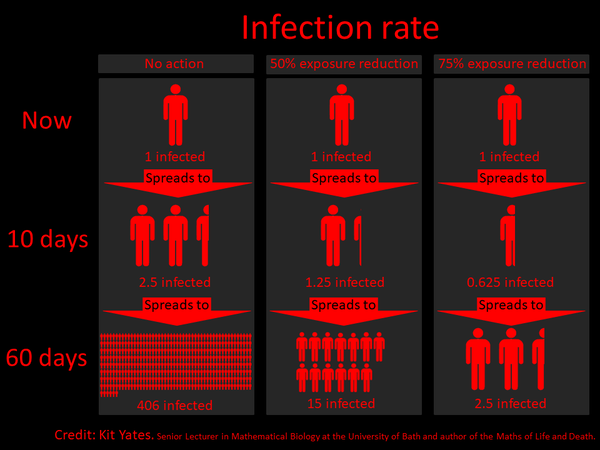
With rapidly escalating disease prevalence, every unmasked contact with a non-household (or ‘pod’) member carries exponential risk.  You breathe on me, I breathe on you.  We have now exposed each other to everybody we have each contacted in the past 14 days—we have merged our bubbles irrevocably in this one encounter, endangering everyone in each bubble and all of their extended contacts.  It cannot be undone.  This is the nature of a pandemic. 

I understand how hard it all is—how inconvenient, fatiguing, disruptive, and maddening.  Our masking and distancing, missing friends and activities, restricting our kids’ social lives, is all immediately and concretely costly to us, and only distantly and abstractly beneficial to others (and us).  Still, it is what we can do to slow the spread of a deadly virus that has infected more than 10 million Americans, and will have killed more than 240,000 of us by tomorrow.

Avoid these 9 pitfalls to stay safe.

If you want to pod, follow this guide closely. 

We can stop all paths of the virus through us.  But it takes all of us.

Affective Polarization

NaBloPoMo 2020 – Today’s Lesson

How fun when learning occurs in clusters.  I linked to a recent Hidden Brain podast on my November 4 post.  It was the first time I had heard the term ‘affective polarization.’  Basically it means that we define and dislike people by only knowing their political party affiliation.  Today I listened to a series of theological essays addressing the same issue, from a Christian perspective.  I can’t wait to learn more.

Increasingly, we judge and relate to one another based on this one factor, which may or may not be important to how we define ourselves.  Apparently it’s a pretty new phenomenon, and escalating fast (surprise). 

The podcast discusses how we feel as and about people who are deeply involved in politics or not, and how that affects our attitudes and decisions about which relationships to enter, whom to hire, where to live, etc.  The essays explain further that it has to do with in- and out-group (tribal) identity, self-esteem, and meaning.  In 21st Century American culture, our politics identify us more than they used to—it has replaced religion in this way, perhaps.  But, he posits, while we have cultivated religious attitudes and practices “from dogmatism and fundamentalism toward a faith that is more tolerant, inclusive, peaceable and generous,” not so for politics.  Partisans on both sides are basically fundamentalists, and that carries important implications for violence— the new holy wars.

This may all seem rather alarmist.  But I bet anyone who hears the podcast or reads the articles will recognize and relate to much of their content.  The best outcome from consumption of these pieces will be a little more awareness, and a desire to monitor and modify how we relate, for the better.  Let’s get to it, shall we?