Curiosity, Humility, and Emotions

Temple of Aesculapius, Villa Borghese, Rome, Italy

Huh. It’s all a jumble tonight.

Another dense week of patient care and life in a chaotic geopolitical environment. *deep breath* All I can say is, thank God for my friends. Without fail, they hold me up every day. Our conversations lift me; our connections nourish me. The exchange of ideas, the positive reinforcement of kindness, generosity, and optimism–they make life worth living!

How often do you find yourself asking your friends and loved ones lately, “How are you?” Where do you put the emphasis? How are you? How are you? How are you? Context matters, right? Yesterday that remark, today this event, tomorrow that executive order, next week a reversal. This friend’s lab shutting down and that friend’s project halted because funding is suddenly gravely uncertain. Legal immigrants getting detained, POC history erased from public visibility (then reinstated and called a mistake). All kinds of emotions, all over the place, just under the surface if not fully emergent, effusing, and utterly hijacking.

I had an amazing call with Mande and Sharon tonight, my wonderful friends from Braver Angels. None of us actively lead Braver Angels workshops anymore, but we meet on FaceTime monthly to discuss and mutually support one another in living its principles. For ninety minutes we shared, questioned, reflected, admired, and wondered. By the end of the call my mind was so full of ideas for this post that I could barely wait to write. I quickly jotted it all down and now here I sit, befuddled at the scope of it all. Each idea could be its own post! I share the list of ideas below to document it for myself, and also to show how rich conversations can be if we approach them with a certain mindset.

Curiosity

If you haven’t already, I highly recommend reading Curious by Ian Leslie. I have consumed this book about three times and what struck me most the last time was the origin of curiosity: the desire to know more about something. Curiosity does not emerge from a vacuum; it originates from a germ of information or knowledge that we then wonder about–when we recognize a gap between what’s already known and not, and seek to fill it in.

Too often now, Blue and Red voters assume that they already know everything there is to know about the other side and everybody on it. I see and hear an utter dearth of curiosity on both sides, so many people speaking and writing in sweeping assumptions, narrow conclusions, and disparaging judgments all around. Honestly, how can you know everything there is to know about any person just by how they voted in one election? You may say you don’t need to know anything more; you feel justified judging them wholly and disparagingly just based on that one act. You are entitiled to this position, of course. I just think it’s one of the foundational mindsets that drives our most toxic divisions.

When was the last time you learned something about someone that surprised you, or that you simply did not previously know about them? When was the last time you wondered about someone and acted on that curiosity in a nonjudgmental, open, and connecting way? When did you last connect with someone meaningfully across difference, finding something in common that brought you closer as fellow humans? Imagine if these were all regular occurrences in your daily life–how wonderful would that be? I submit that this life is absolutely attainable–all we have to do is get just a little more curious than we are today, and express that curiosity openly and without prejudice.

Humility

When did you last honestly admit that you don’t know something? When someone offered new information or knowledge, how open were you to receiving it? How open are you in general to admitting what you don’t know, to entertaining new ideas, to holding space for your mind to be changed on any given topic, to acknowledging that you may be wrong? I will look harder this week now that I have posed the question, but I don’t notice a lot of humility in political discourse on either side. What do we not know? What assumptions do we make, and then draw incorrect and potentially harmful conclusions, based on ignorance and worse, the delusion of certainty? What would a more humble existence feel like?

Emotions

Friend Sharon is so wise. She practices attunement, emotional awareness, self-regulation, and effective communication. She queried her own reactions, responses, and needs in the chaos and determined that in order to connect across difference, we need to address our feelings. Not rocket science, and also profoundly uncomfortable and threatening for so many of us. Imagine gathering under the premise of politics, and conducting a discussion in which you don’t actually talk about policy, politicians, or political happenings. Rather, you talk about how it all makes you feel, how your values are involved, and what you believe. How would your expressions necessarily change in that kind of conversation? Leave your opinions, judgments, and arguments at the door, folks. Let’s talk and connect from the heart. Wow. Sign me up. Wanna join in?

Take a look at the idea list at the bottom of this post. What piques your curiosity? Leave a comment and I can write about it next week.

Meanwhile, here is my most current To Be Listened (to–TBL) book list and some resources that I found helpful or fascinating(ly frustrating) this week.

Wishing you all a week of curiosity, humility, and connecting emotion!

Possible, William Ury
Food For Thought, Alton Brown
Abundance, Ezra Klein and Derek Thompson
How to Change, Katy Milkman
The Certainty Trap, Ilana Redstone

Pete Buttigieg:
on DEI–watch here and here
his Substack
his book Trust–fast, easy, accessible, and important–a blueprint for healing our divisions, one interaction and relationship at a time.

A thoughtful and short piece from The Free Press: “I’m a Liberal at a ‘Conservative’ University. How Did I End Up Here?”

From The Guardian:
“The US has blocked Canadian access to a library straddling the Canada-US border, drawing criticism from a Quebec town where people have long enjoyed easy entry to the space.
“The Haskell Free Library and Opera House is located between Stanstead, Quebec, and Derby Line, Vermont. It was built deliberately to straddle the frontier between the two countries – a symbol of cooperation and friendship between Canada and the US.
The library’s entrance is on the Vermont side. Previously, Canadian visitors were able to enter using the sidewalk and entrance on the American side but were encouraged to bring documentation, according to the library’s website.
“Inside, a line of electrical tape demarcates the international boundary. About 60% of the building, including the books, is located in Canada. Upstairs, in the opera house, the audience sits in the US while the performers are in Canada.
“Under the new rules, Canadians will need to go through a formal border crossing before entering the library.”

Personal leadership
Known and unknown unknowns
Unknown to known is a huge step IF we are willing to take it
Openness
Relationship
DEI implementation methods, fairness, Buttigieg reel
Cis het white male allies
Historical romance as non-adversarial, powerful male-allied change agency
Lie in the bed we made of burn down the patriarchy, all men suck
Masculine and feminine energy in balance
What if we recorded our calls
How would we monitor and modify our words
Sharon’s workshop: feelings, values, and beliefs only. No judgments, no ad hominem, no politics. Connect across difference through shared humanity–harder than anyone anticipated
Vulnerability
Psychological safety
Woman doc bad exprience
Past adverse experiences that make us rigid, eg blood transfusion story
Stories we know nothing about that drive others’ thoughts feelings and behaviors

Time Under Tension: A Fitness Model for Training Political Discourse

Learn. Practice. Train.

To get better at anything, we must be willing to tolerate the discomfort of being bad at it–for a while. And the reward has to be worth the effort.

What reward will make it worth the effort for us to tolerate the discomfort of political discourse, in order to get better at it?
What other uncomfortable training can we compare it to?

“Agonist Supersets! The focus of this block is adding more intensity + time under tension to a specific muscle group. Lower body in A series, upper body in B series for TBS (total body strength) days. Two movments focusing on the same muscle group back to back. First movement more focused on neural engagement and higher movement complexity, the second movement for increased TUT and hypertrophy!”
–Ethos Training Systems, February 2025

Rear foot elevated split squat. 20# each hand. 6 reps x 4 sets.
Tempo: 2 count down, pause 1, up 1, repeat.

To pause for one second at the bottom of a rear foot elevated split squat can be uncomfortable. The longer I hold tension with the glute of the forward leg extended in that position, the more challenging it is to stand back up, especially by the 24th repetition. But the rewards are a stronger posterior chain, a more stable core, and confidence and ease getting up and down from the floor as I age.

Since there are only six reps per set in this block, I can lift heavier weights. I think this is the first time I have done this movement with 20 pounds in each hand. And the program builds in longer rest periods after heavy load sets. Consistent and disciplined repetition for neural pathway learning and muscle hypertrophy–I get better each time I train.

I so wish more of us would take this attitude toward our political conversations–see it as personal training to get better at it. What do I mean by ‘better’? I do not mean better at criticizing and shaming people who voted differently. I do not mean amplifying derisive words and ad hominem attacks on public figures. I do not mean aggressively debating ideology and attempting to convince someone their values and ideals are ‘wrongheaded’ or otherwise invalid.

By ‘get better’ at political discourse I mean asking more open and curious questions, listening to understand rather than to rebut, reject, or demean. I mean challenging our own convictions for consistency and integrity. I mean engaging in earnest, in the spirit of critical collaboration, to find common ground in shared goals, where we can stand and work together to make our systems better. Policies born from this laborious process last, rather than getting overturned from one administration to the next. It requires leaders as well as citizens to withstand the discomfort of disagreement and clash of ideology. It demands patience, diplomacy, professionalism, self-awareness, self-regulation, humility, honesty, and mutual respect.

Who looks at this list of requirements and thinks, “Sure, no problem, I’m very comfortable with that, sign me up.” More often I suspect a reaction along the lines of, “Are you kidding me? Like anybody (on the other side) will show up that way to me? Why would I bother doing it for them?”

And therein lies our impasse. Who will go first? Only those who can tolerate the discomfort–of vulnerability, uncertainty, and humility–with confidence. It will be those who have trained.

Time under tension: It builds muscle strength and stability, improves load tolerance, and allows us to lift heavy things with grace. We have to get in the gym, grip the weights, and submit ourselves to the struggle. And we have to do it consistently, with discipline. We must take time to rest and recover, between sets and sessions alike. We need coaches to monitor and correct form and position. And it always helps to have our friends doing it with us and cheering us on.

If we don’t feel like it and don’t do it, then muscles atrophy and risk of injury increases when weekend warrior mindset overtakes us. A healthcare system can get overburdened by people who fall and fracture hips due to frailty from lack of physical training. A society’s political system can be similarly overburdened, and thus vulnerable to nefarious actors, by a citizenry that fails at political discourse due to frailty in conversational exchange of ideas and difference of opinion.

So how do we train? Thankfully there are more and more resources to help us. My suggestions:

  1. Start within our own group. Find people willing to put down the ad hominem approach, who are willing to look at what we say and do with a critical eye, looking at it from ‘the opposition’s’ point of view, and seeing how our messages may be counterproductive.
  2. With these peers, practice engaging with ideas you disagree with. Role play the ‘other side.’ Research objective evidence that supports that point of view–avoid that group’s ad hominem attacks also; look for evidence that they also understand our point of view.
  3. Attend a Braver Angels workshop or event. Learn and practice the skills we need to engage calmly, openly, and with respect and curiosity in front.
  4. Follow groups like Builders and A Common America to see who among our elected officials, and those who might run, already practices non-adversarial discourse. Amplify them on your social media and to your peers.
  5. Finally, seek out people who voted differently from you, whom you respect and whose relationship you value. Get vulnerable. Tell them you want to get better at talking politics, that you want to connect more than divide our country. Be prepared for an incredulous and dismissive reaction. Decide how and whether you will persist. Comment here if you want a pep talk, I’m good at giving those! And then if they agree, practice all of the above and below with them! Go for it!

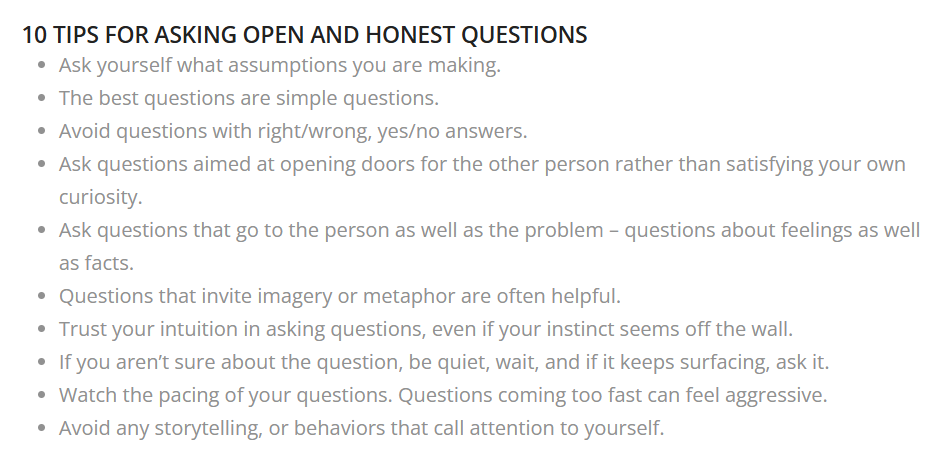
In any conversation, aim to ask questions at least twice as often as you make statements. This is an uncomfortable, challenging, humbling, and extremely effective way to get better at engaging anyone in conversation. But they can’t just be any questions. The best questions–the ones that make us pause, resist our canned and offhand responses–are open and honest–see tips below. And the intention must be earnest–the goal must be to connect and understand, never to one-up or ‘win’.

Time under tension in political discourse builds the muscles of engagement. It improves our tolerance of intra- and interpersonal discomfort. It gives us the ability to think in curious rather than adversarial ways. It makes us stronger citizens, neighbors, friends, and family members who can withstand disagreement and conflict with resilience.

I’m considering how I will spend my time, energy, and resources this year. Work will be busier. Daughter will launch to college. I will continue to write. And now I hear the call of advocacy getting louder. I have a few ideas about the whats and hows; the Why remains steadfast: to foster the healthiest relationships among all whose lives I touch.

Exciting times, friends! Scary for so many, I know.

How will we all help?

https://healingcircleslangley.org/2016/10/asking-open-honest-questions/

On Personal Activism

Strong back, soft front.
Am I doing enough?
Am I enough?

Once again I find myself alarmed and agitated, wondering how we got here. One week in and it feels exponentially worse than last time. Some would argue that all politicians are equally nefarious and selfish, equally devoid of character. I suppose that is possible, but I just don’t think so. Jimmy Carter, George HW Bush, and Barack Obama stand out to me as role models, men of character and integrity. Not so the person in office now.

Executive acts this past week have served what I believe to be their intended purpose, stoking unrest and outrage, churning anxiety, division, alienation, and escalating susceptibility to fear and rage-based behavior, inclulding violence. I believe some of the most sweeping acts will be successfully challenged and modified, if not stalled, but at what cost to the system? What of the workers who suddenly lost their jobs? What of the scientific and medical researchers whose funding may not exist anymore, and the patients whose very survival or mortality may hang on that funding? And all while real and present problems loom at impasse after impasse because our elected officials refuse to negotiate like mature, reasonable adults? How did we get here? How did we choose these people to ‘lead’ us? End rant.

How will our daily lives feel the impact of this administration? I wonder how racism, misogyny, and dehumanization will cascade again en masse from the precedents that this POTUS sets? He validates, encourages, and exemplifies the most derisive of human behavior and relationship.
How did we get here?

Once again I find myself asking, “What can I do, I’m just one person?” Somehow this week, treating people all along the political spectrum with respect, asking open and honest questions, holding the benefit of the doubt, resisting outrage in favor of calm and curious exploration of diverse perspectives, and withholding judgment just don’t feel like enough. And yet there is so much to advocate for, so much to resist, so much happening every day, it’s overwhelming. Where would I even start? And I think that’s the point, right? Submission by way of learned helplessness.

I had the good fortune of two incredibly insightful and enlightening conversations this weekend. I was invited to articulate my Why, my purpose, and explore my Whats. I talk to people. I write. My favorite and most effective forum is one on one, and I also do well speaking to large, live, interactive audiences. I am an integrator of ideas, an innate mediator, a ‘boundary spanner.’ Normally that feels exceptional and more than enough, I realize as I write this. But today it feels small, inconsequential, puny.
But maybe that is not the sensation to heed.

Connection across difference is exactly what we need right now, all of us, elected leaders and all. We have lost this capacity and skill at a collective level, it seems. So if I can retain it, then it’s actually a big deal. If I can exemplify and amplify it, be the connection and do it every chance I get (which is any given human encounter), then I am making a difference. Me, one of seven billion.

What if I could modify, even a little, the mindset and behavior of just two people in their encounters with people who disagree? And each of them two more? What if each of my Braver Angels friends could do the same? What if even a fraction of Mónica Guzmán‘s readers also had this impact? That’s exponential growth–a movement–of connection across difference.

Ok I feel better now. DIY pep talk via blogging! I can keep doing what I’m doing. Talking, writing, Healing Through Connection is my domain, literally and figuratively. Abortion, equity work, gender policy, healthcare, and intellectual freedom are all issues I care deeply about. I can find ways to support initiatives and leaders in those spaces ad hoc. But my own work, my personal activism, lies principally in person to person relationship, which applies in all other domains more than most people realize. I can raise that awareness and help folks acquire and hone those intra- and interpersonal skills that may, one day, steer us toward electing legislators who also practice successfully. Meanwhile, we could heal friendships and family ties wounded by political divergence. How hopeful.

So, dear reader, what is your brand of personal activism?