Perspective

“Tribe.”

What is your perspective on this word? I’m feeling a little defensive tonight, and also holding mind space to consider different perspectives, while clarifying my own in the process. I have used the word to describe my ‘found family,’ people with whom I share a deeply meaningful bond, my innermost circle and closest confidants. Including unpublished drafts, a search of ‘tribe‘ on this blog yields 105 posts.

Recently I have heard that using the word ‘tribe’ could be offensive to Native Americans. My initial reaction is divergent. Yes, I can see why. And, really? Does this group hold the exclusive right to use this word to describe something meaningful to them? Is its use in other contexts offensive to all indigenous people? Has it always been?

Four sources of perspective:

On the etymology of the word ‘tribe’: “In the Biblical sense, which was the original one in English, the Latin word translates Greek phyle “race or tribe of men, body of men united by ties of blood and descent, a clan” (see phylo-). Extension to modern ethnic groups or races of people is from 1590s, specifically “a division of a barbarous race of people, usually distinguishable in some way from their congeners, united into a community under a recognized head or chief” [Century Dictionary], but colloquially of any aggregate of individuals of a kind. also from mid-13c.

“What is a Tribe?” “True, “tribe” is a troublesome word, bearing the weight of decades of anthropological study that privileged Western civilization over all other traditions. But let us rescue it here, pare it down to its simplest meaning, as a name for the first human communities that formed beyond the primal bonds of kinship — the beginnings of the great experiment we call society, which taught us to be human.”

“A teen recently told me that using the phrase “find your tribe” or using the word “tribe” is offensive to Native Americans.” “For Indigenous people, tribal identity is important. So when non-Native people say “find your tribe” or “tribe” to describe groups of shared interest, it is offensive because it erases the significance of Tribal sovereignty, identity, and people. Instead, we can use words like: group, crew, friends, or circle.”

Tribal Leadership, Dave Logan et al. From a sociological point of view, using the word as a reseach group defines it academically: “The success of a company depends on its tribes. The strength of its tribes is determined by the tribal culture, and a thriving corporate culture can only be established by an effective tribal leader.” This book has influenced my perspective on leadership and culture very deeply, hence my reluctance to stop using the word altogether.

How do I do perspective well already?
–My perspective taking skills are strong. This has to do with empathy, attunement, effective question formation and expression, and active listening. I have trained to be slow to judgment and opposition. I can engage with openness, calm, and patience.
–I understand that my Asian-American cis-het-monogamous-married woman physician parent identity gives me a certain perspective that is not shared by everyone I meet. I try to remember this, especially when I engage with people whose identities do not overlap much with mine.

How could I do it better?
–It’s easy to feel confident and competent about my skills when I only practice in easy situations. I can look for situations and practice when it’s hard–really train my openness and curiosity. I don’t mean to pick fights with people, rather simply attune to divergent opinions and perspectives around me, and choose more mindfully to engage with that divergence, even if it’s only in my own head.
–Also do it out loud, or in writing. Tonight’s post was prompted by my Facebook post and its comments. I plan not to engage in a complex exchange on social media, and this post will not be my last writing on perspective.

How does society to perspective well already?

Information. This is a tricky one. We can basically find ardent examples of and support for any perspective we want on the internet. So on one hand, it’s really easy to find a diversity of perspectives to explore, process, and deepen understanding and connection. On the other hand….

Groups who lead by example. See the November 9 post on polarity management; organizations like Polarity Partnerships, Braver Angels, and the Aspen Institute all have programs to help us open our minds to broader perspective taking, more effective communication, and better relationships.

How could we do better?

Long form: Conversations and reading. My friend, intending to be helpful, dropped the link for the third perspective piece above as a comment on my Facebook post tonight. There was no accompanying writing or explanation. So far there has been a brief exchange in which she suggests that since the word may be offensive to some people, I should avoid using it (in the context of my post). It made me think more, but rather than engage there, I decided to write out my thoughts here. I’m grateful to her for prompting me to search and read more. Depending on the topic and participants, social media may not be the best place to exchange perspectives, but we can always use it ourselves as a springboard for our own inner and outer work. That work, in my opinion, requires more words, more time, and more real, in person connection.

“Count higher than two”. This article introduced me to David Blankenhorn, co-founder of Braver Angels, a group I admire deeply for its efforts to help people from opposing American political groups de-escalate political discussions. “Sometimes an important phenomenon actually does divide naturally into two and only two parts or sides, between which one all-or-nothing choice must be made. But in most cases, this way of thinking about the world is not only polarizing, it is highly simplistic and leads mainly to pseudo-disagreements as opposed to real ones.” This idea reminds me of the ABC exercise (Adversity-Belief-Consequence), which basically asks us to tell multiple plausible stories to explain adversity to unglue ourselves from our most kneejerk and often dysfunctional assumptions and their subsequent thoughts, words, and actions.

For tonight, I have decided that I can still use the word ‘tribe’ mostly as I have been–with reverence. I am now more aware, however, of the potential drawbacks of using it casually, the impact that may have on people for whom the word has specific and deep meaning. This perspective exercise tonight reminds me to continue practicing mindfulness, respect, and intention in my language. And when I offend someone inadvertently, I can own and correct my ignorance while discerning what’s mine to account for and what’s not.

Here on day 16 of NaBloPoMo 2023, we could choose to see these posts as banal and redundant. I’m feeling more that they mutually reinforce some central tenets of effective relationship, which is my WHY. My net of interconnected practices, their importance, and their mutually upholding properties, strengthens and tightens with each post. My motivation to write it all more coherently and inspiringly in the BFHP also grows daily. AND I’m still gettng to bed on time most nights! HALLELUJAH, FRIENDS!

Ooooo, Leadership tomorrow. Bring it.

Polarity Management

Yes, AND.

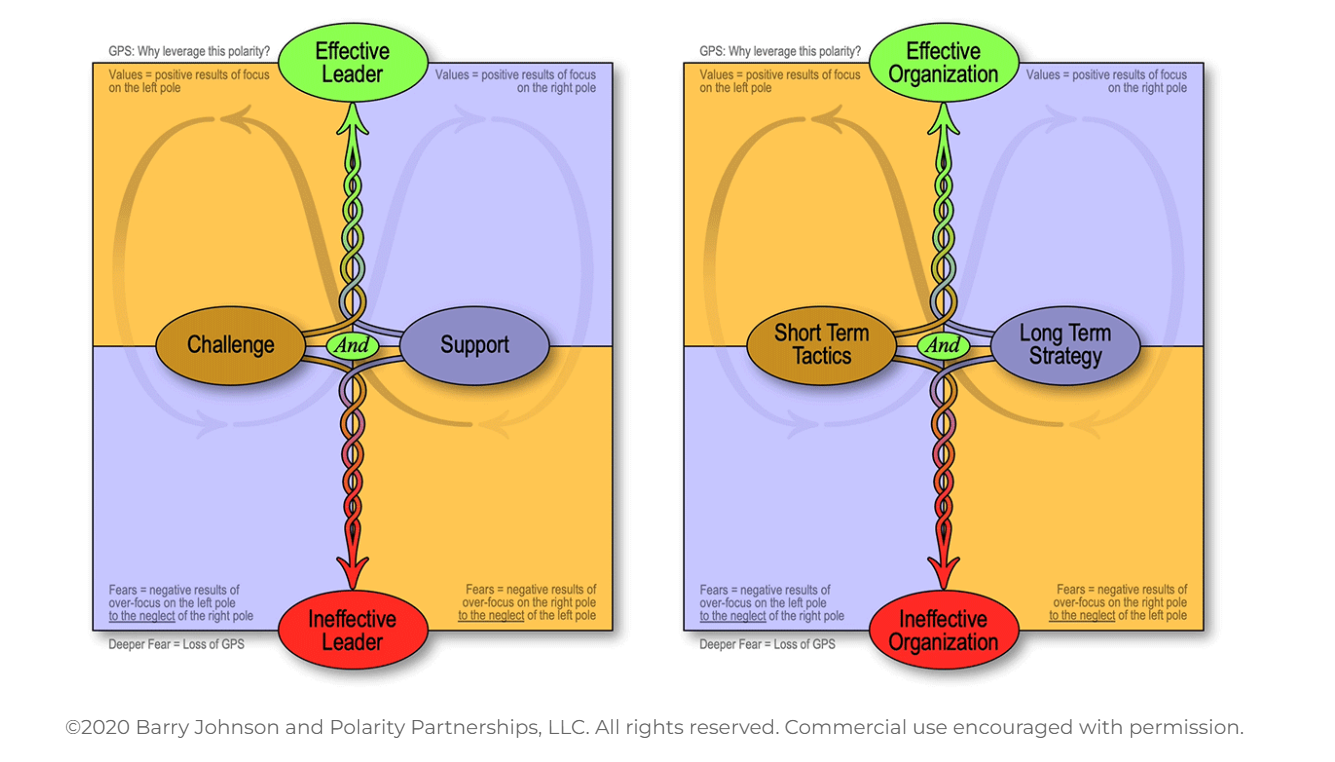
This is the central tenet of polarity management. It’s about holding divergent and apparently opposing ideas or positions at the same time, understanding that their relationship is actually complementary and mutually strengthening rather than perpetually conflicting. Masculine/feminine, individual/collective, conservative/progressive, strong/soft, diplomacy/candor, top down/bottom up–what else? Can we frame any two antagonistic ideas in an infinity polarity loop of inextricable relationship? I say yes. Because it puts us into novel perspectives, prompting a mindshift into possibility, creativity, and connection.

I am waiting on permission to use a seminal image from Polarity Partnerships, the organization founded around the idea that in any polar dichotomy, there is a dynamic flow and balance between the advantages and disadvantages of focusing energy and action on either pole. When we can maximize the benefits and minimize the costs of each pole, then leadership and organizations thrive. It’s much easier to show than tell; fingers crossed I’m allowed to share the image; check out their homepage and you will see what I mean.

13 November 2023: Here it is!

Polarity Map® is a registered trademark of Barry Johnson & Polarity Partnerships, LLC. Commercial use encouraged with permission.

How do I already manage polarities well?
–Since I learned the concept during leadership training in 2019, I now think easily in complementary polarities. I was primed c.2000 when my residency classmate introduced me to “Yes, AND”. She took an improv class and invited me to play a game in the workroom. Thanks, Carol! Now whenever I feel an initial resistance or opposition to something, I look for the juxta(op)position that gives that two-sided coin perspective.
–Polarity management and trade-offs feel related to me. I think in terms of the latter more and more, also since 2019, when I read Being Mortal by Atul Gawande. At the end of an elderly life, there is often tension between independence (goal of the elderly) and safety (goal of their family), and a peaceful end of life usually means compromises on both sides. Increasingly as I counsel patients on habit change, I acknowledge that trade offs will be necessary, and only they can define and decide which are and are not worth making, based on their values and goals. I find that approaching behavior in this way eliminates judgment, and also opens the door for flexibility and evolution without (or with less) regret. It is simply flow and growth.
–I definitely parent better from an integrated polarity perspective. Mostly it’s about letting go and hanging on, advising and commanding, that delicate and heavy handed balance. I tend toward a laissez faire parenting style, which risks the kids feeling neglected if I lean too far into my default. I’m getting better at seeing the pitfalls, and I still have some work to do.

How could I manage polarities better?
–Some people in my life prioritize their values and goals very differently from me. I sometimes sit in rigid judgment of this, dismissing their perspective as inferior in some way. I can do better at recognizing the benefits of having these people around to balance and bend my hard biases.
–I will look for strong polarity integration around me and call it out/forth. I will reinforce and amplify it. I will do my part to make both/and thinking, speaking, and leading visible, and move it into mainstream mindset.

How do we already manage polarities well as a society?

We don’t.

How could we do it better?

Where do you see successful, collective, Yes, AND in action?
I can think of two organizations that walk the talk.

Polarity Partnerships.
“In today’s world of increasing interdependency and complexity, it is vital to utilize problem solving AND both/and thinking to address your most strategic challenges and opportunities. The research is clear – leaders, teams and organizations that leverage Polarities well outperform those that don’t. Discover how to leverage your most strategic Polarities (AKA paradox, wicked problems, chronic tensions, dilemmas, etc.) to become more innovative, agile, profitable and competitive immediately and over time.”

Braver Angels.
“Our mission: Bring Americans together to bridge the partisan divide and strengthen our democratic republic.”
“We state our views freely and fully, without fear.
“We treat people who disagree with us with honesty, dignity and respect.
“We welcome opportunities to engage those with whom we disagree.
“We believe all of us have blind spots and none of us are not worth talking to.
“We seek to disagree accurately, avoiding exaggeration and stereotypes.
“We look for common ground where it exists and, if possible, find ways to work together.
“We believe that, in disagreements, both sides share and learn.
“In Braver Angels, neither side is teaching the other or giving feedback on how to think or say things differently.”

Every once in a while I read an article that does it well–not only describing two poles but explaining why each is/both are necessary and good relative to the other, and the importance of balance and flow between them. It’s pretty rare.

For practical application and guidance, I highly recommend Navigating Polarities by Brian Emerson and Kelly Lewis.

Like so many life practices I consider this month, polarity management and navigation is transformational and liberating. I had not realized it so starkly until now. When I get out of either/or, “Yes, BUT,” and “You suck,” accept what is and look for mutually complementary balancing points, new and useful insights almost always follow. My way out of conflict emerges faster and more clearly, and my relationships get stronger along the way. Very cool.

What Do You Mean By That?

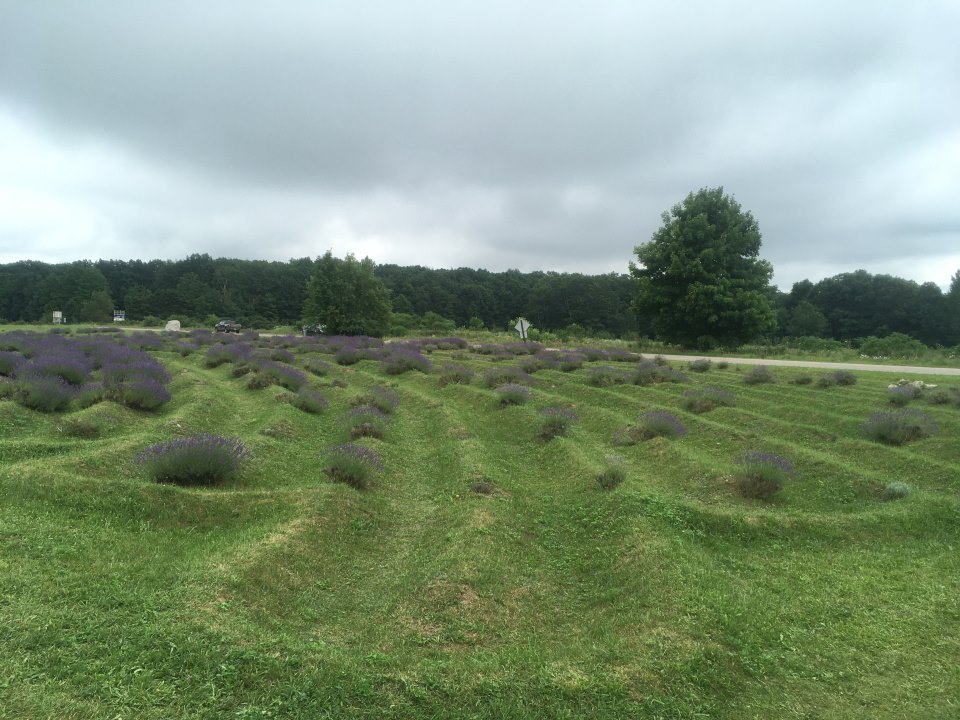
http://www.cherrypointmarket.net/lavender-labyrinth.html

“When we go to a foreign country, we know acutely when we don’t share a common language.  Not so in US political discussions.”

I paraphrase Sharon, my Braver Angels pal.  I had just described what I mean when I say “liberal,” and why I prefer to identify myself as “progressive.”  And though we both consider ourselves to be “Blue,” it turns out that our definitions of these words diverge widely.  I think neither of us uses the words interchangeably (do you?), and I wonder if it has ever caused us to misunderstand each other.  What comes to mind and body for you when you hear these labels?  What about “conservative,” “right wing,” or “Red?”

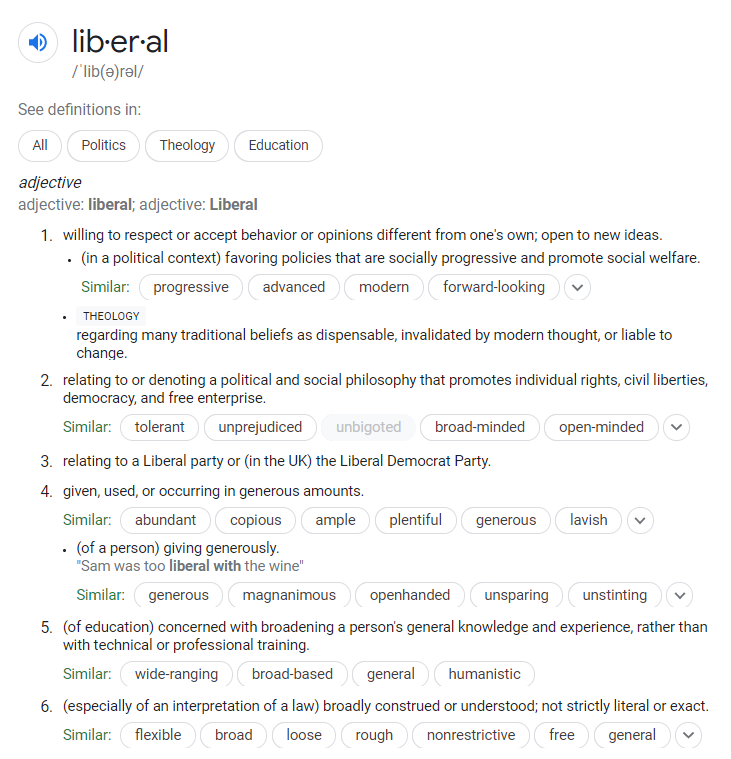
When I read/hear “liberal,” I cringe a little and feel defensive.  Maybe that’s because it’s used so often as a pejorative term anymore by “the right,” like when they jeer people of my ilk (which is what, exactly, though?) as “libtards,” (a dual pejorative against both “liberals” and people with developmental disabilities).  I resist labels, especially when people apply them to me without knowing anything about me.  I suspect we all dislike this, no?  To me, “liberal” means loose, without boundaries or limits, mindless, uncontrolled—as in suntan oil—“apply liberally.”  Maybe I have internalized the contempt of the other side?

Google search

I prefer to identify as progressive because it feels more intentional.  When we progress, it is toward something.  We have a goal.  We serve a purpose, and we walk with conviction to values.  Those values, for me, include equity, compassion, integrity, fairness, and the infinite, dynamic balance between what serves the individual and what serves the collective.  And I absolutely value meeting my political opposition on common ground, looking for shared values and goals to manifest in collaboration, rather than in competition.  This is the opposite of the prevailing idea of the word, I think?

Google search

I think Sharon’s definitions of the two words are more commonly shared.  She sees “liberal” as the general term that defines those who identify as “Blue,” who share and advocate for values attributed to “the left,” such as environmental protection, climate change action, antiracism, social justice, financial regulation, social safety nets, public healthcare, gun control, police reform, etc.  In her mind, “progressive” defines folks on “far left” of the spectrum, whose rhetoric and tactics are more aggressive, and who express much less willingness to negotiate or compromise on their goals and policies.

Tonight I invite you to participate in an experiment.

Sit down, relax; take some deep breaths.  Free your mind and unwind your body.  Feel safe to be totally honest and vulnerable with yourself.  Choose a few words from the list below and free associate for a minute or two.  Notice the images, words, emotions, and physical sensations that emerge when you read, say, and hear each word.  Don’t judge your reactions; they are neither right nor wrong, good nor bad.  They are simply your personal associations.  Write down what emerges for each word.  Take your time.

When you come across an opportunity (or seek it next—or maybe it will find you), invite someone you trust to do the same for the words you chose.   Assure them that you will not judge or criticize their associations (and then don’t).  Maybe offer them to choose some words for you both to associate.

Then compare notes—share.  Consider setting some ground rules, such as mutual non-judgment and respect, before starting.

What does the idea of this personal exercise and exchange bring up for you, in mind, body, and spirit?  What do you make of your reaction?  How might this exercise help you in political conversations, perhaps the way a translator might help you in a foreign country?  How might it also help you in other relationships and domains of life? 

Please feel free to share your associations and exchanges in the comments.

Onward in curiosity, humility, generosity, and connection, my friends.

Word list:

Right

Left

Conservative

Liberal

Progressive

Democrat

Republican

Red

Blue

Democracy

Democratic

Republic

Right wing

Left wing

Negotiate

Compromise

Regulation

Pro-Life

Pro-Choice

Climate Change

Pandemic

Public Health

Healthcare

Social Justice

Racism

Antiracism

Police reform

Gun control

Immigrant

Dreamer

Elite

Conspiracy

Insurrection

Coup

Riot

Patriot

Loyalty

Hypocrisy

Integrity

Bias

Prejudice

Discrimination

Tribe

Party

What else?