
“You know, the death rate from life is 100%.”
–My very wise patient early in my career, age 71
“HALLEFUCKINGLUJAH”
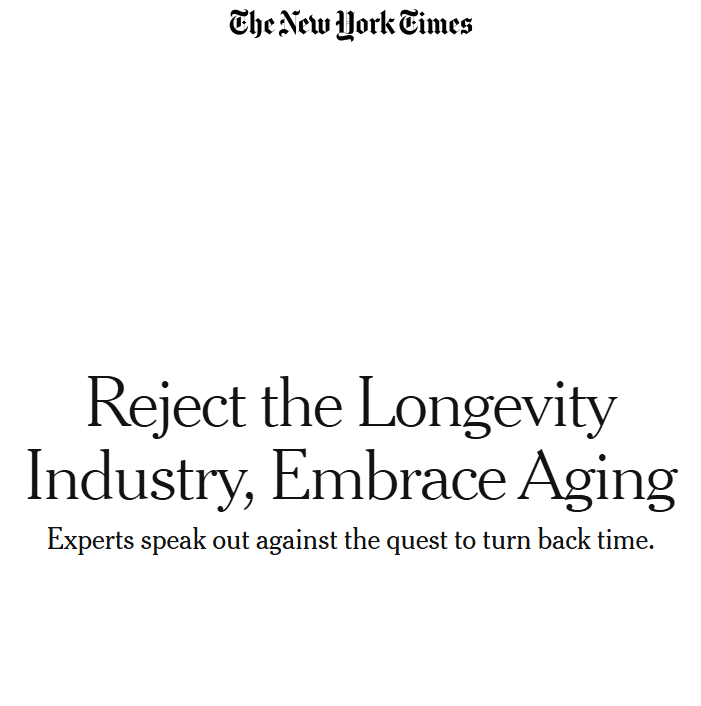
–Me, replying to a text message referencing the NYT article tagged, “The Longevity Obsession Has Gone to Far, Some Experts Say”
Written by Dana G. Smith, the article begins:
“Supplements. Peptides. Protein-maxxing. Zone 2 training. Therapeutic plasma exchange. Off-label drugs. Tests, tests and more tests.
“The quest to live to 120, or the more modest goal of staying healthy into one’s 80s or 90s, has become a multibillion dollar industry. But as the longevity movement has grown, so has the pushback.
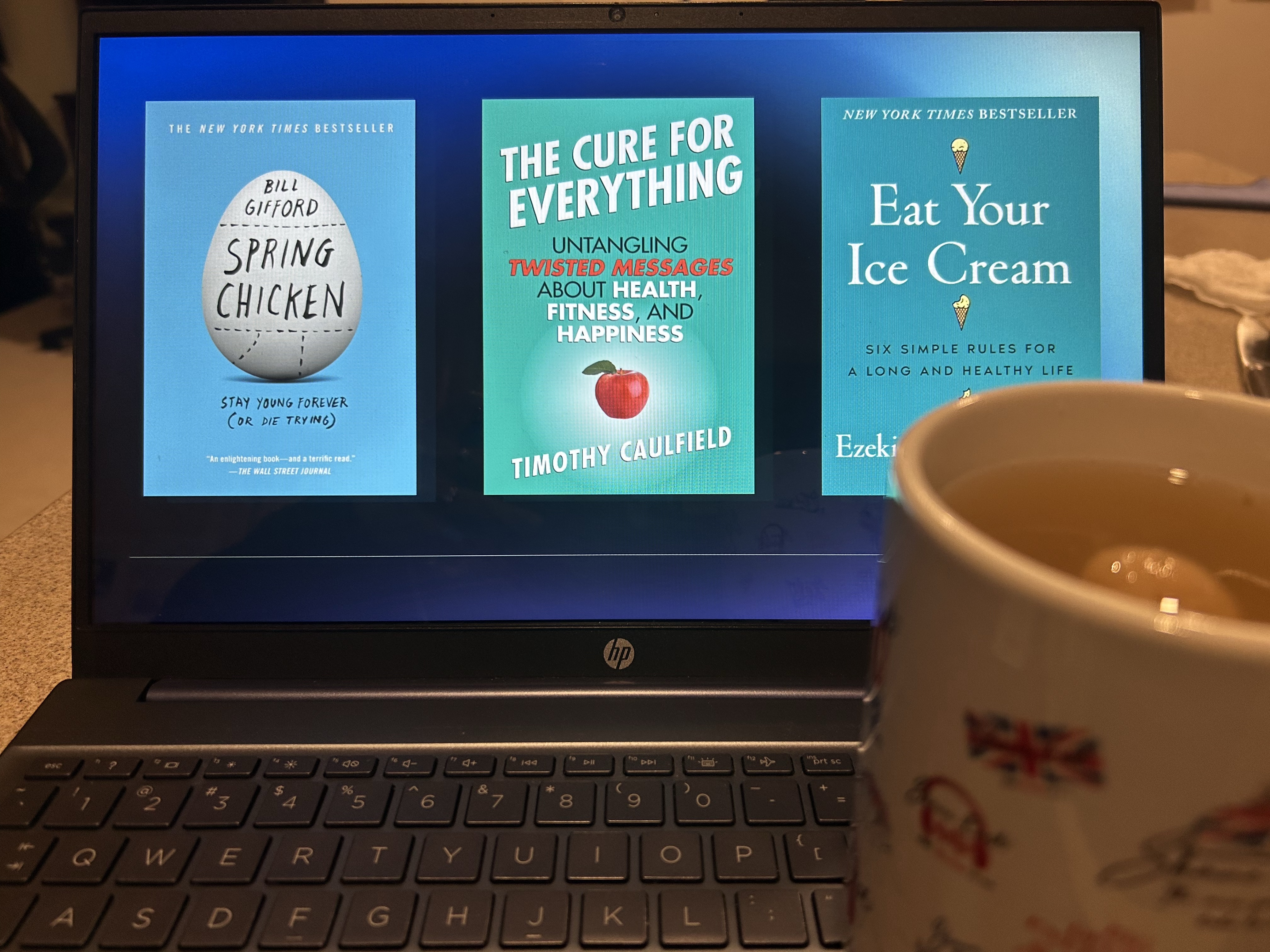
“Three books published in the past year capture a growing sentiment that a myopic pursuit of longevity is unrealistic, misguided and potentially harmful. The authors — a doctor, dietitian and scientist — make the case that the industry is capitalizing on people’s insecurities and fears about growing older to sell them products they don’t need, or that don’t work. Here’s what they recommend instead.”
The first book, Eat Your Ice Cream by Ezekial J Emanuel, MD, was on my To Be Read (TBR) list and I have now started listening. I’m most of the way through the first chapter: “Don’t Be A Schmuck: Avoiding Self-Destructive Risks.” It’s funny and evidence-based but in the most practical and realistic way. I wish Dr. E had been my teacher in training.
From the NYT article: “Dr. Emanuel, now 69, …criticize(s) society’s longevity fixation. He especially takes issue with the goal of living longer just for the sake of living longer, and he argues that the preoccupation with longevity wrongly prioritizes time at the end of one’s life over having a full life now.
“Dr. Emanuel, an oncologist and professor of medical ethics and health policy at the University of Pennsylvania Perelman School of Medicine, said he was inspired to write his book after Dr. Peter Attia published his longevity manifesto, “Outlive,” in 2023. “It just made me livid,” Dr. Emanuel said. That’s because out of over 400 pages, only the three-page epilogue acknowledged the importance of relationships, he said.”
HALLELUJAH and AMEN.
I’ll share exerpts from the article on the other two featured books, then tell you about two that I have consumed this year that I liked:
“Embrace the Changes
“Deb Benfield, who has worked for decades as a dietitian specializing in eating disorder recovery, views healthy aging messaging — particularly the kind aimed at menopausal women — as a new version of diet culture.
“’I feel like we have a target on our backs when it comes to being sold and told that our changing bodies are a problem and are pathological,’ Ms. Benfield said. ‘Perimenopause and older, there is just another layer of intensified pressure to treat our bodies as these never-ending projects.’
“She calls out influencers for stoking fears about the changes that can occur during menopause and pushing supplements and intense exercise and diet regimens as the solution. And while the recommendations are often couched in the language of healthy aging, like preventing osteoporosis and sarcopenia, the unspoken message is that, for women, healthy means maintaining an appearance that is thin and youthful.
“Ms. Benfield said she wrote her book, “Unapologetic Aging: How to Mend and Nourish Your Relationship with Your Body,” to help women understand that ‘their changing bodies aren’t necessarily something to fear and fight.’
“She encourages readers to mourn their old bodies, but she rejects the idea that the changes, like extra belly fat, are inherently bad. And she argues that feeling shame about your body or anxiety about getting older can negatively impact your health by causing stress, which in turn can result in inflammation. Indeed, research has shown that internalizing ageist sentiments is associated with having more chronic health conditions.”
“Secong Guess the Fairy Tales
“For roughly a decade, Saul Newman, a senior research fellow at the Center for Longitudinal Studies at University College London, has been a thorn in the side of researchers who study the upper limits of human life span. In his recent book, “Morbid: Debunking Modern Longevity Science,” he states that much of longevity research has been built on bad data, bad statistics and, in some cases, bad actors.
“Dr. Newman has been especially critical of studies on centenarians, arguing that, because of questionable record keeping, not all 100-year-olds are actually 100, so those insights into how to live longer are fundamentally flawed. He gained notoriety in 2024 for calling into question the validity of so-called blue zones — towns with disproportionately high numbers of healthy 90- and 100-year-olds — and the multimillion dollar industry it spawned.
“In “Morbid,” Dr. Newman presents as evidence the case of Jiroemon Kimura of Japan, who died in 2013 at the recorded age of 116. In addition to holding the world record for oldest man, Mr. Kimura was also documented as having two names, two birthdays, three wedding dates to the same woman and three elementary school graduations. (A study verifying Mr. Kimura’s age noted that “although we found several date inconsistencies among documents and mismatches between told episodes and actual dates of events, no critical discordances were discovered.”)
“Mr. Kimura is not the only Japanese super-ager with identity issues: In 2010, the Japanese government reported that it was unable to account for 230,000 centenarians, most of whom likely died years before their 100th birthday. And this problem isn’t unique to Japan; Dr. Newman cites numerous examples of error and fraud in birth and death certificates from India, Qatar, Greece, the United States and elsewhere.
“’This is a huge cultural failing,’ Dr. Newman writes in regard to faulty data sets, ‘where people ‘overlooked’ bad data to perpetuate a myth.’”
The Cure for Everything! by Timothy Caulfield
Highly recommend! Caulfield, a Canadian academic, queried his academic colleagues in fitness, nutrition, cancer, and medicine for their most evidence-based health recommendations. He then applied the advice in his own life, implementing the lifestyle changes (because the highest recommendations were all behavioral, not medication, no supplements, and not diagnostic tests) and documenting his experience in the book. By all accounts he did get healthier (lost weight, got stronger, felt better), and I found the whole book both validating and instructive.
Spring Chicken by Bill Gifford
Also highly recommend! Gifford also shares personal stories of health habit changes attempted while researching the book. He also quotes Jay Olshansky, one of the most memorable speakers of my professional life. Many years ago during our physician annual continuing education meeting, Profession Olshansky presented to us on aging. He said for most mammal species, individuals start procreating as soon as they are physiologically able, and live about until their grandchildren are born. DNA has now survived two generations on and teleologically their job is done. It struck me that for humans, that would make our lifespan about 35 years–which is about the age when many people start to complain about ‘getting old.’ I tell the story that our frontal lobes got big enough to make things to control our environment, enabling us to live as long as we live now, and all the physiologic changes associated with aging are just nature’s way of adapting our bodies to what they were never originally designed to do. Allostasis!
Gifford reviews data from experiments on interventions from calorie restriction to cold plunges and finds, similarly to Caulfield, that none of the fads and trends are backed by much evidence, and people are generally healthiest when they eat well, move a lot, rest a lot, and experience joy and connection with other people.
Our culture and systems make living healthy about as easy as swimming upstream in the Mississippi River during flood season. I spend every day at work helping people figure out how to fit healthier habits into their routines, how to set up their default environments and schedules to facilitate those habits, how to be both consistent and flexible, and how to maintain a mindset of accountable self-compassion. It’s not rocket science–we just have to sit together and talk it through, staying in curiosity, openness, and creativity. It’s incredibly rewarding and I look forward to it every day.
Incidentally, the audiobooks of both Cure and Chicken are narrated by Jeremy Arthur, another one of my favorite voice actors.
Eight more posts to go, friends! See you tomorrow!

