
November 20:  A Little Profanity Makes Me Better

IMG_2073

NaBloPoMo 2019

I swear I was surrounded by idiots today.  Not at work or home…  Mostly on the roads.  It started early, my friends, and they were everywhere.  Is the moon full?  Maybe there’s a toxic gas leak somewhere?  I found myself aggravated before I even got to the office, where usual hiccups in schedule and daily operations continued to poke my inner rage monster.

*deep breath*

Thankfully, I have learned a few helpful strategies over the years.

One is to vocalize.  There is a reason babies and little kids cry and scream at the drop of a hat.  It’s the most efficient way to discharge an acute emotion.  Then it’s over and they can get on with playing and learning.  As adults, this isn’t socially acceptable most the time.  But in the privacy of one’s own car, it can help.  After the fourth or fifth encounter with the truly insane on my morning commute, I growled.  It was not a planned, but I’m doing it more often over the years, perhaps.  It was spontaneous, and I noticed instant release and relief.  Then I literally chuckled a little.  I continued on my way and forgot about those vehicular fools.  I even found a little charity—must be the weather, or that toxic gas.

A dear friend recommended a book this year, The 15 Commitments of Conscious Leadership, which I love.  The third commitment is ‘Feeling all the Feelings’.  The authors explain: “Feeling a feeling all the way through means letting that feeling have its full life cycle (less than 90 seconds) by breathing, moving and vocalizing, resting in calmness, and riding the next wave through to completion.”  In other words, rather than repressing, denying, or wallowing in our emotions, we can acknowledge, identify, accept, honor, and release them.  Then they don’t rule us, driving us to hurtful action, damaged relationships, and toxic work environments.

Here is their method:

When a feeling arises, pause and…

  • Locate the sensation in your body. What are the ‘bits’ doing?
  • Breathe and allow the bits to simply do what they do.
  • Move and/or make a sound to match what the bits are doing.

Sometimes the bits need something more than private growl.

Recall the daily work hiccups.  Most of the time, I can roll with them easily.  I am blessed with a truly amazing team—flexible and smart, able to anticipate patients’ and my needs with keen precision.  But today was a true aberration for me—my already tenuous mental state (apparently not yet resolved) unraveled quickly in the first hour of work.  So, in the safety of the workroom, surrounded by the team I knew could hold the space, I let loose at least two or three sonorous f-bombs, accompanied by some appropriately expressive full-body gestures.  Not only did the team tolerate the outburst, they offered loving support and encouragement.  “Let it out,” one told me.  Once again, I felt instantly better.  I took a deep breath, thanked them, exited the Cave of Camaraderie, and faced the rest of my day with exponentially more grace and generosity.

It was not my best moment.  I should apologize for making anyone feel uncomfortable—cursing in the workroom is not the example of professionalism that I aspire to set.  Still, I don’t regret it.  And it will not become a recurring pattern, I can say with confidence.

Some evidence suggests that swearing raises pain tolerance and relieves stress.  I didn’t lash out at anyone, I didn’t destroy any property.  But my little episode helped me regroup, get my head on straight, and show up my best for my patients today.

Looking back, there were probably no more insane drivers out today than any other day. I will reflect more on what I brought to this day that created my experience. I attribute my ability to approach this reflection with calm and intention to the freedom from emotional tumult that vocalization and a little swearing affords me.

Recent research has shown that swearing while exercising increases physical strength and power.  I may test this self-improvement theory in my workouts this week—in the seclusion of my home gym, of course.
November 19:  Board Review Makes Me Better, For Sure

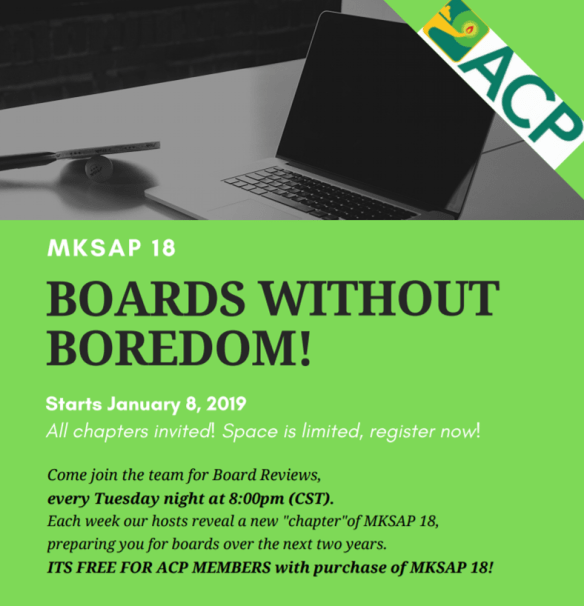
MKSAP flyer

NaBloPoMo 2019

Are you required to do continuing education for your work?

Since 2013, the Illinois Chapter of the American College of Physicians has run a weekly internal medicine board review webinar, MKSAP Live Online Study Hall.  We use questions that ACP publishes through the Medical Knowledge Self-Assessment Program, covering topics in general medicine and its subspecialties, including cardiology, pulmonary, infectious diseases, and rheumatology.  Every Tuesday night at 8pm Central time, two of us moderators and one webinar organizer get online and review about 14 questions, SAT-style.  We interact with audience members through a chat function on GoToWebinar, and we poll some of the questions each session.

I love this program for multiple reasons.

First, I was there when it started.  Gathered around then Governor Dr. Marie Brown’s dining room table, a handful of local ACP members brainstormed and created what is now an international, comprehensive internal medicine board review webinar series.  After some playful, off-topic, post-prandial banter between Dr. Sean Greenhalgh and me, our colleague across the table said wryly, “I’d watch that for an hour.”  Hence the dual-moderator, morning radio DJ style webinar was born.  That was in the fall of 2012, and the Study Hall is now halfway through its third two-year cycle.

Second, I get to hang out with my doctor friends online.  Besides Marie and a couple others, I did not know any of the dozen folks involved in the project before that night at her house.  We did improv workshops at the beginning to form our team and ease our communication skills.  Since then we have all become friends—a clique, even.  We have followed kids’ graduations, births of babies and grandbabies, and some personal challenges as well, all while getting together every few weeks to talk shop for an hour online.  We have even become celebrities of sorts—first at Illinois Chapter meetings and now sometimes at ACP National, people come up to us to say how much they like the program.  We’ve become a fixture in some colleagues’ lives.  We feel pretty proud and special about that.

The best thing about the Study Hall, though, is that just in the space of one hour on a Tuesday night, I am consistently humbled by the sheer volume of knowledge there is to absorb, just in internal medicine.  This is only one specialty of the whole medical profession!  And it’s not just the volume—it’s the complexity, the context, and the ever-evolving research, diagnostic and treatment development, and guidelines.  MKSAP publishes a new set of comprehensive questions every two years, and I do not envy the writers their colossal task of keeping us all up to date.  Without fail, every session I learn something that I will use the following week in clinic.

As this month of daily posts progresses, I feel increasing awe and gratitude for all of the people and opportunities in my life.  Thanks to all my colleagues, leaders, family and friends who make this life so full and loving.

November 18:  Relentless Curiosity Makes Me Better

IMG_4440

NaBloPoMo 2019

“Be patient toward all that is unsolved in your heart and try to love the questions themselves, like locked rooms and like books that are now written in a very foreign tongue. Do not now seek the answers, which cannot be given you because you would not be able to live them. And the point is, to live everything. Live the questions now. Perhaps you will then gradually, without noticing it, live along some distant day into the answer.”
― Rainer Maria Rilke

Tonight, in the month of gratitude, I feel deeply thankful for Coach Christine.  I might have been a curious person all along, but it was not until I got a life coach that I learned the vast and profound value of curiosity in every realm.  As I wrote earlier this month, standing always in curiosity liberates my mind.  It relieves me of unnecessary urgency for an answer.  I can exercise professional creativity in forming better and better questions, and the answers (often multiple, intertwined, and intriguing) emerge more easily and artfully than if I chase them demandingly.

The business of medicine is to solve problems, to heal, to cure.  So we assume that the faster we get to answers, the better.  And they had better be the right ones, because lives are at stake here!  It’s always interesting to me when patients talk about my work as ‘saving lives.’  I can’t remember a time when I could actually make that claim, at least at all directly.  But to my colleagues—emergency medicine and critical care docs, trauma surgeons, suicide hotline counselors—thank you, you really do save lives every day!

I love primary care because I usually have the luxury of ‘(living) the question.’  When patients present with new problems, as soon as I know they are stable, I get really excited.  I’m liberated to get deeply curious, ask as many questions as they will tolerate, paint the big picture together.  I follow the standard physiologic and diagnostic process initially, which often yields a straight forward answer and plan of care.  But life and work would be pretty boring if that were always the case.  When the usual suspects are all acquitted and the mystery persists, that’s when things get fascinating.  This is when I really get to know a person.  When I ask truly open, honest questions—the questions I don’t know the answers to and that are not meant to lead anywhere—I never know where the conversation will go.  And I always learn something new and relevant, something that helps me connect.  This is the information that makes a person memorable, because it is truly unique to them.

One of my favorite moments in a patient encounter is when I have to pause a few seconds to form a really good question.  What do I really want to know, what am I after, what will really break open this conversation?  It happens regularly, and wow, what a rush.  OH, I just never know what I will learn!  You’d think people would get impatient and grumpy with such prolonged, sometimes meandering interrogation.  But I find that they often lean in, look me in the eye.  They get on the train with me and look as eagerly as I around the next bend.  What will we find?  Let’s explore together!

Relentless Curiosity.  It’s the funnest part of my work.  I love it.  And as we all know, loving our work makes us better.