Study… Then Experiment!

Experimental Sven bread ~4.0

NaBloPoMo 2021:  Do Good, Kid

How do we build confidence to try new things?

Sven the sourdough starter is now 13 days old and thriving.  Its texture gets silkier with each feed, the rise faster and more reliable, even from discard out of the fridge.  Still, I hesitate to try making a real sourdough loaf.  I think it’s the sheer labor intensity of it—seriously, it can take 12 to 24 hours start to finish—ya gotta be dedicated in ways that I just am not…yet.  It’s also the measuring.  Bread recipe ingredients are written in terms of weight rather than volume, and in grams.  This requires a kitchen scale, which I do not have and am reticent to purchase.  And that’s the last thing—equipment.  While it’s possible to make good bread in an open oven, the great stuff comes out of a Dutch oven, which would require yet another investment of money and cabinet space.

So of course, over the past week, I have flouted conventional wisdom and experimented with Sven.  I read various discard recipes and attempted some metric weight to English volume math conversions.  Eyeballing amounts and substituting random baking pans for a Dutch oven, I made a fantastically dense sourdough brick in the toaster oven, and then a Kalamata olive Frisbee in the big box.  So sad!  It was really discouraging, especially since I had had such fun with successful quickbreads and onion pancakes recently.

But all I had to do was study a little more.  I love the internet!  I knew I had a starter:water:flour ratio problem, so found this article that explains the right proportions.  The author mentioned Mark Bittman’s piece on a simple, no-knead bread recipe, which includes a handy video, yay!  But that recipe used instant yeast.  Being committed to using Sven instead, all I had to do was look up how to adapt or substitute yeast recipes to/with sourdough ones—easy peesy!  And bonus, now I know the difference between baking soda and baking powder

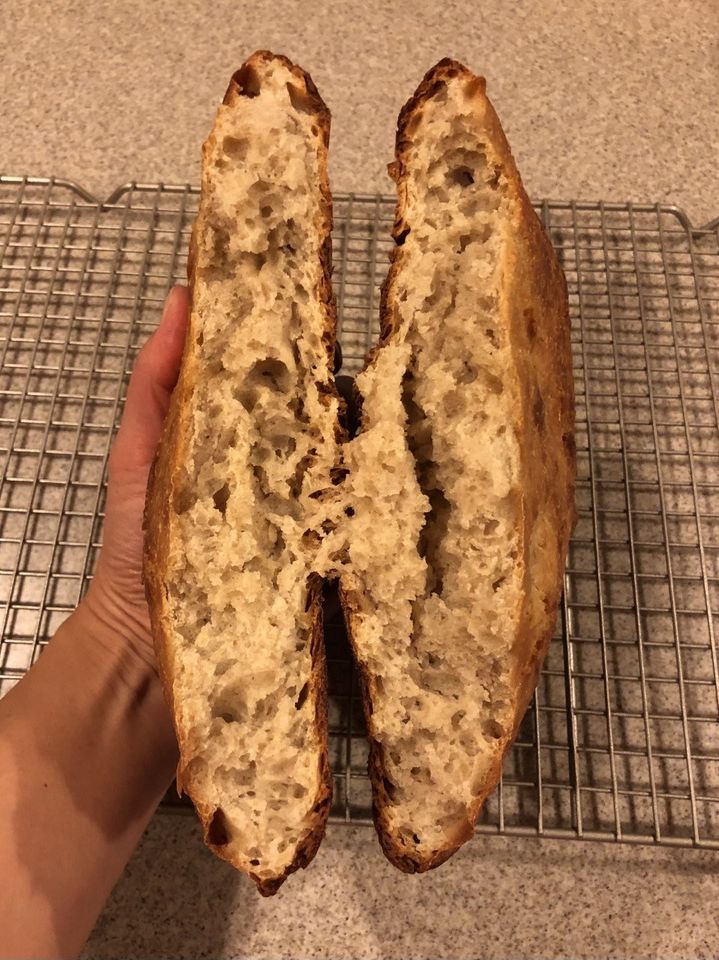
Still, I resisted following any recipe.  I did not want to commit whole loaf-sized quantities of ingredients, only to make potentially inedible products.  My eyeballing better approximated recommended ingredient ratios with the last experiment, and the dough expanded nicely through both proofing periods overnight and this afternoon, though much more laterally than vertically (will study more to figure that one out). I committed and purchased a Dutch oven, rationalizing that it could also be used for other purposes, and followed preheating and baking directions.  And voila!  I got a little loaf with a beautiful, crackling brown crust, a pleasing aroma, and an internal texture that could arguably be called bread.  YAAAAAYY!  We opened it while still warm, and the kids and I ate half of it inside five minutes.

Tonight I took the leap of faith and dropped 3 whole cups of flour in the mixing bowl, along with a quarter cup of Sven and the prescribed amount of water and salt in the NYT recipe. While it incubates under the kitchen sink, I will go out again tomorrow and get a digital kitchen scale. *sigh* I know now that for this project, I have to study and imitate before I can improvise. Using the scale will teach me how to eyeball 500 versus 800 grams of flour, and proportionally how much water and starter to use. With repeated practice I can overcome my aversion to getting my hands gooey (hello, spatula), and learn how dough feels, stretches, folds, laminates, etc. After a while, as in so many fields, cumulative experience will found, and then strengthen my intuition. Eventually I bet I won’t need the scale for the methods I use most often.

Then I can embark on the next fun cooking adventure that may require a scale—one never knows…  Daughter and I binged the end of season 2 of The Great British Baking Show last night, which we both found quite inspiring… Choux buns, anyone?

Toaster oven Sven brick
Kalamata Sven frisbee
YUMMO Sven green onion pancakes!
Sven success!

Celebrate the Return

NaBloPoMo 2021:  Do Good, Kid

How often do you say to yourself, “I knew better than that”?

I am 48 years old—how many more times will I have to relearn lessons that I thought I had integrated already?  It’s all the things I write about here—for the last six years, and studied since long before that—Give the A; take a deep breath; withhold judgment; embrace polarities and paradox… Often, if I’m paying attention, I observe myself walking these talks.  But maybe just as often, I look back on an interaction and realize I completely forgot to practice one or all of these fundamental skills.

Before I get too down on myself, though, I can usually look a little farther back and see how much I really have progressed over the years. That’s one of the best things about keeping a blog for so long—I can read any of the last 430+ posts and see clearly my mindset then versus now. I have evidence for how I am exactly the same person and also a better version of myself today than in 2015. That is reassuring, and motivates me to stay on the path of inner work.

Mindfulness meditation teachers talk about ‘monkey mind’—the tendency for our thoughts to flit from one tree to another, hard to focus or apprehend, constantly bringing us away from the present moment, often speaking in regret about the past or anxiety about the future, making lists of tasks, grievances, aspirations, barriers, etc.  But in this school of inner work, we don’t judge the mind for its capricious vaulting from one state of disquiet to another, so often in random, exhausting chaos.  We walk the talk by simply noticing the wander, and then practicing the return.  It’s about being with what is, including how we feel about it, without judgment, and learning from what that awareness has to teach us.  We strengthen our internal practice of centering, grounding, focusing, and engaging ourselves and our world with more peace and magnanimity.

If I know where my center resides, then my personal compass is always accurate.  No matter where my experience leads, which core skills I forget, even in the most intense emotional hijack, I can always find my way back.  No matter how far afield I have roamed, for however long, I can learn and return.  I can bring new and relevant awareness from before, to whatever comes ahead, by way of this present moment.  I do this when I return to myself—to my why, that which gives me meaning and purpose—and that roots me.  I can refresh, recharge, reassess, and restart.  And that is definitely something to celebrate.

Be Respectful

NaBloPoMo 2021:  Do Good, Kid

I can just see every writing teacher cringing to see ‘Be’ as my verb in this action mantra.

I just cannot think of a better way to express this fundamental admonition.  It’s like the cheer we all know from high school—instead of ‘aggressive’, it’s, “R.  E-S.  P-E-C-T-F-U-L.  Be. Respectful.  B-E Respectful!”  Ha, the two words even have the same number of letters so the rhythm transposes perfectly.  Hmmm, maybe we can start a movement from the sidelines here.

In the grocery check-out line.  At the Target returns desk.  On the phone with customer service.  Driving.  With your in-laws, your coworkers, your spouse, your children, your direct reports, the building custodian. With your kids’ teachers.  With elected officials.  With people who disagree with you on issues that matter deeply to you.  With the person aggressively disrespecting you to your face.  With the authoritarian police officer using excessive force, the boss acting out of sheer prejudice, even malice.  With the militant supremacist throwing rocks and spitting at you.

Why be respectful? Because it’s the best way to show that you see the other person as also human, equal in worth to yourself, even if they don’t feel or think the same about you. They may say they do—don’t we all say it? It’s not socially acceptable to say out loud that we think someone is beneath us—at least not in public, or ‘polite society.’ Is there actually even such a thing anymore, polite society? Every year it seems easier for people to demean one another out loud, viciously, violently, in public, with no politeness whatsoever, and no consequences. I think every one of us needs to query ourselves truthfully about how much we really value and believe in equality, and get honest about where we don’t: Own it. Stand up and accountable for it.

But if we are sincerely convinced that we see all humans as equally valuable, that we harbor no occult supremacist ideals, then the least we can do is be respectful toward one another in all of our interactions. It may even serve as a prophylactic, keeping us from speaking or acting on our latent negative biases, if we simply commit to practicing respectfulness.

Disrespect is the first arrogant step down the slippery slope of dehumanization, and that descent leads straight to relationship hell.