
Fifteen Years’ Perspective

Which fifteen years of your life are particularly meaningful, memorable, or important to you?

I have practiced medicine for 26 years now, 15 of them at my current place (nice mug, isn’t it?). A handful of patients have been with me since I started here. I met them in their 50s, and now they are all Medicare age. We’ve been through some stuff together. In that same time, I have aged from 36 to 51. Reflecting on last night’s post, it occurred to me to compare my fifteen years to each of theirs, a juxtaposition of life stages in real time. Then I thought about my kids’ fifteen years: 6 to 21, and 2 to 17. Even the few years separating their ages feels like a significant delta, which surprised me and also not.

It’s a reflection on change, growth, evolution, and relationship.

I wrote last week that I feel more connected to people now than ever; this week I am positively swimming in oxytocin. The three friends who met one another last week on Zoom and I are still reflecting on our gathering and I, for one, marvel with glee at the connections we made so easily and deeply. I have delivered more jar smiles to friends, sparking conversations and smiles for them and me both. When I think of my longest known patients and how well we know each other, how easily we navigate new issues and shared decision making, I feel loyal, peaceful, protective, and grateful.

The past fifteen years have been dense and intense, full of everything. Lots of disruption (including but not limited to politics and pandemic), and also steadfast stability and anchored strength. I think my most important learnings are not taking anything or anyone for granted and the value and benefits of mindfulness. Self-compassion, non-judgment, and deep, unwavering curiosity also emerge as foundation practices; they move me closer to that inner peace that I want to live and die with. Fifteen years’ perspective sharply clarifies a particular segment of my journey in mind, body, spirit, relationships, and world view.

Looking ahead feels no less profound. Between now and 66, barring any traumas or crises, I wish for us all continued growth, evolution, and connection. Changes in our social fabric feel accelerated and chaotic, uncertain and even threatening. I still submit that we always get to choose our response: mindset, energy expenditure, agency application. We can make the most of whatever time we are given; we create our own experiences to a large degree. Our subjective sense of control (mostly an illusion) and agency (too often underestimated) matter moment to moment and thus year to year, decade to decade.
A5R: Attune, Attend, Assess, Adjust, Adapt, Repeat. Forgive my redundance–it just keeps coming up. So I’ll let it. It’s integrating. Nice. I think that’s how it should be.

100 Pregnancies

Shane East, Instagram, January 28, 2025

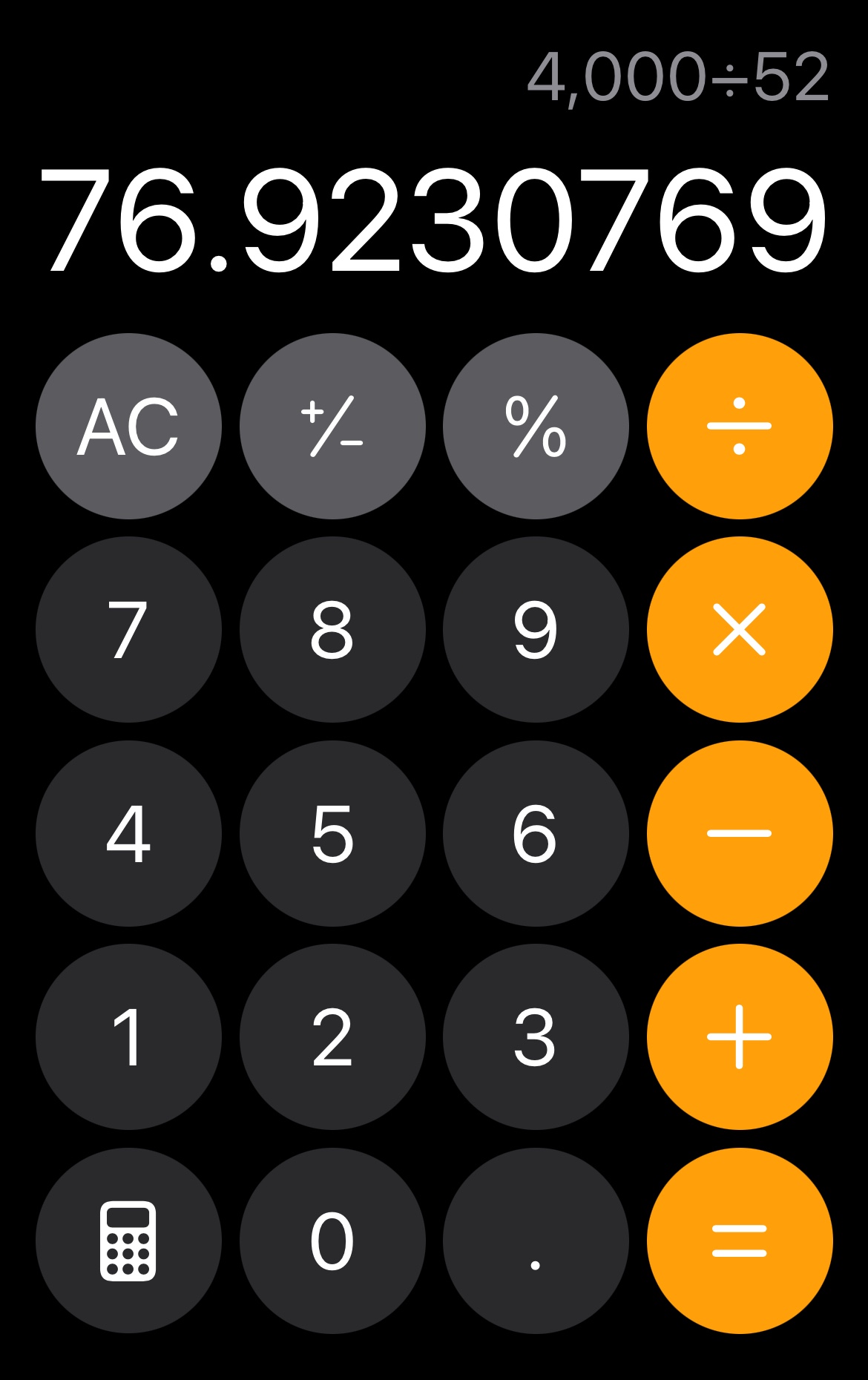
“How many weeks to you think the average human lifespan has in it?” asked Shane East on Instagram, on January 28.

I did the ballpark math in my head as I listened to the rest of the reel, and it seemed about right, somewhere around 78 years, I thought. But to express it in weeks gave no perspective for me at the time. Years and decades are much more my speed.

Then, weeks (ha!) later, it occurred to me that pregnancy is measured in weeks, and expected to last 40. So in one of those ah-HA! shower moments, I realized that by the time we are born, we may already be 1% down the road to death. Huh. So if a pregnancy is 1% of an average human lifespan, then a whole lifespan is 100 pregnancies.

Suddenly 4000 weeks had a whole new meaning in terms of duration, potential, and load. What else do (or could) we do (or witness, or cause, or anything) 100 times in our life? How many puberties, summer camps, college degrees, PhDs, MDs, and residencies is 4000 weeks? How many relationships, sex partners, attempted and failed new experiences or jobs?

How else can we frame the length of an average human lifespan to shake our perspective and make different meaning? Why would we want to?

How does the length of your life, to date and pending, make sense to you?
How do you chunk it?

What is y/our relationship with death?

And as the wise Mary Oliver asked, “Tell me, what is it you plan to do with your one wild and precious life?” (Shane has posted this question before, also. He is my people.)

Living toward death–it’s another fun paradox of reality that I love to ponder. And it always brings me back to, “Live in peace to die at peace.” Easier said than done, and I won’t know until the end if I can walk the talk.

Does it feel morbid or fatalistic? Not to me. Rather I feel mindful and realistic, present and optimistic. I get to choose what meaning I make out of 4000 weeks, 100 pregnancies, or however else I consider my time in this body, on this planet, at this time in history, whatever is happening at any time.

I have agency. These days, that may be the most important meaning I can embrace and express.

Connecting Through Meaning

Sometimes you just know connection is imminent and when it happens, your world sparkles better than the best fireworks over the clearest water.

I follow AJ, a wonderful artist and creator, and joined his Patreon. He invites questions from patrons and answers them on monthly videos. He is a lovely human above all, and also a musician, a composer, a filmmaker, a lover of all forms of life, and a remarkably effective gatherer and leader of community. He is generous, kind, honest, humble, and an empath. AND he’s a NERD! So when I started to noodle on the nature of meaning, I knew I had to invite him to think with me. The question:

“Thinking about the aspects of meaning. If we were to plot meaning on some kind of 3D map, what would the axes be? What is the nature of meaning? I’ve never asked this before so I’m only starting to wonder. So far I’m considering x = cognitive, y = emotional, z = relational. Or combine cognitive and emotional into x = psychological, y = relational, z = importance. Or maybe it’s just not a useful or worthy idea? It’s just fascinating to me that we can all observe the exact same event, article, speech, etc. and each come away with wildly divergent experiences. How do we make these experiences for ourselves and how can we more easily and effectively understand, empathize with, and hold space and love for experiences that diverge from our own? What think you…?”

Over a few days my own cogitation persisted:

If we define meaning as a 3-dimensional entity, then it has a volume and a density, among other properties. It is also fluid, I decided. Meaning in any moment can change, shift, and/or transform, according to values, goals, context, additional information, perception, and experience. The scale of each axis can be defined ad hoc, for example, linear or exponential, by minute or millenia, atomic or cosmic. There are just so many ways to consider, to imagine, to analogize, am I right? It’s one of the FUNNEST and most joyfully mind-bending questions I have ever asked, I think! I literally made myself giggle with it.

Interestingly, I stopped wondering and felt content to pause my exploration once I decided meaning is like a murmuration of starlings (see embedded link for another time I made this analogy). It is finite, has a shape that moves and changes conformation constantly, freely, and fliuidly but not randomly. It shifts in response to both extrinsic and intrinsic signals. It exemplifies A5R, no (this just occurred to me as I write now)? Attune, Attend, Assess, Adjust, Adapt, Repeat.

Meaning, like a murmuration, is alive. How awesome!

Not many people may appreciate or share the deep, giddy, goofy joy I get from this exploration, but I was pretty sure AJ would. Here are highlights from his video response:

“Cathy, what an unbelievably interesting question. I-I love that!” (said with that squinting, nose bridge wrinkling expression of joy) “That’s going to get the old cogs turning in my brain, I know it… What I want to do… is just sit silently for about 45 minutes thinking about it…” What made it “particularly compelling for me is: How are all of own personal axes calibrated?”
YAAAAASSS!!!
“And what does that say about how we perceive and experience particular events and what makes them meaningful to us, and therefore, is it that our axes being calibrated in a similar way to one another, is that what allows us to relate more closely to each other and perceive the world in the same way? If yes, what are the contributing factors to an individual’s calibration?”
AGAIN, YES!! Oh my goodness, I feel so seen by this response!

These are exactly the questions I wish for us all to take time and energy to ask and explore. I’m not that interested in or attached to any particular answers, because 1) meaning is limbic and any verbal answer is likely a cognitive rationalization [NO judgment here–we all do it and it’s how we get through life–I just want us to admit and accept it], and 2) any meaning we make now is likely to evolve, and I want us to be aware of and embrace that constant evolution, to always stay open to it for ourselves and one another.

Imagine how much more collaboration, less conflict, and greater connection we could all enjoy if we could be more acutely and honestly attuned and attentive to how we make our own meaning, and hold bigger and more loving space for how other people make theirs?

AJ agreed that psychological, relational, and importance are three good axes to start with. How validating, to have another thoughtful mind appreciate the thinking that I already did–he even acknowledged how combining cognitive and emotional into psychlogical ‘freed up’ the third axis to add another dimension–Exactly! He called it analytical and insightful, and said my perspective was ‘finely tuned’. Why thank you, thank you very much. *sigh*

In the end, my friends, aren’t connections made through shared meaning the most–ha!–meaningful ones we can have? And don’t they just make life so much better?

“I’m so grateful that you’ve written that down,” AJ said at the end.
So am I, dear one. So. Am. I.