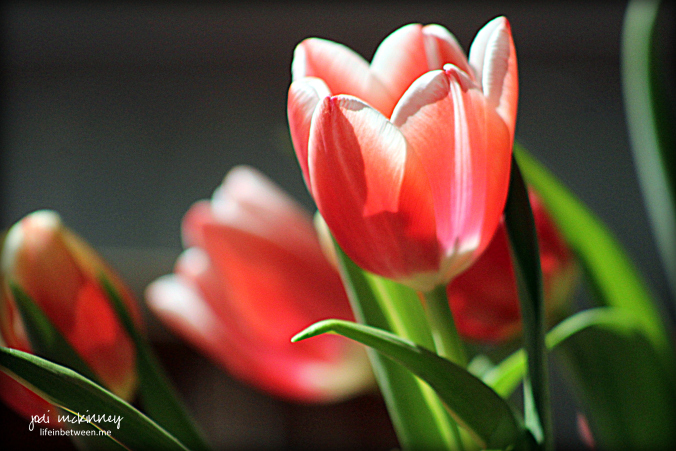
#AtoZChallenge: On Belay!

Lately I feel like I berate my kids. Could you please rinse your spoon?  How many times do I need to tell you to pick up your clothes?  Please, thank you, please, thank you, please?  Maybe I’m tired, stressed, sleep deprived; maybe I’m just irritable.  I don’t like it.  I’d rather guide them with more patience and love.  Like Toni Morrison said, “You think your affection and deep love is on display, because you’re caring for them.  It’s not.”  She asks, “Does you face light up” when you see your children?  In other words, can they see and feel your love for them when they see your face?

I don’t want to berate. I want to belay!

I first learned this word at a ropes course, maybe in high school. It’s a climbing term many of you will know.  Dictionary.com’s mountain climbing definition of belay is as follows:

  1. To secure (a person) by attaching to one end of a rope.
  2. To secure (a rope) by attaching to a person or to an object offering stable support.

I remember hearing, “On belay!” as part of the climbing sequence. A quick Google search of the phrase yields this explanation:  “Your belayer…lets you know that he is on belay and that it is safe for you to climb, saying, ‘On belay.’”  The voice commands before climbing commences are:

Belayer: “On Belay.”

Climber: “Ready to Climb.”

Belayer: “Climb” or “Climb on.”

Climber: “Climbing.”

I want to be the belayer, the anchor—of character, behavior, confidence, and love—from which my children can cast themselves. They need to know that I am here to secure them, the stable place from which they can strive for new heights.  In order to do this, they need to know that I believe in them, that I see their essential worthiness.  I could say something more like, “Hey, I know you’re a good kid and you want to help out.  It really helps keep our home clean if you pick up your clothes from the floor.”  It’s much more mindful.

Recently the actor Tom Hiddleston appeared on The Late Show with Stephen Colbert, to promote his new movie, “I Saw the Light.”  Hiddleston, a Brit, plays Hank Williams, the iconic American folk singer.  I already love both Hiddleston and Colbert, so I could not wait to watch the video of them singing a duet on the show.  It turns out that Hiddleston had never sung before this role, but did all the singing himself in the film.  Colbert invites him to sing, live and impromptu, on the show, and what follows is a perfect study in belaying.  Allow me to dissect and interpret:

2:18   Stephen first invites Tom to sing.  Tom expresses apprehension.  The crowd goes wild and he looks conflicted, as if he mostly does not want to sing.  He tries to quiet the crowd but they are rowdy.

2:33   Stephen lightens the mood by playing spoons on the desk.  He makes it safe for Tom to consider the invitation, buys him some time to decide.

2:36   Tom says if we want to see him sing, we should see the film.  He looks almost deflated, like he feels at once dutiful to have plugged his movie, and disappointed that he might have passed up a chance to perform.

2:41     Stephen chuckles playfully and says, “Okay, uh, we’ll see.”  He’s thinking of another way to coax Tom out a little.

2:45     Stephen promptly finds a way to relate to Tom—says he grew up on Hank Williams.  He appeals to Tom’s admiration for the singer, makes a connection.  He suggests they sing “I Saw the Light,” the title track from the movie.  Tom still looks disinclined.

2:56   Stephen gets a riff from the band, and sings the first line of the song.  It’s pitch perfect, and completely authentic.  He puts himself out there first, an honest and vulnerable invitation for Tom to join in.  On belay!

3:03   Tom has been holding his breath, and lets it out in a reluctant puff, shaking his head.  You can still see his conflict, and you’re rooting for him.  Jump in, Stephen will hold you up!

3:10-5   Tom sings the second line with Stephen, slowly, and in perfect harmony.  He’s still sitting back, a little stiff, hands clasped in his lap, cautiously accepting the invitation.  Ready to climb!photo 1.PNG
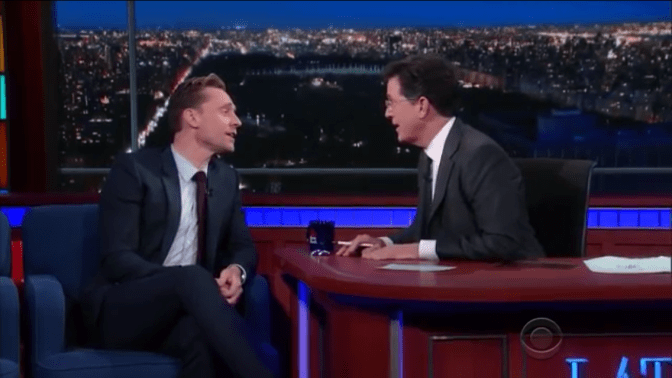
3:26   Tom starts to lean forward toward Stephen, engaging more.

3:29   The band starts playing in earnest and the audience immediately starts clapping enthusiastically.  At this point you just want to get up and dance, the energy palpably rising.  Climb on!

3:34   Tom breaks a smile while singing—a big, joyous smile.  photo 2+.PNG

3:37   His shoulders relax, he gets animated.  He leans in further, starts to really have fun.  Climbing!

3:45   Tom turns to the audience to encourage them in return, while Stephen interjects, “Everybody!”  Tom starts to clap, and sings to the audience.

3:55   Tom’s really enjoying himself, he’s into it.  If you’re not moving your body by now, there might be something wrong with you.

4:06   The finale starts.  Tom leans into Stephen again, following timing cues as the chorus slows.

4:15   He looks to Stephen, grateful and maybe a little relieved, and also very glad that he took this chance to sing and have fun.  photo 3.PNG
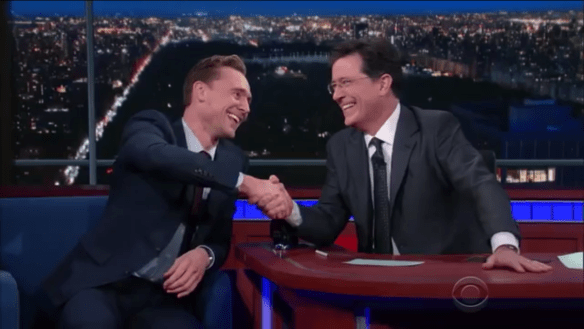
4:19  After shaking hands, Tom lightly hits the desk with his fist.  I bet he’s thinking, “Nailed it.”  photo 4.PNG
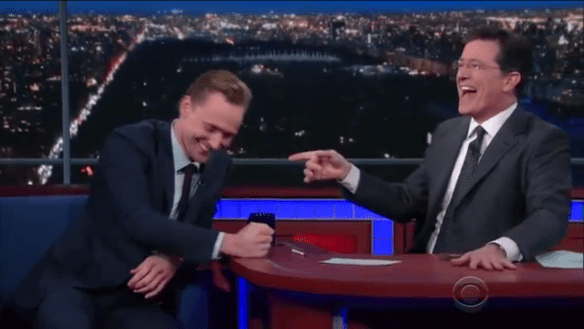
 

The interview starts with the two men talking about Hank Williams’ troubled life, his ‘formidable demons,’ as Hiddleston puts it. He expresses compassion for this, as I have seen him do in previous interviews about other characters he has portrayed.  He describes how Williams rose to stardom quickly, but ‘with no real support, no one to anchor him.’  Funny how he uses that word, anchor—like belayer.

We all need our anchors, our belayers. They are the people in our lives to whom we secure ourselves, and who look out for us.  Thanks to them, we can climb on, toward new experiences.  From their stable posts, we can stretch out and grow.  And when one of us grows, we can all grow.  Or in the case of this video, we all at least have a great time!

We can belay one another in seemingly the smallest ways…or maybe they’re not so small after all.  I bet Tom will remember this duet his whole life.

#AtoZChallenge: Assumptions and Appreciation

Welcome to my first attempt at the Blogging A to Z Challenge!  26 posts in April, one for each letter of the alphabet (I get one day off per week).  I will explore meaningful words to apply to perceptions, attitudes, behaviors, and relationships. It’s a personal journey, part of my mission of self-assessment and development through writing.  Thank you for stopping by, and please feel free to comment! 🙂


Yoga instructors. Football players.  ER nurses.  Asian college students.  Old white men.

Hold these likenesses in your mind’s eye for a moment. Who do you see?

Was the yoga instructor a man or woman? The football player?  It’s impossible not to make assumptions, to apply stereotypes.  Such constructions help us make sense of the world.  They allow us to move through countless human encounters quickly and automatically.  And, they can limit us far more than we realize.

One spring day my kids and I sat in the car, waiting to exit the parking lot after church. Three men, Caucasian, in their 60s, crossed in front of us.  They were well-groomed and overweight—grandpas, likely.  Their expressions were neutral, absorbed in conversation.  One of them looked a little winded from walking.  They were perfectly unremarkable, and they did not notice us.

I felt an acute flash of fear.  It was visceral, as if, at any moment, they could decide that my kids and I were not worthy of being at that intersection, and that they somehow had the power to impact my life in ways that I could not control or influence.  Three apparently unassuming white men.   Fascinating.

I remembered this story when a friend and colleague recently shared this blog post on our assumptions about surgeons.  I realized that despite being married to a surgeon, having multiple surgeon friends, and trying every day to live with an open mind, I still ascribe to the stereotype of the mean surgeon.  It comes out when I hang up the phone after a pleasant conversation with an ENT fellow.  “Wow, he was so nice,” I think, surprised.  Or when I feel righteously annoyed after a terse and condescending interaction with his attending.  “What do you expect,” I say to myself, “he’s a(n old, white, male) surgeon.”  Nobody would ever say that about a pediatrician.

I don’t shame myself for harboring the mean surgeon and old white men stereotypes. They were born of a certain reality and make me appropriately cautious in new situations.  I don’t think I behave badly because of them, and I readily acknowledge when the stereotypes are broken.  But the realization that I hold these assumptions so deeply—subconsciously—gives me pause.  What other assumptions do I carry, and how do they limit my relationships?  I think it’s fair to say that we all carry shards of racism, classism, and other forms of blatant prejudice.  Here’s what I also think:  It’s okay.  We can’t help it, that’s just how it is.  Denying it just makes it that much more insidious, subversive, and toxic.  I’m prejudiced, you’re prejudiced, we’re all prejudiced.  The more we say it, the less scary it gets.  The first step is acknowledgement without shame.

But we cannot, and must not, stop there. We can’t only say, “We can’t help it, that’s just how it is.”  We must take the next step, which is to manage it better.

I think an excellent antidote to toxic assumptions is appreciation.

Dictionary.com includes the following definitions of appreciate:

  1. To regard highly; place high estimate on: to appreciate good wine.
  2. To be fully conscious of; be aware of/ detect: to appreciate the dangers of the situation.

Let us first fully appreciate (be aware of/detect) the scope of our prejudices: Their cultural, familial, or experiential origins, their subtle influence on our perceptions, and the covert ways they manipulate our thoughts, words, and actions toward others.  Awareness is key.  It is also hard.  It’s hard because we know we shouldn’t be prejudiced, it’s bad.  Prejudiced people are bad, they do bad things, we don’t want to be like them; if we admit our prejudices then that means we are bad, that we are not worthy.  STOP.  The only way to keep from acting on our negative stereotypes and perpetuating racism and xenophobia is to fully acknowledge their existence and confront them, head on.  They do not define us.  They are not all of who we are and what we stand for.  Their presence does not negate all that is good, generous, and inclusive about us.  AND, they are part of us.  We cannot escape them by way of denial.  If we can call ourselves out honestly, lovingly, and with forgiveness, we can then integrate our prejudices, and put them in their place.  Appreciation does not mean approval of, or abject subjugation by, our biases.  It is simply the first step to living wholly, to knowing and owning all of ourselves, and moving with intention and mindfulness.

Then, let us apply the other definition of appreciation to others. Let us regard more highly those whom we may automatically, however subtly, belittle in our subconscious.  How might we do this?  Look for that which we share.  She is a mom.  She must love her kids as much as I love mine.  What are their circumstances, what lessons is she trying to teach them, and what would I do in her place?  Why did he become a doctor?  He must want to help people like I do.  I could never do what he does, so high risk, so much responsibility.  God bless him, we need people like him.

Let us then solidify the process with words, out loud. “I can tell you really love your son.”  “Thank you for caring so much about our patient.”  It may sound trite, even silly, at first.  But we can never underestimate the impact of a few kind words, not just on others, but on ourselves.  When I acknowledge myself in you, I make a connection.  I see you, I recognize you, I appreciate you, as I do myself.  Prejudice thrives in silence and denial.  It cannot long survive being spoken out loud and it certainly withers in the presence of true connection.

We will always make assumptions.  Tempered with some well-placed appreciation, though, perhaps we can get through life with a little more love and a little less suffering.

Choose Flowers!

Some impromptu thoughts on a Saturday morning… Thanks for the prompt, Jodi! 🙂

“Your mind is a garden.
Your thoughts are seeds.

You can grow flowers,
or you can grow weeds.

– paraphrase from William Wordsworth

Choose flowers!
Cherish the moments.

Cheers & Hugs,
Jodi”

I found myself replying to a comment from Kerfe at https://methodtwomadness.wordpress.com/about/, which said, “Although ‘weeds’ is just our perception…all plants have their place in the ecosystem. As a child, I never understood why people wouldn’t want dandelions covering their yard…”

And since my reply was getting a little long, I decided to make it an actual post…

We will all have unwelcome thoughts from time to time, of course!  And we can learn something from taking some time to examine what the ‘weed’ thoughts look like.  How do they change the landscape?  What, if any, danger do they pose, or, can they be integrated into the natural beauty of the garden?  Sometimes they will just have to go–as attractive as they may seem initially.  Destructive thoughts, like invasive plant species, can overtake the peaceful gardens of our minds, and disrupt an otherwise stable, if dynamic, balance.  In the end I agree with Wordsworth–it’s our choice which flora we nurture in our mind’s garden.

We each must take responsibility for that which we cultivate.  As the saying goes, our thoughts become our words, become our actions, etc.  Pollen and spores from my garden disperse to those around me, carried by forces I may not control.  My neighbor’s soil may be resilient to any weeds I accidentally spread.  Or, it may be fertile breeding ground for an invasive species to take hold and multiply recklessly.  Thus, what I allow to grow in my own garden affects those around me, like it or not.

I suggest that we make some conscious efforts at constructive, rather than destructive, gardening.  I’m thinking of politics here.  I have decided to stop posting things on Facebook that make fun of a certain candidate, or ridicule a certain point of view.  That is simply not helpful; those are definitely weeds in my garden and I categorically reject them.  I will try to resist the temptation to be drawn into circular arguments, incited by others’ attacks on my beliefs.  To those who post crass, below-the-belt insults at certain groups, I will actively guard my plot against the spores of hatred by scrolling over your memes.  I invite you, instead, to use your platform to grow things that sustain us.  What beauty can you bring into the world, what foods can you grow to help feed it?  Can you use your picks and shovels to tend, rather than demolish?

I don’t have to like your garden.  You don’t have to like mine.  But I know we can find ways to exist in each other’s presence without mutually poisoning and undermining the earth we inhabit.  If we try hard enough, we may even grow to appreciate our unique combinations of plant life.  Wouldn’t that be so much better?

Jodi's avatarthe creative life in between

Tulips Pink Spring

Your mind is a garden.
Your thoughts are seeds.

You can grow flowers,
or you can grow weeds.

– paraphrase from William Wordsworth

Choose flowers!
Cherish the moments.

Cheers & Hugs,
Jodi

View original post