Even the ‘Oppressor’ Deserves Safety and Support

This weekend I reflected in gratitude at my LOH experience in the past year. After resonating with Dr. Suchman’s moving keynote at a physician health conference in 2018, I sought him out to express thanks. He encouraged me to apply for the program. Then he coached me twice on getting institutional support, something I had never done before. All through the program, he and Diane Rawlins, two of the best teachers I have had (and that is saying a lot), led us all through ten months of complex conceptual learning and skills practice. Even better, they helped us synthesize and integrate learning between sessions, applying concepts through practice in our natural habitats, knowing we could report back to the group to debrief and trouble shoot before heading back into ‘the trenches.’ LOH runs annual reunions, refreshers and mixers during which attendees from different cohorts can meet, bond, and both expand and tighten our community of lifelong learners. In the time of COVID, alum meetings have occurred about every two weeks over Zoom, from the comfort of our homes all across the country. The more I think about it, the more I wish everybody had this kind of safety and support—this loving learning lab and community—to acquire scary new skills that, when practiced, benefit many more people than just us learners.

I imagine this may be what participants in the White Men’s Caucus feel. Read all about it in Four Days to Change, which I started and finished in about three sittings. –No really, read this book. It provides a unique and profoundly important perspective on the true meaning of inclusion, that is, white men absolutely need to be included in leading and benefiting from systemic change for equity, not just passively doing the changing for others’ sake. During the Caucus retreat, white men are both challenged and supported to dig deep into their own privilege. Inescapable mirrors of truth and profound discomfort, and also of love and compassion, surround them for four days. They are expected to feel tremendous guilt and shame, both natural emotions that occur on the path of self-discovery and humility. But rather than weaponizing these feelings, facilitators love the attendees through them, shepherding them through the emotional (shit)storm to a place of self-compassion and forgiveness. This is where their outward humility, openness, and sincere advocacy for inclusion and diversity take root—because they experience it first hand from their teachers and peer learners. Leadership is hard enough, but leading initiatives in diversity, equity, and inclusion is a whole other dimension of complexity. How can we expect any leader, white male or otherwise (but white males especially), to do it well alone, without a core peer group willing to hold their feet to the fire with both love and conviction?

I wrote earlier this year, “Practicing inclusion INCLUDES the OWG (Old White Guy) ‘oppressor’!  If we talk only about him needing to include others, while we make him feel excluded himself, how can we ever expect to enroll him in our cause or even behave in the way we ask? We do how we feel. And when we feel threatened and marginalized, especially from a place of loss, we act accordingly.” 

Michael Welp writes in Four Days, “(My mentor) inspired me when he (said), ‘The only way to touch other white men is through love.’  His words have always stayed with me.  However, the overall pattern observed in my dissertation was that white male diversity advocates disconnected from other white men and drew most of their support from white women and people of color.  They were frustrated and angry toward other white men.” 

Imagine people of your own tribe, a tribe you may lead in good faith, suddenly confronting you about biases and prejudices that you never knew you had, telling you how you’re harming people all around the tribe, and that you have to change it all now, adopt a new set of beliefs and initiatives today, and they will accept nothing less than your complete and unquestioning compliance because you are simply in the wrong.  Would you respond better if they came at you with such accusations and demands, or came alongside you with a grave and critical invitation to curiosity and learning together, for the good of the whole tribe, yourself included?  Which approach is more likely to yield tangible results in the near term?  Which one is more likely to still engage you in the long term?

We can learn important lessons from addiction medicine.  Patients succeed in rehab with a lot of grit and commitment.  They also benefit from the unyielding support and dedication of treatment staff and various environmental safety precautions.  But relapse rates are high (40-80%) in no small part because the safety and support so crucial to getting sober in rehab too often simply do not exist in an addict’s natural habitat.  

The converse was found to be true among American servicemen who fought in the Vietnam War.  Up to 20% of them were found to be addicted to heroin while overseas.  But upon return, only 5% of those who recovered relapsed.  After rigorous study (by a well-respected woman researcher, whose results and report were initially questioned and even derided—but that’s for another post), it is now widely accepted that the environment plays a key role in our behaviors, habits, and ability to change.  Soldiers in Vietnam, as James Clear writes, “spent all day surrounded by cues triggering heroin use: it was easy to access, they were engulfed by the constant stress of war, they built friendships with fellow soldiers who were also heroin users, and they were thousands of miles from home. Once a soldier returned to the United States, though, he found himself in an environment devoid of those triggers. When the context changed, so did the habit.”

The system often dictates, or at least strongly influences, how we perceive, think, behave, and relate. And we are the system, every one of us. By assimilating to the dominant white male culture, even as we see ourselves as resistors, we perpetuate it. But when we resist by only opposing our white male counterparts, without also enrolling them in the resistance movement as equals, we also undermine our own progress. Everybody deserves the safety and support to do their own personal Reckoning, Rumbling, and Revolution, as Brené Brown describes in her book Rising Strong. Real positive change is grounded in vulnerability, humility, and courage. If we really expect our white male leaders to change in ways fundamental and profound enough to advance equity in any meaningful way, they need the safety and support to reckon and rumble with their resistance, their rage, their fear, culture, identity, relationships, memories, realizations—all of it—with people they can relate to and who can hold them up fully, who will not turn away from or against them. As I wrote last week, more and more I see that perhaps only other white men can truly do this.

To be clear, this post is not an apology for white male supremacy and the vast suffering this mentality has wreaked all throughout history.  I just think it’s important, and too seldom attended to, that white men also suffer in and from the culture they dominate.  And in order to really change this culture for the better, we all need to support one another, white men included.

Not Just Words

IMG_5293

Friends, it’s been another week of observing, processing, learning, and integrating.  Holy cow, I really need this vacation.  I need nature, time with family away from work, away from the news.  I need to take a breath.

Things feel different this time.  I think this cautiously; I allow it—hope.  Change will be incremental and slow, but I feel a real acceleration today.  Equality is an infinite game, and we who play to advance it find ourselves in a moment of palpable solidarity and purpose.  But what comes next?  What will the field look and feel like at the end of the summer?  In a year?  In ten years?  When my kids are my age? What progress will we look back and see, initiated in this movement of 2020?  How can we make this a turning point?

IMG_5367

Stories

First, we must seek to understand the scope and nature of the challenge.  For many of us this means listening.  “Facts don’t change our minds.  Friendship does,” James Clear writes.  We humans are not rational, logical beings at our core.  We change our minds when we can relate to someone else’s experience, and the best way to do that is to listen to their stories.

Here are some stories that moved me this week:

Reflections of a Token Black Friend by Ramesh A. Nagarajah:  I think back to when my friends never understood why I wasn’t allowed to play with water guns — or any toy guns, for that matter — when I was a boy. I’d be so excited to visit a friend’s house and use their airsoft gun in the backyard. I used to get so frustrated when my mom told us it was “too dangerous” for black boys to do that and that someone would mistake it for a real gun. When I was 16, 12-year-old Tamir Rice was shot and killed while playing with a replica toy airsoft gun. I realized my mom was right.  …I think of the way the black girls were treated as second rate in high school. Guys rarely tried to talk to them romantically, and if they did, others discussed it with an undertone of comedy. I never felt this way, personally, but didn’t realize until college that my silence was compliance. I was participating in denying dignity to the black women around me.

A passionate and powerful video by Kimberly Jones, author of I’m Not Dying With You Tonight, which is now in my queue.  Listen and watch to the end.  Embrace the discomfort.  Whatever you experience in these few minutes is nothing compared to what Black people have suffered for generations.  Then mull over her last sentence.

A heartfelt and important essay by Dr. Marie Ramas, on her role as a Black woman primary care physician during a pandemic:  Once again, as a healer working in a system seemingly based more on economics than wellness, I felt forced to make an impossible ethical decision. Then, I realized that the underlying question for me to answer was not whether I would treat individuals at the risk of my own self. Rather, I needed to pan out my scope of view and ask, “How can I help rebalance the scales of justice to reflect the inherent worth of the black and brown lives that I both serve and represent?”

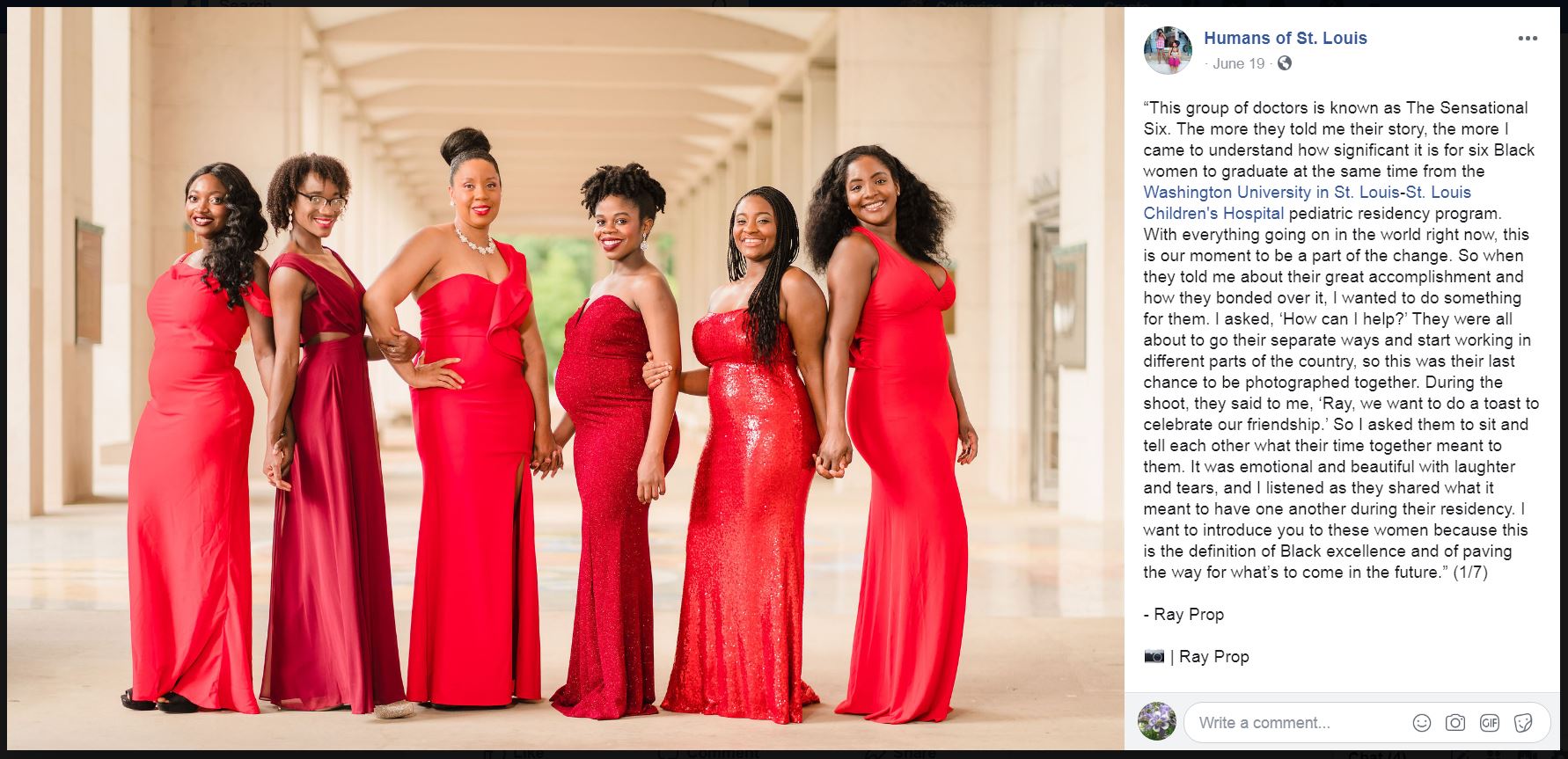
Sensational six FB Humans of St Louis 1 of 7 June 2020

The Sensational Six:  Six Black women graduated from the pediatrics residency at Washington University St. Louis this month.   Follow the link to read the 7 consecutive posts about these remarkable women, and look for their mark on our future.  Their names are

Fehintola Olaiya, MD
Stephanie Diggs, MD
Frances Annan-Fohtung, MD
Mia Henderson, MD/PhD
Olivia Beaubrun, MD
Tobi Olayiwola, MD

IMG_5273

Connection, Action, Accountability, and Togetherness

The goal of all this seeking and listening, of course, is Connection.  The only way to get to shared humanity—true connection—is stories.  And the only way to stay in the infinite game fighting against structural racism is to play together, team members rotating on and off the field.  The metaphor of a choir holding the prolonged single note, strong and clear, by staggering each person’s breaths, applies here.

The team is huge—every one of us has a role to play and a contribution to make.  What Actions can we each take?  Here is a list of 75 to choose from.  Start now.  No action is too small.  Do it sincerely, consistently, and with integrity.

How will we hold each other Accountable?  Company after company declares their opposition and intolerance to racism.  “It’s all words,” as one Black woman told me bluntly.  We need metrics, goals, and transparency.  Medical schools must recruit more students of color.  Companies must promote more people of color to designated leadership roles.  Citizens must demand of our legislators to address systemic and institutionalized discrimination, to give it tangible consequences that motivate change.

Most importantly, we must do the deep work of ferreting out where bias hides in our institutions, understanding clearly how it impacts our practices for the worse, and then reworking our systems to eliminate, or at least moderate, those negative consequences.  The legend of the Boston Symphony Orchestra’s blind auditions can instruct us here.  We can claim success when we see people of color represented proportionally in leadership, policymaking, and all of the most influential and impactful aspects of our culture.

We have so very far to go.  But at least it feels, for the time being, that more of us have opened our eyes to the path ahead.  And rather than turning (running) away, we turn toward—Together.  We find each other’s hands and grab on, holding tight.  We take one tentative step, then another, and another.

If we keep walking, together, we will make progress.

The Power and Potential of Blind Spots

Sunset 10-25-2019

Whoa Nellie, what a week.  How are you?  What’s vexing you most right now?  What’s holding you up?

A 651 KB PDF sits portentously in my work inbox.

It’s the report of the 14 people who completed surveys for my 360 leadership evaluation.  What a fantastic learning opportunity (assuming the feedback is concrete and actionable)!  I had planned to do it last winter, and then I procrastinated.  And then the pandemic hit.  At home and not seeing patients, I debated whether to bother people with such a frivolous ask.  I decided to proceed because as a leader, what better chance and reason to get real time feedback than during a crisis?  And will there be a better time in the coming months?  I am grateful to/for the 14 respondents.

My biggest fear is that I will be blindsided, and then frozen, by unexpected and severely negative feedback.  I’d say I have a moderate case of imposter syndrome.  So this report carries, in my lizard brain, a high risk of confirming every insecurity I harbor about my leadership, personality, and value to my (any!) organization.  *deep breath*

Johari Window

https://www.communicationtheory.org/the-johari-window-model/


Thankfully I am more than my threat-vigilant self; I can receive feedback calmly and rationally.  And, I have support.  One of my LOH classmates introduced me to the Johari Window model the other day.  How have I not come across (remembered) this model before now?  Into the first of the four panes, my ‘Arena’, I put aspects of my leadership style that are known to both myself and others—strengths and weaknesses.  A second pane, my ‘Façade,’ comprises things known to me but that I conceal from others.  These can include deep seated fears, insecurities, traumas, and other emotional baggage.  I bet many of us underestimate the influence and consequences of façade traits on our leadership style and results.  My 360 will show what lives in the upper right pane, my ‘Blind Spot(s)’—what is known to others and not known to me—hence the risk for being ‘blindsided.’  Finally, the parts of my leadership that are as yet unknown to both myself and to others are simply labelled ‘Unknown.’  I have renamed this quadrant ‘Potential for Supported Learning and Growth.’

The best possible result from this 360 exercise is a new, clear, and useful awareness of my leadership Blind Spots.  In her book Insight, Tasha Eurich asserts that true, effective self-awareness embraces and processes both the self-known and other-known domains, and their intersection.  I plan to map out my Johari Window for both strengths and weaknesses before opening my report.  Then I can organize them into broad categories as a framework for approaching the results, and see how well they reconcile (or not).

But beyond professional leadership in my little clinical practice, how else can I apply this self-awareness framework?  How can this exercise inform larger, more global  relationships and culture?

Racism

In July, 2016, I wrote this post about racism and listening for peace.  I’m glad to have documented my thoughts and experiences over the years.  Rereading it now, I can see how I have both sustained and evolved my attitudes on addressing racism.  I still respect all points of view, at least partially.  But I am now more willing to take risks and engage in the hard conversations, to show that I have the capacity to address complexity, to hold tension between divergent and opposing perspectives.  I used to fear being misconstrued as a member of an antagonist monolith.  I am less afraid today to confront such assumptions that others may make of me (and I of them), to invite dialog, to withstand the discomfort of digging in and exchanging in earnest.  This includes with those whose ideology I oppose, as well as those with whom I align.

A principal value of inviting divergent dialog, like the 360 evaluation, is to reveal my Blind Spots.  For instance, even as I think of myself as ‘not racist,’ what behaviors have I that actually are racist, or at least ignorant and complicit?  How can I be more anti-racist?  What can the mirror show me that I can act on and improve, to make a positive difference?

For more on the vital importance and dire need for more of this kind of engagement and self-reflection, read David French’s piece from this morning, “American Racism: We’ve Got So Very Far to Go.”

For an excellent example of how Blind Spots manifest publicly, and how this can instruct us, read John Pavlovitz’s excellent essay on how Drew Brees slammed straight into the mirror as blind as any of us.

We can all map out Johari Window panes for our racism and anti-racism, just like leadership strengths and weaknesses.  Then we can shut up and listen to our Black friends and colleagues, learn in earnest about how racism really is built into and manifests in every aspect of our national heritage and culture.  We can speak up and act when we witness racist thought, attitude, behavior, words, decisions, and policies.  Each of us, in small and still significant ways, can lighten the burden our Black peers carry—we can and should share the work of dismantling our oppressive and marginalizing, racist systems.

It all starts with awareness—the closer to 360 the better.