Comfort Food

“Rice Grandma”, fermented glutinous rice just like my own PoPo used to make, and in the background glutinous rice balls filled with black sesame paste. Both foods that bring me home.

What foods make you happy?  Why?

In Disney’s 2007 film “Ratatouille”, the hostile food critic experiences an existential transformation after his first bite of the unsophisticated but sentimental title dish.  His olfactory sense, the most primitive and tightly bound to long term memory of them all, triggers intense feelings of comfort, love, and security from childhood, when his mother served him ratatouille after he was hurt.

Sister and I bonded recently over the Asian food display at my local Costco.  We found the pork sausage that Ma used to use in her fried rice, and egg yolk pies that we can almost never find in stores, even in Chinatown.  When I gushed about it to a fellow East Asian friend, she pointed me to a new Chinese supermarket near me.  Daughter and I went exploring today.  …While I would not quite call my experience existential, it was intensely joyful, and our haul provided a unique satisfaction that moved me unexpectedly.  I found myself texting photos to my parents, wishing they could be with us, recalling the flavors, sounds, and memories of growing up Chinese in white, suburban America.

I learned early in childhood not to bring food from home for lunch at school.  Stares and disgusted facial expressions from classmates at the appearance or smell of my family’s cooking vaporized my appetite and made me unpleasantly self-conscious.  It’s okay though, because I loved hot lunches at school—it was stuff I never got at home—overcooked green beans, spaghetti and meatballs served with an oversized ice cream scooper, and chicken fried steak—I had no idea what it was, but it tasted great—so different!

Authentic Chinese food was enjoyed at home only, especially the really weird stuff like preserved or salted duck eggs, fermented bean curd, and dried pork sung.  Like most teens, I did not fully appreciate these foods at the time.  In college I got to explore Japanese, Indian, Middle Eastern, and Thai food, all new to my naïve palate.  But when I went home—when I go home still—Sunday mornings eating rice porridge with the small plates of colorful, multi-odorous, myriad-textured food really was (is!) comforting.  Daughter saw today how giddy it all made me, and it excites her to try these foods for herself.  Another generation bonded to cultural roots awaits its next awakening.  

One of my goals this year is to live much more mindfully.  This includes cooking more at home, and really appreciating and enjoying—savoring!—my food, rather than inhaling it while attending to a dozen other tasks or problems.  My Chinese grocery acquisitions these last few weeks excite me more than I anticipated.  Maybe I’ll start bringing leftovers for lunch again.
Paradoxes and Polarities

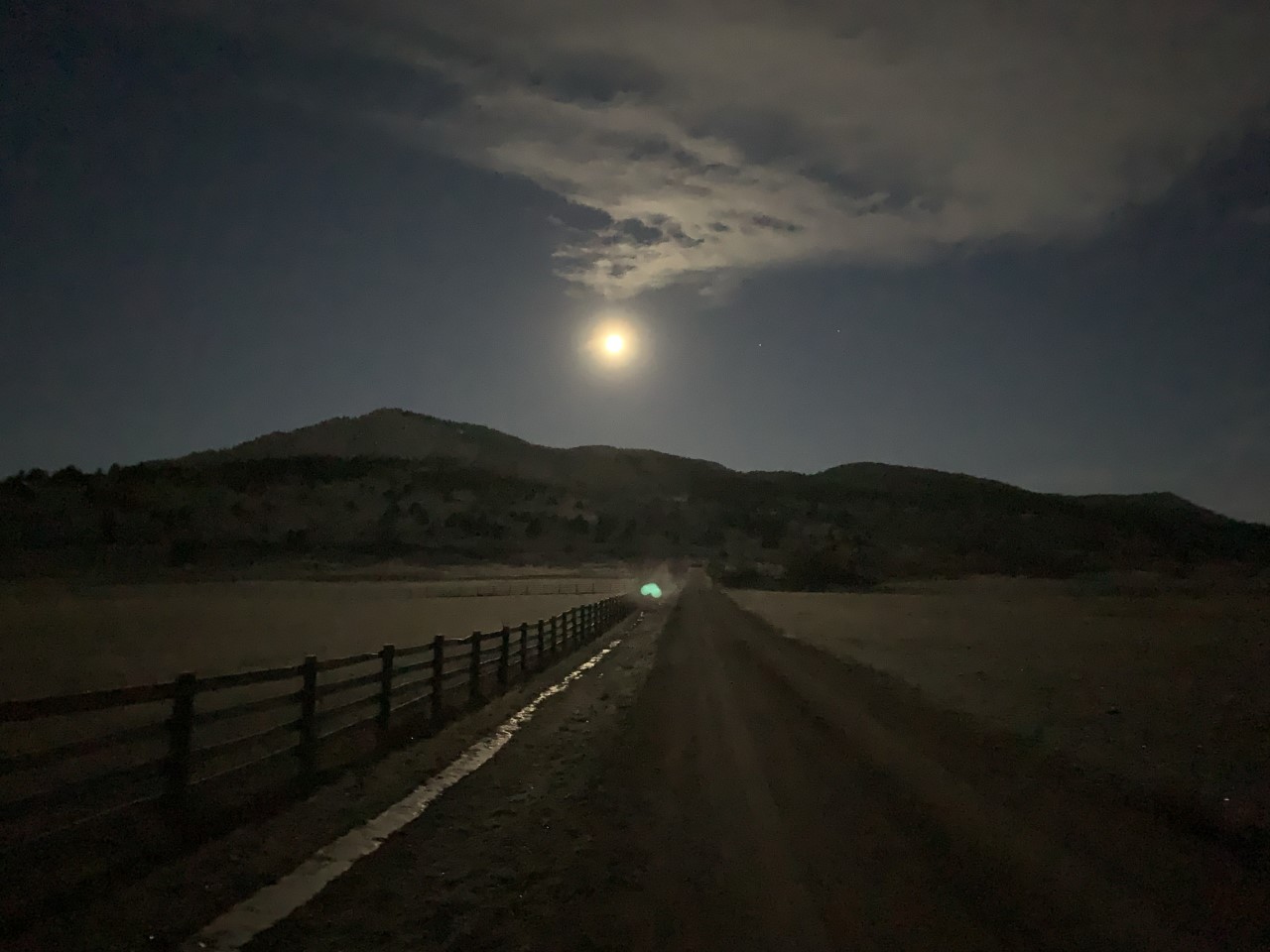
Moonset, Sylvan Dale Guest Ranch, Loveland, CO January 2020.
Photo by Karen Cornell, DVM, PhD, DACVS

NaBloPoMo 2020 – Today’s Lesson

The last NaBlo of 2020, hallelujah!  I do this for myself, but the views, likes, and comments are rewarding—so thank you all!

Every cloud has a silver lining; every light casts a shadow.

What paradoxes did you experience in 2020?  Here are mine:

  • Unearned vacation
  • Survivor’s guilt
  • Loss of control/autonomy of schedule
  • Loss of social activities/tightening of social bonds
  • Attention toward global humanitarian issues/Focus on intimate relationships
  • Disruption of usual routines/Return to fundamental patterns
  • Things are so bad/So much potential for good

Now some polarities I managed… What were yours?

  • Fear/Acceptance?  Curiosity?  Courage?
  • Self-care/Care for others
  • Doom scroll/Tune it all out
  • There’s nothing I can do, not my problem/I must do everything I can to help, it’s all up to me
  • I belong to this tribe/I reject this tribe
  • Think it through/Take action
  • Burn down the Patriarchy NOW/Culture change happens slowly
  • Intrinsic calling/Extrinsic conformity
  • I’m Awesome!/I will never be good enough
  • Inner peace/Outrage
  • Make sweeping delcarations/Qualify every statement

Wow.  That’s kind of a lot, and pretty complex.  And yet it’s so simple, so Zen

Life is an exercise in holding space—physically, mentally, emotionally, spiritually, and relationally—for all that feels like contradiction.  We are here to reconcile it all, to dig it up in order to smooth it out, to make peace in the morass, to turn manure into fertilizer.  The flexibility to hold mutually divergent ideas at the same time, and to move fluidly from one pole to its opposite and back again in dynamic balance—this is my most valuable lesson from this year.

In April I wrote about the best thing that could happen from this pandemic:  Connection.  It’s already happening, and I’m so grateful.  I’m also inspired, empowered, and ambitious for more. 

Can’t wait for 2021.

Pandemic Lesson #1: Flexibility

NaBloPoMo 2020 – Today’s Lesson

What have you had to be flexible about this year?  What has this taught you?

It’s not that we cannot make plans anymore.  It’s that we must be willing and able to change them, quickly and effectively, if we want to actually get anything done.  Move all primary care and primary/secondary education online?  Done.  Stop flying?  Okay.  Come back to work and school?  Sure.  Wait no, outbreak, go home again, please?  Fine.  Postpone big vacation 3…6 months… indefinitely…  *sigh*…we can deal.

Many of my patients are actually thriving in the new work from home normal.  Without the constant travel, jetlag, business dinners (the quadruple threat to acid reflux:  late, fatty, large, and full of alcohol), and long commutes, they sleep more and better, spend more time with family, exercise more, and eat healthier.  If all goes well, my executive health job may be obsolete in the next decade, hallelujah! 

Not everybody’s doing well, of course.  60% of the workforce still shows up in person; risk, stress, and burnout are very real, and escalating.  The people who are well are those with choice.  They are the privileged ones.

Most of us still don’t know how the new work life balance will look in the coming years, but we hope to retain and expand the flexibility that has given us some sense of agency and control.  Check out this episode of Hidden Brain to hear a Stanford work from home researcher on implications of this augmented world for all of us. 

What flexibility do you wish for in 2021?

Agency and control in the midst of a global pandemic—how ironic!  Pandemic lesson #2 may be Paradox and Polarities… The last 2020 NaBlo…  Wait for it…