November 2: Reading Makes Me Better

Mesler book window

NaBloPoMo 2019

Today I share a Facebook comment series I wrote in response to a prompt from a progressive friend, in its original form.  His post made me look up and read 7 additional articles, all of which I linked in my comments.  In the end I became more aware of my own biases, and recommitted to finding common ground with people who think differently from me.  So I think reading makes me better.  What think you?

wsj divided nation 2019

Friend’s post:  (Cathy):  I’d be interested in your perspective on this article in terms of your work to bridge divides and create civil conversations.   [Wall Street Journal slide deck describing the economic basis of party divisions in the US—it’s a fast click through which I recommend.]

My comments:

Thanks for sharing, (Friend)! Okay, I will take the time to make a long comment thread, as this is really interesting to me. Thank you for asking the question you did–I’ll get to it eventually! First: The information presented in this slide show is consistent with what I have read before. The facts presented are real. And they are incomplete. It looks at differences between districts, which is the best way to highlight division. I think this is a direct consequence of gerrymandering, which is designed exactly to create districts that will reliably vote one way or another. And we have all seen the US map showing blue clustered around big cities and red everywhere else. AND, this report ignores the glaring truth that despite the economic divisions by district and income, a much larger proportion of the top 1% is either declared or leans Republican than Democrat (though not necessarily more conservative):  https://news.gallup.com/poll/151310/u.s.-republican-not-conservative.aspx
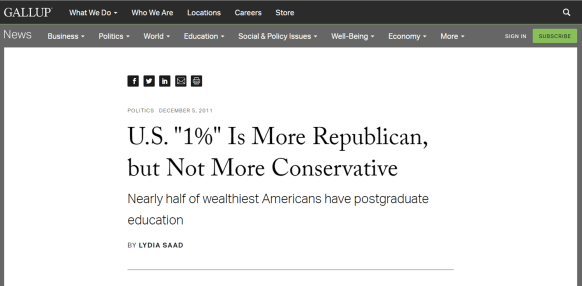
Gallup 1% 2011

Second: The suburbs are where Reds/Blues live amongst one another, and this report ignores them, pretty much. That said, even without gerrymandering, we Americans have sorted ourselves ideologically. Bill Bishop wrote a fascinating book that details the economic and social evolution, _The Big Sort_ (listened to the whole book a year ago, I highly recommend it): http://www.thebigsort.com/home.php

I think suburbs are where work like Better Angels has the most potential to spark civil discourse, except that people are hesitant to engage, for fear of upsetting the tenuous and silent politeness that constrains their ability to talk openly about politics. That cultural noose is hard to untie.

Dem demographic 2019

[Below are a] couple of other links that have additional demographic information that gives context and texture to the WSJ slide deck. The point of all of this is that when we I read articles that start out with nihilistic, Vader-like proclamations of “America’s political polarization is almost complete,” I see an implicit agenda to actively contribute to that polarization for the good of the publisher. Brené Brown reminds us to beware of those who tell us things are absolute, either/or. Reality is almost never this dichotomous, and whenever we hear it is, we should look for who benefits from us thinking it is. Economic demographics of Democrats: https://www.debt.org/…/economic-demographics-democrats/

Economic demographics of Republicans: https://www.debt.org/…/economic-demographics-democrats/

Okay finally, to answer your question, on my “perspective on this article in terms of (my) work to bridge divides and create civil conversations”: My favorite visual is this table from the first article I linked to. In some ways we are ‘almost completely’ divided, as the Vader article posits. In other ways, we are not. I think of the surveys showing a majority of Americans being in favor of background checks for gun ownership, in agreement that abortion is generally not something we want happening all the time. I think of all of the conversations I have with pretty much any other human, and how we are all 90% more alike than different. But this article and 90% of the articles we see highlight the other 10% of differences, and worse, the most vehement and violent expressions of those differences. So my perspective on this article is that it contributes significantly, if not blatantly, to the division it reports. And it does not serve us in any way. And, I hope I would have the same response if it were published by the New York Times. 😉

top 1% demographics 2011

HANG ON. I just saw that this favorite article I cited is from 2011. I have found a couple of more recent ones; will review and continue the thread….
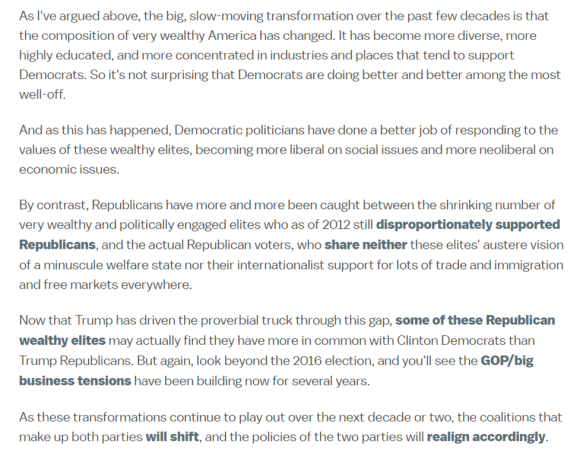
vox welthy dems 2016

Okay, here is an article from 2016 by a poli-sci expert who, [Bill Bishop-style], explains well the progressive evolution of the top 4%. Very interesting:  https://www.vox.com/…/6/3/11843780/democrats-wealthy-party

And hey, here is one from Forbes this year, which quotes the author of the Vox article, highlighting how a sizable number of Republicans actually align ideologically with Democratic policies:

“The fact that lower-income Republicans, largely known as the ‘basket of deplorables,’ support more social spending and taxing the rich was a key takeaway from this year’s report, says Lee Drutman, senior fellow on the political reform program at New America, a Washington D.C.-based think tank… ‘It is pretty striking that about a fifth of Republicans had views closer to the median Democrat than their own party,’ he says. ‘A lot of them actually want a sizeable social welfare state. It’s a little bit of a puzzle why they don’t vote for the Democratic Party, other than long-standing cultural ties maybe and other ballot issues. What we have here is just one of the two parties stands out to have a bunch of its supporters in opposition to some of the party’s economic platforms but still gives them their vote.’” https://www.forbes.com/sites/kenrapoza/2019/06/24/how-democrats-and-republicans-differ-on-matters-of-wealth–equality/#13e06ab8702f

More from the Forbes article:

“But when looked at closer, a plurality of voters (72%) across the spectrum said the government should provide tax credits for low-income workers. Some 60% are in favor of raising the minimum wage, and 58% were in favor of raising taxes for those families earning over $200,000 a year.

“Across party lines, Democrats were the ones who were most interested in a higher tax burden for the wealthy, though it is unclear if they considered themselves to be part of the income group that would be hit with higher taxation in a more progressive tax structure.

“An overwhelming majority (79%) of Democrats earning under $40,000 a year wanted to tax the rich more. Democratic Party voters earning over $80,000 were 83% on board with taxing higher incomes at higher rates. For Republicans earning under $40,000, 45% were in favor of taxing the rich. Republicans who earned over $80,000 didn’t like the idea. Only 23% were in favor.”

[In conclusion:]  Complexity does not make for headlines, sadly, and we should take this into account when we read and share. Thanks for posting on my page and asking the question, [Friend], you have made me think and thus made me better! 😀

Why I Cried On Rounds

IMG_2534

Wow friends, I’m inspired.  You know that’s the case because I sit here less than 24 hours after my last post, writing again.

Today I learned about Public Narrative during the ICCH conference workshop entitled, “How to Become an Effective Advocate for Humanism in Your Healthcare Organization”.  The process was developed by Marshall Ganz, at Harvard.  Here is the course description (MLD-355M Public Narrative: Self, Us, Now):

Questions of what I am called to do, what is my community called to do, and what we are called to do now are at least as old as the three questions posed by the first century Jerusalem sage, Rabbi Hillel:

If I am not for myself, who will be for me?

When I am for myself alone, what am I?

if not now, when?

This course offers students an opportunity to develop their capacity to lead by asking themselves these questions at a time in their lives when it really matters. . . and learning how to ask them of others. Public narrative is the leadership practice of translating values into action. To lead is to accept responsibility for enabling others to achieve shared purpose in the face of uncertainty. Public narrative is a discursive process through which individuals, communities, and nations learn to make choices, construct identity, and inspire action. Responding to challenges with agency requires courage that is grounded in our capacity to access hope over fear; empathy over alienation; and self-worth over self-doubt. We can use public narrative to link our own calling to that of our community to a call to action. It is learning how to tell a story of self, a story of us, and a story of now. Because it engages the “head” and the “heart” narrative can instruct and inspire – teaching us not only why we should act, but moving us to act. Based on a pedagogy of reflective practice, this course offers students the opportunity to work in groups to learn to tell their own public narrative.

See also this video, where Ganz describes the central tenets himself.

In our introductory workshop today, we were invited to try writing our own narrative, and provide/receive feedback from a fellow participant.  My responses to the exercise prompts are below.  Just want to share.

  1. What is the change you want to make in the world:  Your Story of Now?

I wish to improve all of our relationships:  To foster meaningful personal connections in all realms, in an increasingly disconnected (yet deceptively ‘connected’) world.  This includes doctor-patient, doctor-administration, parent-child, teacher-learner, political opponent, colleague, friend, spouse relationships and more.  We all desperately need deep connection now more than ever.

  1. Why are you called to make this change: What specific experiences have shaped your Story of Self?

I am a Boundary Spanner.  From early in life I have repeatedly and consistently found myself in Middle Spaces, serving as liaison between divergent perspectives, such as family members, Chinese and American culture, conventional and alternative medicine, patients and physicians, physicians and our leaders.  I have an easy ability to take perspectives, withhold judgment, and communicate to connect.  I am perfectly positioned to do this work—I live at the intersection of each of these relationships and others, and I am comfortable serving as a bridge.

  1. What personal story can you tell that will help others understand why you want to make that change? What is the challenge?  The choice?  The Outcome?

In my fourth year of medical school, I rotated on nephrology consults.  Hospital care teams called us to evaluate their patients who had new kidney failure in the hospital, to advise on potential causes and make recommendations for treatment.  I had become confident in my knowledge in renal pathophysiology and collegial communication skills.  On this day we were consulted on a patient in the intensive care unit.  I was taken aback when I saw the man—a Vietnamese man close to my dad’s age.  He was gravely ill, intubated, swollen and jaundiced.  I met his daughter, who looked about my age.  Her hair was jet black and straight, cut like a schoolgirl’s.  She wore a modest t-shirt tucked into high-waisted jeans that looked about a decade behind the current fashion trends.  She did not speak English, so our encounter was brief.  But I remember being struck by the utter confusion and fear in her countenance.  She looked like a deer in the headlights.

I conducted the usual chart review, lab analysis, and physical exam.  I thought through the usual causes of acute kidney failure in critically ill patients, and then the concurrent conditions that made treatment a fine balance of volume, pressure, and perfusion (sepsis, heart failure, kidney failure).  But this case, though medically typical, was emotionally fraught for me.  I saw my own family in this patient and his daughter.  What if my dad had fallen critically ill when he arrived in the US back in the 1970s?  Who could have advocated for him, and how could his care team know what they needed in order to care well for him?  My heart went out to this man, likely about do die, and his daughter, apparently alone to manage everything for him and herself.  I related in a way that surprised and scared me, and I felt vaguely uncomfortable.

So when I overheard the ICU and nephrology consult residents making offhand fun of his monosyllabic last name, as so many people had done to my name growing up, I lost it.  I started crying right there in the unit, or maybe when our team rounded, I don’t remember.  I felt embarrassed and also angry.  How unfair.  These residents had not even known what they had done, they had no idea that I reacted to their words and attitude, which I imagine they would have defended as benign.  I was too embarrassed to say why I was so upset—felt it was selfish, unimportant.  I worried they would think I was being hypersensitive, over-reactive.  I also worried, I realize now, that I would hurt their feelings if I told them how much their passing, offhand remarks had hurt me.  It was too much, and I could not voice any of it.

So my team, perplexed and taken by surprise even more than I, just sat.  They were confused, concerned; they did not know what to do, had no skills at their fingertips to make it safe for me to open up and share.  I don’t remember any gestures of support or reassuring touch.  They sat, like deer in headlights.

My choice was to speak up or not.  To bring attention to what might today, I suppose, be labelled a microaggression?  I chose not to speak.  The outcome is that I regret.  I regret that nobody had any way of consoling me, even as they did not know what was happening.  I regret that I did not have the courage or language to describe my experience, that I did not advocate for myself and future Asian immigrant patients.  I liked our attending.  He was a decent and caring man.  But he had no idea what to do.  If he had briefly halted rounds and taken me aside privately, or asked to sit down later, I might have shared my story then.  But he did not.  I pulled myself together, we completed rounds, and nobody ever brought it up again that I remember, myself included.  He wrote a very generous letter of recommendation for me for residency.

My challenge today was to make sense of this sudden and profound emotional hijack, after marveling briefly that this was the only story that emerged to tell.  I had not thought about this incident in many years already.  My pair/share workshop partner pointed out, insightfully, that once again I found myself in the Middle Space, spanning the boundary between the modern American healthcare system and an East Asian immigrant family unit, both personally familiar to me, and mutually unintelligible to the people on either side.  “I’m not surprised that you’re trying to do something with this story,” she said.  Yes.  My calling is to foster awareness, respect, and mutual understanding between all people.

This is why I get Hippie Zealot Conference High, because insights like this hit me every time I commune with my meeting tribes.  Can’t wait to see what happens tomorrow.

Medicine:  Science + Humanity = Professional Pride

IMG_2525

Lots of learning this month, friends.  I’m overwhelmed and overjoyed, and proud of my profession.

It’s too much to write about in one post, but I will try all the same, in order of occurrence.

18 October 2019

Once again I had the privilege of meeting with medical students, this time to discuss their experience of leadership in medicine.  As is my new custom, I started with an appreciative inquiry exercise: What is the best thing about medicine, WHY do you do this?  One of their responses:

“The medical encounter is a unique combination of compassion and intellect—the conversation is my favorite thing, and that I also get to help.”

19 October 2019

Looking through the basement bookshelf, I came across my medical school application from 1994.  The general application included a one page personal statement, in which I wrote:

“Science, and the human body in particular, have always fascinated me… In practice, while I pursue the challenge of each new patient’s illness, I want to share with them my enthusiasm for the science of medicine…  But being a doctor involves more than curing people’s illnesses…  It is the job of the physician to reassure and comfort the patient…  In my practice I will…do my best to communicate with (patients) in terms they will accept.  The best way to comfort people is to relate to them.  I believe this skill will make me understand not only patients’ medical needs, but their emotional and psychological needs as well…  I hope to keep learning from my patients in the future.”

Turns out I’ve been both a science nerd, and also thinking and writing about relationships and connection for a while now, go figure.

IMG_2397

25-26 October 2019

This year’s ACP Illinois Chapter Meeting was the best one in recent years, in my humble opinion.  I’m so proud that under the leadership of our Northern Region Governer, Dr. Suja Mathew, we were able to present a robust clinical education conference, as is the ACP tradition.  Along with sessions on diabetes, heart failure, office orthopaedics, and cancer survivorship, however, we also included sessions on critical social and public health issues, such as diversity/inclusion, the impact of social media, firearm injury and death, medical marijuana, trauma-informed care, and sexual harassment in the workplace.  Esteemed colleagues from across the country came to share their expertise.  Here are just a few examples of Science + Humanity, in action every day in our work:

Diabetes

Science:  We now understand that it’s the wide swings in blood sugar, and especially very low sugar, that lead to end organ damage.  We have new classes of drugs with novel mechanisms of action.  They decrease the burden of glucose control on pancreas cells, and also seem to prevent heart failure in some patients.  Humanity:  All diabetic patients need education—face to face time with a trained professional who can teach them about the disease and how to manage it. Even the most highly educated and most well-informed person cannot automatically know how to be a diabetes patient without the help of these medical team members.  More and more, diabetes care in particular is a team sport, and our collective skills get better every year.

Cancer

Science: We are curing cancer.  There are more survivors now than ever before, thanks to targeted genetic and immunotherapy and minimally invasive surgery, among other treatments.  Humanity:  Survivorship starts at the time of diagnosis, and cancer patients have both unique and diverse needs and concerns.  Complications from treatment such as neuropathy and heart failure can occur years out from treatment, and the psychosocial consequences for patients and their families can be lasting and transformative.  The better we understand this as their care teams, the healthier and happier our patients will be.

Childhood Trauma

Science: Since the 1970s, cumulative evidence shows that Adverse Childhood Experiences and trauma correlate with an increased risk of negative health behaviors, mental illness, chronic diseases such as diabetes and heart disease, decreased academic performance, limited professional productivity, and early death.  And they appear to affect each of these outcomes independently.  In the Tree of ACEs, branches and leaves represent the interpersonal experiences.  We are only starting to understand the roles played by Adverse Collective Historical Events (slavery, genocide, mass incarceration, forced displacements)—the soil, and Adverse Community Environments (poverty, violence)—the roots.  HumanityThe key factor that correlates with escape from the early mortality path from ACEs is a stable and nurturing relationship with an adult caregiver.  As healthcare providers, we have a unique and important part to play in the healing of all ACEs—our patients’ and our own—and all evidence points to the quality of our patient-provider relationships as foundation—no surprise.

Gun Violence

Science: In 2012 33,000 people died from firearm injuries (it was up to 40,000 in 2018); 62% of these deaths were suicides.  That same year there were 62,000 nonfatal firearm injuries, 72% of which were assault, 5% self-inflicted, and 17% unintentional.  Higher rates of gun ownership correlate with higher rates of death from firearm injuries.  States with both background checks and waiting periods have lower rates of suicide by firearm compared to those with background checks only.  It is still unclear whether states with more lax concealed carry laws have different rates of firearm related deaths compared to stricter states.  Humanity: Though mass shootings dominate the media, the majority of deaths from firearms are self-inflicted.  The acute impulsivity of mental illness, combined with an accessible, loaded firearm, destroys lives—whole families and communities at a time.  Our job as physician advocates is to not alienate gun owners, and rather enroll and recruit their help to address the factors that take our friends and loved ones from us.  It’s not an Us vs. Them fight over rights.  It’s a shared challenge to create policy that honors our unique national history and culture, and also effectively addresses our public health crises.  Here is where our highest notions of collaboration, respect, and shared purpose must be exercised.

10-22-19-3

27-30 October 2019

Today I arrived in San Diego for the International Conference on Communication in Healthcare, my first time at this meeting.  Many of the sessions will present research on effective ways to teach communication skills to trainees, factors that impact health literacy, and methods for measuring effective communication.  This conference is all about the science of communication in healthcare.  And it’s also about the humanity.  The first plenary speaker was Dr. Lisa Fitzpatrick, who interviews people on the streets of DC in her series, “Dr. Lisa on the Street.”  The videos show over an over how people feel ignored and dismissed by our healthcare system, and how unsafe it is for them to admit what they don’t know or ask questions.  This is one of the only meetings I have attended at which patients are invited to present and voice their perspective.  At the end of this session one patient attendee stood up and spoke words that will guide me throughout this week and my career:  “Doctors may have all the education in the world, and if you cannot talk to your patients in a way that makes them trust you, it really doesn’t matter.”

Sessions I plan to attend:

Moving Health Care from a Team of Experts to an Expert Team

How to Become an Effective Advocate for Humanism in Your Healthcare Organization

Collaboration and Communication Across Multidisciplinary Healthcare Teams

Civility Ninjas:  A Field Guide to Improving Colleague-Colleague Interactions

Understanding and Addressing Mistrust

Shared Decision-Making as Ethical Practice

Thanks for reading to the end, friends.  I know it was a lot.  As I age I learn to hold patience as well as eagerness, absorbing the input as well as creating my own, integrated outputs for good.  How lucky I am to have so many amazing people to keep me company on the journey!

Four days to NaBloPoMo, my fifth attempt, HOLY COW!  Better get to bed…