
Bask In the Wonder

Kelley Dallas Fine Art Photography, Facebook, 12-23-2022

If I ever get a tattoo, it’ll be a toss up between a little cartoon buffalo and the Colorado flag “C”. I was born in 1973, the Year of the Ox, bison thrive in Colorado, and my initials are CCC. …I’ll probably get some combination of the two… So there, I’ve just decided! I wonder if I can/will design it myself, or if Daughter will do it?

Here at the end of 2022, in the midst of a polar bomb cyclone gnarling much of the country, I’m happy and grateful to have some time off and a functioning furnace. The shortest day of the season has passed; everything gets lighter for the next 6 months now. So for this post, I share some light and wonder on my mind. Keeping it in my pocket for the still dark days ahead.

Designed to Survive

Driving west on I-70 from Denver, around the Genesee Park exit, I always look for the buffalo herd at the overlook to the north. I have yet to see them in the winter, and I slow down anytime they’re around. I just love these animals–so strong, resilient, and majestic. And HUGE. But the thing that amazes me most is how they can survive the brutal plains winters–their coat, holy cow (pun!)! Its thickness and structure insulates body heat such that snow and ice don’t melt on the pelt, even over such a vast surface area. I wonder if the circulation in their legs and feet have that countercurrent heat exchange anatomy that penguins have? Regardless, this is my spirit animal (sorry, moose). All hail, mighty buffalo.

https://www.noaa.gov/stories/how-do-snowflakes-form-science-behind-snow?utm_source=pocket_reader

The Beauty of Nature and Science

I have known for a while that ice takes up more space than water because of the obligatory orientation of oxygen and hydrogen in a frozen state. But it never occurred to me that this is also why snowflakes always have a hexagonal crystal shape. Thanks to NOAA and Scientific American, now I know–it’s still all about molecular structure! And depending on atmospheric conditions surrounding each individual flake as it forms while falling, the crystal takes on its ultimately unique configuration. I also learned that the flakes themselves occur when freezing water vapor interacts with solid particles in the air. Sky ice needs a nidus on which to form–a seed. So does that mean more snow falls in places with more pollution? I wonder how else pollution affects the properties of snow?

Ooo, what analogies can we make to humans here? How do our crystals form in life, and what particles in our environments facilitate what kinds of flakes we become/create? When are we light, airy powder, versus heavy, laden sleet? Fun and philosophical to consider!

Love Really Is All Around

Sister and Brother-In-Law were over last weekend, and we all watched Love Actually–again. It’s still as funny as the first time! And trope-y as it is, I continue to appreciate how the film depicts the various shapes, depths, and circumstances of love in all its forms. Romantic, platonic, parental, marital, fraternal, carnal, unrequited, or other, love and connection between humans are remarkably complex, and worthy of effort and reverence.

It seems like I’ve written every year on this blog how hard things are, how challenging and destructive we humans can be to one another. And it feels worse every year, no? I know this is only partially true. Thankfully, every year I also learn better how to hold the polarity of People Suck and We Are Awesome with more peace and balance. Holidays seem sometimes to amplify both tendencies, and yet reliably, I see connections outshine divisions at this time of year. Take the neighbor who strung Christmas lights from his own house to the lady’s across the street, because he knew she was having a hard time since the pandemic. Then the whole neighborhood started doing it, to the point where a couple who was thinking of moving decided to stay because the community had become so connected. Turns out, showing kindness to others improves our own happiness and well-being. Friend Donna Cameron knows this well, and we all benefit from her writings on it.

Empathy, compassion, and kindness, however, do not require us to give up our own needs–literal selflessness is not necessarily a vitrue. See Adam Grant‘s book Give and Take for an evidence-based treatise on why ‘otherish giving’, a balance of generosity and healthy boundaries, is optimal for relationships and health.

Lastly, props to Topher Payne for writing an alternate ending to Shel Silverstein‘s The Giving Tree. Instead of giving everything to her friend the boy over her lifetime, until there is nothing left of herself but a stump, Tree calls out his self-absorption and negotiates a more respectful, reciprocally loving and fulfilling relationship. I wonder how the world would be if we taught such crucial skills, explicitly, in formal education? I mean is it really less important to know how to take care of each other than how to do algebra?

https://lithub.com/somebody-finally-fixed-the-ending-of-the-giving-tree/

What light and wonder hold you this season? Please share here and everywhere!

May we all enjoy one another’s presence, openness, grounding, kindness, love, and connection, this holiday and well into the New Year.

Giddy Up

Sylvan Dale Guest Ranch, Loveland, Colorado

How is your mood/mindset today? Is it intentional, or did it just happen? What word would you choose for it?

For a couple months now I have practiced setting an intention for the day before getting out of bed, encapsulated in one word. I try to make it aspirational, but often I land on something to counter some heaviness or negativity I feel upon waking. It’s like self-reassurance or something, a DIY pat on the back. On 12/15 I awoke mopey, apathetic, and unmotivated. Thursdays are my busiest days at work, so I had to 打起精神來 (da qi jin shen lai), as Ma always says–literally ‘hit rise energy come’–something akin to ‘get moving’ in English. So my mantra for that day became “Giddy up.” I don’t remember the last time these words even occurred to me, but they apparated that day and carried me through.

The next day I started listening to now Senator John Hickenlooper‘s memoir, The Opposite of Woe: My Life in Beer and Politics. Somewhere in the middle of the book, someone attended a psychology class wherein the professor asked a series of questions along the lines of: What is the opposite of joy? Sadness. What is the opposite of X-emotion? Y-emotion. What is the opposite of woe? And a student stood up and said, “I believe that would be Giddy Up.” HA!! It took me a second… 😉 Henceforth Hickenlooper calls up the phrase in his own self-motivating moments.

So now I feel cosmically connected to “Hick” junior (read this Twitter homage to his dad–I dare you to not be moved). My senior year of high school, I was invited by girls I admired to attend an Amnesty International event at the Wynkoop Brewery, which Hickenlooper had opened with some partners only a couple of years before. I will always remember that day fondly, feeling so included. The stories of that restaurant venture, the first ever brewpub in Colorado, and his life in general, are told with moving poignance and good humor in the book, which I highly recommend. Sometime during his tenure as governor of Colorado, I started following him from afar. These last 10ish years, I have always found him to be down to earth, smiling, and approachable in interviews and public appearances. And I absolutely love that he has always refused to run negative ads during any of his political campaigns. His Facebook posts share good work done in Colorado and Congress alike, and help me feel connected to my home state through someone I admire and feel proud to ‘represent’ me.

Throughout the book he tells engaging stories of his meandering life paths, personal and professional intertwined. He owns his flaws as well as his strengths, neither over- nor underplaying either. His ex-wife has surmised that due to emotional losses early in life, he became a pragmatic, rational-dominant thinker and doer, which served him well in business and then politics. Along the way he also had opportunities and support for self-reflection, including marriage counseling. He has done the inner work of developing his emotional mind, which I also very much admire. Today, working in such a polarized governing body as the US Senate, I hope he can set a dialectical example of respect, pragmatism, and collaboration that others will follow.

I know many of my people in Colorado have mixed feelings and opinions about Uncle Hick, as I will now think of him. Of course that is to be expected, and he himself respects it. He recognizes that in government, trade offs are the norm–if nobody is 100% happy with your work, then you’re probably doing it right. Hearing his perspective, both seriously committed and self-depricatingly lighthearted, as a scientist (English major turned geologist who took 10 years to finish college)-entrepreneur-politician, gives me such hope. He discusses the importance of public-private collaboration and the need to update or eliminate obsolete regulations. He embraces an evidence-based, team approach to novel problem solving (eg inventing effective and accountable recreational cannabis policy in the first state to make it legal). He keeps his compass pointed toward the core value of helping people, while leveraging business tactics to grow economies, and not wasting resources. He describes how he chooses battles worthy of fighting, all in good time. After study and deliberation, he is willing to change his mind on important issues, out loud and without shame (eg capital punishment).

I know I must be severely biased toward Uncle Hick just because he is from Colorado. Often during this book, I recalled feeling a similar admiration while listening to Neil Gorsuch’s memoir; he is another Coloradan. I imagine these two men differ greatly in ideology and politics. I also imagine that they respect each other and would engage in healthy dialogue around their differences if given the chance. Colorado is a big place, with a vastly diverse geography and population. It’s also one of the healthiest, most desirable places to live, by any metric. People there are consistently the friendliest folks I ever meet, compared to anywhere else in the world. There is just an ethos, something ineffable and yet palpable, that allows differences to be acknowledged and overcome, and things to get done. One day I will get back there and participate in person. Cannot. Wait.

Giddy up, indeed.

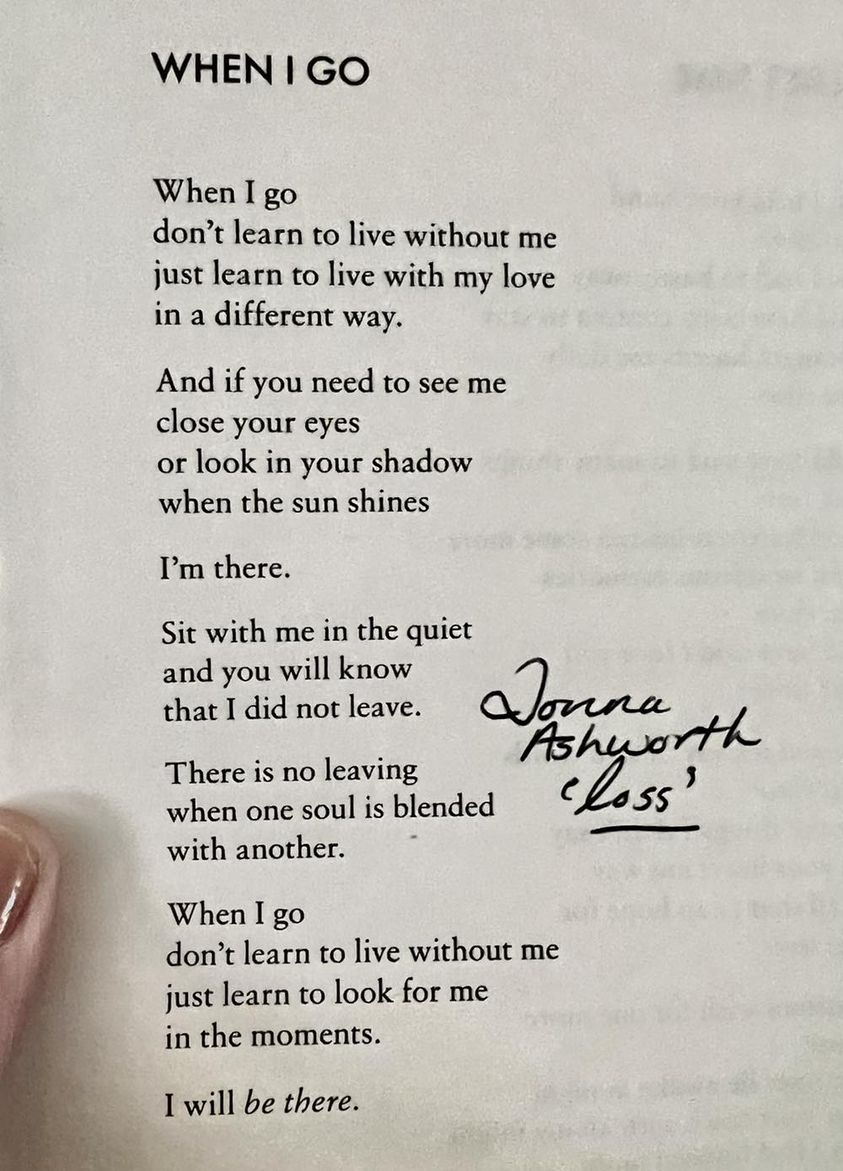
“When I Go”

From _Loss_ by Donna Ashworth

After Friend and I talked about her BEAST lawyer last week, somehow we got to thinking about being at peace with death. I told her I’m okay with it–if it were my time tomorrow, I could accept it. She confirmed that my declaration did not feel delusional or arrogant. I have no intention of dying, and I would not want it or like it, but I would have few regrets, I think. Let me be clear: I would certainly regret any pain and suffering that my death might cause my loved ones. But maybe knowing that I’m at peace with my own mortality would help mitigate their pain? In Being Mortal, Atul Gawande tells us that if the person whose life is ending is at peace (it’s redundant, but there isn’t really another expression for it, is there?) with their own end, then their loved ones are far less likely to experience depression and prolonged grief after their death. This is what I wish for my people. I can go first, literally and figuratively.

A few years ago, another dear friend announced his retirement after nearly 30 years with his company, many of them in leadership roles. His LinkedIn page filled with gushing expressions of gratitude and admiration. I thought about him all day, and wrote him spontaneously in the evening:

…And what will the organization and its people be/feel like without you? 

When my kids were little I used to be afraid to die.  I was afraid they would forget me, and that I would not have a chance to pass down my core values, to have a hand in helping them become excellent people.  But then I realized that as long as I am here, I am the one responsible for that, so nobody else thinks to do it for me.  But if I died, and if I lived well, then people would take what they loved best about me and sustain it for my kids in my place.  If I were successful in building the village around them, then they would not be dependent on me alone to get what I most wanted them to get.  

So now I don’t worry so much about it–partly because they are older and I have had time to instill some things, both by example and by teaching.  But also because I trust that my own circle will enclose them and nurture them if/when they are needed.  That reminds me, maybe I should remind and thank my circle for doing that. ðŸ˜„

Today I have even more confidence. The kids are three years older, their complex adolescent personality formation accelerating. I see my imprints deepen, for better or worse, and we have reflected together how they see my influence in their attitudes and expressions. We agree to help one another identify and manage our respective deficits. The tribe is still strong and willing, and I have hopefully been more explicit about my gratitude and aspirations. But really I just trust Son and Daughter to keep me with them, alive or dead, near or far, like Ashworth’s poem says.

I wrote my 30 ethical earworms for posterity last year, saved now among 504 total posts on this blog so far. If they read one a week starting if I died today, that’s almost 10 more years of me in their mind’s ear. They will continue to become who they are, and find the places where I fit, to carry me most comfortably and usefully.

On the path of life, we leave pieces of ourselves all along the way, accumulated and spread among our relationships. What do we do when our loved ones die? We honor them by nurturing, strenthening, and cultivating those parts of them that live within us, more intentionally and meaningfully than when we had them physically with us.

So it’s a Peace & Mortality Mindset of living, I suppose. Try to not take any day, any moment, with any person, for granted. Take advantage of any and all opportunities to connect in meaning and love. Act with reckless abandon on any and all impulses of empathy, kindness, generosity, and compassion. None of us knows when the end will meet us or those we love. What can we do today to make any of it just a little less painful?

Let’s get on it, ya?