Even the ‘Oppressor’ Deserves Safety and Support

This weekend I reflected in gratitude at my LOH experience in the past year. After resonating with Dr. Suchman’s moving keynote at a physician health conference in 2018, I sought him out to express thanks. He encouraged me to apply for the program. Then he coached me twice on getting institutional support, something I had never done before. All through the program, he and Diane Rawlins, two of the best teachers I have had (and that is saying a lot), led us all through ten months of complex conceptual learning and skills practice. Even better, they helped us synthesize and integrate learning between sessions, applying concepts through practice in our natural habitats, knowing we could report back to the group to debrief and trouble shoot before heading back into ‘the trenches.’ LOH runs annual reunions, refreshers and mixers during which attendees from different cohorts can meet, bond, and both expand and tighten our community of lifelong learners. In the time of COVID, alum meetings have occurred about every two weeks over Zoom, from the comfort of our homes all across the country. The more I think about it, the more I wish everybody had this kind of safety and support—this loving learning lab and community—to acquire scary new skills that, when practiced, benefit many more people than just us learners.

I imagine this may be what participants in the White Men’s Caucus feel. Read all about it in Four Days to Change, which I started and finished in about three sittings. –No really, read this book. It provides a unique and profoundly important perspective on the true meaning of inclusion, that is, white men absolutely need to be included in leading and benefiting from systemic change for equity, not just passively doing the changing for others’ sake. During the Caucus retreat, white men are both challenged and supported to dig deep into their own privilege. Inescapable mirrors of truth and profound discomfort, and also of love and compassion, surround them for four days. They are expected to feel tremendous guilt and shame, both natural emotions that occur on the path of self-discovery and humility. But rather than weaponizing these feelings, facilitators love the attendees through them, shepherding them through the emotional (shit)storm to a place of self-compassion and forgiveness. This is where their outward humility, openness, and sincere advocacy for inclusion and diversity take root—because they experience it first hand from their teachers and peer learners. Leadership is hard enough, but leading initiatives in diversity, equity, and inclusion is a whole other dimension of complexity. How can we expect any leader, white male or otherwise (but white males especially), to do it well alone, without a core peer group willing to hold their feet to the fire with both love and conviction?

I wrote earlier this year, “Practicing inclusion INCLUDES the OWG (Old White Guy) ‘oppressor’!  If we talk only about him needing to include others, while we make him feel excluded himself, how can we ever expect to enroll him in our cause or even behave in the way we ask? We do how we feel. And when we feel threatened and marginalized, especially from a place of loss, we act accordingly.” 

Michael Welp writes in Four Days, “(My mentor) inspired me when he (said), ‘The only way to touch other white men is through love.’  His words have always stayed with me.  However, the overall pattern observed in my dissertation was that white male diversity advocates disconnected from other white men and drew most of their support from white women and people of color.  They were frustrated and angry toward other white men.” 

Imagine people of your own tribe, a tribe you may lead in good faith, suddenly confronting you about biases and prejudices that you never knew you had, telling you how you’re harming people all around the tribe, and that you have to change it all now, adopt a new set of beliefs and initiatives today, and they will accept nothing less than your complete and unquestioning compliance because you are simply in the wrong.  Would you respond better if they came at you with such accusations and demands, or came alongside you with a grave and critical invitation to curiosity and learning together, for the good of the whole tribe, yourself included?  Which approach is more likely to yield tangible results in the near term?  Which one is more likely to still engage you in the long term?

We can learn important lessons from addiction medicine.  Patients succeed in rehab with a lot of grit and commitment.  They also benefit from the unyielding support and dedication of treatment staff and various environmental safety precautions.  But relapse rates are high (40-80%) in no small part because the safety and support so crucial to getting sober in rehab too often simply do not exist in an addict’s natural habitat.  

The converse was found to be true among American servicemen who fought in the Vietnam War.  Up to 20% of them were found to be addicted to heroin while overseas.  But upon return, only 5% of those who recovered relapsed.  After rigorous study (by a well-respected woman researcher, whose results and report were initially questioned and even derided—but that’s for another post), it is now widely accepted that the environment plays a key role in our behaviors, habits, and ability to change.  Soldiers in Vietnam, as James Clear writes, “spent all day surrounded by cues triggering heroin use: it was easy to access, they were engulfed by the constant stress of war, they built friendships with fellow soldiers who were also heroin users, and they were thousands of miles from home. Once a soldier returned to the United States, though, he found himself in an environment devoid of those triggers. When the context changed, so did the habit.”

The system often dictates, or at least strongly influences, how we perceive, think, behave, and relate. And we are the system, every one of us. By assimilating to the dominant white male culture, even as we see ourselves as resistors, we perpetuate it. But when we resist by only opposing our white male counterparts, without also enrolling them in the resistance movement as equals, we also undermine our own progress. Everybody deserves the safety and support to do their own personal Reckoning, Rumbling, and Revolution, as Brené Brown describes in her book Rising Strong. Real positive change is grounded in vulnerability, humility, and courage. If we really expect our white male leaders to change in ways fundamental and profound enough to advance equity in any meaningful way, they need the safety and support to reckon and rumble with their resistance, their rage, their fear, culture, identity, relationships, memories, realizations—all of it—with people they can relate to and who can hold them up fully, who will not turn away from or against them. As I wrote last week, more and more I see that perhaps only other white men can truly do this.

To be clear, this post is not an apology for white male supremacy and the vast suffering this mentality has wreaked all throughout history.  I just think it’s important, and too seldom attended to, that white men also suffer in and from the culture they dominate.  And in order to really change this culture for the better, we all need to support one another, white men included.

Challenging the Cisgender White Christian Male Default

Old new Dillon Reservoir

What do you take for granted?

How must you adjust your words, your actions, your facial expressions—your very presence, to fit into the world around you?

These questions arose for me again recently reading Seth Godin’s blog post from June 17, “The Dominant Culture.”

One of the great cartoons involves two goldfish in a tank talking to one another. One responds in surprise, “wait, there’s water?”

When we don’t see the water, it’s a sign we’re benefitting from being part of the dominant culture.

Visit a country where they don’t speak English and you’ll probably remind yourself all day that you speak English, something you didn’t have to think about last week. You’ll have to work overtime to understand and communicate. Back home, that stress disappears.

Living within a dominant culture means being reminded of this all day, every day.

It reminded me of the famous 2005 commencement address given by David Foster Wallace, the transcript of which was later published, entitled This Is Water.  He admonishes graduates of Kenyon College to open their eyes and minds to the automatic, mindless ways they make meaning from mundane life experiences, to acknowledge and exercise keen awareness of the inescapable interconnectedness of humanity (my interpretation):

And the so-called real world will not discourage you from operating on your default settings, because the so-called real world of men and money and power hums merrily along in a pool of fear and anger and frustration and craving and worship of self. Our own present culture has harnessed these forces in ways that have yielded extraordinary wealth and comfort and personal freedom. The freedom all to be lords of our tiny skull-sized kingdoms, alone at the centre of all creation. This kind of freedom has much to recommend it. But of course there are all different kinds of freedom, and the kind that is most precious you will not hear much talk about much in the great outside world of wanting and achieving…. The really important kind of freedom involves attention and awareness and discipline, and being able truly to care about other people and to sacrifice for them over and over in myriad petty, unsexy ways every day.

I started to think and wonder…  For cisgender, white, Christian men (CWCM), the dominant culture in the United States, the ‘rise’ of ‘other groups’ to ‘power’ can be understandably threatening–Black Brown Asian Gay Trans Muslim Female Other…

But there are CWCM who seem not to feel threatened, and who actively ally/accomplice to help other groups rise, to help them claim agency and work toward inclusion and equity.  They are what I imagine Chip and Dan Heath might call the ‘bright spots’ (see Switch: How to Change When Change is Hard) of the Patriarchy.

While engaging (fighting, overcoming) those who resist, why not also study and amplify those who assist?

What is it about these men, their networks, their environment, or whatever else, that facilitates their allyship with marginalized, non-dominant-culture people and groups?

Or even better, how does their conversion occur?  How do they overcome the perceived threat, conscious or not, to see the benefits of equality, and then join the fight to advance it?  What happens there, and how can we replicate and scale that conversion?

Last week on vacation I started reading Four Days to Change by Michael Welp, recommended to me by a wise old white man.  Welp and his partners run the White Men’s Caucus, the flagship retreat program of White Men as Full Diversity Partners.  As I understand it, the organization strives for exactly this conversion of awareness, enlightenment, and action.  On retreat, white men are provided the space and safety, as well as the excruciating challenge, to explore, without shame or suppression, their personal and shared experience of cultural privilege, entitlement, and responsibility.  I have a feeling this will be a transformational book for me, a cisgender, East Asian, Cathuddhist woman.  How’s that for intersectionality?

The author, speaking to White Men’s Caucus attendees:  “’If we created most of the institutions we dwell in today, they are going to reflect our culture.  But we don’t see this cultural water we swim in because we never have to leave it.  So we equate it with just being a good human.  Others assimilate into it, so it looks to us like it’s everyone’s culture.’”

He goes on to list the ‘core threads of the fabric of white male culture in the United States’ (how do they land on you?):

  • Rugged Individualism
  • Low Tolerance of Uncertainty
  • Action over Reflection
  • Rationality over Emotion
  • Time Is Linear & Future Focused
  • Status & Rank over Connection

After discussion with participants he notes, “’Notice that the guys who bring the skills less emphasized in the culture can more quickly identify how the culture works against them.  You might imagine the same experience for women and people of color.’  …It’s even more critical in today’s global world that we as members of the dominant group understand our water.”  I can’t wait to keep reading and see hearts broken open, as Parker Palmer says, to the power and potential of inescapable interconnectedness.

Lastly, I watched again Michael Kimmel’s 2015 TED talk on gender equality. I mentioned it on this blog in 2016, writing about Brock Turner and white male privilege.  At 1:08, listen to his story about the moment he realized he was a middle class white man.  In 16 minutes, he eloquently addresses gender and racial inequity, with evidence for the myriad societal benefits of dismantling them both.  “Privilege is invisible to those who have it…  It is a luxury, I will say to the white people sitting in this room, to not have to think about race every split second of our lives.”  It’s the water we swim in.  To white men the water is body temperature, almost like a sensory deprivation river, holding them up, always flowing in the direction of their dreams and aspirations, never a hindrance.  For too many others, it’s exactly the opposite.

It’s not that we should make water harder for CWCMs to swim.  It’s that white men can and must learn to see how the water hinders so many others, and then use their advantages to help those who struggle.  The collective benefits far outweigh the costs, as Kimmel describes.  The perceived personal risks loom large, however, and it’s ever clearer to me that only white men can truly lead other white men to overcome their visceral, existential risk aversion.

I’m still figuring out my own role in all of this Work.  I trust that I will know soon enough.

This Is the Work

IMG_2032

Every chance I get now, I ask people, “What stands out the most for you, from the last three months and the last three weeks?”  Every answer is unique, just like every person is.  And I cannot really predict what anyone will say.  It’s fascinating.

In this time some of us have been blessed with a chance to really look inward and reflect, consider, reassess, recalibrate.  But what will we have to show for it?  What is our Work?

This week I had eleven conversations centered around COVID-19 and Black Lives Matter.  Only two were incidental; the others were all intentional, most initiated by me.  Only three were with people of color, all women.  I have learned so much, and it motivates me to continue my query widely.

white frag 2

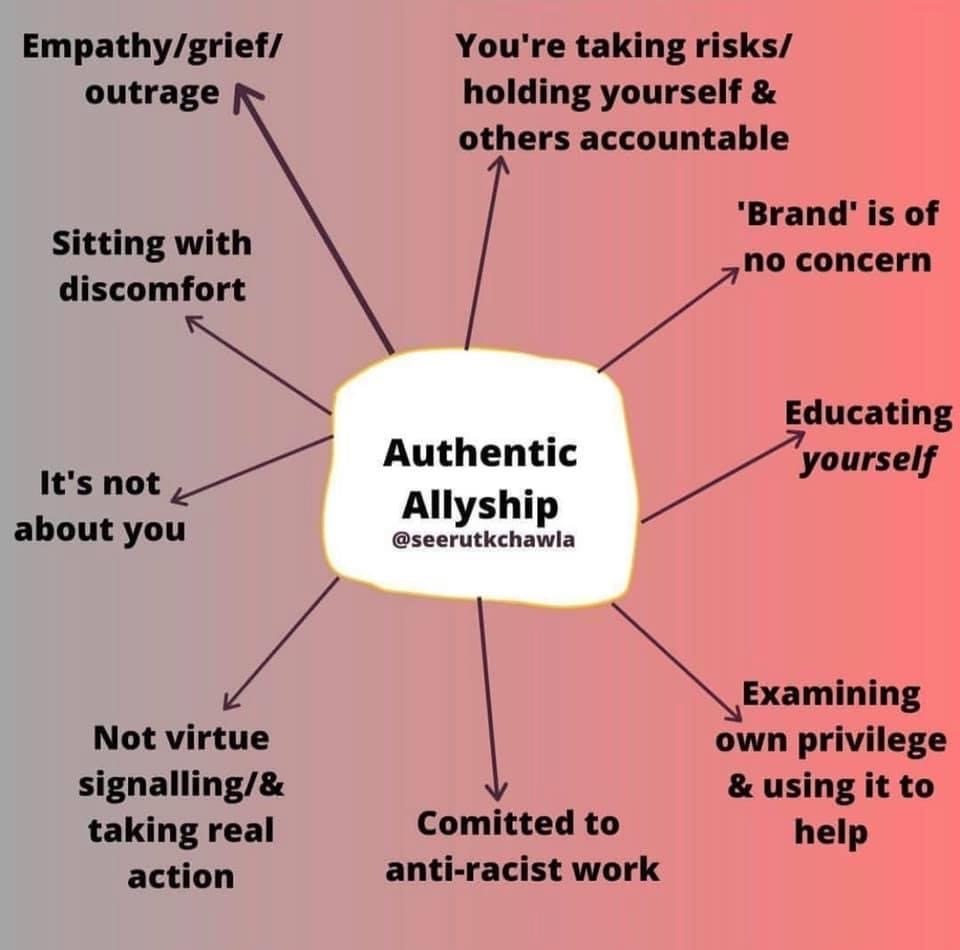
I started following Seerut K. Chawla on Instagram, who developed these graphics that really capture what we are all witnessing around race.  Amy Cooper and Derek Chauvin manifest the insidious and overt versions of weaponizing white fragility.  They and others instigated the tidal wave of activism we see today.  I feel weirdly, gravely grateful.  They kicked open, with utter impunity, the door to the profound opportunity for both individual and collective growth and advancement that we confront, right here, right now.

We are all called to face our discomfort head on, to stand up and take responsibility.  We can no longer escape the harsh reality of choice that we all must continually face:  Do what’s Right or do what’s easy.  Let’s assume for a moment that it really is that simple—all qualifications moot.  It may be unrealistic to expect ourselves to choose Right every time…because qualifications.  But aaaaarrrgh we do not do it nearly, nearly enough.  Nothing will change without a critical mass of us choosing Right, much more of the time, for a very long time to come.

performative allyship

My chief concern is that the current moment passes, and nothing meaningful will result.  I learned two new phrases this past week:  “virtue signaling” and “performative allyship”.  Basically they mean that we respond superficially to a trendy peer pressure, to appear supportive of Black Lives.  I imagine part of such words and even actions are sincere to some degree.  But they serve mostly to make us feel better about ourselves.  And the risk is high that this sudden hyper-motivation will go the way of New Year’s resolutions, once we have soothed ourselves, in order to revert to our prior, comfortable obliviousness.

My friends, we cannot let that happen.

But how?  What do we need in order to really seize this chance of a lifetime, to sustain action into meaningful policy reform?  We need one another.

Our work is to listen, self-educate, engage, and persist.

We must tolerate, even embrace the discomfort, knowing that it is nothing compared to what Black people have suffered for 400 years.

Our approach must be founded in Curiosity, Humility, and Respect.

Our goals, first and foremost, are to learn, to understand, and to connect.

authentic allyship

We can and should each start small, with our own inner work.  Actually this is not really small, is it?  Looking at these panes, I bet most of us don’t live all the time in Authentic Allyship.  This is the Work.  The activation energy for collective change requires all of us together to overcome, before we could ever hope to sustain that change.

And there is good news!  Going together synergizes our energy, lowering each of our individual thresholds for openness and learning, allowing us to advance the collective that much faster!  We can speak and act in our own small circles of influence—our tribes.  Then we reach out and merge our tribes, bonding in solidarity, common purpose, and love.  Is it not inspiring??

Stop with the ‘yes, but…’  Do the right thing, more and more and more and more and more.  Support each other doing it, show up for one another—hold each other up!  Allow for mistakes and imperfection, for continuous learning.  Seek the very next opportunity.  We can do this, Yes We Can.

The pieces below inspire me.  Take the time to read and listen.  Share in the comments what keeps the flame of change alive for you.  I see things changing already.  Let’s keep going.  We’ got this if we go together.

IMG_2639

The Heartbeat of Racism is Denial” by Ibram X. Kendi

Denial is fueled by the stigma associated with being a racist. Feeding the stigma is how “racist” is considered almost like an identity, a brand.

But a racist is not who a person is. A racist is what a person is, what a person is saying, what a person is doing.

Racist is not a fixed category like “not racist,” which is steeped denial. Only racists say they are not racist. Only the racist lives by the heartbeat of denial.

The antiracist lives by the opposite heartbeat, one that rarely and irregularly sounds in America — the heartbeat of confession.

How to Build an Antiracist World, TED Conversation with Ibram X. Kendi

Antiracist Resources from the Greater Good Science Center at the University of California, Berkeley

Unarmed Professionals Will Now Respond to Non-Criminal Police Calls in San Francisco