Trust and Safety in an Uncertain World

IMG_2022

Suddenly I felt my heart pounding.  My palms got sweaty.  My jaw felt tense.  I’m anxious, I realized.  It felt like sometimes when I speak up in big meetings.  Wow, I don’t even have to be in front of people for this to happen, how fascinating.

It was the second or third comment I had written on another Facebook page, belonging to a high school classmate.  I think we became ‘friends’ through his wife, a friendly acquaintance of mine in high school, with whom I’ve been connected on Facebook for several years.  I don’t really know her husband at all, and yet here I was, writing long replies on his page about universal masking, why recommendations changed between March and now, and why I trust Dr. Fauci despite his apparent flip-flop on this issue.

I had entered someone else’s house, offering my unsolicited opinions.  Though we have a handful of mutual friends, I had no idea who else would attend this party, and whether I would be welcome.  I wasn’t sure it was safe.

And yet I felt compelled to enter, why?  Perhaps I felt defensive of my professional standard bearer, Dr. Fauci, the father of modern infectious disease and icon of science, medicine, and public health.  He has basically led the research to define and defeat HIV/AIDS since the 1980s.  Through six administrations, he has directed the National Institute of Allergy and Infectious Diseases (NIAID) to successfully manage H1N1, Ebola, and Zika, at home and abroad.  He is one of my heroes.  Likely, I also wanted to absolve myself a little, as I had also recommended against masking in public early on.  I wanted to help some strangers see us, the ‘experts’, as human and fallible, and also earnest and caring, worthy of heeding.

So I obsessed over my comments.  I read and reread before posting.  I edited after posting.  I included the links embedded above, inviting anyone on the thread to hear Dr. Fauci in his own words, in full.  I offered my own mea culpa twice, explaining how academics sometimes fall victim to ivory tower thinking, as we did in this case.  Perhaps this was my attempt at earning back whatever trust people may have lost because we experts contradicted ourselves in such an important and pivotal moment.  I regret this, and I wanted people to know, and then maybe not hold it against me (us).  Would I be crucified?  Or would I crack a door open to hearing what I had to say?  I feel anxious now, just thinking about it again.

My own friends discussed this on my page a few weeks ago, after my post on antibody testing (our recommendations have not changed yet).  Paul, MD PhD and rheumatologist, pointed out, “US experts really blew it initially when it came to masks… All they had to do was consider the possibility that Asian countries might be right and then consider that the risk associated with (masking) was virtually zero.  The first thing experts need to do, when confronted with circumstances that are truly new to them, is admit uncertainty and base recommendations accordingly.”  I’m so lucky to have such honest and direct friends.  I replied that I felt badly for following the ‘expert’ advice like a sheep (which is exactly how others on my acquaintance’s page described followers of universal masking, yikes).  “Lesson learned,” I wrote—but have I really learned it?  David, Paul’s and my classmate who now leads quality and hospitalist programs at his institution, replied, “It’s weird to be here with you (two) bashing experts, since the three of us are by any definition, experts.  But the value of experts is not that they’re always right, but that they have a) a better track record and b) the ability to self-correct.”  Yes, humility is key.

It all makes me wonder, how do we trust someone?  I have conversations every day with patients and non-medical friends and family, educating and advising, and they are appreciative; they trust me.  But we have already established mutually respectful, personal relationships.  What made me think I could go on this unfamiliar man’s social media page, interact with perfect strangers, and have them trust or accept anything I said, when they had already expressed reservations about, if not hostility toward, my ‘tribe’?  Was it my place?

The original post commented on universal masking and referenced Dr. Fauci not in a snarky, pejorative, or aggressive way.  If it had I would have scrolled right by.  Because it was a neutral presentation, I felt it could be safe to enter this house and offer my perspective.  Out of respect for the page owner and his friends, I did my best to present both humbly and objectively, to be informative but not condescending.  I really wanted to put my best online foot forward, to represent my tribe and my profession as well and as trustworthily (it’s a word!), as possible—to connect.  So far I have not been attacked, and a few readers have liked my comments.

In the end, as I have written before, I think it’s about how we show up to one another.  I wrote recently about tribal culture, and how through this crisis, individuals can help our own tribes thrive by modeling a more collaborative rather than competitive mindset, by amplifying our togetherness.  “Who do we want to be on the other side of this crisis?” I asked.  David Logan and colleagues go on in their work to discuss how tribes can effectively interact with other tribes, forming alliances and advancing even greater good together.  They posit that tribes draw closer when their respective members, especially designated leaders (representatives), connect.

We find ourselves now in an existential battle for our lives, literally.  Now is exactly the time to find common ground, step onto it, set up camp, and make decisions from there—to merge tribes.  A friend asked me today, “Who do you want to be now?”

I want to be a connector, I answered.  I will do my best not to contribute to division, polarization, alienation, disconnection, and suffering, through my words or actions.  I will not be perfect.  I will make mistakes.  I will continue to learn and apply.  I will strive to earn and maintain people’s trust.  And I will help make it safe for people to question and challenge, discuss and explore any point of view.  In the face of uncertainty, this is what I can offer.

COVID-19 Antibody Testing: What We (Think We) Know and Don’t Know

IMG_3750

Friends, my practice has sent this letter to our patients.  It is a summary of what we think we know about COVID-19 antibody testing, as of today.  This is our collective opinion and expression as a practice.  We do not speak for our employer or colleagues at large.  It is our best interpretation of the available evidence to date, and we present it in good faith.  Information evolves rapidly, and we expect to update our position and practices accordingly.  Please vet your information sources well, and make any and all medical decisions in collaboration with your primary care physician.

Many states are likely to extend shelter in place orders, albeit with some slow loosening of restrictions.  I worry that this will incite further unrest and divisions along ideological lines.

We all must now call forth our highest practices of patience, generosity, and love, so as to pull together better rather than separate further in body, mind, and spirit.  Hang in there, my peeps.  We can do this.

* * * * *

COVID-19 Antibody Testing

Covid-19 antibody testing is being promoted as a way to tell who has already had COVID-19 and therefore may be immune. We are getting many inquiries about the availability of antibody testing and wanted to let you know about the current state of antibody testing.

If you have had COVID-19, are you immune to it?

We don’t know the answer to this.  What we do know:

  • Most other viral infections stimulate your body to make antibodies against the virus which provide some degree of protection from re-infection for some period of time.
  • Antibodies to the common cold, which is sometimes caused by another type of coronavirus, seem to last only 1-3 years. Antibodies to measles generally last a lifetime.
  • There have been a few reports of seeming re-infections with COVID-19 in China and South Korea, but this is thought to more likely be due to a testing problem rather than true re-infection.
  • It’s very likely that people who have had COVID-19 should have some immunity for some period of time, but nobody knows for sure.

Does the severity of COVID-19 illness or the levels of antibody matter for presumed immunity?

When you are infected with a virus, your body makes many different types of antibodies against many different parts of the virus, in differing quantities. The IgG class of antibodies is the one that tends to provide long term immunity. Scientists are currently looking at all of the different antibodies present in the plasma of people who have had COVID-19, to see which antibodies seem to be the most numerous and react most strongly against the virus.

We currently don’t know which antibodies are most protective, how many of the different antibodies you need to have to be protected, or whether the levels of the antibodies matter for either degree or longevity of protection.

What do we need to know about a test before we call it a good test?

After the onset of the pandemic, the FDA allowed institutions and companies produce their own tests, provided they used an FDA-approved procedure to validate the tests. It’s not at all difficult to make an antibody test . . .but it’s very difficult to make a GOOD antibody test. You have to know:

  • Which antibodies to look for
  • How many antibodies to look for
  • What it means if some antibodies are present but not others (what if 2 of 4 tested antibodies are found -does that mean you are immune?)
  • How good your test is at picking up the people who have a positive test and are truly immune (the positive predictive value of the test)
  • If your test correctly tests negative when people have NOT been infected (the negative predictive value)
  • If your test is specific to COVID-19, or if it shows a positive result by detecting antibodies from infection with a different virus in the last few years (many common colds are caused by other types of coronaviruses).
  • That your test is valid -meaning you have reliably answered the questions above in as many people as possible. Generally this requires hundreds of people known to be positive and negative, as well as some who had other upper respiratory illnesses.

Finally, it is VERY important to remember what we DON’T KNOW:

  • Whether having antibodies and which type of antibodies actually provide immunity
  • If it does, how long the immunity lasts
  • If you have antibodies and have a new virus exposure, whether reinfection can occur
  • If you have antibodies and have a new virus exposure, whether you could still potentially transmit it to non-infected people

If scientists are still studying the antibodies, why are there hundreds of antibody tests already on the market and one being done by a drive-through facility in Chicago?

Many of the tests currently on the market are imported from China or Europe, and some have been made by small US companies who have rushed to produce a test (again, it’s easy to make any test; hard to make a good one).

We have investigated a number of these tests to see how they have been validated and how reliable they are, and the answer is that all of these tests are remarkably poor. (For those who want the scientific details, see below.)

NONE OF THESE TESTS HAVE BEEN VALIDATED OR APPROVED BY ANYONE OTHER THAN THE PEOPLE WHO  MADE THEM, AND THEY CAN DO ANY KIND OF TESTING THEY WANT, WHICH IS LARGELY GROSSLY INADEQUATE.

OK, so if what’s available now is terrible, will there be good antibody tests, and when?

YES! There will be good tests, likely in several weeks. Abbott has a test they are working to validate, as does Roche. When a RELIABLY GOOD, adequately validated antibody test is available to the general public, we will let you know. We anticipate that the first tests will be used to test healthcare and other essential workers, and then as production increases and reliability confirmed, extended to test the public.

Just a reminder . . .

Continue to wash your hands well and frequently, especially if you have been out in public.

Continue to stay 6 feet away from anyone if you leave your house.

We recommend wearing a mask if you are out in public. Remember that the mask protects others from you, and does not necessarily protect you from others . . .so the 6-feet distancing remains very important!

The nitty gritty scientific details, for those who may be interested . . .

Many of these tests look for antibodies to the coronavirus ‘spike protein’, the part that attaches the virus to human cells. The spike protein is very similar across all coronavirus species, so the risk for false positives is high in people who have had the common cold in the last few years (which is all of us).

The test currently being offered by a drive-through in Chicago is made by a German company, Euroimmun.  A recent paper examining its performance found that its sensitivity (meaning the test both accurately found positive and negatives) was only 67%. Put another way, a full third of people had test results that weren’t accurate. The positive predictive value -meaning if you test positive, the likelihood that you actually had the disease -is only 82% (so 18% of people think they are immune to COVID when they are not), and the negative predictive value is 87%.

Another test that is being marked by Vibrant America for $149, was ‘validated’ in a total of only 20-30 patients, which is far too few to claim reliable test performance. It tests several antibodies, each with a sensitivity of only 65-80%. The company doesn’t say how they interpret  a mixed positive/negative result (indeed no one knows how to interpret this right now). Finally, in the small print, the company notes that their test may be positive in people who had common colds in the past.

4/23/2020 11:10pm CDT–  Updated to add:  Please click/tap to find the formal statement on SARS-CoV-2 antibody testing from the Infectious Diseases Society of America (IDSA).  Bottom line:  There are no reliable tests at this time, and none of them should be used to make individual diagnostic or screening decisions.  Also, answers to myriad questions about antibody response are required for vaccine development and testing, so that will likely take many, many months (I expect closer to 18 months or longer, than the 12-18 we have all heard).


How Do We Get Better?

IMG_4328

It is Week 5 of sheltering in place for many of us.  How are you feeling?  What emotions occur most often?  To where and on whom are they directed?  How do you see the future, and what does that feel like?

Who do we want to be on the other side if this crisis?

For all our sakes, I hope we can be more patient, kind, empathic, open-minded, thoughtful, intentional, and connected.  The COVID-19 pandemic shows us what ultimate paradox really means—trauma and grief on a scale not seen in generations, as well as an opportunity for unprecedented growth, both as individuals and as a society.

I think about the risks and possibilities as both a clinician and citizen.  The experiences overlap, as do the strategies to mitigate suffering.  I am so grateful that physician burnout and well-being has already been addressed in so many institutions, and at so many levels, before this crisis hit.  Programs like physician peer support and Balint Groups show us that our leadership cares for our well-being, or at least recognizes the need for organizational support of it.  Employee Assistance Programs and the like are much more visible now, and hopefully barriers to access are also down.  Everywhere I see offers for formal organizational support and ‘wellness.’

But what will really make the difference in the end?  How will we really grow into our best selves through this, the greatest global challenge of most of our lives so far?

I think it will be in our small, day to day, apparently mundane interactions.

Too often we underestimate the impact of our milieu on our attitudes, thoughts, words, and actions—how we are impacted by our environment, and how we impact it in return.

A wise friend observed two groups of people responding to COVID-19.  One sees the pandemic in terms of ‘what’s happening to me.’  The other experiences it as ‘what’s happening to all of us.’  This is a falsely dichotomous oversimplification, obviously.  But it may be instructive to notice one day this week, if we were to categorize our own thinking/feeling/speaking/acting with regard to COVID, where would we land more of the time?

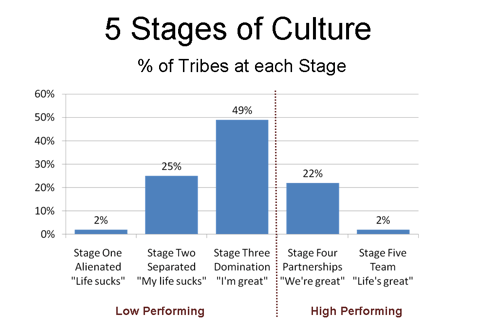
I’m reminded of the stages of tribal culture described by David Logan and colleagues in their book, Tribal Leadership, and presented eloquently in his TED talk.  I have discussed this idea in previous posts.

The visual above encapsulates Logan et al’s theory of tribal culture.  Their work aims to advance groups from lower to higher levels of culture and performance.  In this framework, the currency of cultural economy is language.  Each tribe member’s dominant cultural stage mindset emanates in their words, and is represented/encapsulated in each stage’s mantra above.

Those who experience COVID-19 as ‘what’s happening to me’ likely live in the lower three stages most of the time—self-absorbed, competing, uninterested in personal or societal connection and growth.  Those able to see how ‘this is happening to us all’ have made the shift toward an Outward Mindset, seeing their node selves as inextricable members of a larger, interconnected system.  For a system to function well, grow, and sustain itself best through crisis after crisis, it must achieve a collective “We’re great” or “Life is Great” mindset.

Whom do you know on your team, among your friends, or in your family, who lives these words (most of the time)?  How do you feel when you’re around them?  What do you hear them saying right now? What energy do they exude?  When I meet people like this in my life, I feel calm, soothed.  They remind me to be humble, and to remember what I can do to help, both myself and others.  I feel connected in their presence; I recall my strengths and potential for contribution, and I’m motivated to act accordingly.  They give me hope.

So what do I hear them saying, what language do they speak that elevates our communal culture?

First, they avoid ad hominem.  They refrain not just from political rhetoric and attacks; they don’t make generalizations about groups based on race, gender, geography, social class, etc.  They also withhold judgment—they entertain various stories about people’s motivation, circumstances, and values, rather than jumping to oversimplified conclusions based on their own biases.

Second, they empathize.  They strive to relate to each person they’re with, as well ‘the others’.  And if they can’t do that, they validate the others’ feelings.  “That’s so hard,” can be the most soothing words a person can hear when they’re struggling and suffering. And “Well, we don’t know what they’re living,” reminds me to be humble.

Third, they offer hope.  But it’s not false hope or superficial, Pollyannish positivity.  They honestly believe in and see the light at the end of the tunnel, and they point to it for our benefit.  They do this by asking, “What do you need?”  “How can I help?” and saying simply, “I’m here.”

When I come across people like this, I want to be around them more.  I want to emulate them.  I point out their words and actions to others, and show the positive movement they inspire in me and others.  Stage 4 and 5 tribal leaders lead by example.  And make no mistake, they are everywhere.  They often don’t have a title or any designated authority.  But the team/organization/family is always better for their presence.

If you have people like this on your team, consider:  how can you be more like them?  What do they inspire in you?  If you are this person, how can you bring people along in this mindset?  This is how we get better through our current crisis:  We find the leaders who speak the language of We, Together, Growth, and Hope.  We find and follow those who set the example, and we strive to set it ourselves.  We take advantage of the programs and support systems around us.  We get help, get better, and then turn around and help others.

Yes, there is much trauma and grief.  There is also boundless love and connection.  We find the latter easily when we look, and it sustains us.  We can absorb that energy, join that movement, and make a difference in every encounter with our fellow humans.  We can absolutely be better.