
The Feels Are Good

IMG_4436

NaBloPoMo 2018:  What I’m Learning

I’ve been working for many years now on feeling my feelings rather than thinking them.  Rationality and analysis in service of self-awareness and understanding are great, but I have tried too long to will my hard feelings away, or experience them all as anger rather than what they really are—sadness, shame, fear, etc.

With books like The Art of Possibility, Mindsight, and Rising Strong, after multiple readings, along with years of therapy, I have acquired the skills to allow these feelings to emerge, engage, and pass.  I understand much better now the purpose of emotions: they are simply signals.  They are meant to draw our attention to something meaningful in our existence.  This could be a threat, a connection, a relationship, anything.  We modern humans spend a lot of time judging our emotions (and thus one another’s), trying to suppress the ones that make us feel bad, masking them, numbing them, and offloading them.  For whatever reason, we are not good at simply allowing them, learning from them, and letting them go.

I started following Nate Green on Facebook just before he deactivated his page.  He now communicates with readers through email newsletters, and his is one of the few I actually read.  This week he sent a rare second message, linking to his recent article for Men’s Health, “There Will Be Tears: Inside the Retreat Where Men Purge Toxic Emotions.”  If you read nothing else this weekend, read this.

Nate participates in an Evryman retreat in Big Sky, Montana, a project “aimed at teaching men how to access and express their emotions.”  When I saw the headline I felt a squirming in my gut, which surprised me.  We, especially we women, are always urging men to be more ‘in touch’ with their feelings, right?  Don’t we always want our men to be more sensitive and caring, more empathic and expressive?  Don’t we want them to role model all of this for our children, especially our boys?

Nate describes the retreat and its exercises:

My thoughts are racing. I shift my feet. Andrew shifts his. We continue to stare at each other. Finally, Andrew takes a deep breath and speaks. “If you really knew me, you’d know that I smoke too much pot and use it as a coping mechanism. And you would know I’m ashamed of it.”

His gaze lowers, embarrassed. He looks back up and we lock eyes. Now it’s my turn.

“If you really knew me, you’d know that I sometimes drink too much alcohol and it worries me.”

I have never spoken those words out loud before. I instantly feel lighter, like a giant
weight I didn’t even know was there has been lifted. Andrew smiles, happy to not be alone in his confession.

“Thanks,” he says.

“Thank you,” I say.

…To our left and right are 16 other men, paired off just like us. Behind us sits a gigantic log cabin that will be our home for the next two nights. After that, we’ll carry 50-pound packs into the backcountry of Yellowstone National Park, where we’ll walk and sleep among the grizzlies, mosquitoes, and stars for three more nights.

We all met maybe an hour ago.

Yikes.  I’m pretty emotionally confident and open, and this would be hard for me.  Imagine (or maybe you don’t have to) how hard it would be for outwardly strong, independent, and stoic men to do this.  What would it take for you men to go on a retreat like this?  Women, how do you picture the men in your life going through something like this?  How would we react if our men disclosed their innermost fears to us, cried openly in front of us, at home, at work, on the field?

For a long time I did not understand how hard this is for men.  I thought they were all just shallow and simply did not have emotions (other than anger and sarcasm).  In Daring Greatly Brené Brown writes how she learned about the severe threat that vulnerability really is for men.  After one of her presentations she was approached by an older man, a husband and father of her superfans.  He pointed out to her that though we say we want men to show more vulnerability, the moment any man does, he immediately pays a steep price.  I like to think we would welcome it, but I have a feeling many of us would react with shock and dismay, at least initially.  We complain about how women are perceived as weak and ‘hysterical’ when showing emotion, and if I’m honest, I might feel the same or worse about a man doing it.

So our mission should be to make it okay for all of us, men included, to ‘be emotional.’  That does not mean losing control and acting out.  It does not mean using emotions as an excuse for abusive behaviors.  It means allowing and holding space for our common human experiences to affect us at our core, and acknowledging how it feels.  It means helping each other breathe and walk through it all, holding each other up through the hard parts.  In Rising Strong and Dare to Lead, Brown takes us through steps she and her team have developed for working through hard emotions, called the Reckoning, Rumbling, and Revolution.  I’m getting really good at the first step, also known as the Shitty First Draft.

I know I have included multiple links here with minimal explanation.  It’s late.  And you can click and read at your leisure.  Or maybe you don’t need to; maybe you know exactly what I’m referring to and you march with the same mission already.  If so, let’s connect.  Let’s find all of us who understand the profound need for this shift in culture and society.  Let us form a chorus and sing loudly to whomever will listen, and make the world better for all of us—men, women, children—all of us for one another.
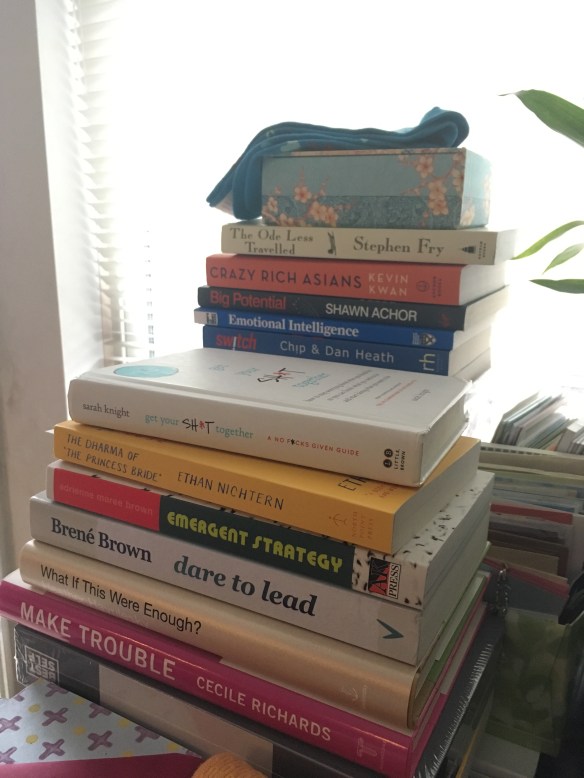
 

Less Phone, More BOOKS!

books 11-3-2018

NaBloPoMo 2018: What I’m Learning

Hi, I’m Cathy, and I’m addicted to my phone.

Last month I finally decided to do something about it, mostly so I could be more present to the kids.  It’s been a fascinating journey so far, and I’m proud to say I’ve already made progress.  First I banned Facebook after 6pm.  That went well until I traveled.  Then I took the Facebook app off of my phone.  The withdrawl continues to spike at times.  I also notice that I use other things to substitute—New York Times, email, Washington Post, email, WordPress Reader, email.  I notice an anxiety, a frustration, a kind of crazed, darting hankering– I crave that dopamine hit.

The awareness of it all, however, and the commitment to get disentangled from my screen, has cleared space for a recently dormant impulse to surface afresh:

READ!

* * *

At the conference last month I was turned on to the idea of complexity (or chaos) theory and how it relates to fixing physician burnout and turning our whole medical system around.  It was positively mind-blowing (for me—most others did not seem quite as lit).  The speaker was Anthony Suchman, my newest hero.  Some highlight ideas:

  • Every system is perfectly designed to get exactly the results it gets. Our current healthcare system evolved to this point precisely from serial and cumulative decisions made over years, even though the current state was never the intent.
  • We think of organizations as machines, with predictable, linear consequences of adjustments in one part or another. This is rarely how organizations (of people) actually work.  Rather, we can think of organizations as conversations, and let go our expectations of particular outcomes, the illusion of total control.  We can let things unfold and go where the outcomes lead us, all while holding to core values and goals.
  • Patterns are (re)created in each moment, and also self-organizing. So at the same time that a pattern (eg culture) seems inevitable and self-propagating, sometimes small, almost imperceptible perturbations can create new and dramatic cascades that lead to transformation (the butterfly effect).
  • Emergent Design thus embraces the approach of “finding answers we are willing to not know,” trusting that we will get where we need to go simply because we are paying attention (or that’s how I interpret it today).

This theory that everything within a system both results from and also contributes to the whole system (a fractal) validates an idea I have been advocating to my patients for years, and that I continue to personally relearn ad nauseam: It’s all connected.  The most concrete examples are Sleep, Exercise, Nutrition, Stress Management, and Relationships—I used to call them the 5 Realms of Health; now I call them the 5 Reciprocal Domains.  Each one is inextricably connected to every other one, and they all move in concert, with subtle or dramatic dynamics.

books 11-2-18

I browsed around my local bookstore a couple weeks ago and came across a colorful title on the shelf: Emergent Strategy by Adrienne Maree Brown.  So of course I snatched it up.  The blurb says:

Inspired by Octavia Butler’s explorations of our human relationship to change, Emergent Strategy is radical self-help, society-help, and planet-help designed to shape the futures we want to live.  Change is constant.  The world is in a continual state of flux.  It is a stream of ever-mutating, emergent patterns.  Rather than steel ourselves against such change, this book invites us to feel, map, assess, and learn from the swirling patterns around us in order to better understand and influence them as they happen.  This is a resolutely materialist “spirituality” based equally on science and science fiction, a visionary incantation to transform that which ultimately transforms us.

Holy cow, YAAAAS!!  I could not wait to read it!  So I bought it, along with Make Trouble by Cecile Richards, What If This Were Enough? By Heather Havrilesky, and The Dharma of “The Princess Bride” by Ethan Nichtern.  I had also ordered Leading Change in Healthcare, coauthored by Dr. Suchman and two others.  That copy arrived last week.

Suchman 1

I feel this as all part of a slow turn, getting off my phone and diving into books again.  I’m so excited.  I have done this before—buy a bunch of books and never read them.  They occupy whole shelves in my bedroom.  But I honestly feel a transformation coming on.  Yesterday I spent a couple hours reading, researching, and writing the blog post, then I turned off the computer and opened Brown’s book.  I read through the long introduction and resonated with sentences like, “Emergence is the way complex systems and patterns arise out of a multiplicity of relatively simple interactions.”  This is a quote from Complex Adaptive Leadership: Embracing Paradox and Uncertainty by Nick Obolensky (which I have also now ordered).  I also love (ha!), “Perhaps humans’ core function is love.  Love leads us to observe in a much deeper way than any other emotion.”  Also:

all that you touch

you change

all that you change

changes you

the only lasting truth

is change

god is change

That is a quote from Parable of the Sower by Octavia Butler.

Then before bed I opened Suchman et al’s book and found these words, also in the introduction:

Complexity theory here is enriched by the focus on relationships [Hallelujah!], rather than the more traditional reference to science.  “Relationship-Centered Care” is a way of thinking that brings love and all that is personal into a world, the world of healthcare, that is mostly interested in more control and more data-based, evidence-based practices.

The point is made throughout that administrators cannot bring real change into their healthcare institutions without going through change themselves.

(The book describes) the relationship-centered social dynamics that are at the heart of Lean and a major source of this method’s success.  Unfortunately, these social dynamics are overshadowed or even displaced by the analytic technique in some Lean implementations, compromising results.

Suchman 2

So I’m learning about new ways to think on change.   It’s changing how I approach trying to change my patterns, how I see my relationship to them, how I see all relationships.  Wow.

All of this to say, I feel a deeply personal, yet global and cosmic impulse for growth, for transformation—a shift into more mindful and intentional use of my time and energy, and how I manifest it outward.  Less distraction, more focus.  Less incidental information consumption, more integrated learning and coordinated application.  Less phone, more BOOKS.

What will be the outcome?  I have no idea, that’s what makes it so exciting and wonderful!  Onward!


Running Strong In Our Lane

photo 1

NaBloPoMo 2018:  What I’m Learning

So the NRA tweets, “Someone should tell self-important anti-gun doctors to stay in their lane. Half of the articles in Annals of Internal Medicine are pushing for gun control. Most upsetting, however, the medical community seems to have consulted NO ONE but themselves.”

Hmmm, self-important.  Yes, sometimes.  After four years of college, four years of medical school, up to seven years of residency and then another 3 years of fellowship to earn the privilege of operating on the spines, nerves, organs, and blood vessels of gunshot victims, to maybe give them a chance to stay alive much less walk and talk, I can tolerate a little (just a little) self-importance in my emergency medicine, neurosurgery, trauma surgery, critical care and other colleagues.  They are f*ing rock stars.

Anti-gun.  I have yet to meet any physician, or any person, really, who is wholly anti-gun.  We are pro-gun safety, anti-violence by guns.  We would like for toddlers to not kill their siblings and parents by accident.  We would like for domestic disputes to not escalate to someone shooting their family and then themselves in an impulsive fit of rage.  We would like for depressed and suicidal patients not to actually kill themselves, which is too much easier to do with a firearm than any other method.  We just want to stop being the only country where so many die every year from being shot by guns.

The American College of Physicians (ACP), the internal medicine professional society and my home for professional communion and development, and the largest medical specialty organization, has published an updated position paper on reducing firearm deaths in the US:

In 2015, 9 (the ACP) joined the American College of Surgeons, American College of Obstetricians and Gynecologists, American Public Health Association, American Psychiatric Association, American Academy of Family Physicians, American Academy of Pediatrics, American College of Emergency Physicians, and American Bar Association in a call to action to address gun violence as a public health threat, which was subsequently endorsed by 52 organizations that included clinician organizations, consumer organizations, organizations representing families of gun violence victims, research organizations, public health organizations, and other health advocacy organizations (2). Yet, firearm violence remains a problem—firearm-related mortality rates in the United States are still the highest among high-income countries (3).

Cited in their tweet, the NRA Institute for Legislative Action posted an article (no author identified) picking apart the ACP’s research citations and approach, stating, “This position paper leaves one wondering if the authors reviewed the evidence, or just found works that suited their needs. For all of the bluster about their own important role in the anti-gun movement and all of the misuse of research findings, the ACP makes one thing clear: they respect their own rights and opinions far more than they do those of law-abiding gun owners.”  *sigh*  As I have not read the primary literature on gun mortality and public health myself, I will not comment on that here.  I will just say that I wholeheartedly trust in the integrity of my colleagues and leaders at the ACP.  I’m proud of our advocacy for patients and, more recently, for physicians ourselves and our well-being.

My physician colleagues have posted a multitude of passionate responses on Twitter; you can read them here, here, and here.  And I just now saw this open letter to the NRA from the American Foundation for Firearm Injury Reduction in Medicine (AFFIRM) and signed it.  Below are highlights—please take a look.

I admit, I initially responded with profanity at seeing the NRA tweet.  My threshold for swearing is very low these days.  And I wanted to just post screenshots of the anti-NRA tweet storm and let them speak for me.  But that’s not me. I have yet to really decide how I want to design my public platform and conduct on issues like this.  For now, I can just say that tweets and articles like the NRA posted are disappointing.  I don’t want to follow that lead.

* * *

Dear National Rifle Association,

On Wednesday night (11/7/2018), in response to a position paper released by the American College of Physicians (ACP) Reducing Firearm Injuries and Death in the United States, your organization published the statement “Someone should tell self-important anti-gun doctors to stay in their lane.”

On that same day, the CDC published new data indicating that the death toll from gun violence in our nation continues to rise. As we read your demand for us doctors to stay in our lane, we awoke to learn of the 307th mass shooting in 2018 with another 12 innocent lives lost to an entirely preventable cause of death–gun violence.

Every medical professional practicing in the United States has seen enough gun violence firsthand to deeply understand the toll that this public health epidemic is taking on our children, families, and entire communities.

It is long past time for us to acknowledge the epidemic is real, devastating, and has root causes that can be addressed to assuage the damage. We must ALL come together to find meaningful solutions to this very American problem.

We, the undersigned – physicians, nurses, therapists, medical professionals, and other concerned community members – want to tell you that we are absolutely “in our lane” when we propose solutions to prevent death and disability from gun violence.

Our research efforts have been curtailed by your lobbying efforts to Congress. We ask that you join forces with us to find solutions. Help us in our non-partisan, physician-driven research efforts at AFFIRM Research.

We invite you to be part of the solution.

You dismissed the ACP’s position statement on preventing death and injury from gun violence by stating, “Most upsetting, however, the medical community seems to have consulted NO ONE but themselves.”

We extend our invitation for you to collaborate with us to find workable, effective strategies to diminish the death toll from suicide, homicide, domestic violence, and unintentional shootings for the thousands of Americans who will one day find themselves on the wrong side of a barrel of a gun.

We are not anti-gun. We are anti-bullet hole. Let’s work together.

Join us, or move over! This is our lane.