Polarity Management

Yes, AND.

This is the central tenet of polarity management. It’s about holding divergent and apparently opposing ideas or positions at the same time, understanding that their relationship is actually complementary and mutually strengthening rather than perpetually conflicting. Masculine/feminine, individual/collective, conservative/progressive, strong/soft, diplomacy/candor, top down/bottom up–what else? Can we frame any two antagonistic ideas in an infinity polarity loop of inextricable relationship? I say yes. Because it puts us into novel perspectives, prompting a mindshift into possibility, creativity, and connection.

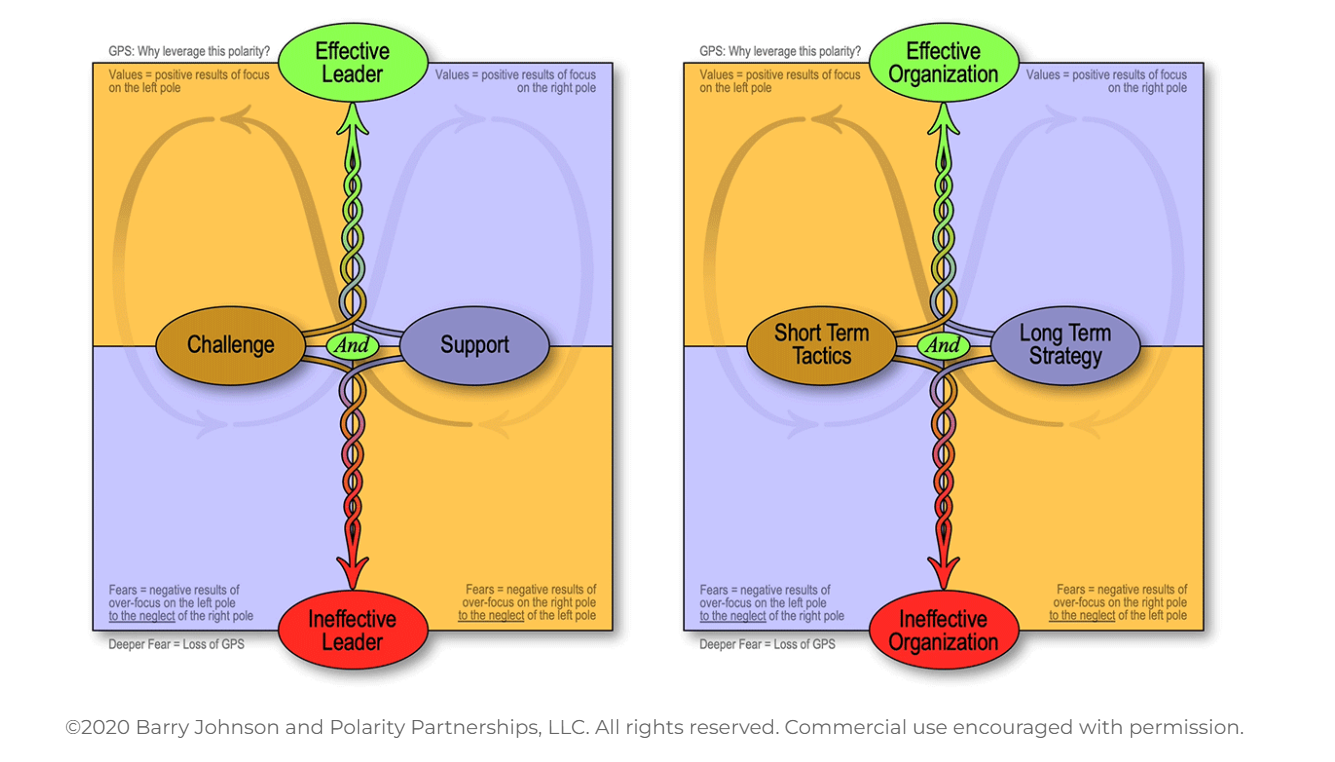
I am waiting on permission to use a seminal image from Polarity Partnerships, the organization founded around the idea that in any polar dichotomy, there is a dynamic flow and balance between the advantages and disadvantages of focusing energy and action on either pole. When we can maximize the benefits and minimize the costs of each pole, then leadership and organizations thrive. It’s much easier to show than tell; fingers crossed I’m allowed to share the image; check out their homepage and you will see what I mean.

13 November 2023: Here it is!

Polarity Map® is a registered trademark of Barry Johnson & Polarity Partnerships, LLC. Commercial use encouraged with permission.

How do I already manage polarities well?
–Since I learned the concept during leadership training in 2019, I now think easily in complementary polarities. I was primed c.2000 when my residency classmate introduced me to “Yes, AND”. She took an improv class and invited me to play a game in the workroom. Thanks, Carol! Now whenever I feel an initial resistance or opposition to something, I look for the juxta(op)position that gives that two-sided coin perspective.
–Polarity management and trade-offs feel related to me. I think in terms of the latter more and more, also since 2019, when I read Being Mortal by Atul Gawande. At the end of an elderly life, there is often tension between independence (goal of the elderly) and safety (goal of their family), and a peaceful end of life usually means compromises on both sides. Increasingly as I counsel patients on habit change, I acknowledge that trade offs will be necessary, and only they can define and decide which are and are not worth making, based on their values and goals. I find that approaching behavior in this way eliminates judgment, and also opens the door for flexibility and evolution without (or with less) regret. It is simply flow and growth.
–I definitely parent better from an integrated polarity perspective. Mostly it’s about letting go and hanging on, advising and commanding, that delicate and heavy handed balance. I tend toward a laissez faire parenting style, which risks the kids feeling neglected if I lean too far into my default. I’m getting better at seeing the pitfalls, and I still have some work to do.

How could I manage polarities better?
–Some people in my life prioritize their values and goals very differently from me. I sometimes sit in rigid judgment of this, dismissing their perspective as inferior in some way. I can do better at recognizing the benefits of having these people around to balance and bend my hard biases.
–I will look for strong polarity integration around me and call it out/forth. I will reinforce and amplify it. I will do my part to make both/and thinking, speaking, and leading visible, and move it into mainstream mindset.

How do we already manage polarities well as a society?

We don’t.

How could we do it better?

Where do you see successful, collective, Yes, AND in action?
I can think of two organizations that walk the talk.

Polarity Partnerships.
“In today’s world of increasing interdependency and complexity, it is vital to utilize problem solving AND both/and thinking to address your most strategic challenges and opportunities. The research is clear – leaders, teams and organizations that leverage Polarities well outperform those that don’t. Discover how to leverage your most strategic Polarities (AKA paradox, wicked problems, chronic tensions, dilemmas, etc.) to become more innovative, agile, profitable and competitive immediately and over time.”

Braver Angels.
“Our mission: Bring Americans together to bridge the partisan divide and strengthen our democratic republic.”
“We state our views freely and fully, without fear.
“We treat people who disagree with us with honesty, dignity and respect.
“We welcome opportunities to engage those with whom we disagree.
“We believe all of us have blind spots and none of us are not worth talking to.
“We seek to disagree accurately, avoiding exaggeration and stereotypes.
“We look for common ground where it exists and, if possible, find ways to work together.
“We believe that, in disagreements, both sides share and learn.
“In Braver Angels, neither side is teaching the other or giving feedback on how to think or say things differently.”

Every once in a while I read an article that does it well–not only describing two poles but explaining why each is/both are necessary and good relative to the other, and the importance of balance and flow between them. It’s pretty rare.

For practical application and guidance, I highly recommend Navigating Polarities by Brian Emerson and Kelly Lewis.

Like so many life practices I consider this month, polarity management and navigation is transformational and liberating. I had not realized it so starkly until now. When I get out of either/or, “Yes, BUT,” and “You suck,” accept what is and look for mutually complementary balancing points, new and useful insights almost always follow. My way out of conflict emerges faster and more clearly, and my relationships get stronger along the way. Very cool.

Mindfulness

Photo by Lyra Luu, Schalenbrunnen im Botanischen Garten, Munich, June 2023

I count 47 posts on this blog when I search ‘mindfulness.’ I talk about it almost every day with patients. Of all self-care practices I have acquired over the years, I think this is the most useful. Funny how I did not list it in the stress management post this month? Maybe because I see mindfulness as a way of being more than something I do? It really does bring me peace, for which I am both grateful and proud, as I have trained long to gain its benefits.

If you’re not yet familiar, I recommend starting at www.mindful.org. From their site:

“What is mindfulness?

“Mindfulness is the basic human ability to be fully present, aware of where we are and what we’re doing, and not overly reactive or overwhelmed by what’s going on around us.

“While mindfulness is something we all naturally possess, it’s more readily available to us when we practice on a daily basis.

“Whenever you bring awareness to what you’re directly experiencing via your senses, or to your state of mind via your thoughts and emotions, you’re being mindful. And there’s growing research showing that when you train your brain to be mindful, you’re actually remodeling the physical structure of your brain.”

Ok so, how do I already do mindfulness well?
–I have a strong informal practice. Often and at any given moment, I drop (or rise) easily into awareness of my environment, the people around me and their signals, and my own physical, mental, and emotional sensations. Even when it’s uncomfortable or painful, I can hold it loosely, with openness and curiosity. I wonder how many times a day I say or think, “Huh,” “What is up with that,” and “How fascinating”? This leads me often to novel questions, which I then express to others, engaging in unexpected ways, which is almost always more rewarding that I anticipate.
–My practice helps me be present to others as they need me. When I attend to what is, resisting the pull toward what I want or what I think should be, I can empathize, validate, and reflect with others, rather than go straight to problem solving, which is seldom what people want or need.
–Mindfulness makes me a more sensitive and agile speaker. As words and expressions form in my head and exit my mouth, I monitor their intent and impact in real time. I speak quickly and at times with sharpness and irreverence, but more often with kindness and passion, and rarely without thought to every word. Is that mindfulness or conscientiousness? Probably something mutually entwined?
–I lead by example. People say they feel peaceful around me, that I have a calming effect. I attribute this to my ability to be with whatever is, in the moment, without (or with minimal) judgment, together with others.

How could my mindfulness practice be better?
–I could establish a formal sitting practice. A daily session of breath and awareness, a mental discipline to quiet the monkey mind, to strengthen my parasympathetic nervous system, would likely make me healthier in all domains. I’m just not quite moved yet to commit. But maybe if it helps my writing…
–I could read more of the masters’ works: Jon Kabat-Zinn, Thich Naht Hanh, Sharon Salzberg, Pema Chodron. Then I’d be more knowledgeable, could maybe explain it better to people whom I think could benefit. ..and if it helps my writing…
–Overall I’m pretty satisfied with current state. I faced trials of the last several years with relative equanimity, and the challenges themselves strengthened my practice. I trust myself to know when I need to do more, because I’m mindful enough already to notice.

What’s already good about our collective mindfulness?

Awareness. John Kabat-Zinn developed Mindfulness-Based Stress Reduction (MBSR) as a meditative therapy method for stress management in 1979. I learned nothing about it in medical school or residency. I’d say the first ten years of my career, mind-body medicine was still considered fringy; colleagues would stare blankly or even roll their eyes when I talked about it. Today mindfulness and other techniques of meditation and mind-body practices live in the mainstream, their benefits available to everybody, and fewer people feel self-conscious about participating.

Language. “Be with what is.” “Hold the space.” “Withhold judgment.” “Breathwork.” One could say that mindfulness lingo has infiltrated our general vernacular. Good. These concise phrases can moor us to a mindset of alert and relaxed presence, which makes us calmer, less impulsive, more attuned, and healthier. Words matter; the more we can use them for mutual de-escalation and connection, the better.

Connection. As mindfulness gains awareness and its expressions spread, fellow practitioners can connect more easily in any forum. They become magnets for yet others, and communities form around this attentive way of being which, nourished by strong ties, makes us better leaders by example wherever we go, to whomever we encounter. Jeez, I’m making it sound like a cult.

How could we do better together?

Teach Mindfulness In School. Mindfulness skills are life skills. Learning breath work, body awareness, and mental discipline in iterative, age appropriate ways prepares children and adolescents to tolerate and navigate an ever accelerating world of volatile change and chaos. It would be easy to incorporate skills practice into play, sports, and academics at all stages of brain and social development.

Incorporate Mindfulness Into Leadership Training. Thinking of leaders you admire, what qualities and behaviors make them great? Mine give me their full attention, make me feel seen, heard, and understood. They emote relatably, easily, and appropriately, and also carry themselves with steady, unflappable confidence. They name what is with clarity, desireable and/or not, and hold it peacefully while working consistently for change and improvement. They are honest. Thus they attract and inspire followers rather than coercing them. Healthy mindfulness skills and practice amplify and maximize relational leadership strengths by grounding leaders in self-awareness and self-regulation as foundation for outward action.

Just writing about mindfulness lowers my respiratory rate and helps me attune to myself and my surroundings better. I feel gratitude and peace, confident in my ability to face and manage whatever comes around the corner, satisfied that I have lived the present moment to its fullest. I have very little to regret if I can keep this up.

Honesty

“How am I the asshole here?”

How often do we ask ourselves this question, let alone answer, and do so honestly? I can think of few more uncomfortable exercises. And yet, the world really needs us to do it more, each and all of us. I’m not saying we’re all assholes. I’m saying we all need to get better at owning our shit, and holding one another accountable for doing it.

How am I already honesting well?
–I ask myself the asshole question all the time. It’s humbling, no doubt. And that is the point. I keeps me mostly out of rampant self-righteousness and blame of others for any given conflict. I still tell my at-least-partially justifiable stories of injustices done to me, and I am also forced to admit injustices I perpetrate on others. This practice saves my relationships from impulsive disconnection. Taken too far, I easily fall into shame and self-loathing, but I have learned to mitigate this over the years.
–I practice loving rather than brutal honesty as much as I can. Bad news, difficult feedback, and the like are hard enough to receive, without the messenger also showing up cold and indifferent. I don’t sugar coat; I do my best to show that I see someone’s strengths and contributions as well as the things that need work. I stick to objective facts and my interpretation of them, not as truth but as perception and extrapolation, which can be modifed through questioning and deeper understanding through discussion.
–I scrutinize the stories I tell about other people, and I check in. Especially if I have an acute or disproportionately emotional reaction to something or someone, I call on the tribe, describe the event, and ask for feedback. I consistently get validation of my experience and emotions, as well as a loving challenge to consider alternate perspectives, which always makes me better.

How could I do better?
–Revise my narratives–again. Not just about individual people–my personal biases and judgments–but about groups, society, our nested and overlapping cultures. I think this is about challenging the stereotypes I hold, especially the deepest ones, which I notice more easily and admit more readily now than in the past. I can acknowledge their presence without judgment, as they are not intentionally malicious; I can simply monitor and choose not to act on them.
–Continue to query the origins of my own attitudes, prejudices, and behaviors, especially if they hinder my ability to relate and connect with others. Face them head on; reconcile them with my core values with self-compassion; commit to acting in accordance with the insights gained.
–Seize opportunities to provide honest feedback, especially the positive kind, in real time. For negative feedback, consider thoughtfully (“THINK”) whether providing it will serve the relationship or the person’s goals. Not all feedback is necessary or useful.

How does our culture already do honesty well?

Food labels. As a family with anaphylactic food allergies, we really appreciate this.

Books, film, entertainment. Sometimes it’s just easier and more effective to show than to tell. When we read novels or watch movies depicting the experiences of people very different from ourselves, somehow we are more open to empathizing and understanding than if we attended a lecture or read articles. We are less likely to form and express arguments as to why someone’s experiences are not valid, that they should not feel how they feel, that our biases and stereotypes are, in fact, correct and reliable. In moments of vulnerability on our part, we can see the cracks in our self-delusions. Fiction is one of the most honest forms of communication, if we pay attention. We can challenge our biases indirectly and in the privacy of our own thoughts, shown to us vicariously. How pleasingly ironic.

How could we do better?

Transparency and Fair Process. I’m thinking of policy, government, and organizational leadership here. Too often decisions affecting large groups of people are made without clear rationale or respectful and truly honest communication of goals, purpose, and process. I understand the importance of discretion and ‘need to know’ basis, etc. But too many of our systems operate in the dark at the upper eschelons, fostering suspicion, mistrust, disconnection, backbiting, and overall toxic work and societal envrionments in the long run. Telling people what you can tell them, acknowledging outright that you cannot tell all, and keeping communication as open and honest as possible creates a culture of safety and loyalty worth well more than its weight in rentention, reputation, and productivity, especially when things get hard.

Accountability. All humans make mistakes. Leaders take risks that don’t always reward as anticipated. They let their emotions cloud their judgment in big ways and small, sometimes with severe consequences. OWN IT. People know it anyway, and no matter what happens operationally, leaders who take responsibility for their own actions can stand up straight with self-respect, and likely more respect from others than if they deflect, obfuscate, and scapegoat. Walk the talk of integrity that’s written in all those mission/vision/values statements. Lead by example. This goes for all of us, by the way. Make no mistake, someone is always watching you, gauging their work ethic with yours, adjusting standards of behavior according to the prevailing local norm. Do you part to elevate it as much as possible.

Psychological Safety. This is both the result and the foundation of our ability to be honest, with ourselves and one another. When we can answer the “how am I the asshole” question to ourselves without shame and commit to managing our own inadvertent assholery, then we can better hold space for others to do the same. The Asshole in me sees the Asshole in you, and we can all love us both. I can hold you accountable for your mistakes, actions, and harm done to others, and not throw you away as a person, because I hope you would do the same for me. Again, it starts with our leaders, designated and not.

Any and every effort at consistent and deep honesty is worth the effort. The discomfort, pain, and risk are worth the rewards of self-respect, connection, and stronger families, organizations, communities, and cultures. Consistent honesty frees us from the mental and ethical burden of deception and secrecy, which foster disconnection, loneliness, and conflict.

Honesty builds character. We must strengthen our collective commitment to live as people of character, demand it of ourselves and our leaders, every day, in every encounter.