Holding FORtitude

Doesn’t it feel like boarding up our windows for an oncoming hurricane?

It’s late. I’m tired. We’re all so tired. We have all done what we can to this point. Whether we have seen it as a fight, a war, a crusade, a mission, a tragedy, a comedy, a farse, an apocalypse or something else, it’s all about to climax–we think. But let’s consider a moment.

Will there be resolution of any kind by the time we go to bed Tuesday night? Very likely not. Even if the election result is clear, the road ahead looms treacherous either way. This is why I have committed to writing with the election in mind for the entire month–we will live in this morass for a long while yet, and we each/all get to decide how we will show up for our fellow citizens and humans. Will we participate in fomenting division and rage, or can we find another way to be and do?

*deep breath*

How will we get through? Can we be:

Mindful Intentional Thoughtful Humane Empathetic Compassionate Kind Generous ?

Tonight I implore us to frame our opinions, goals, aspirations etc around what we are for far ahead of what we are against. Constant rumination and speech around what we don’t want centers and amplifies just that. It keeps us stagnant and limits creativity, innovation, and collaboration. We can reframe “I’m against illegal immigration” into “I’m for justice and rule of law.” “I’m against family separation” can become “I’m for humane and merciful treatment of people fleeing violence.” We are far more likely to find shared values and goals around things we are for–because these are expressions of hope and aspiration. No surprise, we humans share these in common more than we admit in times of conflict. The both/all AND solutions emerge far more readily when we de-escalate from oncoming to coming alongside.

Here’s what I’m FOR:

Leaders of character and integrity

Holding elected officials accountable to their words and actions

Treating my fellow humans with respect, understanding, and kindness, regardless of their political leanings

Holding my fellow humans accountable for their words and behaviors toward me and others; low tolerance for ad hominem attacks and demeaning behavior of any kind

Government that is socially progressive and fiscally responsible and accountable

Patient-physician autonomy in medical decisions, especially women’s reproductive decisions

Non-violent, non-adversarial, mutually respectful political discourse

Transparency about conflicts of interest

Self-awareness, self-regulation, and effective communication at all levels of the electorate and elected/appointed officials

Learn. Practice. Train. Nothing will improve if we continue to cycle/spiral through futile interactions of emotional hijack and refusal to see one another’s points of view. We have so far and long yet to go, and it is up to each/all of us to heal the deep ruptures in our social fabric.

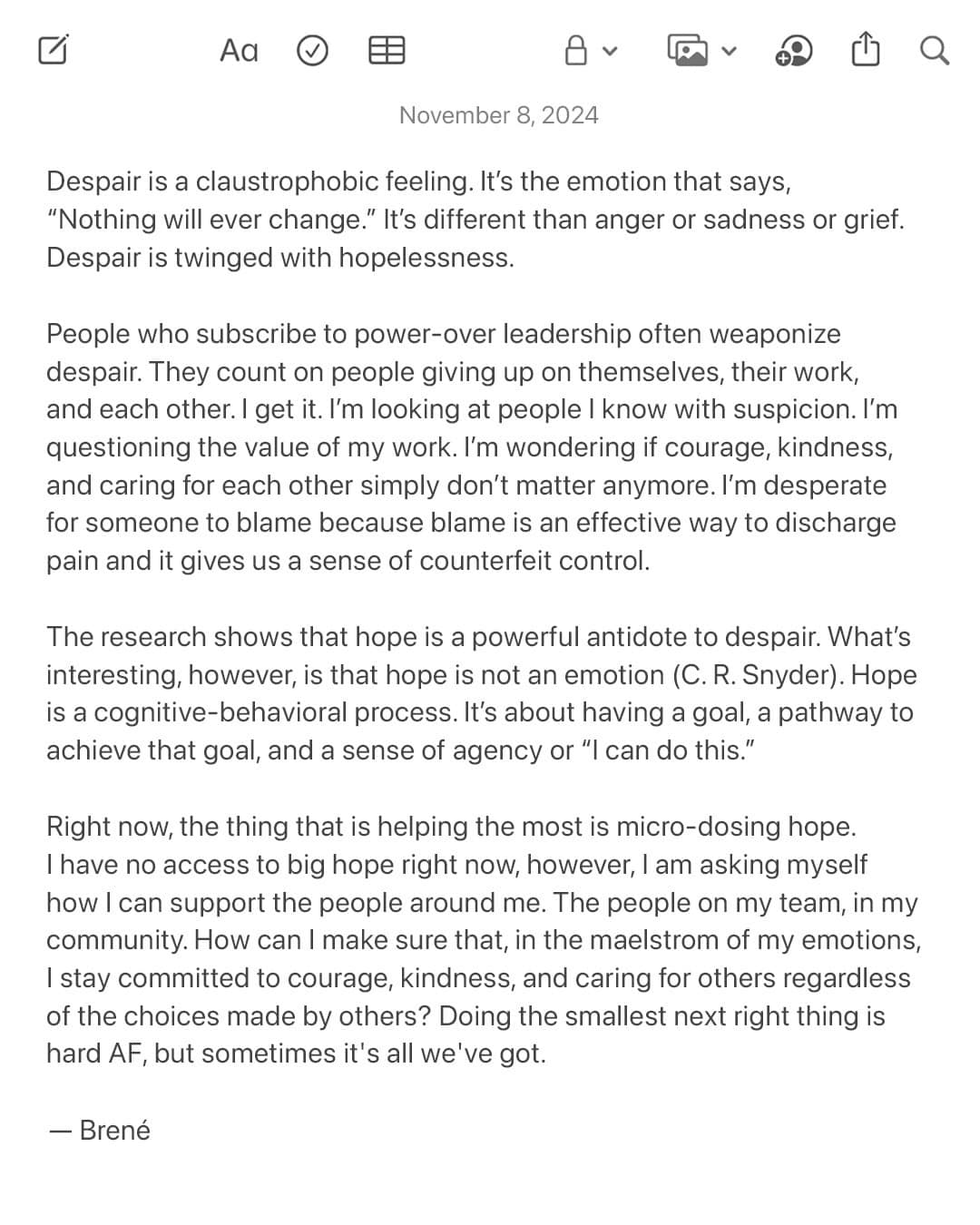
Please, for the love of us all, let us stay engaged. Rest when you must, know your limits, find your niche and make your contribution. Do it as humanely as you can–resist the urge to lash out, to offload your frustrations in hurtful ways. Find what upholds your patience, your forbearance, your steadfast perseverance, your courage–your fortitude–and immerse in these when you can. Look for the humanity in everyone around you, especially in those you may perceive as your ‘enemy’. The real enemies are cynicism, hopelessness, despair, and hatred. They are the hurricane.

The road is so long, so arduous. We trudge it together, like it or not.
Let us help one another onward, leaning and supporting in turn.

I Hold FORtitude for Us, individually and collectively.

Board our windows, and leave the porch lights on.

From Instagram
From Instagram
From Instagram
From Instagram

Holding Fear

I submitted my ballot today, November 3, 2024.  The US Presidential Election is two days away.

So many people fear not only the outcome, but the process.  Confidence in election integrity flags severely in recent years, for myriad reasons.  People of any political persuasion suspect their fellow humans of nefarious motivations and acts, both in general and individually.  Trust flickers and wanes like a candle in a hailstorm.

We cannot be reasoned out of our fears.  The more someone tries to convince us that our fears are unfounded, the more our fears escalate, and we get frustrated and often angry on top of that, further inflaming the encounter, risking damage to relationship. 

Emotions are, by nature and definition, irrational.  This does not mean they are unjustified, unhelpful, or unimportant.  Emotions are signals that something important to us is at stake—often relating to our survival, at least as far as our limbic brains are concerned.  Fear is a primal instinct and emotion, conserved over millennia of evolution to keep us alive.  As I described yesterday, fear often sublimates itself into anger, without help from outside forces.  This inner rage can then manifest in ugly words or actions, harming others, our relationships, and ultimately ourselves.

When we see someone on ‘the other side’ acting out like this, of course we feel fear and anger.  Of course we rail at them as horrible people and want justice for their abhorrent actions.  And of course, we see them as representative of everybody we grossly identify as their tribe (see image below from the @startswithus Instagram account).  That is the lens that fear places before our eyes, so we may be alert to threats—to our safety, security, and identity, among other things.  We separate from and divide people into groups deemed ‘safe’ and ‘unsafe’.  But this is an oversimplification that can lead to destructive patterns of perception and interaction. 

Fear is a vitally important emotion, necessary for safety and survival.  And we must manage it, for our own well-being and that of our social integrity.

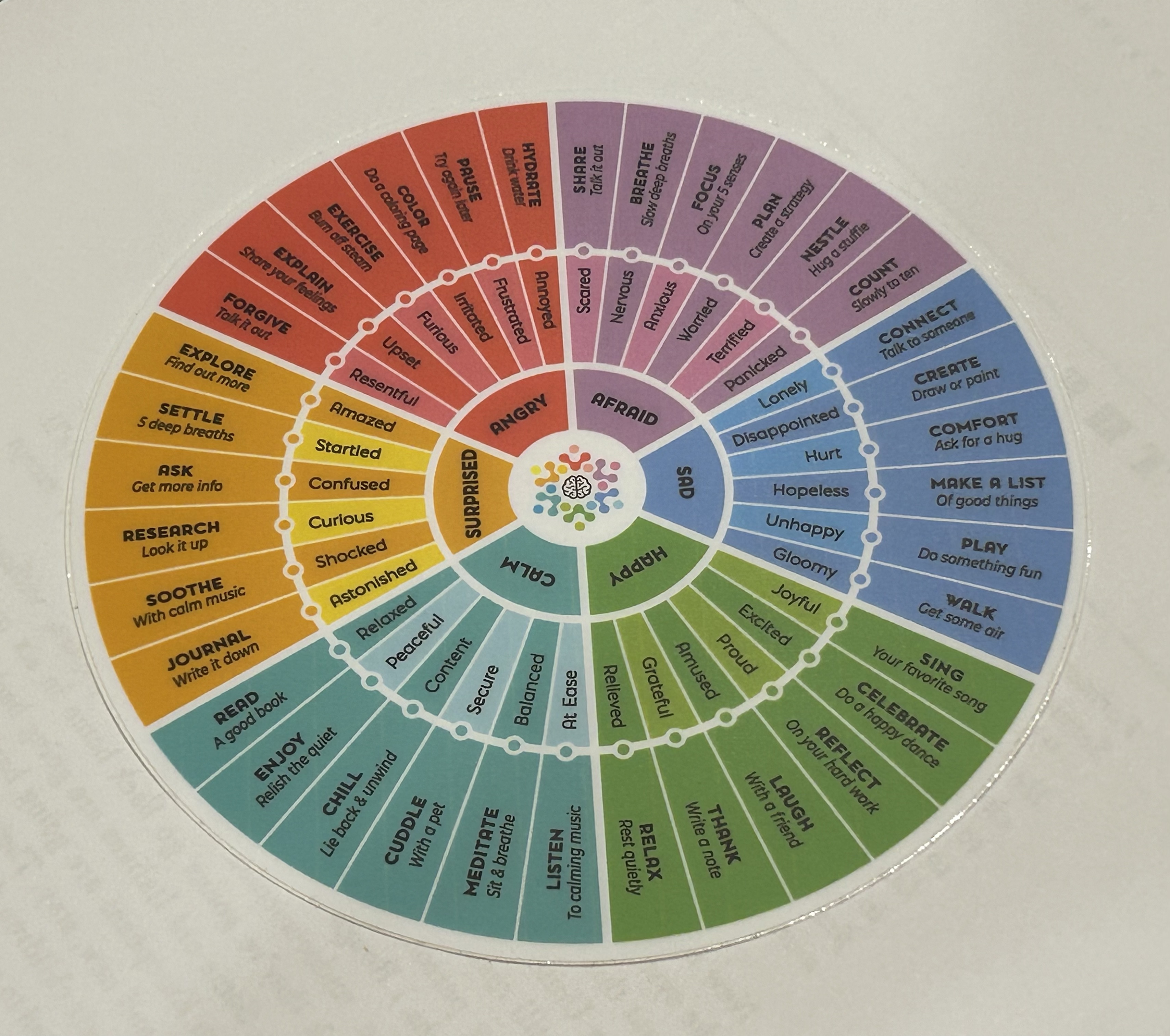
Dialectical Behavior Therapy, or DBT, teaches simple and accessible (though not necessarily easy) skills to help us do just this.  The goal is not to discredit or eliminate our fear.  Rather, DBT skills help us gain and maintain perspective, so we may hold our fear more stably, then think more clearly and make decisions with balanced emotional and rational input, in accordance with our values, goals, and integrity.  The four pillars of DBT are Mindfulness, Emotional Regulation, Distress Tolerance, and Interpersonal Effectiveness (communication).  The method is founded on the concept of the Wise Mind: the effective integration and balance of the emotional and the rational.  I won’t describe the individual skills here, but I have studied them at length and recommend them to patients every week.  In essence they teach us to monitor our emotions, identify them, accept and validate them, and query their consequences.  We are challenged to be honest about what’s objectively true versus a story we make up.  In the case of fear, DBT skills help us make and maintain the distinction between real potential risk (even if high) and imagined foregone catastrophic inevitability.  The latter belief makes us act impulsively; holding the former reality helps us slow down, set strategy, and execute with intention.  Unbridled fear separates us; appropriately restrained fear helps us form coalitions and act more effectively. 

Fear well managed allows agency to emerge and effect positive change.

People fear on all sides of politics right now.  It’s not going away—I think ever.  And it’s natural.  We just don’t have to let it drive all our thoughts, words, and interactions.

In the coming days, I Hold Fear for Us this way: 

May we see one another as whole human beings, each and all with both unique and shared experiences, hopes, loves, and fears. 
May we recognize that all our fears are valid simply because all emotions are valid, regardless of their origin.  We feel how we feel and ignoring, dismissing, denying, or comparing one another’s fears gets us nowhere. 
May we sit and be with each other’s fears in empathy and compassion, and solidarity if we can muster it even (especially) if we do not share the same fears or even understand them.
May we vote according to not just our fears but our values, our goals, and our hopes.
May we meet one another with our fears leashed, and our love in front.
May we speak and act in ways that give nobody reason to fear us.

Deep breaths, friends.  We’ got this. Hang in there. I’m right there with you.

https://www.instagram.com/startswithus/?hl=en

Holding Regret

What are your best and worst regrets? What is the difference?

If we pay attention, regret is inevitable. Living life with ‘no regrets’ is unrealistic at best, oblivious at worst. I’ve thought and written about this a lot, as evidenced by my birthday post in 2022 and the 12 (now 13) times I have tagged it subsequently.
How does regret feel? In my body it feels tight at the neck, shallow in breath. My head hangs, my lips purse. I avoid eye contact–don’t want to be seen–that’s shame, right?

“I would rather regret being too kind than not kind enough.”

I have said this for some years and now, in this moment of writing, I know why. As I realized and wrote in 2022, my worst regrets are relational–times when I have caused a rupture, especially when repair was incomplete or impossible. I could easily substitute honest, empathetic, compassionate, generous, humble, and forthright for ‘kind’. These memories still sting, and I will carry them forever. Thankfully, I pack them better now. They occupy a smaller, more condensed compartment of my life baggage, less damaging when they leak.

Holding regret well, I have learned, requires both accountability and self-compassion. Accountability makes me reflect, learn, and commit to doing better in the future. Self-compassion helps me step out of shame (I’m such a bad mom/friend/doctor/person), and stand instead in guilt (I did a bad thing). The difference: Shame seizes; guilt activates.

Brené Brown wrote yesterday on Instagram:

My research and my life have taught me that regret is one of our most powerful emotional reminders that reflection, change, and growth are necessary. In our research, regret emerged as a function of empathy. And, when used constructively, it’s a call to courage and a path toward wisdom.

The idea that regret is a fair but tough teacher can really piss people off. “No regrets” has become synonymous with daring and adventure, but I disagree. The idea of “no regrets” doesn’t mean living with courage, it means living without reflection. To live without regret is to believe we have nothing to learn, no amends to make, and no opportunity to be braver with our lives.

In our work, we find that what we regret most are our failures of courage, whether it’s the courage to be kinder, to show up, to say how we feel, to set boundaries, to be good to ourselves, to say yes to something scary. Regret has taught me that living outside my values is not tenable for me.

Regrets about not taking chances have made me braver. Regrets about shaming or blaming people I care about have made me more thoughtful.

Sometimes the most uncomfortable learning is the most powerful.

Discomfort: What actions do we take to avoid it? When does this lead to regret down the road, and which of these discomforts would we choose, if we had it to do over? Vulnerability is extremely uncomfortable–a risk of variable magnitude, depending on context. The reward, however, can be transformative. I regret causing others discomfort with my vulnerability; I’m better at attuning to that risk as I age. I regret when my vulnerability is met with dismissal, invalidation, or minimization. Still, deep human connection cannot occur without real vulnerability, risks and all. Since I live for connection, I have a very high tolerance for the discomfort of vulnerability. Expressed alongside kindness, honesty, and humility, likelihood of connection rises and regret declines. How lovely.

What regrets would you rather carry forever?

I Hold Regret for Us that shows us our core values, that keeps us honest and accountable. I also hold love, compassion, and deep connection that lightens regret’s perpetual load on us all. We walk on, my friends, all on the path, all doing our best.