
Books For Road Tripping and Empty Nesting

  1. Coming Up Short, Robert Reich
  2. Honor, Kristen Proby
  3. [Never the Roses, Jennifer K Lambert]
  4. Who Is Mr. Satoshi?, Jonathan Lee
  5. Why We Love, Helen Fisher
  6. Polysecure, Jessica Fern
  7. What a Duke Dares, Anna Campbell
  8. (The Well at the World’s End, AJ Mackinnon)
  9. How to Change, Katy Milkman

These are the books I have consumed in the past two weeks. (This one is ongoing) and [this was a repeat listen]. As usual, bold indicates favorites.

I’m still processing this new empty nest experience; suffice it to say for now, it’s a mild emotional roller coaster with a net very positive effect on mood and well-being. Kids are both well and communicating enough (they are merciful on their anxious mom), which is all I need to feel liberated and joyous. I can now find my way in this new life phase of long, loose, still secure tethers. So exciting!

Wanna know about the books? They have all been worthy companions on the road, in the hotels, and in my now very quiet house.

Coming up Short, Robert Reich
Mei and I saved this for the two day road trip to New York, and we loved it. We have both admired both Robert Reich and his son Sam, CEO of Dropout TV, which Mei introduced me to a few years ago. The elder Reich’s memoir is funny, heartfelt, honest, vulnerable, and instructive. To hear inside stories from various arms of government in every administration since Ford, from the perspective of one who has always championed causes and positions to protect people against bullies, inspires and agitates. Highly recommend.

Honor, Kristen Proby
Fun, small town romance with Florence Nightengale x bodyguard vibes–sexy. Listened to this one in preparation to meet Kristen as well as narrators Shane East and Andi Arndt at an upcoming event in Proby’s home state of Montana. I’ll be back in the Rockies this autumn, my friends–life is good.

Never the Roses, Jennifer K Lambert
This may be my favorite book of the year so far; I almost wrote a whole post about it. This is Lambert’s debut novel and narrators Shane East and Chloe Campbell take it and run. The rivals to lovers, slow burn, low spice romantasy captured my attention with intellectual intrigue and exquisite literary writing style, as well as clever humor and characters whose vulnerability and power juxtapose in the most delicious ways. Both sides of my brain would have lit up on fMRI while listening, I’m sure. Hero and heroine’s mutual respect, ethics, self-restraint and finally abiding love and loyalty just wring me for everything I love about romance. GAH!

Who Is Mr. Satoshi?, Jonathan Lee
Narrated by Steve West, a novel about a son’s journey of self- and family discovery after his mother’s death. The characters are lovable in their quirky ways, and I learned things I never knew about Western occupation of Japan after the Second World War. Not a romance, but I consider it a love story. In the end, it’s our relationships that save us. No question.

Why We Love, Helen Fisher
Love is a drive, not an emotion! This revelation and the science behind it continues to fascinate me, and I admire teachers like Fisher and Esther Perel who explain it all so well! Romantic love, lust, and attachment: The book describes these three aspects of human love relationships in a way that makes sense, but doesn’t diminish the mystery and awe of the lived experience. May Fisher’s memory be a blessing on all of us who wish to understand ourselves and one another better!

Polysecure, Jessica Fern
I listened to this one at 1.75x after the library notified me that it was due in three days and I had not started! Highly recommend. Fern explains social, emotional, psychological, and operational foundations of polyamory and other forms of consensual nonmonogamy. Much of the book delves deeply into attachment theory, and I learned how much more complex it is than my prior, superficial understanding. This book helped reassure me, possibly more than any other objective source, that I have probably been a good enough mom.

What a Duke Dares, Anna Campbell
From 2014, narrated solo by Steve West. I forewent writing and sleep for this story, which is my highest sign of audiobook engagement. Something about strong willed and irreverent heroines maneuvering rigid, patriarchal social norms, their heroes finding ‘safe’ ways to defy the same toxic societal constraints to discover and express their own emotional vulnerability, the pairs overcoming it all to finally secure their mutual love despite all the forces that oppose it, and in every instance with the help of loyal family or friends, just makes me melt. And Campbell’s writing style, like Lambert’s, elevates the intellect! Highly recommend.

How to Change, Katy Milkman
It’s not just about habit change, my friends. It’s about systems. Our brains, our environments, our behavior patterns are all overlapping and nested systems with mechanics, levers, frictions, triggers, and keys. A competitive tennis player, engineer, and now professor of behavioral economics at Penn, Milkman expertly explains how these systems work and how we can work with rather than against them to make change both easier and sustainable. I don’t see it as just a self-help book, though. The attitudes and skills she describes apply to leadership. Of course they do. Because nobody lives or operates in a vacuum. We all lead one another by example. For those familiar with concepts from Nudge by Thaler and Sunstein and Mindset by Carol Dweck, this audiobook can easily be absorbed at 1.5x speed.

Up next: Moral Ambition by Rutger Bregman and A Scoundrel by Moonlight by Anna Campbell. The list of pending books grows by the day, and I maintain both hope and conviction to plow, absorb, and integrate my way through it with tenacity and enthusiasm!

Hope you all had a great weekend, friends. Onward through the chaos in courage and connection!! [fist bump and praying hands emojis]
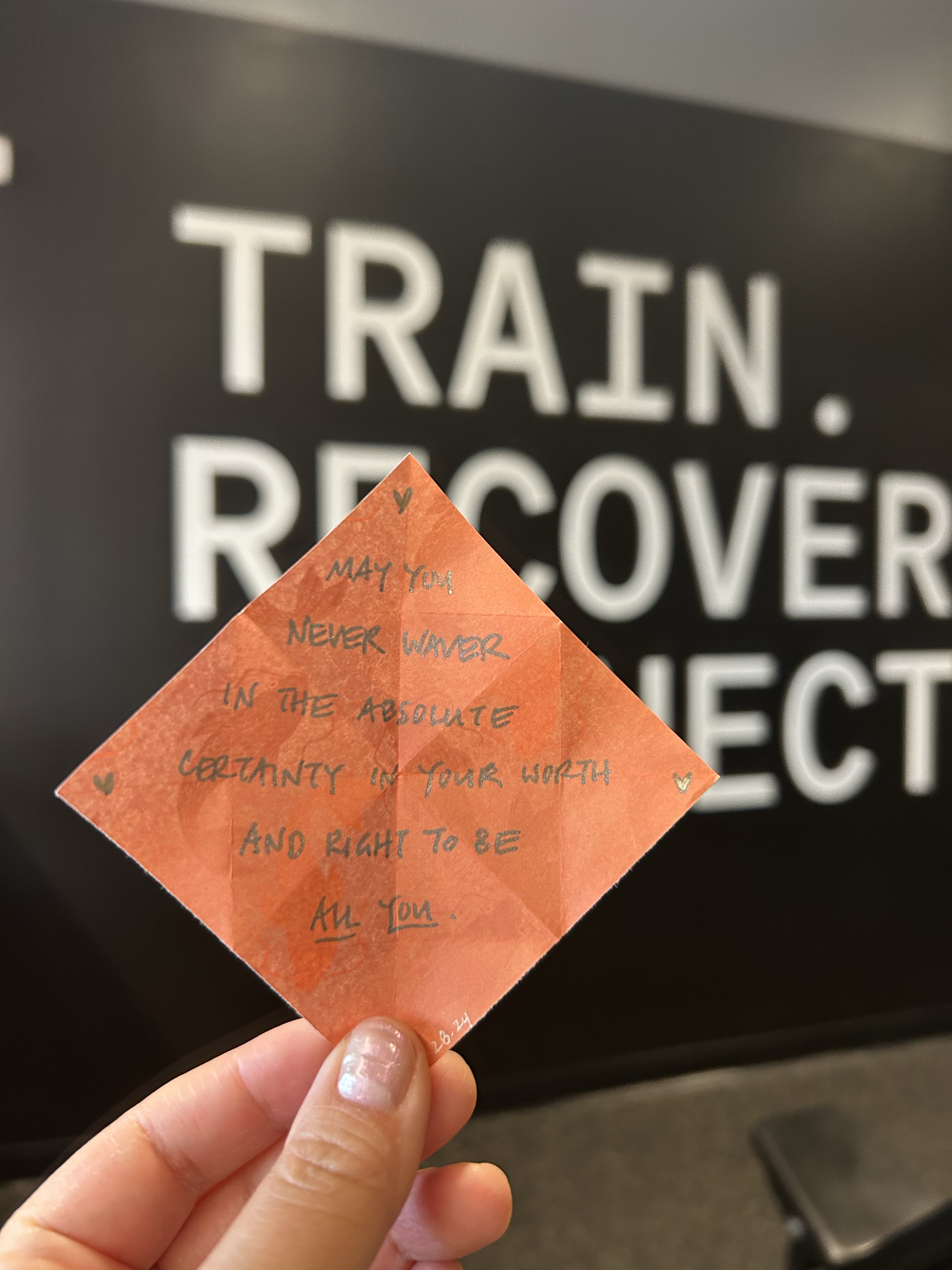
No Longer Stupid, Not Yet Infirm: Make Every Pull Count

Reflections on turning 52, yay!

I’ gotta say, I kinda killed it at the gym yesterday. It’s because Jacob was coaching, and because it was the third week of the block and I had avoided death the prior two Saturdays–that does wonders for confidence! Band rotations, bike, rope waves (I hate ropes), butterfly sit ups, mountain climbers, rower and SkiErg–woohooooo!

Remember when I wrote about how much I love driving curvy roads in the mountains? It’s the challenge of hugging that perfect tangent, timing the brake and acceleration just right–such a thrill! I feel the same way about rowing and skiing at the gym. Every pull on the machine is a chance to train that movement just a little better. What proportion of rowing power comes from hip and knee extension versus lat pull? When during the stroke is best to extend the back, if at all? How much hinge and knee flexion is optimal on that ski? If I practice this well and I ever get on The Price Is Right, will I have an advantage spinning that big wheel? We train functional movements, after all!

It’s a practice in presence. When I focus on each pull of the rower or SkiErg, I’m almost one with the machine, flowing in real time, in fluid motion. It borders on meditative, honestly. Each pull, each session feels a little more fluid, a little more powerful, efficient, and rewarding. Where else can I apply this mindset? On the slackboard. For two months now I have set the goal of spending five minutes each work day balancing on a two inch wide nylon strap that spans the length of a skateboard-shaped wooden plank. I’m already good on both long and round boards and a Bosu, but this is a whole new challenge. The asymmetry between left and right, which I sense only somewhat doing single leg movements in the gym, amplifies exponentially on the slack line. But in fifteen minutes or less per week, in eight weeks, I have made noticeable improvements in both physical balance and mental focus.

What fantastic opportunities, these training modalities, to continue growing body, mind, and spirit at this age! My nest is about to empty. I have things yet to do and plenty of runway still to do them, if I attend to what matters:

5 Domains: Sleep, Exercise, Nutrition, Stress Management, and Relationships.
3 Fundamental Skills: Self-Awareness, Self-Regulation, and Effective Communication.
5 Attributes of physical, mental, emotional, and relational fitness: Stable, Strong, Flexible, Agile, and Resilient.

Life is crazy fun when we keep learning and growing, making new friends, finding love and connection around every corner.

Love multiplies when offered, received, reflected, and amplified. I experience it every day and never take it for granted. There are also areas where I could love better; every day is another chance to practice that, too.

Who knows how long we each have on this earth, really? Regardless, I still think of every life as having infinite possibilities–HA! I wrote that post on my birthday three years ago! We just never know what encounters will change our lives for the better, set us on a path of even deeper, brighter, tighter, and more inclusive love. Even through pain and struggle, there can always be light on the other side.

No longer stupid, yes… Maybe for a decade or so now?
Not yet infirm, RAH! Not for many more years, if I can help it!

Make every pull, every encounter, every relationship, every expression, every breath count, my friends!

Bring What Ya Got. Wow, I wrote that one over ten years ago. I got the advice in 1987, and it’s just as relevant for me at 52 as it was at 14, maybe even more so, as what I’ ‘got’ right now is definitely not what I had then! OH that makes me laugh in so many different ways, it’s just too good.

Daughter and I hit the road tomorrow, friends. I’ gotta pack! I have an idea what I may write here next week, and it could all change multiple times between now and then–life! Onward in love, light, peace, and snacks!

Be The Kindest Truth Teller

When is it safe to tell the truth?
And not?
What does the ‘not’ cost us?
What does the truth cost us?

Feeling called back to my non-fiction roots lately, I have listened to Revenge of the Tipping Point by Malcolm Gladwell, My Next Breath by Jeremy Renner, and Four Thousand Weeks by Oliver Burkeman. Burkeman’s book, subtitled “Time Management for Mortals,” reminded me of both The Subtle Art of Not Giving a F*ck by Mark Manson and The Infinite Game by Simon Sinek. These three books, as well as Renner’s memoir, remind me that it’s not about manipulating schedules and timetables. It’s about choosing how and on what we will spend our precious and powerful time, energy, and resources, about what impact we intend and act to make in this finite life we are given.

Moved to listen again to Sinek’s descriptions of a Just Cause (for something [rather than against], inclusive, service-oriented, resilient, and idealistic) and how to advance it sustainably (build trusting teams, learn from worthy rivals, flex proactively and authentically, and lead with courage), and considering our current politics and systems, I feel my inner fire of purpose burn a little brighter. The past week has shown me both courage and cowardice, just cause and quick buck, and the risks and consequences of both. Wow.

https://readingraphics.com/book-summary-the-infinite-game-simon-sinek/#:~:text=A%20Just%20Cause%20must%20fulfill,keep%20their%20teams%20on%2Dtrack.

A colleague once told me, “You call BS (when you see it),” and it was a high compliment. I like to think I do so diplomatically; I can also be both direct and blunt. My wellness talks this summer have centered around psychological safety–building trusting teams on which colleagues feel free to show up their whole, authentic selves. That is when we can all make our best contribution–when our diversity is sought and honored, where inclusivity and mutual respect are the intrinsic ethos more than an external mandate. When I feel safe to call BS and ask the hard questions, to challenge my peers to live into our integrity and highest stated values, I feel it in my chest and the lumbar spine. My posture is upright and I am grounded. I make eye contact and hold my shoulders square. The call to uphold our ideals outweighs any fear of reprimand or retaliation.

And yet, I can imagine how that fear can be paralyzing. How will I respond when the stakes for truth telling are high and the consequences threatening? Will I lose my job? Will I damage a relationship? Will I damage my conscience?

Today, as I think about all the competing interests at play in our systems–institutions, politics, business, economies, family dynamics–it all still boils down, for me, to core values of honesty, integrity, empathy, compassion, and respect. Playing the Infinite Game, to me, means keeping the long view in sight. It means making decisions that advance my just cause now and in the future. I must be vigilant about monitoring for when I’m making excuses, rationalizing, and justifying actions that my gut knows compromise my ethics, that pander.

Looking back, I imagine I have lost ‘opportunities’ as others would see them, when I speak directly, when I dissent. I can point to specific conversations when that may have happened. Overall the relationships I care about are intact, as far as I know. And there are probably negative dynamics I don’t know about–we can never know what everyone/anyone may be saying about us behind our backs. When I look at my life, however, I see no deficits. I believe my reputation is solid and consistent where it matters. I don’t call BS to bring people down or elevate myself. I do it when I see a threat to or violation of a core or stated value, when I see hypocrisy at play. I assume we are all here doing our best. I strive always to be kind, if direct. I hope others will call me out when my words and actions do not align with my professed values. I try to be open and honest about my ambivalence and conflicts (eg practicing concierge medicine when I know access to healthcare is at an all-time low for most people–yikes).

To live an ethical life, I must first be honest with myself–tell the raw, unsweetened truth to myself before I can hope to do it for anyone else. But the truth does not have to be brutal or mean. Kindness goes a long way to making truth bearable, and thus actionable. And what is truth even worth if we do not act on it?

Thank you, Mr. Burkeman, for prompting me to revisit Mr. Sinek’s work. I just never know when, where, or how the next epiphany or breakthrough will come, and it’s always gratifying to meet old lessons with new perspective.

How can we be more kind and truthful in our daily lives?
What if we all did both a little more consistently?
How can we make it safe for one another to tell the truth and thrive for it?
I think it’s about honesty, humility, integrity, empathy, and respect, all in mutual reciprocity. They’re big, aspirational words, I know. But what are we here to do, if not the big, aspirational stuff?