Honesty

“How am I the asshole here?”

How often do we ask ourselves this question, let alone answer, and do so honestly? I can think of few more uncomfortable exercises. And yet, the world really needs us to do it more, each and all of us. I’m not saying we’re all assholes. I’m saying we all need to get better at owning our shit, and holding one another accountable for doing it.

How am I already honesting well?
–I ask myself the asshole question all the time. It’s humbling, no doubt. And that is the point. I keeps me mostly out of rampant self-righteousness and blame of others for any given conflict. I still tell my at-least-partially justifiable stories of injustices done to me, and I am also forced to admit injustices I perpetrate on others. This practice saves my relationships from impulsive disconnection. Taken too far, I easily fall into shame and self-loathing, but I have learned to mitigate this over the years.
–I practice loving rather than brutal honesty as much as I can. Bad news, difficult feedback, and the like are hard enough to receive, without the messenger also showing up cold and indifferent. I don’t sugar coat; I do my best to show that I see someone’s strengths and contributions as well as the things that need work. I stick to objective facts and my interpretation of them, not as truth but as perception and extrapolation, which can be modifed through questioning and deeper understanding through discussion.
–I scrutinize the stories I tell about other people, and I check in. Especially if I have an acute or disproportionately emotional reaction to something or someone, I call on the tribe, describe the event, and ask for feedback. I consistently get validation of my experience and emotions, as well as a loving challenge to consider alternate perspectives, which always makes me better.

How could I do better?
–Revise my narratives–again. Not just about individual people–my personal biases and judgments–but about groups, society, our nested and overlapping cultures. I think this is about challenging the stereotypes I hold, especially the deepest ones, which I notice more easily and admit more readily now than in the past. I can acknowledge their presence without judgment, as they are not intentionally malicious; I can simply monitor and choose not to act on them.
–Continue to query the origins of my own attitudes, prejudices, and behaviors, especially if they hinder my ability to relate and connect with others. Face them head on; reconcile them with my core values with self-compassion; commit to acting in accordance with the insights gained.
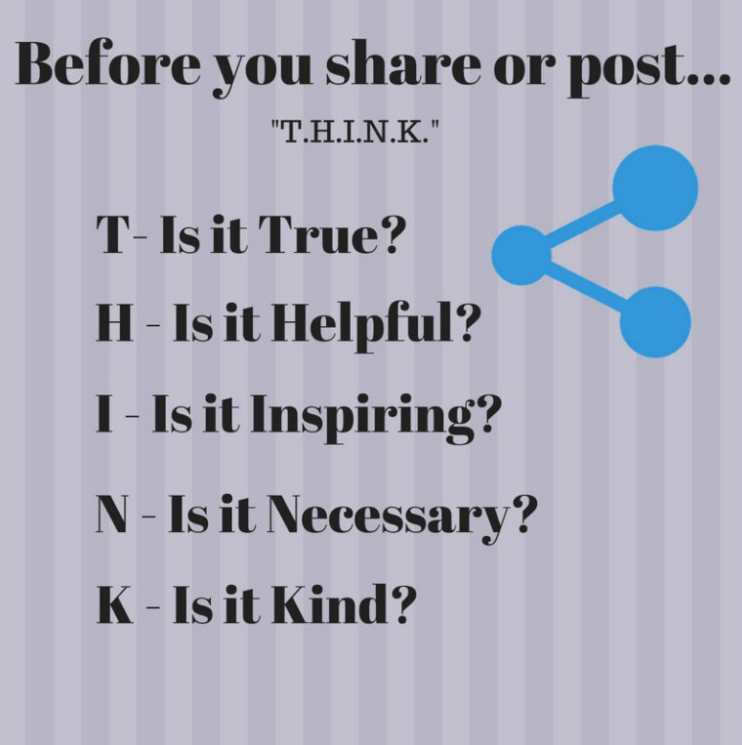
–Seize opportunities to provide honest feedback, especially the positive kind, in real time. For negative feedback, consider thoughtfully (“THINK”) whether providing it will serve the relationship or the person’s goals. Not all feedback is necessary or useful.

How does our culture already do honesty well?

Food labels. As a family with anaphylactic food allergies, we really appreciate this.

Books, film, entertainment. Sometimes it’s just easier and more effective to show than to tell. When we read novels or watch movies depicting the experiences of people very different from ourselves, somehow we are more open to empathizing and understanding than if we attended a lecture or read articles. We are less likely to form and express arguments as to why someone’s experiences are not valid, that they should not feel how they feel, that our biases and stereotypes are, in fact, correct and reliable. In moments of vulnerability on our part, we can see the cracks in our self-delusions. Fiction is one of the most honest forms of communication, if we pay attention. We can challenge our biases indirectly and in the privacy of our own thoughts, shown to us vicariously. How pleasingly ironic.

How could we do better?

Transparency and Fair Process. I’m thinking of policy, government, and organizational leadership here. Too often decisions affecting large groups of people are made without clear rationale or respectful and truly honest communication of goals, purpose, and process. I understand the importance of discretion and ‘need to know’ basis, etc. But too many of our systems operate in the dark at the upper eschelons, fostering suspicion, mistrust, disconnection, backbiting, and overall toxic work and societal envrionments in the long run. Telling people what you can tell them, acknowledging outright that you cannot tell all, and keeping communication as open and honest as possible creates a culture of safety and loyalty worth well more than its weight in rentention, reputation, and productivity, especially when things get hard.

Accountability. All humans make mistakes. Leaders take risks that don’t always reward as anticipated. They let their emotions cloud their judgment in big ways and small, sometimes with severe consequences. OWN IT. People know it anyway, and no matter what happens operationally, leaders who take responsibility for their own actions can stand up straight with self-respect, and likely more respect from others than if they deflect, obfuscate, and scapegoat. Walk the talk of integrity that’s written in all those mission/vision/values statements. Lead by example. This goes for all of us, by the way. Make no mistake, someone is always watching you, gauging their work ethic with yours, adjusting standards of behavior according to the prevailing local norm. Do you part to elevate it as much as possible.

Psychological Safety. This is both the result and the foundation of our ability to be honest, with ourselves and one another. When we can answer the “how am I the asshole” question to ourselves without shame and commit to managing our own inadvertent assholery, then we can better hold space for others to do the same. The Asshole in me sees the Asshole in you, and we can all love us both. I can hold you accountable for your mistakes, actions, and harm done to others, and not throw you away as a person, because I hope you would do the same for me. Again, it starts with our leaders, designated and not.

Any and every effort at consistent and deep honesty is worth the effort. The discomfort, pain, and risk are worth the rewards of self-respect, connection, and stronger families, organizations, communities, and cultures. Consistent honesty frees us from the mental and ethical burden of deception and secrecy, which foster disconnection, loneliness, and conflict.

Honesty builds character. We must strengthen our collective commitment to live as people of character, demand it of ourselves and our leaders, every day, in every encounter.
Reading

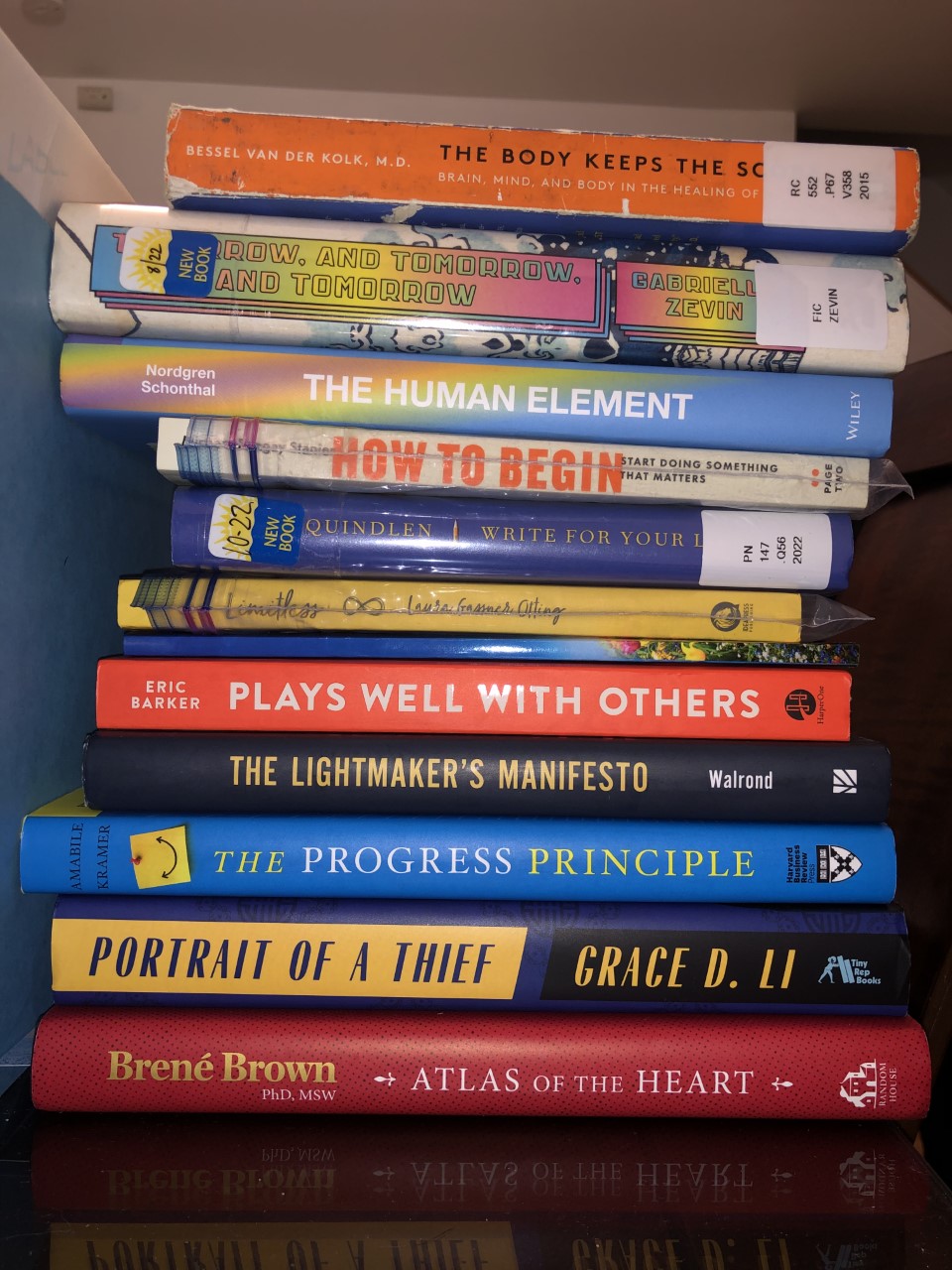
Friends, what are you reading these days? 
How have your reading patterns evolved? 
How and what we read in general is very different now from even ten years ago, let alone 20 or 30, no?

What’s good about my reading right now?
–I read no political opinion and very little news anymore. I’m still informed, and my life is much better this way.
–I read on digital devices as well as print now. I have the Everand (formerly Scribd), Kindle, and BookFunnel apps, so I always have a bevy of titles to read wherever I go, all in few ounces of iPhone.
–I can get pretty much any book I want within seconds or days, depending on the format. That’s pretty amazing.
–My reading habits are happily looser now. I allow myself to not finish books that don’t resonate. I let myself skim. This makes me surprisingly fearless about starting any book (who knew one could have that fear?), freed from obligation.
–I consume many more genres than ever; my perspective widens and I learn so much more.

What could be better?
–I want to retain more of what I consume.  Although I may do better than I realize.  I started listening to Master of Change by Brad Stulberg and bought the hardcover halfway through so I could mark it up, really absorb it.  Turns out I had already soaked up the parts that mattered.  Maybe it’s about repetition.  I have listened to my favorite books multiple times, and each time something different stands out, depending on the current state of my life, deepening my relationship with the authors’ concepts and practices.  At least I’ve stopped rushing through audiobooks at 1.2x speed.  1x is fine now, unless I’m cramming for book club, then it could be 2x+.
–Still working on discipline.  I fantasize about reading and writing every day…  And I mean eyeball reading here, which would require me to be still and do nothing else.  Okay blog and book work first; one thing at a time.  Maybe start small—two to three short eyeball sessions a week?
–I need more bookshelves, or to donate the books I don’t want… Likely both.  My books deserve better than to live in random (though neat) piles all over my house.  Goal by 12/31/2023.

—-

What’s good about our reading as a society?

Access. It boggles me how easily we can obtain any written content.  YAAAYY!  Paywalls not withstanding and with reliable internet service, we could spend our whole lives reading any article from any news outlet, magazine, or blog, and so many sources, on our little handheld computers.  When I want a book, I look first on the public library site.  They often have it in print, large print, downloadable audiobook, and CD audiobook.  If it’s at a far away branch, I can ask to transfer it to my neighborhood and be notified on its arrival.  If all copies are in use, I can place a hold and be notified when it’s available.  If they don’t have it, I look on Everand to see if it’s included in my membership.  If not, the app will show me related books, podcast episodes, and news or magazine articles.  If it’s not there, I can search Bookshop.org or my local indie bookstore sites to see if they have or can order it.  If I still can’t find it, I can go on Amazon.  Once there, I can see availability in print, or on Kindle, Audible, and Whispersync.  In print, Amazon will link to new and used copies from other vendors. I add books to my wish list and receive notifications when they go on sale.  And sometimes a title I want will be included in my Audible membership for a limited time.  There is even an app on my phone that will read me whatever text is currently on my screen.  And the Pocket app lets me save articles to read or reference later.  Ho.ly.Cow.  Amazing.

What could be better?

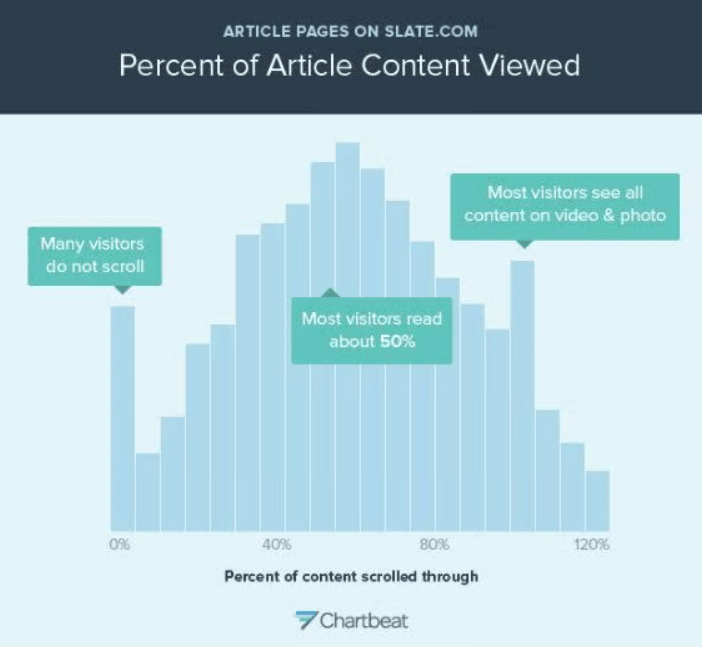
Read to the end.  How many words/minutes/pixels(!?) do you read before you abandon a news or interest article?  According to Slate, where I saw the graphic above, most online readers get through about half of the articles they open.  Interesting also is that many comment and share without reading to the end.  I did this with the link around ‘very little news’ above.  Mark Manson warns how long the article is by giving a table of contents at the top (It really is quite long, I scrolled to the end and it looks really good, typical Manson).  I’ll read the whole thing; right now I’ gotta get this post published [edited to add: read it through; highly recommend].  I just feel good that the title validates my behavior.  I did fully read the Slate, TIME, and MarketingDive articles I found by searching “how many minutes before american readers abandon an article”.  I generally try to read whole articles before sharing, and if they’re long, I’ll include my favorite excerpts in my Facebook posts so friends don’t have to read the whole thing if they don’t want to.  The analytics on this blog show that readers rarely click all the links I include.  That’s okay, I do it for me as much as for you.  But I think we’d all be better off if we took (and it must be taken) the time to read longer and more in depth.

Vet.  The downside of access to vast information, obviously, is the widely variable quality of that information.  If you’re looking for reliable medical information, stick with WebMD and the big academic medical centers—look for ‘.edu’.  Mayo Clinic, Cleveland Clinic, and the University of San Francisco all publish excellent articles on myriad symptoms and conditions.  For guidelines, go to the US Preventive Services Task Force.  Look at the ‘about’ page on any website; sometimes even then it can be hard to know what a given group’s agenda or funding source.  That’s when I search about the organization itself. I rarely take advice from any site that’s trying to sell a product.
Vetting information of any kind takes time.  Mostly it must be done by reading.  If we’re going to be a truly well-informed citizenry and electorate, however, it must be done. 

From the Iowa City Mom Collective

Share in service of connection.  I still fall into the trap of rage posting, thankfully less now than before.  Let us all be more mindful, yes?  Before sharing on social media, or emailing and text blasting our friends, let us THINK:  What will this accomplish?  How does this make our day/life better?  How am I impacting others by putting this on their consciousness?  I’m not saying we should not commiserate over common grievances.  But let’s gather our information with more depth, process and digest it a while, and then discuss calmly in personal conversation?  Maybe over a healthy meal?

Both individually and collectively, we need to slow down, select our information sources thoughtfully, engage with worthy sources mindfully, manage our impulses better, and make time for deeper, more meaningful and critical understanding of what we read.  The ultimate benefit of this is elevation of our knowledge, our conversations, and thus our connections, locally and at scale. 

Read on, my friends.

Stress Management

Anybody else feel daunted thinking about stress managment lately? [wide eyed emoji]

It’s November of the hardest year in my recent professional memory, and the escalating stress levels I witness every day show no signs of abating. My patients are sleeping poorly, gaining weight, and their blood pressure continues to rise. They miss quality time with loved ones and rethink their life paths more seriously now than ever. Strangers on the street seem increasingly confrontational. The world is once again embroiled in war and violence. Our stress management skills are called forth, no question.

I attended the second ever Harvard Medical School coaching conference in the spring of 2009, where I met Benjamin Zander and The Art of Possibility became my personal development bible. Roz Zander, co-author, former wife, and decades long collaborator to Ben Zander, died suddenly this year. I hope my writing and impact may honor her, as these 14 years of my inner and outer work, sparked by the Zanders at that meeting, made me a better person that I would otherwise have been, founded on the practices in their book.

**Deep breath**

It’s been at least a decade, and I still ask patients to assess work stress in terms of threat and challenge. Threat stress–basically fight or flight–is physiologically taxing, meant to last seconds (not years), and costs us our health if prolonged. Challenge stress is activating, productive, and beneficial. I also query about personal fulfillment from work–meaning. We can tolerate very high levels of stress, even prolonged threat, if it’s worth it to us.

Parenting may be a better example than work. When we fear for our children’s well being, and even their lives in crises, how do we manage that? Is there any worse threat? We’d all rather it be ourselves suffering than our kids, right? How do we cope when we have no control?

At the risk of sounding arrogant, I feel very confident in my stress management skills. This is not to say I don’t experience severe stress or feel its consequences. I just move through it much more easily and with a lot less suffering now than in the past. I feel a lot less threat than challenge. Briefly, the practices:
Breathe. Ever since my first medical assistant posted “TAKE A DEEP BREATH” at my workspace, I have appreciated the calming effect of one deep breath, physically and psychologically. We can breathe ourselves through childbirth, injury, emotional trauma, and myriad other urgent and emergent situations. Deep breathing stimulates the de-escalating parasympathetic (rest and digest) nervous system, balancing the autonomic hijack mediated by the sympathetic system. I breathe along with patients when I listen to their lungs. I inhale deeply when listening to books, and during strenuous exercise. It is my central grounding practice.
Accept. “It is what it is.” This has nothing to do with how I feel about it. But the sooner I separate what is from what I want it to be, the less I suffer. Obviously I find this much easier to do for things I care less about. But even for big things, like the state of our healthcare system, the brokenness of our government, and my estimate of the ultimate demise of humanity (I think five more generations, give or take), just being with what is, as a first step to figuring out what to do next, helps me suffer a lot less.
Withhold judgment. I’m really good now at not jumping to conclusions and not making sweeping judgments about people based on limited information. I am able to separate judgment of actions from people’s character and humanity. If you’re screaming at my team and me, you are clearly unwell. We can hold you accountable to your actions and still show you compassion and respect. I don’t have to think you’re a bad person. This way, I don’t take your negative actions personally, and I can stay calm and even.
Get help. I ask every patient every year about their emotional support network, because it matters. Mine is phenomenal and I could not be more grateful. But I only know they are so because I call on them enough and they on me. Rarely I am disappointed, and I learn to turn elsewhere. I cannot overstate the profound importance of tribe and connection. It is my raison d’etre.
Move. When daughter was admitted to the hospital and I stayed with her there, I made sure to get on the ellipitical each day that week. When I go too many days without movement, I get edgy and stuck in my thoughts. My stress is exponentially more manageable if I protect my workouts, which I have now done for many years.
Attune and differentiate. My greatest stressors involve other people. Friction, tension, grating, colliding, etc. Since my LOH leadership training helped me articulate these complementary concepts, I recognize now that attuning/aligning with others, as well as differentiating and standing firm in my own core values and practices are equally important and fluid in their dynamics. Feeling out that optimal integration in any given interaction is rewarding in itself, and the outcomes are always better when I attend to both, knowing that I am showing up true to myself. What more can I ask of me?

So what could be better? Anything, really. For the rest of my life, new stressors will continually emerge. In his book Master of Change, Brad Stulberg quotes a statistic that in an average adult life, we will experience 34 major disruption events, which works out to about one every 18 months. Sounds about right to me! So I can expect to be challenged and trained in all of these skills and more, usque ad mortem. I only hope I can keep learning, applying, improving, and growing. Bring it.

I feel less harshly about our collective, societal stress management skills and outcomes than I do about our obessions and ironies with exercise and nutrition. Really, I think everybody’s doing the best they can, with the skills they have, in the circumstances of their lives at any given time. I just wish our environments didn’t create and perpetuate so many of our stressors in the first place.

So what’s already good?
Potential. We are all surrounded by one another. So every encounter, any time, any place, is an opportunity to do people-ing better. In any given relationship, if anyone is willing at all, there is always the chance for repair after rupture. Humans are innate learners; we can continually acquire the skills to stop impaling ourselves with the second arrow of suffering, after the arrows of pain hit us in daily life. We can even hold one another up and heal our injuries together.
Books, teachers, resources. Those aisles and shelves of stress management books really are dense, and I can say with conviction from first hand consumption that the knowledge and potential benefit living in those pages is immense. For those with the bandwidth to actively seek, consume, digest, and apply, lives can be transformed, especially if shared, discussed, and practiced together.
–Sometimes it really doesn’t take much. Your friend calls to check on you. A stranger helpsy you carry your groceries. When we say ‘it’s the little things,’ we speak truth. Small acts of kindness and incidental connections will not solve our hardest problems, but we must not underestimate their profound potential to help, and for that help to amplify in unexpectedly large ways. What’s more, both the helper and the helped benefit from the encounter.

What could be better?
–Teach it explicitly. There is a movement afoot among Dialectical Behavior (T)herapists to formally incorporate stress management skills into school curriculum. DBT organizes life skills around four central pillars: Mindfulness, Emotional Regulation, Distress Tolerance, and Interpersonal Effectiveness. Within each module are sets of practices, many with campy acronyms to help us remember. I refer patients to the DBT skills website often, not just to help them cope better themselves, but to help them model better coping skills to their children, direct reports, and leaders. Simply having the confidence that we can handle whatever comes our way, because we know what to do, decreases stress exponentially. What if we learn these skills in childhood, before the chaos of adolescence and serial tumult that is adulting? Can you imagine?
–Relational Leadership Training and Valuation. Leadership done well is a practice in empathic, compassionate, accountable, and transparent stewardship. It is a way of being and doing, one that requires high level self-awareness and self-regulation, and excellent attunement and communication skills. Right now I think leadership training focuses a lot on transactional communication, superficial team dynamics, and not enough on building leaders’ stewardship mindset and deeper relational skills. We should require evidence of these skills for promotion and provide communal support and feedback to strengthen their practice. This would reduce overall stress in organizations by building cultures of empathy, compassion, accountability, and transparency from the top. Workers’ stress, in my observation, stems in large part from toxic cultures set by relationally inept leaders.

So, another plot twist, but maybe not really. My solution to stress management optimization is relationship-centered: first relationship with self, then between self and others, and then between/among those who know us, by way of example setting.

Stress is complex. Its optimal management is a lifelong practice. It’s never too late to start, and no skills practice is too small or wasted.

“The only way out is through. The best way through is together.” I think that applies here.