Medicine:  Science + Humanity = Professional Pride

IMG_2525

Lots of learning this month, friends.  I’m overwhelmed and overjoyed, and proud of my profession.

It’s too much to write about in one post, but I will try all the same, in order of occurrence.

18 October 2019

Once again I had the privilege of meeting with medical students, this time to discuss their experience of leadership in medicine.  As is my new custom, I started with an appreciative inquiry exercise: What is the best thing about medicine, WHY do you do this?  One of their responses:

“The medical encounter is a unique combination of compassion and intellect—the conversation is my favorite thing, and that I also get to help.”

19 October 2019

Looking through the basement bookshelf, I came across my medical school application from 1994.  The general application included a one page personal statement, in which I wrote:

“Science, and the human body in particular, have always fascinated me… In practice, while I pursue the challenge of each new patient’s illness, I want to share with them my enthusiasm for the science of medicine…  But being a doctor involves more than curing people’s illnesses…  It is the job of the physician to reassure and comfort the patient…  In my practice I will…do my best to communicate with (patients) in terms they will accept.  The best way to comfort people is to relate to them.  I believe this skill will make me understand not only patients’ medical needs, but their emotional and psychological needs as well…  I hope to keep learning from my patients in the future.”

Turns out I’ve been both a science nerd, and also thinking and writing about relationships and connection for a while now, go figure.

IMG_2397

25-26 October 2019

This year’s ACP Illinois Chapter Meeting was the best one in recent years, in my humble opinion.  I’m so proud that under the leadership of our Northern Region Governer, Dr. Suja Mathew, we were able to present a robust clinical education conference, as is the ACP tradition.  Along with sessions on diabetes, heart failure, office orthopaedics, and cancer survivorship, however, we also included sessions on critical social and public health issues, such as diversity/inclusion, the impact of social media, firearm injury and death, medical marijuana, trauma-informed care, and sexual harassment in the workplace.  Esteemed colleagues from across the country came to share their expertise.  Here are just a few examples of Science + Humanity, in action every day in our work:

Diabetes

Science:  We now understand that it’s the wide swings in blood sugar, and especially very low sugar, that lead to end organ damage.  We have new classes of drugs with novel mechanisms of action.  They decrease the burden of glucose control on pancreas cells, and also seem to prevent heart failure in some patients.  Humanity:  All diabetic patients need education—face to face time with a trained professional who can teach them about the disease and how to manage it. Even the most highly educated and most well-informed person cannot automatically know how to be a diabetes patient without the help of these medical team members.  More and more, diabetes care in particular is a team sport, and our collective skills get better every year.

Cancer

Science: We are curing cancer.  There are more survivors now than ever before, thanks to targeted genetic and immunotherapy and minimally invasive surgery, among other treatments.  Humanity:  Survivorship starts at the time of diagnosis, and cancer patients have both unique and diverse needs and concerns.  Complications from treatment such as neuropathy and heart failure can occur years out from treatment, and the psychosocial consequences for patients and their families can be lasting and transformative.  The better we understand this as their care teams, the healthier and happier our patients will be.

Childhood Trauma

Science: Since the 1970s, cumulative evidence shows that Adverse Childhood Experiences and trauma correlate with an increased risk of negative health behaviors, mental illness, chronic diseases such as diabetes and heart disease, decreased academic performance, limited professional productivity, and early death.  And they appear to affect each of these outcomes independently.  In the Tree of ACEs, branches and leaves represent the interpersonal experiences.  We are only starting to understand the roles played by Adverse Collective Historical Events (slavery, genocide, mass incarceration, forced displacements)—the soil, and Adverse Community Environments (poverty, violence)—the roots.  HumanityThe key factor that correlates with escape from the early mortality path from ACEs is a stable and nurturing relationship with an adult caregiver.  As healthcare providers, we have a unique and important part to play in the healing of all ACEs—our patients’ and our own—and all evidence points to the quality of our patient-provider relationships as foundation—no surprise.

Gun Violence

Science: In 2012 33,000 people died from firearm injuries (it was up to 40,000 in 2018); 62% of these deaths were suicides.  That same year there were 62,000 nonfatal firearm injuries, 72% of which were assault, 5% self-inflicted, and 17% unintentional.  Higher rates of gun ownership correlate with higher rates of death from firearm injuries.  States with both background checks and waiting periods have lower rates of suicide by firearm compared to those with background checks only.  It is still unclear whether states with more lax concealed carry laws have different rates of firearm related deaths compared to stricter states.  Humanity: Though mass shootings dominate the media, the majority of deaths from firearms are self-inflicted.  The acute impulsivity of mental illness, combined with an accessible, loaded firearm, destroys lives—whole families and communities at a time.  Our job as physician advocates is to not alienate gun owners, and rather enroll and recruit their help to address the factors that take our friends and loved ones from us.  It’s not an Us vs. Them fight over rights.  It’s a shared challenge to create policy that honors our unique national history and culture, and also effectively addresses our public health crises.  Here is where our highest notions of collaboration, respect, and shared purpose must be exercised.
10-22-19-3

27-30 October 2019

Today I arrived in San Diego for the International Conference on Communication in Healthcare, my first time at this meeting.  Many of the sessions will present research on effective ways to teach communication skills to trainees, factors that impact health literacy, and methods for measuring effective communication.  This conference is all about the science of communication in healthcare.  And it’s also about the humanity.  The first plenary speaker was Dr. Lisa Fitzpatrick, who interviews people on the streets of DC in her series, “Dr. Lisa on the Street.”  The videos show over an over how people feel ignored and dismissed by our healthcare system, and how unsafe it is for them to admit what they don’t know or ask questions.  This is one of the only meetings I have attended at which patients are invited to present and voice their perspective.  At the end of this session one patient attendee stood up and spoke words that will guide me throughout this week and my career:  “Doctors may have all the education in the world, and if you cannot talk to your patients in a way that makes them trust you, it really doesn’t matter.”

Sessions I plan to attend:

Moving Health Care from a Team of Experts to an Expert Team

How to Become an Effective Advocate for Humanism in Your Healthcare Organization

Collaboration and Communication Across Multidisciplinary Healthcare Teams

Civility Ninjas:  A Field Guide to Improving Colleague-Colleague Interactions

Understanding and Addressing Mistrust

Shared Decision-Making as Ethical Practice

Thanks for reading to the end, friends.  I know it was a lot.  As I age I learn to hold patience as well as eagerness, absorbing the input as well as creating my own, integrated outputs for good.  How lucky I am to have so many amazing people to keep me company on the journey!

Four days to NaBloPoMo, my fifth attempt, HOLY COW!  Better get to bed…

The Mark You Make

IMG_2633

Friends, Ozan has written another book!  I know it may seem like it, but he’s not paying me to promote his work, really!  He has offered perks for Inner Circle members, however, like an advance digital copy for preordering, and signed copies when the book is released next April.  In considering what I would ask him to inscribe to my friends in the books I will give them, I realized yet another evocative dimension of my relationships.

If you were to describe your friendships to a third party, or make a meaningful introduction in service of connecting two amazing people, what would you say?  I call it ‘connecting fellow Awesomes,’ and it’s always a pleasure and privilege to serve in this capacity.  I thought to ask Ozan to write to one friend something like, “Cathy thinks the world of you—happy to make such a positive new connection!”  Then I thought, this friend has really made a mark on me.  Then I thought of the mark Ozan has also made, in just 9 months of virtual contact.  And then my mind was blown with the realization of my cosmically marked-up self—the finger, hand, and footprints of all those whom I have contacted.

Years ago I attended the orthopaedic surgery resident graduation dinner with my husband, a happy and fun annual event.  At the end, mingling with faculty and trainees, one of the graduates looked at me and his eyes widened.  “You’re Dr. Cheng!  You were my teaching attending during my third year medicine rotation [7 years prior] at [the hospital where I used to work]!”  I was gratified that his expression was cheerful, rather than distressed or awkward, surprise.  He went on to tell me that I held the team to a high standard of discussion, and that he appreciated my presence and teaching.  I will always remember this encounter with pride and appreciation.

In the past year three patients from my past have resurfaced and told me the positive difference I made it their lives.  I remembered two of them so clearly, both their faces and their names (after 20 years and thousands of patients, I can usually only remember one or other).  Talking to each of them reminded me of all that we had been through together, and I was glad that I had done my job well.

But what about those for whom I have not been a great doctor?  I have had my fair share of patients who left me, for various reasons.  I know I have been seriously disappointing for many.  I wonder how many times I have contributed to patients’ negative overall experience of medicine, and further widened the divide between doctors and patients in our fraught and flawed healthcare system?  Sometimes I look back on my early years of practice and cringe a little—all the writing I do now on empathy, compassion, curiosity, openness, and humility results from years of lessons learned in real time, on real people.  I’m definitely much more adept at it all now than in the beginning.  And I’m still learning—I still get triggered, still fall into old, counterproductive thought and behavior patterns.  Sometimes it feels like I will never be good enough, or enough in general.

IMG_1852

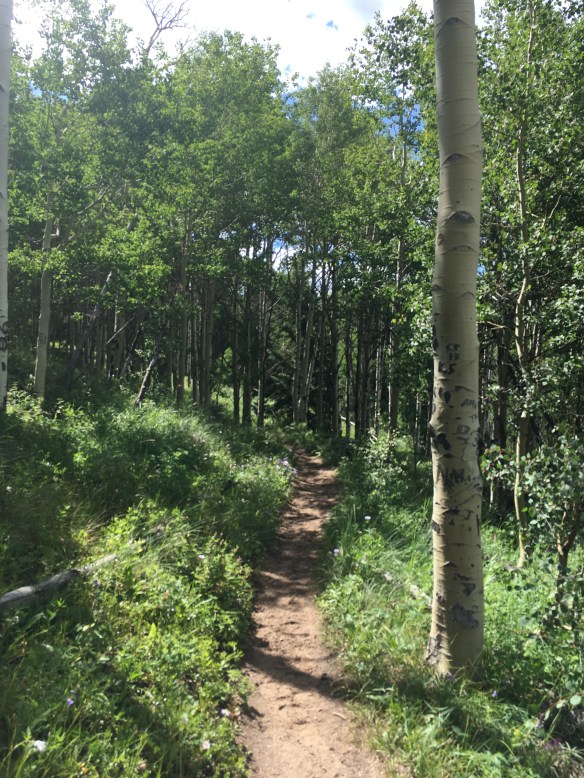
I also think about the people whose marks on me were/are hurtful, dismissive, and otherwise wounding.  It reminds me of carvings I see in the trunks of the beautiful aspens I walked among this weekend.  Did the folks who made them set out to harm the trees?  If they thought the tree might die from their knife marks, would they think twice?  Maybe they were overcome with their profound experience in nature and just wanted to mark it in some way, especially if they shared it with someone they loved (so may initials with plus signs and hearts)?  Sometimes we just want or need to be right, competent, respected, and acknowledged.  So we mark our encounters with stubbornness, aggression, or even violence (in its many forms, overt and cloaked).  Like the strong and flexible aspens, I bear scars from such encounters and still continue to thrive.  Such marks have taught me how to care for myself, and also how not to be toward others.

In the end, how do I reconcile these relationship phenomena?  Sometimes we can see and know the mark we make on others.  Many times we cannot.  Nobody is perfect.  My whole life I will scrape and nick those around me, hopefully never with malicious intent.  I can only hope for their generosity and grace, and forgiveness.

Sister Brené Brown, once again, helps me continue.  In her book Rising Strong, she describes a choice, a mental attitude, that can help us all suffer less.  If you have not read or heard the book, I highly recommend it—it’s my favorite of the 5 of her books I have read.  Assume, she says (with the help of her pediatrician husband), that we are all doing the best we can.  That’s it.  We are all imperfect.  Our circumstances mess with us, our patterns mess with each other, and sometimes it can feel like a strange and inexplicable miracle that we have not all killed one another already.  But choosing to give each other this one, simple, and at times colossally difficult benefit of the doubt, could be what saves us all.

We simply cannot extricate ourselves from each other.  So we can just do your best to take care of one another.  And be prepared to apologize, early and often.

IMG_2498

70 Years Married


IMG_7417

Dear Mr. and Mrs. Wonderful,

Hello and hugs to you both!  How are you feeling?

I received a message from Wonderful Son this weekend, and it made my day!  He said you have settled in a place where you are both happy and getting the care you need.  You live near Wonderful Daughter, whom you see often, and everybody is happy and doing well.  I’m so glad!

More importantly, Son said the family will celebrate your 70th wedding anniversary soon!  He invited me to contribute a short video selfie to the well wishes.  Wow, what an honor.  I only got to serve as your primary care doctor a couple of years before you moved.  In that time I had the privilege of witnessing not just each of you as my patients, but you both as a couple, and your Wonderful family.  Please allow me to share my observations?  Here is my experience of you:

Ease.  Whenever I saw you two together, there was a peace and ease about your dynamic.  Patterns of relation were established long ago, and it worked.  I witnessed friction at times, but it was transient.  The vibe of our encounters was never agitated; it always felt to me that I had stepped respectfully into your well-oiled routine, and I tried my best to not disrupt it.

Patience.  Nobody rushed anybody when we were together.  Questions were answered, sometimes right away, sometimes after a while.  But you always gave each other the time and space to get where we were all going.

True Acceptance.  The Gottmans tell us that about 2/3 of marital problems are unsolvable.  This fall I will have been married half my life, 23 years.  This summer I think I may finally understand in my limbic brain, possibly, how to be in a marriage—something to do with really accepting the other person for who he is, like really, honestly, and wholeheartedly.  It was clear soon after meeting you both that you had figured this out long ago.  If I can get to 70 years, maybe I don’t have to feel bad that it took me 23+.

Devotion.  Medically, it has not been all lollipops and rainbows these few years, for either of you.  But whatever was happening for one of you, the other was right there, attending, caring, waiting, loving.  What more could any of us ask for?  And the Wonderful Children learned from your example; knowing them and seeing their devotion to you, their loving parents, inspires me deeply.

Learning, Growth, Adaptation.  Even at your age, there were things you did not know or understand.  Your bodies betrayed you in some ways we could not have predicted, and in others that you may have anticipated but were still a challenge to accept.  With the help of the medical team and your Wonderful Children, you have both managed to adapt to successive new normals with grace.

Loyalty and Commitment.  In it together.  That’s how you two roll.  I know it’s not easy, and we have discussed the challenges.  But you stick with each other through thick and thin, I’ve seen it.  You set the bar for the rest of us.

Love.  I think you, Mr. and Mrs. Wonderful, show us what true love lives like.  After 70 years I imagine you have some colorful stories to tell, some that belie all of the idealistic descriptions I write here.  But that is the point, no?  If we stick with it and do The Work, all of us hope to be rewarded with that deep, peaceful, reliable, and resonant love that transcends even what we innocently and earnestly vowed to each other at the altar.

Science, technology, and social convention have evolved beyond anyone’s imagination, and the pace only accelerates.  But the lifelong human need for love and belonging will never change.  Thank you for showing us how it’s done in a marriage.  Congratulations!

Sincerely, Cathy