Synthesis and Integration: Self and Other Focus

DSC_0439

Hey friends, how was your week?  Learn anything new and interesting?  Anneal any new ideas to existing frameworks in your already complex world view?  I did!  And it came in another big wave after my presentation on Friday.

I wrote last week about how I put together a new presentation.  For the first time, I added the idea of medicine as a complex adaptive system to a talk I gave to physicians at various levels of training and practice.  The objective of the presentation was for people to understand the scope of physician burnout, and leave with some ideas of how they could not only cope better themselves today, but also influence the system and move it toward a healthier, more compassionate state in the future.

As usual for my talks, I focused first on personal resilience.  Many physicians push back at this idea, and rightly so, as many medical organizations have instituted physician wellness programs aimed mainly at ‘fixing’ the doctors with yoga and meditation classes, while allowing the system that burns them out to continue its toxic trends toward over-regulation, loss of physician autonomy, and driving metrics that lie outside of, or even counter to, our core values.  I worried that my talk would be taken as just another attempt to tell physicians we aren’t good enough at self-care.

Thankfully, the feedback so far has been positive and I have not heard anyone say they felt berated or shamed.  I hope it’s because in addition to tips for self-care (eg 7 minute workout, picnic plate method of eating), I talked about how each of us can actually help change the system.  In a complex system, each individual (a ‘node’) is connected to each other individual, directly or indirectly.  So, difficult as it may be to see in medicine, everything I do affects all others, and everything each other does affects me.  This means I can be a victim and an agent at the same time, and the more I choose one or the other (when I am able to choose), I actively, if unintentionally, contribute to the self-organizing system moving in one direction or another [URL credit for image below pending].

Nodes in Complex System

My primary objective in every presentation is to inspire each member of my audience to claim their agency.  Before that can happen we must recognize that we have any agency to begin with, then shore up our resources to exercise it (self-care and relationships), and then decide where, when, and how that agency is best directed.


In 5 years of PowerPoint iterations, including and excluding certain concepts, I have always incorporated David Logan’s framework of stages of tribal culture.  Basically there are 5 stages, 1-3 being low functioning, and 4-5 high functioning.  The tribal mantras for the first three stages are, respectively, “Live sucks,” “My life sucks,” and “I’m great”.  Stage four tribes say, “We’re great” and in stage 5 we say, “Life’s great.”  The gap between stages 3 and 4 is wide, as evidenced by the traffic jam of people and tribes at the third stage.  In my view, the difference is mindset.  In the first three stages, most individuals’ implicit focus is on self, and subconscious mindset centers around scarcity and competition.  Victims abound in these cultures, as we focus on recognition, advancement, and getting ours.  We cross the chasm when we are able to step back and recognize how our mutual connections and how we cultivate them make us better—together—we see the network surrounding and tied to our lone-node-selves.

This week I realized that crossing the stage 3-to-4 chasm relates to two frameworks I learned recently:

The way I see it, in Logan’s tribal culture structure, one initially works toward self-actualization, essentially achieving it when fully inhabiting stage 3, “I’m great.”  But crossing to stage 4 requires self-transcendence, as described by Abraham Maslow, by recognizing a greater purpose for one’s existence than simply advancing self-interest.  In the same way, through stage 3 we live in what the Arbinger Institute describes as an ‘inward mindset,’ and we cross to stage 4 when we acquire an ‘outward mindset’, which is pretty much what it sounds like.  Essentially in stage 3 we mostly say, “I’m great, and I’m surrounded by idiots,” and in stages 4 and 5 the prevailing sentiment resembles, “We’re great, life’s great, and I’m so happy to be here, grateful for the opportunity to contribute.”

An astute colleague pointed out during my talk on Friday that we do not live strictly in one stage or mindset in serial fashion.  Depending on circumstances, context, and yes, state of mind and body (hence the importance of self-care!), we move freely and maybe often between stages, sometimes in the very same conversation!  The goals are to 1) look for role models to lead us to higher functioning stages more of the time, and 2) model for others around us to climb the tribal culture mountain with us, spending more and more mindset and energy at higher and higher stages.

The problem is the system, and we are the system.  So, onward.  Progress moves slowly and inevitably.  It will take time, energy, and collective effort.

We’ got this.

Attune and Attend, Continued

dsc_0755

Last week I started and ended my post incensed on behalf of my friend, who felt coldly and arrogantly dismissed by her new doctor.  While I considered that his behavior may be influenced by his circumstances and did not attack his character or make generalizations based on gender, age, etc., I did blame him individually for how my friend felt in his presence.

Another friend read the post and said the doctor was not to blame, rather it’s the system.  We exchanged thoughts and agreed that it was not all the doctor’s fault, and the whole healthcare system in our country is just a big mess in general.  I continue to have daily conversations around physician well-being and systems transformation in medicine, and every single encounter advances my understanding of and awe at the whole situation.  Here are my most current thoughts—bear with me, please.

3 Reciprocal Domains of Professional Fulfillment

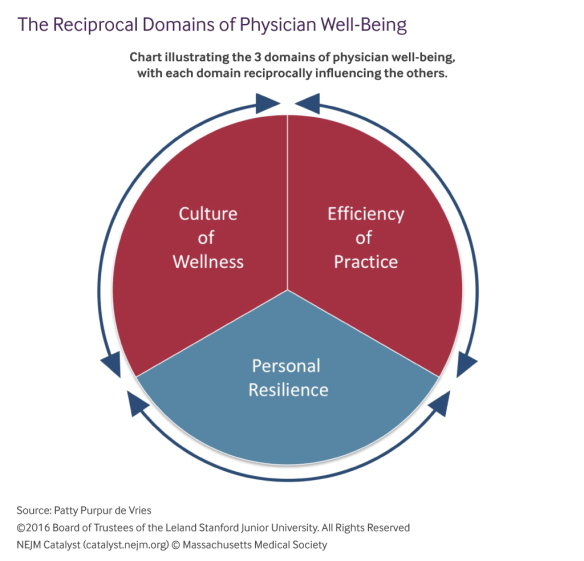
Most of us working in the physician well-being space have adopted a model for professional fulfillment developed by our colleagues at Stanford.  If you care at all about your doctors’ professional health and how that impacts the care they deliver, I encourage you to read this article that describes their approach.  In it, they define efficiency of practice (eg team workflow, electronic health record use and misuse, systems bureaucracy), culture of wellness (institutional attitudes that advocate for self-care, peer support, and mutual compassion between team members and patients), and personal resilience (individual skills and behaviors that promote personal well-being) as the three mutually influencing factors that determine, for individuals as well as organizations, our overall professional health and well-being:

The many drivers of both burnout and high professional fulfillment fall into three major domains: efficiency of practice, a culture of wellness, and personal resilience… Each domain reciprocally influences the others; thus, a balanced approach is necessary to build a stable platform that will drive sustained improvements in physician well-being and the performance of our health care systems.

For the record, I fully concur with this approach, and with one of the authors whom I met at the international conference in Toronto, that the most important parts of the framework are the arrows reminding us always to look for how the domains intersect and influence one another.

We Are the System

In the article, the authors write, “Efficiency of practice and a culture of wellness are primarily organizational responsibilities, whereas maintaining personal resilience is primarily the obligation of the individual physician.”  This is where I differ somewhat.  I fully agree that an organization’s culture is set at the top.  Designated leaders lead by example, admit it or not, like it or not.  They (and we—all doctors bear this responsibility on any given care team) provide cues for acceptable and unacceptable behavior, positive and negative.

That said, a team or an organization’s culture is executed and manifested day to day, moment to moment, in every interaction, by each individual within the system.  This is the essence of complex systems—they are self-organizing at a global level (hence soon after joining a group we find ourselves adapting to fit in), and also emergent and evolutionary at the granular level (one person can turn a place around over time—have you seen it?).  So in my opinion, both leaders and individuals are responsible for creating and maintaining the Culture of Wellness in medicine.  We are the system.  If you’re interested in more of what I think about this, check out this podcast from September 2018 when I presented to the surgeons and anesthesiologists at the University of Wisconsin at Madison.

In a Complex System, It’s All About Relationships

A person is a complex system.  In my practice (and in my own life) I try always to attend to the relationships between 5 reciprocal domains (labelled intentionally after the Stanford model) of health: Sleep, Exercise, Nutrition, Stress Management, and Relationships.  How do they relate?  When I don’t get enough sleep I tend to overeat; when I eat too much I feel sluggish and unmotivated to exercise.  When I exercise less I am more susceptible to stress, which puts my relationships at risk, which then disrupts my sleep, and the downward spiral persists.

A patient care team, a medical practice, a hospital—these are all complex systems.  Besides the three domains in the Stanford model, what other factors contribute to the self-organizing nature of such systems?  Perhaps individual autonomy, collective loyalty, shared mission, attention to training, and communication?  What inter-relational factors dictate an individual’s or a subgroup’s behavior, and how does that influence the whole organization?

I am reminded of starlings in a murmuration, or sardines in a school.  Seen from afar, the mass of animals appears to move as one agile and sentient organism.  In reality, each animal’s movement is at once independent of and intimately tied to those in its immediate vicinity.  Each animal’s awareness of and response to its neighbors are acute and instantaneous, respectively, and thus the collective is able to evade predators and give humans insight into what true multi-mutual cooperation looks like.  They are attuned.  This is possible because, according to science:

The change in the behavioral state of one animal affects and is affected by that of all other animals in the group, no matter how large the group is. Scale-free correlations provide each animal with an effective perception range much larger than the direct interindividual interaction range, thus enhancing global response to perturbations.

Would your organization, seen from afar, appear as organized and fluid as a flock of murmuring starlings?  What would it require in order to do so?

* * * *

So what does this mean for my friend and how she (and we all) should think about doctors and our healthcare system in general?  How does this actually relate to solutions to the problems I presented last week?  Clearly, as I beat the long dead horse again and again, it’s about relationships, of course.  But we have to think more deeply than just about our behaviors and actions—we’ gotta buckle up and dive into their origins—spelunk our default orientations toward self and others, our automatic settings, and how they manifest in our relationships and create, intentionally and not, our collective systems.

Once again, I have hit 1000 words on this post and it’s late.  I’m getting there, I promise—not that I have the solution!  I’m simply learning and synthesizing more every week about how we can more consciously and mindfully approach the problem.  It has everything to do with the books I started reading recently about complexity, leadership, and mindset, and how they help me see my conversations and relationships in a new, exciting light.

More next week, friends!

Attune and Attend

dsc_0450

My friends, I am offended.  I’m insulted and frustrated.  Part of me screams, stomps, and rages inside.

I am embarrassed.

My friend went to establish care with a new primary care physician last week.  Before the appointment she was told to bring all of her medical records.  No instructions, no specification of which parts or in what form.  So, being the tech-savvy and eco-friendly woman she is, she downloaded all that was available to her onto a thumb drive, as it was rather copious now in her 7th decade of life.

Upon arrival, she presented the drive to the woman who initiated the evaluation.  She thinks this was a nurse; but she’s not sure.  The woman said she could not ‘handle’ the thumb drive, but said, “I can just pull it up here online.”  What?  Ok whatever, clearly the medical record request was simply a routine request made of all new patients.  Thereafter the woman proceeded through routine medical questioning.  But as my friend answered the interrogation, she felt distinctly ignored.  Her concerns were not addressed and she did not feel any rapport.  The woman did an EKG and left the exam room.

Later, while my friend was still sitting on the exam table, the woman returned with an old man in a white coat.  He stood there, hands behind his back, and informed my friend they had called for an ambulance to take her to the emergency department.   The EKG showed an abnormal heart rhythm.  They said she would likely be in the hospital for two days for observation and tests.  The nurse and doctor spoke to each other but not to my friend.  They did not ask her how she was feeling, or what she knew about the/her condition, and they did not check the online record for evidence of past evaluations or recommendations.

My friend refused, for various reasons, not the least of which was that this condition had already been thoroughly evaluated, multiple times, and was actually well controlled.  But the doctor and nurse showed no interest in knowing my friend, nor did they seem to care to include her in any medical decision they made about (for) her.

Granted, this is my friend’s side of the story.  But for right now this is where I focus, because her experience is all too common, and I hate it.  She experienced everything that makes physicians and our healthcare system look and feel so broken, and that contributes to the widening relationship gap between patients and physicians/providers.

She was asked to bring her records, she put forth the effort to do so, and they were not reviewed.

She felt ignored and dismissed, even though the objective of the visit was to establish care and initiate a long term, collaborative relationship with a new primary care doctor.

She was ordered to submit to an ambulance transfer to a hospital emergency department, with neither discussion nor negotiation of other care options, and without regard to the financial and other costs to her.

She felt harassed by the office in the following days, receiving calls admonishing her for not presenting herself to the emergency department.

The bottom line is that my friend felt completely unseen in this encounter.  She felt treated like an object—a set of data, a statistic, a box on a flowchart.  Context, history, and individuality be damned.  When you’re in a relationship with someone who is supposed to help you, on whom you rely to help you understand the best plan of care for you personally, feeling unseen, dismissed, and belittled is exactly the opposite of helpful.

Maybe we should not judge the nurse and doctor too harshly.  We all know the time and volume pressures primary care providers live under these days.  Maybe they were distracted by other, sicker patients they had seen that day.  Maybe that made them more vigilant and aggressive with care recommendations for her, and put them behind schedule so they felt they could not take the time to explain things in more detail.  Maybe the doctor had seen this arrhythmia once before, treated it more casually, and the patient died.  We have no idea.  And it matters, insofar as it impacted how he presented to my friend.  Because his presence was dominating, authoritarian, rigid, and cold.

The patient-physician relationship serves as the foundation for medical care and healing.  No matter how much we talk about and try to honor patient autonomy, the power differential in this relationship remains fixed and real.  The doctor has the power and the responsibility to make the patient feel safe, to earn the patient’s trust.  On this day, in this visit, this doctor blew it, in my opinion.  It was their first encounter.  He should have taken the time and interest to get to know her, even a little, to agree on how they would work together.  If he were truly concerned about her health, knowing she had an arrhythmia (which are often made worse with stress), might he not have noticed the distress he was causing her?  Couldn’t he have given her additional care options, like referring her to a specialist within the week?  Or perhaps he could have opened the electronic health record and looked at her previous cardiologist’s last note?

He did none of these things—or at least not in any way that my friend perceived.

Further, he not only failed to establish a good relationship with her; he undermined her trust in our whole medical system.  How many experiences like this does a person have before she starts to reject the medical community altogether, ignoring symptoms of disease because she would rather deal with pain and disability than try to navigate a hostile system?  Fewer than you might think.  This is how patients end up in emergency rooms with truly life-threatening illness, where, guess what?  They get shamed again for not seeking help sooner.

It’s rather tragic when you think about it.

There is hope, though.  But as this post has already a thousand words, my thoughts on solutions will have to wait.

I hope you all had a restful and joyous holiday season.  My unplanned holiday writing hiatus lasted longer than I intended, and it’s nice to be back.  May we all reconnect with one another in more meaningful, productive, and uplifting ways in 2019.