Polarity Management

Yes, AND.

This is the central tenet of polarity management. It’s about holding divergent and apparently opposing ideas or positions at the same time, understanding that their relationship is actually complementary and mutually strengthening rather than perpetually conflicting. Masculine/feminine, individual/collective, conservative/progressive, strong/soft, diplomacy/candor, top down/bottom up–what else? Can we frame any two antagonistic ideas in an infinity polarity loop of inextricable relationship? I say yes. Because it puts us into novel perspectives, prompting a mindshift into possibility, creativity, and connection.

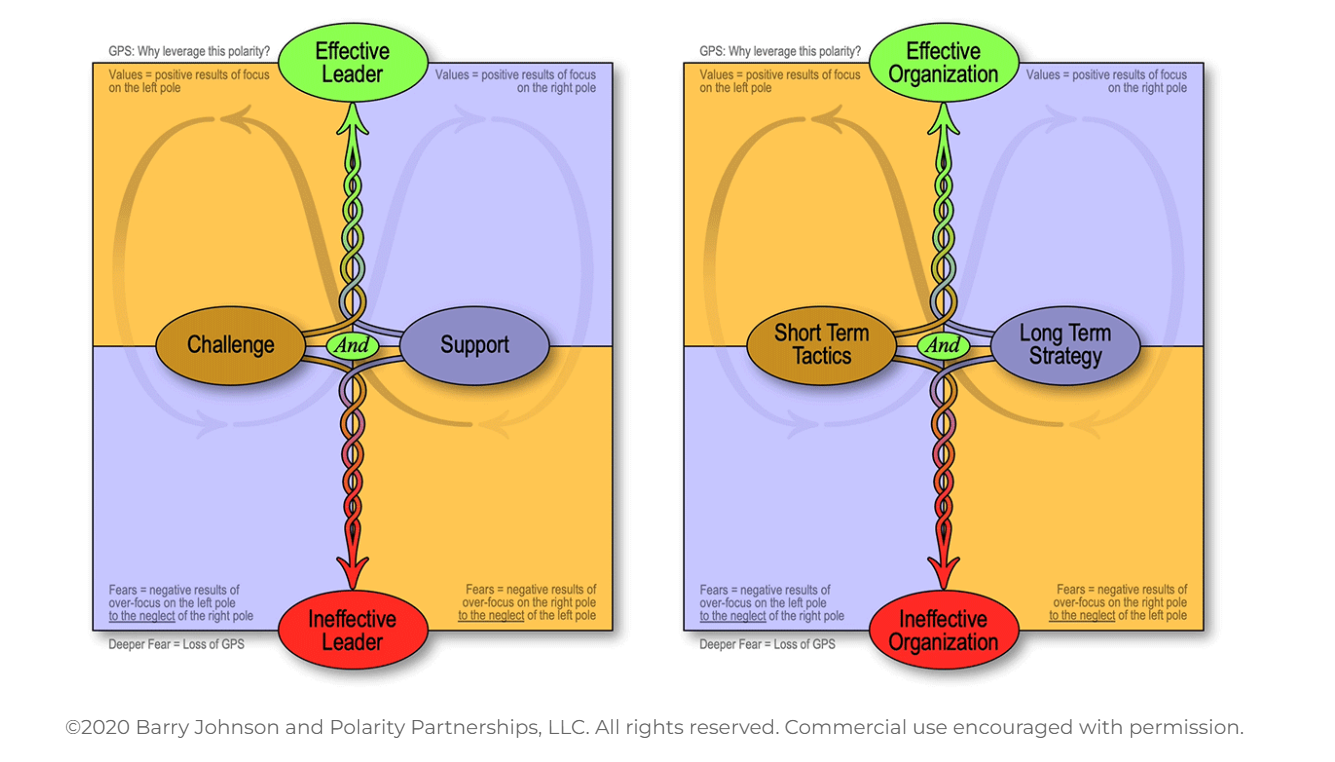
I am waiting on permission to use a seminal image from Polarity Partnerships, the organization founded around the idea that in any polar dichotomy, there is a dynamic flow and balance between the advantages and disadvantages of focusing energy and action on either pole. When we can maximize the benefits and minimize the costs of each pole, then leadership and organizations thrive. It’s much easier to show than tell; fingers crossed I’m allowed to share the image; check out their homepage and you will see what I mean.

13 November 2023: Here it is!

Polarity Map® is a registered trademark of Barry Johnson & Polarity Partnerships, LLC. Commercial use encouraged with permission.

How do I already manage polarities well?
–Since I learned the concept during leadership training in 2019, I now think easily in complementary polarities. I was primed c.2000 when my residency classmate introduced me to “Yes, AND”. She took an improv class and invited me to play a game in the workroom. Thanks, Carol! Now whenever I feel an initial resistance or opposition to something, I look for the juxta(op)position that gives that two-sided coin perspective.
–Polarity management and trade-offs feel related to me. I think in terms of the latter more and more, also since 2019, when I read Being Mortal by Atul Gawande. At the end of an elderly life, there is often tension between independence (goal of the elderly) and safety (goal of their family), and a peaceful end of life usually means compromises on both sides. Increasingly as I counsel patients on habit change, I acknowledge that trade offs will be necessary, and only they can define and decide which are and are not worth making, based on their values and goals. I find that approaching behavior in this way eliminates judgment, and also opens the door for flexibility and evolution without (or with less) regret. It is simply flow and growth.
–I definitely parent better from an integrated polarity perspective. Mostly it’s about letting go and hanging on, advising and commanding, that delicate and heavy handed balance. I tend toward a laissez faire parenting style, which risks the kids feeling neglected if I lean too far into my default. I’m getting better at seeing the pitfalls, and I still have some work to do.

How could I manage polarities better?
–Some people in my life prioritize their values and goals very differently from me. I sometimes sit in rigid judgment of this, dismissing their perspective as inferior in some way. I can do better at recognizing the benefits of having these people around to balance and bend my hard biases.
–I will look for strong polarity integration around me and call it out/forth. I will reinforce and amplify it. I will do my part to make both/and thinking, speaking, and leading visible, and move it into mainstream mindset.

How do we already manage polarities well as a society?

We don’t.

How could we do it better?

Where do you see successful, collective, Yes, AND in action?
I can think of two organizations that walk the talk.

Polarity Partnerships.
“In today’s world of increasing interdependency and complexity, it is vital to utilize problem solving AND both/and thinking to address your most strategic challenges and opportunities. The research is clear – leaders, teams and organizations that leverage Polarities well outperform those that don’t. Discover how to leverage your most strategic Polarities (AKA paradox, wicked problems, chronic tensions, dilemmas, etc.) to become more innovative, agile, profitable and competitive immediately and over time.”

Braver Angels.
“Our mission: Bring Americans together to bridge the partisan divide and strengthen our democratic republic.”
“We state our views freely and fully, without fear.
“We treat people who disagree with us with honesty, dignity and respect.
“We welcome opportunities to engage those with whom we disagree.
“We believe all of us have blind spots and none of us are not worth talking to.
“We seek to disagree accurately, avoiding exaggeration and stereotypes.
“We look for common ground where it exists and, if possible, find ways to work together.
“We believe that, in disagreements, both sides share and learn.
“In Braver Angels, neither side is teaching the other or giving feedback on how to think or say things differently.”

Every once in a while I read an article that does it well–not only describing two poles but explaining why each is/both are necessary and good relative to the other, and the importance of balance and flow between them. It’s pretty rare.

For practical application and guidance, I highly recommend Navigating Polarities by Brian Emerson and Kelly Lewis.

Like so many life practices I consider this month, polarity management and navigation is transformational and liberating. I had not realized it so starkly until now. When I get out of either/or, “Yes, BUT,” and “You suck,” accept what is and look for mutually complementary balancing points, new and useful insights almost always follow. My way out of conflict emerges faster and more clearly, and my relationships get stronger along the way. Very cool.

Breaking Point

“Dr. Cheng, I feel dizzy.”

We’ll call him Joe. I miss Joe. I met him in his early 60s, a pleasant, dapper, rotund man with a jovial demeanor and well-groomed mustache. He was always on time to his appointments and came with crisp reports on his subjective state of health. Whenever I saw Joe on my clinic schedule, I knew at least that part of my day would be good.

Joe lived a conscientious lifestyle. He paid attention to food and movement, and cultivated relationships that held him up in life. When I think of Joe, I remember feeling unworried about his habits and longevity. So it bugged me that his blood pressure was never well controlled. On maximum doses of four medications, it was consistently 140/90 (ideal is 120/80 or less), and it just would not come down. Luckily for me, his previous doctor had done all of the appropriate work up, including sleep study, kidney imaging, stress testing, etc. Eventually they decided together that this was as good as it would get, and Joe would just focus on doing the healthiest things he could every day and get on with life. I concurred.

So when I got the call months later that he was dizzy, my heart sank. We agreed he would come in that day and we’d figure out next steps. I was prepared to call the emergency department and my cardiology friends to let them know I was sending him over for a cardiac event. But on arrival he didn’t look ill or unwell, just moved a little more slowly. His mood was great, though, maybe even better than usual. I asked him why, what had changed? “I retired!”

His blood pressure was 90/60. He was still taking all four of his blood pressure medications, like the diligent patient that he was.

Back then, in a typical primary care practice seeing a patient every 15 minutes, I did not consistently ask deep questions about people’s work stress and meaning, like I do now. Turns out, Joe had a lot of mental stress at work. He managed it well, though–never lashed out at people, never let it affect his performance. Colleagues threw him a big party and he retired feeling satisfied, looking forward to his next life chapter. And it wasn’t until later that he realized how much his work had cost him in health. Over the next several days, we learned that he only needed a low dose of one medication to keep his blood pressure in the 110/70s. The dizziness went away. I think he was getting ready to go on a cruise. I left the practice soon thereafter, and I don’t know about Joe now. I hope he’s still happy and well.

I remember this story so clearly because until recently, it stood out as unique–that my patient could correlate such a dramatic improvement in a crucial vital sign and a leading risk factor for heart disease to retiring from a stressful job.

Not so unique anymore, though. This year, no fewer than four of my patients have experienced the same thing, but in the opposite direction. Having never had high blood pressure before, they all called me with new symptoms: headache, fatigue, full body tension, and just feeling off. Before calling, they thought to monitor their blood pressure, and all of them reported consistent home readings well above 150/90. And they all knew exactly when it started, all correlated with severe work stress escalation. Adjuvant factors included increased travel, longer work hours on global calls, less time for exercise, and continued business eating. It’s all a downward spiral, for sure, and I submit that the underlying cause, the change that makes four people present suddenly in these six months, is our post-pandemic work environment. While I welcome the increased flexibility and autonomy of a hybrid office model, I’m not sure the net effect is good for us long term. Work-life boundaries have perforated, if they even still exist at all. Given the volume of articles in business periodicals progressing from ‘quiet quitting’ to overt labor force decimation, it’s quite clear to me that we have not invented a kinder, more effective work culture. More and more I hear and feel an ‘us versus them’ gulf growing between workers and leaders–yet another relationship domain affected by polarization. It’s as if the short term, profit driven, make money at any cost prepandemic ethos, suppressed and reassessed (I thought?) during three years of acute obligatory disruption, became an abscess that has now ruptured and resurged–exploding like ‘pus under pressure,’ as we say. Organizations scramble to restore anteCOVID earning and productivity status, still measuring success and achievement with the same metrics as before nature showed us how vulnerable we and all of our systems are. We have learned nothing.

All of these patients are now taking at least one blood pressure medication, pulling hard on their stress management skills, and maybe reassessing whether staying in their current roles is worth the cost to their health and relationships. We connect regularly and I always ask, how much longer can you keep this up? How will you know when enough is enough? What will you do then? I don’t recommend that people quit their jobs–that is not my place. But I ask the important questions, lovingly and bluntly.

What does it cost us indeed, as a society, to be killing our workers this way? When will we recognize that sacrificing people in the short term actually wrecks collective success in the long term? When will our culture value people over profit? I hold leaders accountable for their relational output at work, and I also recognize that they–as we all–are simultaneously agents and victims of our complex adaptive systems. Culture does not change easily.

If I have any hand in it, however, more of us will move closer to challenging and changing the most toxic aspects of business culture, one organization, one team, one person, one interaction at a time.

Giddy Up

Sylvan Dale Guest Ranch, Loveland, Colorado

How is your mood/mindset today? Is it intentional, or did it just happen? What word would you choose for it?

For a couple months now I have practiced setting an intention for the day before getting out of bed, encapsulated in one word. I try to make it aspirational, but often I land on something to counter some heaviness or negativity I feel upon waking. It’s like self-reassurance or something, a DIY pat on the back. On 12/15 I awoke mopey, apathetic, and unmotivated. Thursdays are my busiest days at work, so I had to 打起精神來 (da qi jin shen lai), as Ma always says–literally ‘hit rise energy come’–something akin to ‘get moving’ in English. So my mantra for that day became “Giddy up.” I don’t remember the last time these words even occurred to me, but they apparated that day and carried me through.

The next day I started listening to now Senator John Hickenlooper‘s memoir, The Opposite of Woe: My Life in Beer and Politics. Somewhere in the middle of the book, someone attended a psychology class wherein the professor asked a series of questions along the lines of: What is the opposite of joy? Sadness. What is the opposite of X-emotion? Y-emotion. What is the opposite of woe? And a student stood up and said, “I believe that would be Giddy Up.” HA!! It took me a second… 😉 Henceforth Hickenlooper calls up the phrase in his own self-motivating moments.

So now I feel cosmically connected to “Hick” junior (read this Twitter homage to his dad–I dare you to not be moved). My senior year of high school, I was invited by girls I admired to attend an Amnesty International event at the Wynkoop Brewery, which Hickenlooper had opened with some partners only a couple of years before. I will always remember that day fondly, feeling so included. The stories of that restaurant venture, the first ever brewpub in Colorado, and his life in general, are told with moving poignance and good humor in the book, which I highly recommend. Sometime during his tenure as governor of Colorado, I started following him from afar. These last 10ish years, I have always found him to be down to earth, smiling, and approachable in interviews and public appearances. And I absolutely love that he has always refused to run negative ads during any of his political campaigns. His Facebook posts share good work done in Colorado and Congress alike, and help me feel connected to my home state through someone I admire and feel proud to ‘represent’ me.

Throughout the book he tells engaging stories of his meandering life paths, personal and professional intertwined. He owns his flaws as well as his strengths, neither over- nor underplaying either. His ex-wife has surmised that due to emotional losses early in life, he became a pragmatic, rational-dominant thinker and doer, which served him well in business and then politics. Along the way he also had opportunities and support for self-reflection, including marriage counseling. He has done the inner work of developing his emotional mind, which I also very much admire. Today, working in such a polarized governing body as the US Senate, I hope he can set a dialectical example of respect, pragmatism, and collaboration that others will follow.

I know many of my people in Colorado have mixed feelings and opinions about Uncle Hick, as I will now think of him. Of course that is to be expected, and he himself respects it. He recognizes that in government, trade offs are the norm–if nobody is 100% happy with your work, then you’re probably doing it right. Hearing his perspective, both seriously committed and self-depricatingly lighthearted, as a scientist (English major turned geologist who took 10 years to finish college)-entrepreneur-politician, gives me such hope. He discusses the importance of public-private collaboration and the need to update or eliminate obsolete regulations. He embraces an evidence-based, team approach to novel problem solving (eg inventing effective and accountable recreational cannabis policy in the first state to make it legal). He keeps his compass pointed toward the core value of helping people, while leveraging business tactics to grow economies, and not wasting resources. He describes how he chooses battles worthy of fighting, all in good time. After study and deliberation, he is willing to change his mind on important issues, out loud and without shame (eg capital punishment).

I know I must be severely biased toward Uncle Hick just because he is from Colorado. Often during this book, I recalled feeling a similar admiration while listening to Neil Gorsuch’s memoir; he is another Coloradan. I imagine these two men differ greatly in ideology and politics. I also imagine that they respect each other and would engage in healthy dialogue around their differences if given the chance. Colorado is a big place, with a vastly diverse geography and population. It’s also one of the healthiest, most desirable places to live, by any metric. People there are consistently the friendliest folks I ever meet, compared to anywhere else in the world. There is just an ethos, something ineffable and yet palpable, that allows differences to be acknowledged and overcome, and things to get done. One day I will get back there and participate in person. Cannot. Wait.

Giddy up, indeed.