Pre- and Post-op Election Care

Christine Gilmore, “The Path to Peace,” October 2020

Happy Fall, my friends!  Are the leaves near you as brilliant and wakening as they are by me?

This morning I had another Zoom call with my Braver Angels pals Mande and Sharon—we have met monthly since soon after the pandemic’s onset.  I come away feeling seen, valued, and loved every single time.  And we hatch plans to change the world, too—stay tuned. 😉

Mande’s rock star sister hosts “Jeffersonian Dinners,” where friends gather and discuss a meaningful question—a modern day salon—oh, be still my heart.  This week’s question, for the Jeffersonians and me alike:  “After the election, how can we come together?”

Coming together now means connecting and healing.  It means committing to this as work, no more blaming and playing victim.  It means each of us owning our part, because we are all active participants in all of our relationships, and the current state of our culture is the sum total of all of our complex, inextricable relationships. Coming together fosters peace, which I think we all yearn for, especially now.

I believe we cannot die at peace unless we live in peace first, and peace must be cultivated.  A life of peace necessarily embraces openness, curiosity, humility, vulnerability, patience, and generosity.  How lucky I am to know so many models in these domains, like Sharon, who teaches these exact skills—she helps us train.  It’s like prehab—getting the body healthy through clean eating and good sleep before surgery.  Then we build on this foundation in rehab, increasing range of motion as well as both core stability and mobility—think of this as a metaphor for interpersonal encounters and relationships.  It doesn’t just come, even if you’re a natural, and times like this will test your talent as well as your skill.   “If you don’t have the practice then you can’t show up consistently,” Sharon wisely explains.  So what are the practices?

How do you make people feel?

By now you must recognize Maya Angelou’s simple and profound words: “People will forget what you said, people will forget what you did, but people will never forget how you made them feel.”

In these coming weeks and months—actually for the rest of our lives—what if we each attended more to this?  What if we all take responsibility for at least half of how people feel after they encounter us?  And what if we all committed to making every encounter as positive as possible for the other person, ahead of ourselves?  Tonight I will review only two of the myriad practices for pre- and re-hab’ing our ailing culture. 

What are you already doing to make things better?

Listen More Deeply—Much More Deeply 

Listen through the words and beyond your own head. 

The most superficial listening level focuses on what I think of what someone is saying.  I listen to refute and proclaim, to be right, to dominate, to dismiss, and maybe even shame.  Conversations and relationships go south and disintegrate quickly in this scenario.  Yuck. 

We can connect, however, when we start listening holistically to the words, imperfect and inarticulate as they may be, to hear what people think.  How do they perceive, understand, and rationalize (we all rationalize)?  Where, intellectually, do their opinions and positions originate?  This kind of listening can lead to truly curious questioning and when done well, to important insights and deeper understanding.

At the third listening level, where we truly connect personally, we hear how people feel.  Humans are fundamentally emotional beings with the capacity for rational thought, NOT logically thinking beings who happen to have feelings.  If I’m able to hear emotions, then recognize, identify, relate to, and acknowledge them, I diffuse and de-escalate.  This is often the first moment of deep connection in an encounter. 

Lastly, listen for core values.  When conversations escalate and we suffer emotional hijack, often some core value (eg honesty, fairness, integrity, equality) has been violated.  When I recognize this I can then relate and connect, and this mutual understanding almost automatically further de-escalates a conflict.

Elevate Your Opponent’s Humanity

Some years ago driving to work, I saw a young man, maybe in his twenties, cross the street in front of me.  He looked fit, dressed casually, a little scruffy on the face.  Suddenly I saw him not as a pedestrian, or an office worker, or a fellow Chicagoan.  I saw him as a mother’s son.  I wondered to myself, is she thinking of you right now?  I bet she’s proud, no matter what you do.  I hope you carry her love around with you all the time.  I hope it sustains you.  I hope that for my own children.

Listen to Simon Sinek interview Bob Chapman on his podcast about leadership.  Chapman, a father of 6, likens leadership to parenting.  His Why is to make people feel cared for rather than used.  He sees each of his employees as someone’s precious child, and thus someone to be valued and loved, just like he would want his own kids to be treated.

How do we do this?  We recognize people’s strengths.  We acknowledge their core values, we validate their feelings.  We respect their opinions and engage in disagreement with understanding and not ad hominem attacks.  We aim for 5 positive interactions/exchanges for every negative one, to cultivate relationships of deep trust and safety. 

What if we did this with the people who disagree with us?  If we imagine debating someone with each of our parents watching, how would that change the dynamic?  If we truly cared for each other as members of one human family, how much better could this all really be?

I’m thinking hard (and soft) about how best to use my time, energy, creativity, relationships, and writing in these coming months.  We’ve dug ourselves into a great, big, muddy (sh*tty) hole, yes.  And we absolutely can dig ourselves out.  But it will take all of us.  I’ll try to keep reminding us.

The only way out is through.  The best way through is together.

Excavating the Dark Side of the Shitpile

Who’s ready to get off this roller coaster?

Bazinga, no dice!  We are strapped in like fat toddlers to professionally installed car seats and this hellish ride ain’t stopping anytime soon. 

What am I talking about?  COVID?  Racial injustice?  The economy?  Politics?  Riots and looting?  Wildfires?  Square dancing hurricanes?  Climate change?  Well, all of it, of course.  We are in it, my friends.  Oh. Yeah.

*sigh*

As always, my friend Donna enlightens me and I feel better.  In our recent conversation I recalled her assertion a decade ago that humanity pushes toward ever increasing consciousness and enlightenment.  Right after the 2016 election I may have laughed out loud (or cried) at this idea.  But today I take a different perspective.  How can I say this in the middle of all the tumult and crisis?  Because tumult and crisis are exactly the evidence of impending breakthrough.  Anyone who has done any truly deep, inner work knows that enlightenment cannot come without a whole shit-ton of pain and suffering.  We also know that on the other, light side, when we get there, the effort was always worth it.  My “Sh*tpile” post may be only the second or third I ever wrote on this blog:

Everybody has one.  We inherit large parts of it from our parents, whose parents passed theirs down, etc.  Life experiences add mass and odor as we grow up.  It sits squarely in the middle of the house of our existence.  For the most part, we simply live our lives around it, walking past every day, careful not to knock any pieces off.  The surface gets dry and crusty; we grow accustomed to the smell.  No big deal.

Once in a while, something moves us to start digging, like that sudden urge to clean out the closet.  We quickly learn that sh*tpile insides stay fresh and painful, like unhealed wounds when scabs suddenly get torn off.  Our eyes water, our senses are overwhelmed, and we want to escape, and fast.  Maybe we avoid that room for a while, or we come back driving a tank to flatten the pile, to the destruction of other property.

Then last year I wrote about the poop flinging that happens when somebody else knocks off a piece of our shitpile, in “All Hail Your Dark Side”: 

What triggers you?

I don’t mean your pet peeves (please, stop using “there’s” when speaking about anything in the plural).  I mean what gets under your skin and affects you viscerally, really hijacks you?  I’m talking about the thing that escalates you so fast or intensely it’s like an out of body experience—you know you’re overreacting, you know it’s irrational, and yet all you can do is sit by and watch it unfold, powerless to control or direct it.

I submit that we are at this moment, collectively, neck deep in our triggered societal shitpile. I’m thinking mostly about systemic American racism, but I also include our profoundly political, ideological, and cultural polarization.  We’ got some serious reckoning to do, my peeps.  How the hell did we get here, and how the f*** do we get out?

“What if this is not the darkness of the tomb, but the darkness of the womb?”  Valarie Kaur asks.  What if this is exactly the Work we all need to do to reach that higher plane of human relationship?  What if we are all called to participate—fully, both feet, deep end—with only one another as life preservers?  Brené Brown calls it “Day 2,” the messy middle between realization and resolution, where the Reckoning, Rumbling, and Revolution happen.  It’s the second act in Joseph Cambell’s hero story arc, after the hero has tried every way of avoiding, denying, deflecting, and averting the task, and finally resigns, and rises, to meet it.  The gripping, tense, thrilling part of any story is this messy middle, the part we dread and relish at the same time.

In the Shitpile post I assert that we can use our life manure to cultivate a life garden that brings joy, fulfillment, and peace.  I use the metaphor of wise gardeners and tools that we can recruit to make the Work easier and more meaningful.  The pile is deep, pungent, and squishy in that way that creates a vacuum, sucking you further in every time you move, apparently impossible to escape.  But we can do it.  Look for help from people who already wield the most effective implements—Curiosity, Humility, Respect, Openness, Non-judgment, Kindness, Empathy, Self-Awareness, and Self-Control.

I present below my hardware store of other tools, accumulated to date, that help me relish ‘way more than dread.  They inform, educate, challenge, and stimulate me.  Along with my pit crew, these resources and practices give me the vital energy and strength, and really the joy, to pursue the hard conversations, to engage ‘the opposition,’ and to make a God. Damn. Difference.  I hope at least some of it resonates with you.  What else would you add to the store?

The Books

Talking to Strangers by Malcolm Gladwell

Four Days to Change by Micheal Welp

How to Be and Antiracist by Ibram X. Kendi (still getting through this one—it’s the esoteric lecture)

Me and White Supremacy by Layla F. Saad (will revisit this one—it’s the life workbook)

But I Don’t See You as Asian by Bruce Reyes-Chow

Caste by Isabel Wilkerson

The Websites/Groups/Resources

Braver Angels—depolarizing America, one conversation at a time

Uprooting Inequity –Ayo Magwood—American history scholar teaches history of racism in America online.  I’ve taken two of her classes and recommend them highly.

The Root—“The Blacker the Content the Sweeter the Truth”

The Dispatch—conservative news

All Sides—news from left, center, and right organized around topic/issue

David French, The French Press

Chris Ladd, Political Orphans, and formerly GOPLifer

The Concepts and Practices

Technical vs Adaptive Challenges and Change—Heifetz and Linsky

PEARLS:  Fostering connection in communication—a copyrighted framework from the Academy of Communication in HealthcarePartnership, Empathy, Acknowledgement, Respect, Legitimation, Support

Asking truly Open, Honest Questions—Parker Palmer, Center for Courage and Renewal

Cone in the Box:  Perspective taking—Judy Sorum Brown

Managing Polarities—Barry Johnson

This Is the Work

IMG_2032

Every chance I get now, I ask people, “What stands out the most for you, from the last three months and the last three weeks?”  Every answer is unique, just like every person is.  And I cannot really predict what anyone will say.  It’s fascinating.

In this time some of us have been blessed with a chance to really look inward and reflect, consider, reassess, recalibrate.  But what will we have to show for it?  What is our Work?

This week I had eleven conversations centered around COVID-19 and Black Lives Matter.  Only two were incidental; the others were all intentional, most initiated by me.  Only three were with people of color, all women.  I have learned so much, and it motivates me to continue my query widely.

white frag 2

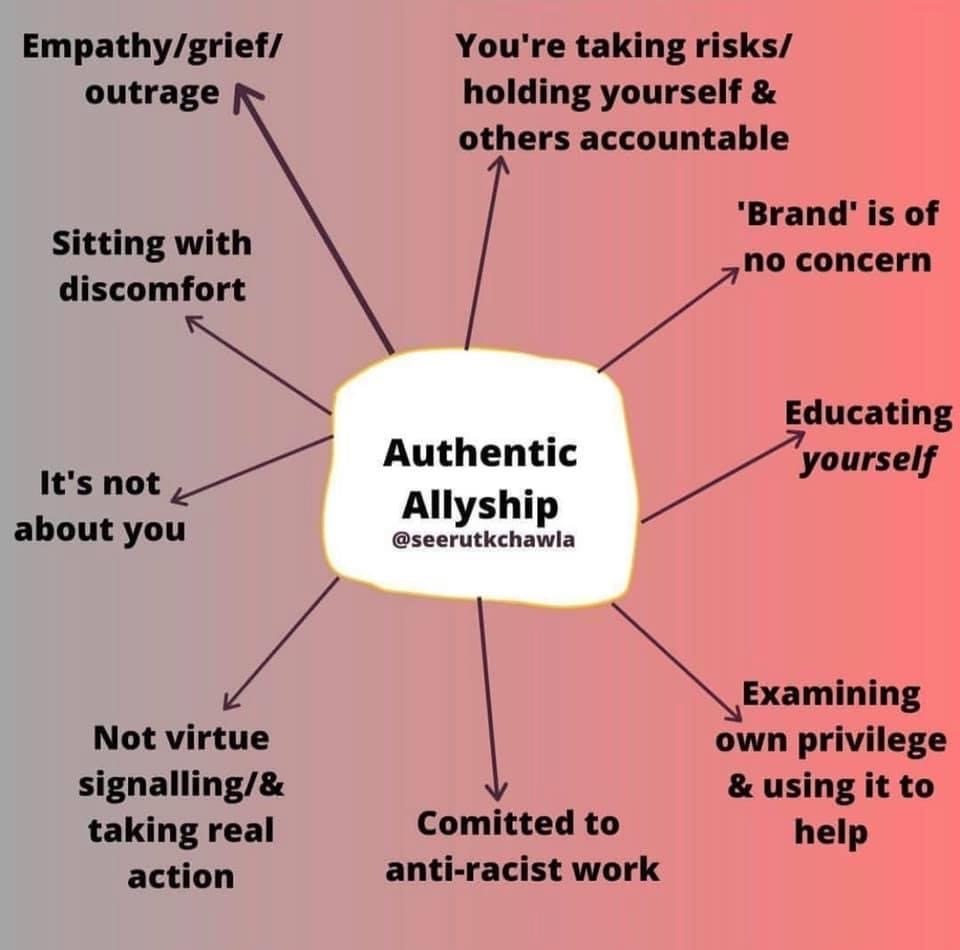
I started following Seerut K. Chawla on Instagram, who developed these graphics that really capture what we are all witnessing around race.  Amy Cooper and Derek Chauvin manifest the insidious and overt versions of weaponizing white fragility.  They and others instigated the tidal wave of activism we see today.  I feel weirdly, gravely grateful.  They kicked open, with utter impunity, the door to the profound opportunity for both individual and collective growth and advancement that we confront, right here, right now.

We are all called to face our discomfort head on, to stand up and take responsibility.  We can no longer escape the harsh reality of choice that we all must continually face:  Do what’s Right or do what’s easy.  Let’s assume for a moment that it really is that simple—all qualifications moot.  It may be unrealistic to expect ourselves to choose Right every time…because qualifications.  But aaaaarrrgh we do not do it nearly, nearly enough.  Nothing will change without a critical mass of us choosing Right, much more of the time, for a very long time to come.

performative allyship

My chief concern is that the current moment passes, and nothing meaningful will result.  I learned two new phrases this past week:  “virtue signaling” and “performative allyship”.  Basically they mean that we respond superficially to a trendy peer pressure, to appear supportive of Black Lives.  I imagine part of such words and even actions are sincere to some degree.  But they serve mostly to make us feel better about ourselves.  And the risk is high that this sudden hyper-motivation will go the way of New Year’s resolutions, once we have soothed ourselves, in order to revert to our prior, comfortable obliviousness.

My friends, we cannot let that happen.

But how?  What do we need in order to really seize this chance of a lifetime, to sustain action into meaningful policy reform?  We need one another.

Our work is to listen, self-educate, engage, and persist.

We must tolerate, even embrace the discomfort, knowing that it is nothing compared to what Black people have suffered for 400 years.

Our approach must be founded in Curiosity, Humility, and Respect.

Our goals, first and foremost, are to learn, to understand, and to connect.

authentic allyship

We can and should each start small, with our own inner work.  Actually this is not really small, is it?  Looking at these panes, I bet most of us don’t live all the time in Authentic Allyship.  This is the Work.  The activation energy for collective change requires all of us together to overcome, before we could ever hope to sustain that change.

And there is good news!  Going together synergizes our energy, lowering each of our individual thresholds for openness and learning, allowing us to advance the collective that much faster!  We can speak and act in our own small circles of influence—our tribes.  Then we reach out and merge our tribes, bonding in solidarity, common purpose, and love.  Is it not inspiring??

Stop with the ‘yes, but…’  Do the right thing, more and more and more and more and more.  Support each other doing it, show up for one another—hold each other up!  Allow for mistakes and imperfection, for continuous learning.  Seek the very next opportunity.  We can do this, Yes We Can.

The pieces below inspire me.  Take the time to read and listen.  Share in the comments what keeps the flame of change alive for you.  I see things changing already.  Let’s keep going.  We’ got this if we go together.

IMG_2639

The Heartbeat of Racism is Denial” by Ibram X. Kendi

Denial is fueled by the stigma associated with being a racist. Feeding the stigma is how “racist” is considered almost like an identity, a brand.

But a racist is not who a person is. A racist is what a person is, what a person is saying, what a person is doing.

Racist is not a fixed category like “not racist,” which is steeped denial. Only racists say they are not racist. Only the racist lives by the heartbeat of denial.

The antiracist lives by the opposite heartbeat, one that rarely and irregularly sounds in America — the heartbeat of confession.

How to Build an Antiracist World, TED Conversation with Ibram X. Kendi

Antiracist Resources from the Greater Good Science Center at the University of California, Berkeley

Unarmed Professionals Will Now Respond to Non-Criminal Police Calls in San Francisco