When and where is it safe for you to disagree strongly and still maintain healthy relationship?
My friend and I had a brief text exchange recently. Me: “…I wonder when they will start profiling East Asians on the street. My kids and I all live in target cities. It’s less and less safe to be non-white.” Friend: “You’re citizens; no need to worry.” Me: “Citizens have been picked up and detained already. Lots to worry about on many fronts. Please do not dismiss people’s concerns, even if you don’t share them. They are not all unfounded.”
Our friendship has developed over a couple of years, accelerating and deepening this year around and through mutually respectful and unreserved political discourse. This thread occurred spontaneously last week. I felt safe to express my fears as well as my reaction to his response. I know he did not mean to dismiss my feelings; he knew that my response was meant to uphold mutual accountability rather than incite shame. Our relationship is now strong and trusting enough for us to be bluntly, caringly honest. We caught up on the phone today and reaffirmed that respect and trust, that bond of platonic love that transends difference even as we embrace and grapple with it. I cannot wait to sit down over lunch and explore each other’s perspectives again soon.
This summer I gave a series of wellness presentations to a global professional firm. Over five Zoom sessions we explored self-awareness and -regulation, open and honest communication, generational differences, variables of diversity, psychological safety, authenticity, leadership, and culture. I did my best to leave an impression and aspiration of empathy, compassion, and accountability in action and relationship, to be cultivated intentionally, both individually and collectively, in the year to come. In all of my conversations with the series organizers before and since, we continue to seek the attitudes, postures, resources, and practices that help a workforce engage and contribute, dissent and challenge, all in the name of elevated collaboration and excellence.
This weekend I traveled to New York City (hence this delayed post) to meet Andy “AJ” Wilson-Taylor and my fellow fans. I only knew two other attendees walking in, and was welcomed and folded into a truly unique throng of uplift and bonding. This community, led by a loving, humble, curious, generous, and kind soul, reflects and amplifies those qualities and values in spades. The brightest love and joy radiated from every person gathered; oxytocin flowed and saturated my whole being. I wondered aloud to more than a few people about the possibilities of capturing the energy of that assembly–the joy, love, shared humanity and connection–concentrating and focusing it, then aiming it to heal the wounds of the world. Members of this group, led by AJ in his unassuming and self-effacing way, have already healed themselves and one another in presence, encouragement, and steadfast mutual support through darkness and disconnection back to light and flourishing kinship.
I pondered this weekend what political discourse would look and feel like in these groups–collegial coworkers practicing interpersonal effectiveness to leverage diversity and elevate creativity and innovation, and a gathering of women brought together by shared love and admiration of a man whose purpose in their space is to ally with and elevate their personal, sexual, and social well-being.
Then yesterday Braver Angels hosted an extemporaneous gathering of leaders from bridging organizations across the country: “Dignity Over Violence: A Unified Civic Response”. I hope to have a link to the recording to share here soon. Claim hope, my friends. This movement of intentional, resilient, and empowering connection across political polarization grows stronger and tighter every year. Love can still win. Over the two hour program, at least twelve leaders both acknowledged what is and pointed to what could be. They cited words and acts of people across the political spectrum, from every demographic, that defy the loudly skewed rhetoric of extremes. In this, yet another mission-driven gathering, I felt an unwavering commitment to mutual understanding and connection, to humility, curiosity, empathy, generosity, and accountability.
“When you hear something triggering, take a deep breath and ask a [good, open and honest] question. Try to understand why that person believes what they believe.” This is the first step to any exchange of true connection.
All systems of human relationship require us all to practice these skills. We cannot just rely on designated leaders to lead by example (especially since so few today do so). Each of us must take up the cause of connection and get to work; more urgently now than ever in my lifetime. But how daunting, to consider reaching across a great political chasm to connect with an adversary, real or perceived?
So after this weekend immersed in gatherings of hope and possibility, I remember that any skill must be developed and cultivated deliberately, consistently, and iteratively. As I prepared to leave the office at 8pm today, I debated briefly about doing my five minutes on the slackboard. Consistency. Commitment. Every session on the slackline, no matter how brief, is another chance to train my nervous system in sensory awareness, feedback integration, and dynamic balance. Over the course of 2.5 songs on my Spotify liked list, I had the best session to date. So too, political discource can be trained in the workplace, in a social gathering, in a family–anywhere and with anybody–by practicing humility, curiosity, empathy, generosity, kindness, and accountability in any relationship system around any topic. We all do it, but I bet we don’t think of it in these terms.
The slackboard, a Braver Angels Zoom call, an AJ’s Angels meet up, my wellness talks, and my conversations with Friend–these are all spaces where I feel safe to express my authentic self. I can challenge staid and conventional social norms, explore the possible. I practice and develop the skills that make me confident to engage in political discourse calmly and with equanimity. Come to think of it, patient encounters train me for this every day, too.
So I ask again: When and where is it safe for you to disagree strongly and still maintain healthy relationship?
Where do you already do this well? When you disagree without getting triggered, how do you show up and conduct yourself? How can you translate this mindset and behavior pattern to the more fraught and emotionally higher risk scenarios? What do you need to feel safe to try/train? Can you identify the ladder of escalating potential triggers to tackle, the way a skier progresses from green to blue to black diamond trails? Can you schedule practice sessions the way an athlete trains for a race, so you can hone the skills, see and feel yourself improving with each encounter?
How can we all make it safe for one another to practice? Like accountability partners at the gym, how can we hold each other up in this effort to save our democracy, to reconnect across polarization and mutual dehumanization, one conversation at a time?
Humility. Curiosity. Empathy. Generosity. Kindness. Accountability. Start where it’s safe and easy. Then look for the next challenge. We grow and strengthen through struggle. Environments and circumstances that feel threatening are not conducive to learning or progress. We can create and cultivate safety for effective disagreement for ourselves and one another. Take a deep breath and ask one good, open, honest question. Start there.
When is it safe to tell the truth? And not? What does the ‘not’ cost us? What does the truth cost us?
Feeling called back to my non-fiction roots lately, I have listened to Revenge of the Tipping Pointby Malcolm Gladwell, My Next Breath by Jeremy Renner, and Four Thousand Weeks by Oliver Burkeman. Burkeman’s book, subtitled “Time Management for Mortals,” reminded me of both The Subtle Art of Not Giving a F*ck by Mark Manson and The Infinite Game by Simon Sinek. These three books, as well as Renner’s memoir, remind me that it’s not about manipulating schedules and timetables. It’s about choosing how and on what we will spend our precious and powerful time, energy, and resources, about what impact we intend and act to make in this finite life we are given.
Moved to listen again to Sinek’s descriptions of a Just Cause (for something [rather than against], inclusive, service-oriented, resilient, and idealistic) and how to advance it sustainably (build trusting teams, learn from worthy rivals, flex proactively and authentically, and lead with courage), and considering our current politics and systems, I feel my inner fire of purpose burn a little brighter. The past week has shown me both courage and cowardice, just cause and quick buck, and the risks and consequences of both. Wow.
A colleague once told me, “You call BS (when you see it),” and it was a high compliment. I like to think I do so diplomatically; I can also be both direct and blunt. My wellness talks this summer have centered around psychological safety–building trusting teams on which colleagues feel free to show up their whole, authentic selves. That is when we can all make our best contribution–when our diversity is sought and honored, where inclusivity and mutual respect are the intrinsic ethos more than an external mandate. When I feel safe to call BS and ask the hard questions, to challenge my peers to live into our integrity and highest stated values, I feel it in my chest and the lumbar spine. My posture is upright and I am grounded. I make eye contact and hold my shoulders square. The call to uphold our ideals outweighs any fear of reprimand or retaliation.
And yet, I can imagine how that fear can be paralyzing. How will I respond when the stakes for truth telling are high and the consequences threatening? Will I lose my job? Will I damage a relationship? Will I damage my conscience?
Today, as I think about all the competing interests at play in our systems–institutions, politics, business, economies, family dynamics–it all still boils down, for me, to core values of honesty, integrity, empathy, compassion, and respect. Playing the Infinite Game, to me, means keeping the long view in sight. It means making decisions that advance my just cause now and in the future. I must be vigilant about monitoring for when I’m making excuses, rationalizing, and justifying actions that my gut knows compromise my ethics, that pander.
Looking back, I imagine I have lost ‘opportunities’ as others would see them, when I speak directly, when I dissent. I can point to specific conversations when that may have happened. Overall the relationships I care about are intact, as far as I know. And there are probably negative dynamics I don’t know about–we can never know what everyone/anyone may be saying about us behind our backs. When I look at my life, however, I see no deficits. I believe my reputation is solid and consistent where it matters. I don’t call BS to bring people down or elevate myself. I do it when I see a threat to or violation of a core or stated value, when I see hypocrisy at play. I assume we are all here doing our best. I strive always to be kind, if direct. I hope others will call me out when my words and actions do not align with my professed values. I try to be open and honest about my ambivalence and conflicts (eg practicing concierge medicine when I know access to healthcare is at an all-time low for most people–yikes).
To live an ethical life, I must first be honest with myself–tell the raw, unsweetened truth to myself before I can hope to do it for anyone else. But the truth does not have to be brutal or mean. Kindness goes a long way to making truth bearable, and thus actionable. And what is truth even worth if we do not act on it?
Thank you, Mr. Burkeman, for prompting me to revisit Mr. Sinek’s work. I just never know when, where, or how the next epiphany or breakthrough will come, and it’s always gratifying to meet old lessons with new perspective.
How can we be more kind and truthful in our daily lives? What if we all did both a little more consistently? How can we make it safe for one another to tell the truth and thrive for it? I think it’s about honesty, humility, integrity, empathy, and respect, all in mutual reciprocity. They’re big, aspirational words, I know. But what are we here to do, if not the big, aspirational stuff?
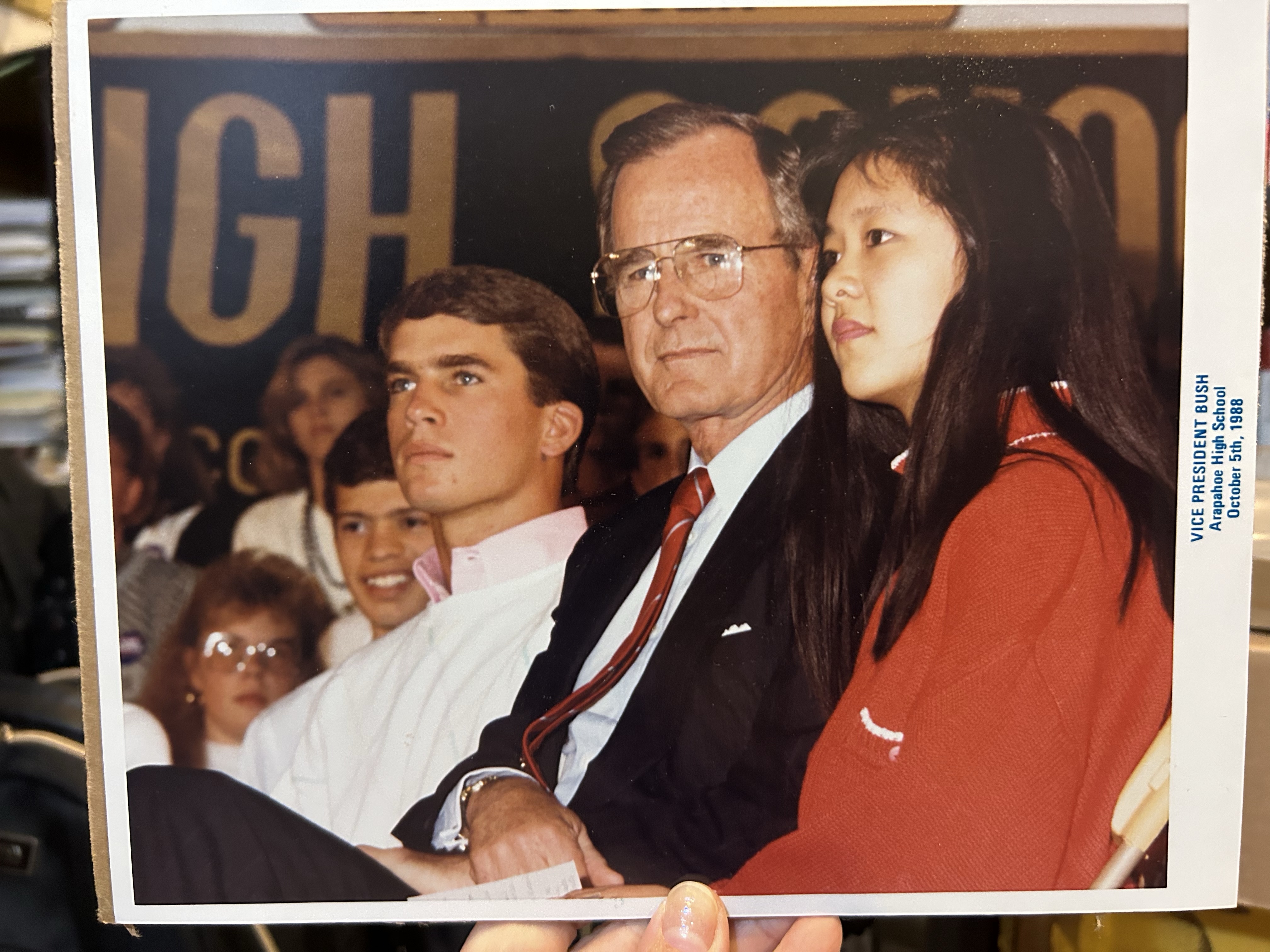
Print found in Parents’ basement this weekend; from October, 1988
Old memories can help us reframe the present.
I post late this week for good reason–I spent the weekend in my Happy Place and was both too giddy and too pensive to draft anything on the plane last night. Daughter and I went home to Colorado to go through my stuff in Parents’ house, a last girls’ getaway before our college road trip in a few weeks. We culled five boxes of report cards, notebooks, Trapper folders, workbooks, test scores, letters and documents to one box of photos, mementos, and original words and art.
Among the finds was a stash of photo prints from when then Vice President George Bush stopped at my high school on his presidential campaign in 1988. I got to share the stage with him and some of my schoolmates; I’m convinced I got to sit next to him because I was (still am) short enough to not block anyone’s view of his face. My friend and I spoke that day about our chapter of Students Against Driving Drunk; I had to stand on my tip toes to reach the microphone. One of the photographs from that day, with him and me in the foreground, is now a Geddy Image.
I was completely politically uninformed and uninterested back in 1988. I heard a classmate criticizing ‘bleeding heart liberals’ in the cafeteria once and I had no idea what those words meant. Looking back, what I remember most about Bush the First then and onward is his decency. As I matured into liberal progressiveness, I still heard his words as earnest and forthright, principled and moderate, always looking to the greater/greatest good ahead of narrow ideology or partisan rhetoric. I see fewer and fewer politicians this way today, though a few still shine forth.
I remember that he spoke of a ‘kinder, gentler’ America–was it just once or multiple times? I searched briefly and found his inaugural speech. The full text is copied below; I invite you to read through it slowly and consider the context of the time–January 20, 1989. What phase of life was that for you? How did you view politics and politicians then? As you read the speech, imagine the words being delivered in 2009, 2017, or now. Imagine in 1989 that they were read by a new Democratic President. The juxtapositions are a little mindbending, no?
When I read this speech, I take issue with some of the rhetoric, but only some, and only mildly. I imagine that I could easily sit down with him and/or his speechwriter and clarify the parts where the word choice and apparent biases and assumptions grate on me, and discuss the complexities of abortion and supporting women who take their unintended pregnancies to term, and their babies. None of this speech inflames or agitates me. I understand that some of it has to be rhetoric and point to policy and agenda. But most of it strikes me as a higher order ethos, a call to ground in shared humanity and common goals. I admire this speech the way I have admired so many of Barack Obama’s orations and writings.
And yet when I look at this campaign literature, also saved from that day, that inclusive ethos is missing. This reminds me much more of contemporary conservative rhetoric; it comes across as othering, punitive, unempathetic, and borderline dehumanizing–seen, of course, through my present day progressive lens. It just makes me notice how we present ourselves and our messages in different contexts, depending on what impressions we wish to leave or what attitudes and behaviors we aim to encourage or incite.
Platforms are powerful. Leaders set the tone for the spaces and people they lead; culture is set at the very top, by words, actions, and relationships.
There is no comparison. Between the man who sat next to me on that stage my sophomore year in high school and the man occupying the White House today, the gap in ethics, character, and leadership dwarfs the Grand Canyon. How far we have fallen, my friends. It is beyond embarrassing and disgraceful.
How do we come back from this? What hope can we cling to for overcoming the division and mutual loathing that drives our politics and discourse into stalemate and brinksmanship so far ahead of good faith, iterative negotiation and compromise? I think reading words from respectable steward-leaders from the past and present, then amplifying, emulating, and applying them is a good start. So when I have time, I will find other speeches and speakers I admire for their ability to inspire and arouse our kinder, gentler, more inclusive impulses, and amplify them. Who does this for you?
Inaugural Address of George Bush
FRIDAY, JANUARY 20, 1989
Mr. Chief Justice, Mr. President, Vice President Quayle, Senator Mitchell, Speaker Wright, Senator Dole, Congressman Michel, and fellow citizens, neighbors, and friends:
There is a man here who has earned a lasting place in our hearts and in our history. President Reagan, on behalf of our Nation, I thank you for the wonderful things that you have done for America.
I have just repeated word for word the oath taken by George Washington 200 years ago, and the Bible on which I placed my hand is the Bible on which he placed his. It is right that the memory of Washington be with us today, not only because this is our Bicentennial Inauguration, but because Washington remains the Father of our Country. And he would, I think, be gladdened by this day; for today is the concrete expression of a stunning fact: our continuity these 200 years since our government began.
We meet on democracy’s front porch, a good place to talk as neighbors and as friends. For this is a day when our nation is made whole, when our differences, for a moment, are suspended.
And my first act as President is a prayer. I ask you to bow your heads:
Heavenly Father, we bow our heads and thank You for Your love. Accept our thanks for the peace that yields this day and the shared faith that makes its continuance likely. Make us strong to do Your work, willing to heed and hear Your will, and write on our hearts these words: “Use power to help people.” For we are given power not to advance our own purposes, nor to make a great show in the world, nor a name. There is but one just use of power, and it is to serve people. Help us to remember it, Lord. Amen.
I come before you and assume the Presidency at a moment rich with promise. We live in a peaceful, prosperous time, but we can make it better. For a new breeze is blowing, and a world refreshed by freedom seems reborn; for in man’s heart, if not in fact, the day of the dictator is over. The totalitarian era is passing, its old ideas blown away like leaves from an ancient, lifeless tree. A new breeze is blowing, and a nation refreshed by freedom stands ready to push on. There is new ground to be broken, and new action to be taken. There are times when the future seems thick as a fog; you sit and wait, hoping the mists will lift and reveal the right path. But this is a time when the future seems a door you can walk right through into a room called tomorrow.
Great nations of the world are moving toward democracy through the door to freedom. Men and women of the world move toward free markets through the door to prosperity. The people of the world agitate for free expression and free thought through the door to the moral and intellectual satisfactions that only liberty allows.
We know what works: Freedom works. We know what’s right: Freedom is right. We know how to secure a more just and prosperous life for man on Earth: through free markets, free speech, free elections, and the exercise of free will unhampered by the state.
For the first time in this century, for the first time in perhaps all history, man does not have to invent a system by which to live. We don’t have to talk late into the night about which form of government is better. We don’t have to wrest justice from the kings. We only have to summon it from within ourselves. We must act on what we know. I take as my guide the hope of a saint: In crucial things, unity; in important things, diversity; in all things, generosity.
America today is a proud, free nation, decent and civil, a place we cannot help but love. We know in our hearts, not loudly and proudly, but as a simple fact, that this country has meaning beyond what we see, and that our strength is a force for good. But have we changed as a nation even in our time? Are we enthralled with material things, less appreciative of the nobility of work and sacrifice?
My friends, we are not the sum of our possessions. They are not the measure of our lives. In our hearts we know what matters. We cannot hope only to leave our children a bigger car, a bigger bank account. We must hope to give them a sense of what it means to be a loyal friend, a loving parent, a citizen who leaves his home, his neighborhood and town better than he found it. What do we want the men and women who work with us to say when we are no longer there? That we were more driven to succeed than anyone around us? Or that we stopped to ask if a sick child had gotten better, and stayed a moment there to trade a word of friendship?
No President, no government, can teach us to remember what is best in what we are. But if the man you have chosen to lead this government can help make a difference; if he can celebrate the quieter, deeper successes that are made not of gold and silk, but of better hearts and finer souls; if he can do these things, then he must.
America is never wholly herself unless she is engaged in high moral principle. We as a people have such a purpose today. It is to make kinder the face of the Nation and gentler the face of the world. My friends, we have work to do. There are the homeless, lost and roaming. There are the children who have nothing, no love, no normalcy. There are those who cannot free themselves of enslavement to whatever addiction–drugs, welfare, the demoralization that rules the slums. There is crime to be conquered, the rough crime of the streets. There are young women to be helped who are about to become mothers of children they can’t care for and might not love. They need our care, our guidance, and our education, though we bless them for choosing life.
The old solution, the old way, was to think that public money alone could end these problems. But we have learned that is not so. And in any case, our funds are low. We have a deficit to bring down. We have more will than wallet; but will is what we need. We will make the hard choices, looking at what we have and perhaps allocating it differently, making our decisions based on honest need and prudent safety. And then we will do the wisest thing of all: We will turn to the only resource we have that in times of need always grows–the goodness and the courage of the American people.
I am speaking of a new engagement in the lives of others, a new activism, hands-on and involved, that gets the job done. We must bring in the generations, harnessing the unused talent of the elderly and the unfocused energy of the young. For not only leadership is passed from generation to generation, but so is stewardship. And the generation born after the Second World War has come of age.
I have spoken of a thousand points of light, of all the community organizations that are spread like stars throughout the Nation, doing good. We will work hand in hand, encouraging, sometimes leading, sometimes being led, rewarding. We will work on this in the White House, in the Cabinet agencies. I will go to the people and the programs that are the brighter points of light, and I will ask every member of my government to become involved. The old ideas are new again because they are not old, they are timeless: duty, sacrifice, commitment, and a patriotism that finds its expression in taking part and pitching in.
We need a new engagement, too, between the Executive and the Congress. The challenges before us will be thrashed out with the House and the Senate. We must bring the Federal budget into balance. And we must ensure that America stands before the world united, strong, at peace, and fiscally sound. But, of course, things may be difficult. We need compromise; we have had dissension. We need harmony; we have had a chorus of discordant voices.
For Congress, too, has changed in our time. There has grown a certain divisiveness. We have seen the hard looks and heard the statements in which not each other’s ideas are challenged, but each other’s motives. And our great parties have too often been far apart and untrusting of each other. It has been this way since Vietnam. That war cleaves us still. But, friends, that war began in earnest a quarter of a century ago; and surely the statute of limitations has been reached. This is a fact: The final lesson of Vietnam is that no great nation can long afford to be sundered by a memory. A new breeze is blowing, and the old bipartisanship must be made new again.
To my friends–and yes, I do mean friends–in the loyal opposition–and yes, I mean loyal: I put out my hand. I am putting out my hand to you, Mr. Speaker. I am putting out my hand to you Mr. Majority Leader. For this is the thing: This is the age of the offered hand. We can’t turn back clocks, and I don’t want to. But when our fathers were young, Mr. Speaker, our differences ended at the water’s edge. And we don’t wish to turn back time, but when our mothers were young, Mr. Majority Leader, the Congress and the Executive were capable of working together to produce a budget on which this nation could live. Let us negotiate soon and hard. But in the end, let us produce. The American people await action. They didn’t send us here to bicker. They ask us to rise above the merely partisan. “In crucial things, unity”–and this, my friends, is crucial.
To the world, too, we offer new engagement and a renewed vow: We will stay strong to protect the peace. The “offered hand” is a reluctant fist; but once made, strong, and can be used with great effect. There are today Americans who are held against their will in foreign lands, and Americans who are unaccounted for. Assistance can be shown here, and will be long remembered. Good will begets good will. Good faith can be a spiral that endlessly moves on.
Great nations like great men must keep their word. When America says something, America means it, whether a treaty or an agreement or a vow made on marble steps. We will always try to speak clearly, for candor is a compliment, but subtlety, too, is good and has its place. While keeping our alliances and friendships around the world strong, ever strong, we will continue the new closeness with the Soviet Union, consistent both with our security and with progress. One might say that our new relationship in part reflects the triumph of hope and strength over experience. But hope is good, and so are strength and vigilance.
Here today are tens of thousands of our citizens who feel the understandable satisfaction of those who have taken part in democracy and seen their hopes fulfilled. But my thoughts have been turning the past few days to those who would be watching at home to an older fellow who will throw a salute by himself when the flag goes by, and the woman who will tell her sons the words of the battle hymns. I don’t mean this to be sentimental. I mean that on days like this, we remember that we are all part of a continuum, inescapably connected by the ties that bind.
Our children are watching in schools throughout our great land. And to them I say, thank you for watching democracy’s big day. For democracy belongs to us all, and freedom is like a beautiful kite that can go higher and higher with the breeze. And to all I say: No matter what your circumstances or where you are, you are part of this day, you are part of the life of our great nation.
A President is neither prince nor pope, and I don’t seek a window on men’s souls. In fact, I yearn for a greater tolerance, an easy- goingness about each other’s attitudes and way of life.
There are few clear areas in which we as a society must rise up united and express our intolerance. The most obvious now is drugs. And when that first cocaine was smuggled in on a ship, it may as well have been a deadly bacteria, so much has it hurt the body, the soul of our country. And there is much to be done and to be said, but take my word for it: This scourge will stop.
And so, there is much to do; and tomorrow the work begins. I do not mistrust the future; I do not fear what is ahead. For our problems are large, but our heart is larger. Our challenges are great, but our will is greater. And if our flaws are endless, God’s love is truly boundless.
Some see leadership as high drama, and the sound of trumpets calling, and sometimes it is that. But I see history as a book with many pages, and each day we fill a page with acts of hopefulness and meaning. The new breeze blows, a page turns, the story unfolds. And so today a chapter begins, a small and stately story of unity, diversity, and generosity–shared, and written, together.
Thank you. God bless you and God bless the United States of America.





 Healing Through Connection