

Learn. Practice. Train.
To get better at anything, we must be willing to tolerate the discomfort of being bad at it–for a while. And the reward has to be worth the effort.
What reward will make it worth the effort for us to tolerate the discomfort of political discourse, in order to get better at it?
What other uncomfortable training can we compare it to?
“Agonist Supersets! The focus of this block is adding more intensity + time under tension to a specific muscle group. Lower body in A series, upper body in B series for TBS (total body strength) days. Two movments focusing on the same muscle group back to back. First movement more focused on neural engagement and higher movement complexity, the second movement for increased TUT and hypertrophy!”
–Ethos Training Systems, February 2025

Tempo: 2 count down, pause 1, up 1, repeat.
To pause for one second at the bottom of a rear foot elevated split squat can be uncomfortable. The longer I hold tension with the glute of the forward leg extended in that position, the more challenging it is to stand back up, especially by the 24th repetition. But the rewards are a stronger posterior chain, a more stable core, and confidence and ease getting up and down from the floor as I age.
Since there are only six reps per set in this block, I can lift heavier weights. I think this is the first time I have done this movement with 20 pounds in each hand. And the program builds in longer rest periods after heavy load sets. Consistent and disciplined repetition for neural pathway learning and muscle hypertrophy–I get better each time I train.
I so wish more of us would take this attitude toward our political conversations–see it as personal training to get better at it. What do I mean by ‘better’? I do not mean better at criticizing and shaming people who voted differently. I do not mean amplifying derisive words and ad hominem attacks on public figures. I do not mean aggressively debating ideology and attempting to convince someone their values and ideals are ‘wrongheaded’ or otherwise invalid.
By ‘get better’ at political discourse I mean asking more open and curious questions, listening to understand rather than to rebut, reject, or demean. I mean challenging our own convictions for consistency and integrity. I mean engaging in earnest, in the spirit of critical collaboration, to find common ground in shared goals, where we can stand and work together to make our systems better. Policies born from this laborious process last, rather than getting overturned from one administration to the next. It requires leaders as well as citizens to withstand the discomfort of disagreement and clash of ideology. It demands patience, diplomacy, professionalism, self-awareness, self-regulation, humility, honesty, and mutual respect.
Who looks at this list of requirements and thinks, “Sure, no problem, I’m very comfortable with that, sign me up.” More often I suspect a reaction along the lines of, “Are you kidding me? Like anybody (on the other side) will show up that way to me? Why would I bother doing it for them?”
And therein lies our impasse. Who will go first? Only those who can tolerate the discomfort–of vulnerability, uncertainty, and humility–with confidence. It will be those who have trained.
Time under tension: It builds muscle strength and stability, improves load tolerance, and allows us to lift heavy things with grace. We have to get in the gym, grip the weights, and submit ourselves to the struggle. And we have to do it consistently, with discipline. We must take time to rest and recover, between sets and sessions alike. We need coaches to monitor and correct form and position. And it always helps to have our friends doing it with us and cheering us on.
If we don’t feel like it and don’t do it, then muscles atrophy and risk of injury increases when weekend warrior mindset overtakes us. A healthcare system can get overburdened by people who fall and fracture hips due to frailty from lack of physical training. A society’s political system can be similarly overburdened, and thus vulnerable to nefarious actors, by a citizenry that fails at political discourse due to frailty in conversational exchange of ideas and difference of opinion.
So how do we train? Thankfully there are more and more resources to help us. My suggestions:
- Start within our own group. Find people willing to put down the ad hominem approach, who are willing to look at what we say and do with a critical eye, looking at it from ‘the opposition’s’ point of view, and seeing how our messages may be counterproductive.
- With these peers, practice engaging with ideas you disagree with. Role play the ‘other side.’ Research objective evidence that supports that point of view–avoid that group’s ad hominem attacks also; look for evidence that they also understand our point of view.
- Attend a Braver Angels workshop or event. Learn and practice the skills we need to engage calmly, openly, and with respect and curiosity in front.
- Follow groups like Builders and A Common America to see who among our elected officials, and those who might run, already practices non-adversarial discourse. Amplify them on your social media and to your peers.
- Finally, seek out people who voted differently from you, whom you respect and whose relationship you value. Get vulnerable. Tell them you want to get better at talking politics, that you want to connect more than divide our country. Be prepared for an incredulous and dismissive reaction. Decide how and whether you will persist. Comment here if you want a pep talk, I’m good at giving those! And then if they agree, practice all of the above and below with them! Go for it!
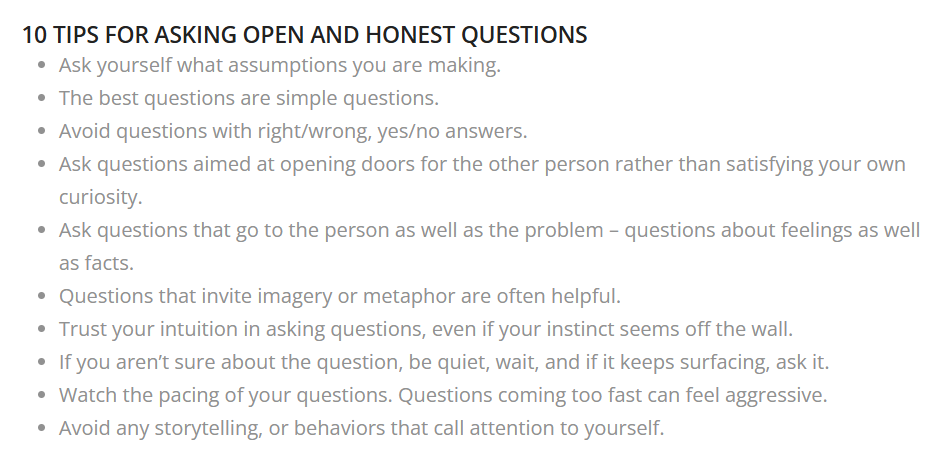
In any conversation, aim to ask questions at least twice as often as you make statements. This is an uncomfortable, challenging, humbling, and extremely effective way to get better at engaging anyone in conversation. But they can’t just be any questions. The best questions–the ones that make us pause, resist our canned and offhand responses–are open and honest–see tips below. And the intention must be earnest–the goal must be to connect and understand, never to one-up or ‘win’.
Time under tension in political discourse builds the muscles of engagement. It improves our tolerance of intra- and interpersonal discomfort. It gives us the ability to think in curious rather than adversarial ways. It makes us stronger citizens, neighbors, friends, and family members who can withstand disagreement and conflict with resilience.
I’m considering how I will spend my time, energy, and resources this year. Work will be busier. Daughter will launch to college. I will continue to write. And now I hear the call of advocacy getting louder. I have a few ideas about the whats and hows; the Why remains steadfast: to foster the healthiest relationships among all whose lives I touch.
Exciting times, friends! Scary for so many, I know.
How will we all help?



 Healing Through Connection
