Inclusion and Belonging

IMG_0927

What do diversity and inclusion mean to you these days?

Honestly for me, they mean different things depending on the context in which I think about them.  Cathy the Cynic thinks diversity initiatives too often feel trendy and superficial, like a knee-jerk response to the social pressure to check a box.  Cathy the Optimist believes that those who direct such initiatives honestly see the communal value in a truly diverse and inclusive work environment.

A wise friend recently pointed out to me that inclusion can be a challenge even in a homogeneous group.  “You could have 25 white men in a room and everybody may not feel included.”  So, he said, perhaps we should work on inclusion first, and diversity will come more naturally as a result.  Brilliant!  If we make it safe for everybody to be themselves, no matter who they are, then they feel free to bring their best, authentic selves—it’s a win-win for each individual and the organization.  An inclusive work culture supports and values each person for their unique contributions.  In such an environment, diversity is achieved because people value their differences as much as their similarities.  They live in curiosity and awe, always in a learning stance.  Inclusive cultures seek more perspectives, experiences, expertise, and backgrounds—they cultivate depth and breadth in the humanity of their workforce.  People from divergent walks of life seek to join such cultures, drawn to vibrant cohesion, synergy, and creativity.

This idea marinated in my mind for some weeks until an article from the Wharton School of Business crossed one of my online feeds last Thursday.  It says diversity and inclusion are not enough; we need to cultivate a sense of belonging in our workplaces.  The article quotes Sam Lalanne, a senior vice president of Global Diversity and Talent Management at Citigroup:  “…whereas diversity often gets linked to numbers and percentages, belonging ‘is about how you feel’ when you’re at work. ‘Do you feel valued? Do you feel like you should be there? Do you feel that your insights, commentary and perspectives matter?’”

“Rebekah Bastian, a vice president of culture and community at Zillow Group, said that the superior business outcomes often associated with having diverse teams can’t be achieved without a sense of belonging. It’s not enough to simply include people at the table, she said, but to ‘amplify everyone’s voices, clear barriers … and appreciate each other for our unique backgrounds.’ Both she and Lalanne said that a sense of belonging means that people can bring their full selves to work, and not feel like they’re a different person there than at home.”

A different person.  So what I described above as inclusion is really what these leaders define as belonging.  We want each person to feel they belong in the work tribe, that their presence and contributions are valuable and worthy, as themselves.  When we include, from our hearts, each person in their wholeness, only then will they truly belong.  And that is the sweet spot where teams thrive.

So what do we do?  How do we create such loving cultures of true belonging?  According to panelists quoted in the Wharton article (and we all know this), it comes from the top:  “Lalanne also commented on the importance of ‘tone at the top’ toward fostering a sense of belonging. ‘Our CEO, Mike Corbat, has really pushed us on our diversity, inclusion and belonging agendas. And it really comes from, what does he preach, what comes out of his mouth, how does he execute against the things that we see around us.’”  Simon Sinek calls us to live our values with clarity, consistency, and discipline.  So if you’re a leader who talks about diversity and inclusion, about belonging, then we workers have to see you, to feel you, living these values out loud and in front of us.

Belonging is more about how we are toward each other than how we act or what we do, which is inclusion.  This is the key to successful ‘diversity and inclusion’ initiatives—they must be sincere.  Humans are intuitively social animals.  We smell insincerity and reject it, because it is unsafe.  We cannot trust it.

A garden of belonging must be grown organically.  There are no shortcuts.  It takes time, and the gardener must tend it regularly.  Young seedlings require protection from weather and predators.  She must bring in pollinators and other helpers—one person cannot do it all.  So we can all pick up a trowel and participate.  We look to our leaders to set the path, and when we see the shining hope of our collective destination we follow willingly, eagerly, and together.

Aunt Rachel’s Blessings

My friends, it’s been an intense couple of weeks!  So much so that I have fully neglected the news headlines—this must be why I’m still in a reasonably good mood.  Another is that I have rediscovered Dr. Rachel Naomi Remen, the wise and benevolent matron of medicine whose gentle and gracious example I aspire to follow.

I first read her books, Kitchen Table Wisdom and My Grandfather’s Blessings, at least ten years ago by now.  They felt like my favorite plush blanket, draped over my shoulders with that welcome, comforting weight, and tucked under my feet, warming me with stories of love and belonging.  Life was just as hectic then as today, but in a different way.  The kids were little, and I had few if any responsibilities at work outside of patient care.  Aunt Rachel’s stories calmed me and gave me peace in that young chaos.  I had meant to reread them, but, well, life.

I perused the shelves and stacks of my personal library recently, searching for a book that my friend might like.  Both avid readers, we share and discuss titles on leadership, philosophy, and personal development.  The search this day felt different from browsing Amazon or my local book store.  A deeper part of me knew exactly what I sought for my friend, even as my conscious mind had only a vague idea.  I wanted to share something different with him, something less cerebral.  As soon as I saw it, I settled on My Grandfather’s Blessings, no question.  But after a day or two, as often happens with instantaneous intuitive decisions, I did question.  So I sat down with Aunt Rachel and her grandfather one evening, as if meeting old friends in the squishy armchairs of a cozy, familiar café.  After some years of listening to books rather than reading them, I find quiet sitting with a paper book so comforting now.  I am called to slow down, to be still, more than I have been (have allowed?), for a very long time.

By page two of the introduction, my doubts vaporized.  This is it, I thought.  Stories of humanity, history, culture, medicine, healing, perspective, and how we humans are intertwined with one another and nature in the most beautiful and cosmic, inescapable and daunting ways.  As I reread her grandfather’s wise sayings, his subtle yet unmistakable messages of reassurance and unconditional love, that familiar warmth enveloped me again.  I could almost feel my blood pressure drop and my oxytocin level rise.

So much love and connection—the book is really all about relationships, which my friend and I both hold as the key to a meaningful life.  As I continue to read this week, it occurs to me that perhaps I was not actually looking for a book for my friend, but rather for myself.  For many years I have hunted ravenously for books to teach me, to elevate my performance in parenting, doctoring, leading.  But Aunt Rachel’s books simply soothe me.  They acknowledge and give credence to that still small voice that advocates and validates the need for deep personal connection, in a world that values it less and less.

I wonder if reading Aunt Rachel’s books so early in my career helped me more than I knew.  Looking back on the past decade, I feel proud to have resisted the pressure of 15 minute clinic visits, to have made the effort to relate as personally as I could with every patient, even if my bids were rejected.  Aunt Rachel’s books honor that heart center in me that holds true to what I value the most, which is connection with people.  Perhaps I have her to thank for watering the strongest, deepest roots of my doctor soul before they could dry up and later require excavation to revive?

I still think my friend will enjoy Aunt Rachel’s book.  Her stories resonate with the humanity in all of us, not just doctors and patients.  I look forward to hearing his feedback, and finding more books to share.  And I must remember to bless our friendship.

May we all acknowledge and share the blessings in our lives, every chance we get.

How Reunions Feed Us

IMG_1337.JPG

It was July 1997.

Maria C. and I had just started our third year of medical school, rotating on general surgery.  We stood on evening rounds–it was already dark outside on this balmy summer night.  The hospital hallway was quiet and half the lights were off.  We visited a little old lady who had had surgery in the prior days.  She looked frail, but also like she had been spry once.  Her lips protruded the way my grandmother’s did when she took her dentures out at night.  She wore a round fuchsia sleeping bonnet, a little askew atop her head.  She looked half asleep, barely aware of our presence, and had slid down in the bed such that the pillow and blankets had effectively swallowed her.

We were tired, Maria and I.  It was not a fun rotation for me.  I had witnessed our attending throw a bloody sponge across the OR that month.  He was not particularly interested in us, I don’t recall any direct teaching (but there could have been), and the sleep deprivation was killing me.  But I had Maria.  She always had a smile, always an encouraging word, and she loved surgery.  Her energy held me up.  We stood dutifully, trying our best to pay attention and learn something.

As we listened to the discussion of the nice lady’s plan of care, suddenly I heard a loud, resonant, and prolonged PPPPPPPTHTHTHTHAAAAAARRRRRRRRTTTT.   Our somnolent charge had just passed the longest breath of colon gas I had ever heard, before or since.  And it didn’t phase anybody.  The team continued to discuss her plan of care as if nothing had happened.  I don’t know, maybe they were encouraged, as flatulence is the first step to oral feeds and eventual discharge after abdominal surgery.  They forged on without acknowledgement.  I wondered if I had imagined it.  But when I caught Maria’s eye, within seconds we could both barely contain ourselves.  Maybe we were just slap happy from too little sleep, or we just needed something to break the tension.  But it was too much, we had to step out.  Back out in the dim hallway we laughed out loud as quietly as we could, to the point of gasping for breath, hanging onto the wall and each other to keep from falling down.  Even today, 22 years later, I cannot help but smile at that moment.  Either we went back inside after composing ourselves, or the team emerged eventually, I don’t remember.  Rounds continued and I tucked away this little memory as one of the best bonding experiences of all my years in training.

*****

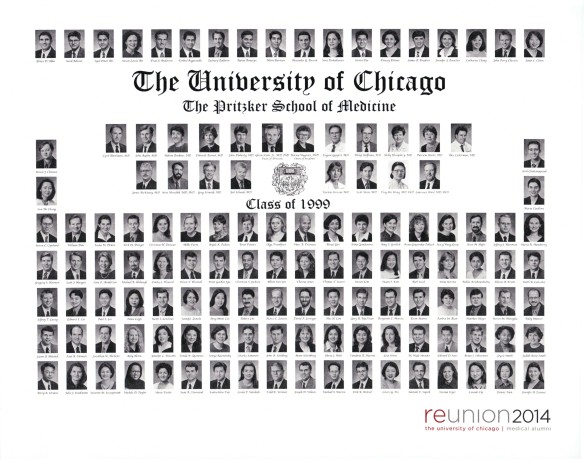
The Class of 1999 returned to The University of Chicago this past weekend to celebrate 20 years since graduation.  I had only signed up for a couple events, in my usual non-committal way.  I arrived at the breakfast venue, a building that did not exist when we were students.  I glanced over at the tables and saw only people much older than me, and my heart sank a little.  Where were my peeps?  Then at a back table an old friend stood up and waved, and my spirits lifted instantly.  We ate and laughed, and shared photos and anecdotes of surly teenagers at home.  As I had made no other plans that day, I met people again for lunch and we walked through campus, which I had not done in years.  The peonies in the quad burst with color and fullness, welcoming us all back.

I’m so proud of our class.  We are general internists and pediatricians, hospitalists, cardiologists, allergists, emergency medicine doctors, and orthopaedic surgeons.  We do neurologic interventional radiology, microvascular plastic surgery, and private equity.  We are medical directors, section chiefs, and NIH researchers; we teach medical students, residents, fellows and colleagues.  We advocate for immigrant health and lead international research teams to win the war on disease.  We are parents of toddlers and college students, single, married, and divorced.  But mostly we are just older versions of our younger selves, in love with the science of medicine and driven by something deeper within to care for our fellow humans, relieve suffering, and make the world better for our having lived.  This weekend gave us the opportunity to reconnect deeply on that level, to recall and relive those bonding memories tucked away all these years.  I had a chance to catch up with classmates whom I had always wanted to know better in school.  What a blessing.

Our specialties are widely diverse, as are our life experiences, before and since medical school.  But we also share so much in common.  Many of us have had painful experiences as patients or family of patients, and that has impacted our attitudes as physicians.  We collectively recall the stages and transitions of training as both trial and reward.  And everybody has something to say about the current, broken state of American healthcare.  But the overarching feeling of the weekend was camaraderie and love.  Emails poured in from classmates across the country and around the world who could not make it back; I count almost 60/100 of us included in our communications thus far.  We were just waiting for the chance to find one another again.

*****

In our current geopolitical climate of division, competition, and polarization, reunion is the antidote.  In this vital ritual of humanity, we reconnect with those who knew us in a more innocent phase of life, when we bonded through shared struggle, with whom our diversity and shared experience are paradoxically complementary in the best ways.  Our souls are fed by one another, in person, surrounded by food, back at our first professional home.  Relationships long dormant stand revived, and we are lifted.

It occurs to me, in this lovefest of reconnection:  How can we leverage this energy?  What if we could sustain these bonds, reforged and hot in this moment?  If we connected like this more often or regularly, across specialties, geography, and practice structure, how much better could we all be at what we do every day?  How much more empathy could we have for those who don’t do what we do, whom we see as competing for resources or otherwise trying to undermine us?  How would our patients feel in our presence?  Our support staff?  Our hospital leaders?  Gatherings like this prove that we have the capacity to just be together, appreciate one another, and support each other with generosity and grace.  So much potential for positive synergy among this group.

We have big plans for our 25th reunion, but I have a feeling our renewed relationships will find powerful expression long before then.  So stay tuned, my friends.  We are Pritzker Class of 1999, and we’ got work to do.

IMG_1339