Perspective

“Tribe.”

What is your perspective on this word? I’m feeling a little defensive tonight, and also holding mind space to consider different perspectives, while clarifying my own in the process. I have used the word to describe my ‘found family,’ people with whom I share a deeply meaningful bond, my innermost circle and closest confidants. Including unpublished drafts, a search of ‘tribe‘ on this blog yields 105 posts.

Recently I have heard that using the word ‘tribe’ could be offensive to Native Americans. My initial reaction is divergent. Yes, I can see why. And, really? Does this group hold the exclusive right to use this word to describe something meaningful to them? Is its use in other contexts offensive to all indigenous people? Has it always been?

Four sources of perspective:

On the etymology of the word ‘tribe’: “In the Biblical sense, which was the original one in English, the Latin word translates Greek phyle “race or tribe of men, body of men united by ties of blood and descent, a clan” (see phylo-). Extension to modern ethnic groups or races of people is from 1590s, specifically “a division of a barbarous race of people, usually distinguishable in some way from their congeners, united into a community under a recognized head or chief” [Century Dictionary], but colloquially of any aggregate of individuals of a kind. also from mid-13c.

“What is a Tribe?” “True, “tribe” is a troublesome word, bearing the weight of decades of anthropological study that privileged Western civilization over all other traditions. But let us rescue it here, pare it down to its simplest meaning, as a name for the first human communities that formed beyond the primal bonds of kinship — the beginnings of the great experiment we call society, which taught us to be human.”

“A teen recently told me that using the phrase “find your tribe” or using the word “tribe” is offensive to Native Americans.” “For Indigenous people, tribal identity is important. So when non-Native people say “find your tribe” or “tribe” to describe groups of shared interest, it is offensive because it erases the significance of Tribal sovereignty, identity, and people. Instead, we can use words like: group, crew, friends, or circle.”

Tribal Leadership, Dave Logan et al. From a sociological point of view, using the word as a reseach group defines it academically: “The success of a company depends on its tribes. The strength of its tribes is determined by the tribal culture, and a thriving corporate culture can only be established by an effective tribal leader.” This book has influenced my perspective on leadership and culture very deeply, hence my reluctance to stop using the word altogether.

How do I do perspective well already?
–My perspective taking skills are strong. This has to do with empathy, attunement, effective question formation and expression, and active listening. I have trained to be slow to judgment and opposition. I can engage with openness, calm, and patience.
–I understand that my Asian-American cis-het-monogamous-married woman physician parent identity gives me a certain perspective that is not shared by everyone I meet. I try to remember this, especially when I engage with people whose identities do not overlap much with mine.

How could I do it better?
–It’s easy to feel confident and competent about my skills when I only practice in easy situations. I can look for situations and practice when it’s hard–really train my openness and curiosity. I don’t mean to pick fights with people, rather simply attune to divergent opinions and perspectives around me, and choose more mindfully to engage with that divergence, even if it’s only in my own head.
–Also do it out loud, or in writing. Tonight’s post was prompted by my Facebook post and its comments. I plan not to engage in a complex exchange on social media, and this post will not be my last writing on perspective.

How does society to perspective well already?

Information. This is a tricky one. We can basically find ardent examples of and support for any perspective we want on the internet. So on one hand, it’s really easy to find a diversity of perspectives to explore, process, and deepen understanding and connection. On the other hand….

Groups who lead by example. See the November 9 post on polarity management; organizations like Polarity Partnerships, Braver Angels, and the Aspen Institute all have programs to help us open our minds to broader perspective taking, more effective communication, and better relationships.

How could we do better?

Long form: Conversations and reading. My friend, intending to be helpful, dropped the link for the third perspective piece above as a comment on my Facebook post tonight. There was no accompanying writing or explanation. So far there has been a brief exchange in which she suggests that since the word may be offensive to some people, I should avoid using it (in the context of my post). It made me think more, but rather than engage there, I decided to write out my thoughts here. I’m grateful to her for prompting me to search and read more. Depending on the topic and participants, social media may not be the best place to exchange perspectives, but we can always use it ourselves as a springboard for our own inner and outer work. That work, in my opinion, requires more words, more time, and more real, in person connection.

“Count higher than two”. This article introduced me to David Blankenhorn, co-founder of Braver Angels, a group I admire deeply for its efforts to help people from opposing American political groups de-escalate political discussions. “Sometimes an important phenomenon actually does divide naturally into two and only two parts or sides, between which one all-or-nothing choice must be made. But in most cases, this way of thinking about the world is not only polarizing, it is highly simplistic and leads mainly to pseudo-disagreements as opposed to real ones.” This idea reminds me of the ABC exercise (Adversity-Belief-Consequence), which basically asks us to tell multiple plausible stories to explain adversity to unglue ourselves from our most kneejerk and often dysfunctional assumptions and their subsequent thoughts, words, and actions.

For tonight, I have decided that I can still use the word ‘tribe’ mostly as I have been–with reverence. I am now more aware, however, of the potential drawbacks of using it casually, the impact that may have on people for whom the word has specific and deep meaning. This perspective exercise tonight reminds me to continue practicing mindfulness, respect, and intention in my language. And when I offend someone inadvertently, I can own and correct my ignorance while discerning what’s mine to account for and what’s not.

Here on day 16 of NaBloPoMo 2023, we could choose to see these posts as banal and redundant. I’m feeling more that they mutually reinforce some central tenets of effective relationship, which is my WHY. My net of interconnected practices, their importance, and their mutually upholding properties, strengthens and tightens with each post. My motivation to write it all more coherently and inspiringly in the BFHP also grows daily. AND I’m still gettng to bed on time most nights! HALLELUJAH, FRIENDS!

Ooooo, Leadership tomorrow. Bring it.

Accountability

What does accountability mean to you? How do you hold it, for yourself and others?

OWN. YOUR. SHIT. No more, no less. The more I think of it, the more I also include fairness and nonjudgment in this concept. At its core, accountability is objective, dispassionate. Ironic, then, that its consistent practice plays a central role in building and maintaining trust, that profound, subjective emotion that can move mountains when strong, and yet can be destroyed in a single breath.

We are almost halfway through the month, friends! Listing my own life practices every day feels like a whole lot of repetitive navel gazing–does it resonate at all? Or are you getting supremely bored? I’m loving it personally, as new insights emerge almost as soon as I sit down each evening, and I see so many nascent and intertwined ideas to develop and expand in the book. Do the societal assessments and admonishments feel pedantic? Redundant and preachy? Oh well, I’m working stuff out here–thanks for joining the ride, and feel free to get off and get back on later, it won’t be like this forever! Okay onward:

How do I already do accountability well?
–I take responsibility. After an initial WTF, ‘you suck’ moment in interpersonal conflict, I am quick to self-assess, ask myself the asshole question, apologize if needed, and make repairs. For operational snags at work I trouble shoot with the team and our collaborative root cause analyses are efficient and effective.
–I invite others to own their stuff, gently. Holding someone accountable is not the same as blaming, shaming, or guilt tripping. The objective is not to make someone ‘feel bad’, but rather to acknowledge and address mistakes and course correct going forward.
–I’m able to separate facts from interpretation, most of the time. Even in the most emotionally charged situations, I’m able to reason through and eventually get to reconciliation.

How could I do better?
–It’s hard to put my finger on it…sometimes I’m in such a rush to take responsibility that I get anxious, almost like it’s a race to blame myself before others can do it–is it virtue signaling? I really do believe, in my thinking brain, what I wrote above. True accountability is not about blame. But my feeling brain may still harbor some false unworthiness that I need to work out?
–I think I can do better at upholding accountability around me. It can be a delicate balance of relationship, task, emotional regulation, and other factors… Sometimes it’s not appropriate to do it in real time, rather people (I) need to cool down, find the loving posture, attitude, and words. This risks missing the opportunity. So I can balance commitment with timing?

How does society do accountability well?

Wheels of Justice. They turn, at least sometimes, if slowly, imperfectly, and incompletely. There are tenacious and resilient people all around working to make visible and accountable that which others would sweep under any rug. Their relentless persistence and infinite mindset truly boggle me, and I bow in admiration.

How could we do better?

Transparency. Political campaign funding. Corporate finance and taxes. Pharmaceutical research. Medical billing. Legal loopholes. We can’t hold anyone accountable if we don’t know who’s doing what. Sunlight is the best disinfectant, as they say–it’s at least a partial truth.

Cull the bureaucracy, grow the manpower. So many systems remind me of the Weasleys’ Burrow, a house built of lopsided additions, ricketty stairs, and hoarded artifacts from divergent historical worlds. FDA drug approval and post market safety monitoring, civil and criminal litigation, employee hiring, promotion, and retention–so much red tape and not enough people who understand and can navigate it–people who do good go overworked and unrecognized and those who do harm fly blithely under the radar, all for far longer than serves us. Like individual people, our organizations and institutions need agility, responsiveness, and adaptiveness to operate optimally in the accelerating complexity of our world. Easier said than done, I know.

What else? How does accountability show up effectively in your life? Where do you really need more? I will revisit this; stay tuned.

Integrity

Note:
For those of you just joining, I’m doing NaBloPoMo, or National Blog Posting Month, a challenge to publish 30 blog posts in 30 days. This is my 9th year of participation, and the theme is “What’s already good, and what could be better?” I answer these questions for myself personally and as I see society as a whole, for one topic each day of November.


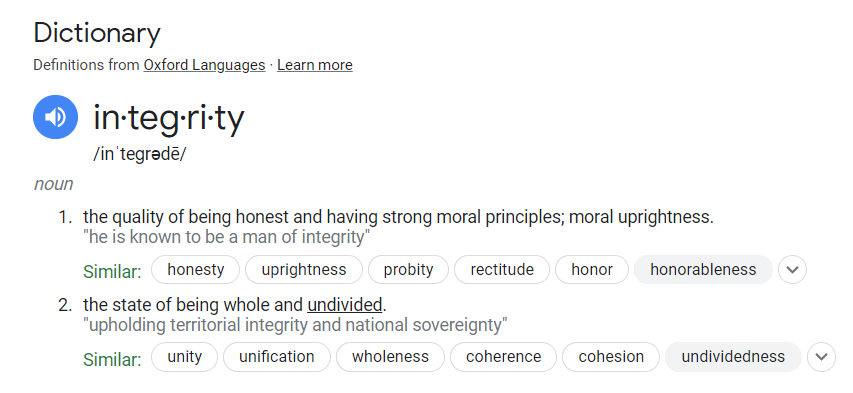
Google search

I love how integrity has these two definitions. I think of a person’s integrity more as the second, as one’s character being unassailably indivisible. It means we show up our whole, honest selves everywhere and with everybody, ourselves included.

There is an identity exercise wherein the self is drawn as a flower, and aspects of identity as petals. The flower is modified by reorienting petals depending on the context in which a person finds themselves–most relevant identity markers in front, most protective around the edges–however the person thinks of themselves as that flower in any given environment. I think this is a fantastic analogy for integrity, because it acknowledges that maintaining wholeness does not necessarily require all parts to be equally visible, vulnerable, dominant, or accessible at the same time. I suspect that for many of us, certain petals are kept out, big, and vibrant, with others more tender and close to the center. Roses have guard petals, tough outer layers that protect the inner petals as the whole bloom opens. Many florists remove the guards for aesthetics, but some recommend retaining them, honoring nature’s form and function. Myriad potential comparisons to the human identity flower here tickle my metaphor-loving brain. What would your flower look like? How does it feel?

How do I do integrity well already?
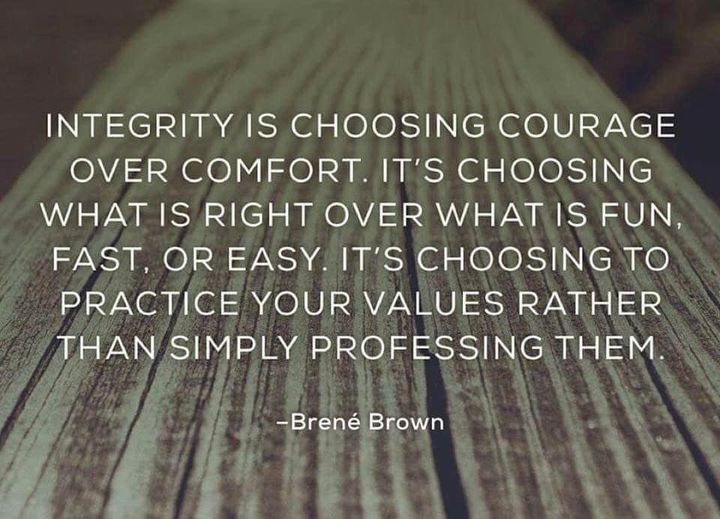
–How does one answer this question without sounding self-righteous and arrogant? I keep thinking I should ask others, “(How) Does Cathy walk her talk?” That is the true test, because self-delusion is real and too often invisible. Walking the talk is how I define integrity, and it is a high value of mine. I think it shows when as a leader, I don’t ask the team to do anything I would not do myself, and I often do whatever I’m asking right alongside everybody.
–I check in often with those who know and observe me. I seek honest feedback and do my best to receive it graciously, so people feel safe to give it.
–I live by a handful of words and ruminate on them daily: present, open, grounded, kind, loving, smart, curious, generous, fun. If you know me and would describe me this way, then I know I’m living into my integrity.

How can I do it better?
–Could I be louder about amplifying my values? Bolder? More assertive and insistent about enrolling others in advancing my just causes? Somehow that feels like showing off, attention seeking, which is not how I think of integrity…
–When I enter situations of ambivalence and conflict, for instance when honesty may rupture relationship, or showing up loving tempts me to withhold honesty, I can slow down and consider, prioritize my values in context, assess risk and harm of each potential action. I think I do this already… At least I practice awareness and acceptance of that discomfort rather than denying or dismissing. I slow down and try not do speak or do irretrievable things impulsively. I can keep practicing this and keep checking in with those in the mud with me.
–I could be clearer and more explicit in times of ambiguity and conflict about which core values I prioritize, what I’m willing to sacrifice, why, and how that informs my decisions and actions. This is transparency and fair process, which are important to me.

What’s already good about our integrity as a society?

National identity and pride. Freedom. Independence. Innovation. Ingenuity. We Americans identify with these values, and despite our many and significant contradictions, I think we exhibit them clearly in many contexts. I hear people from other countries describe how American culture feels liberated/liberating in many ways (though constricting in others). Those contradictions, though, yikes.

In the small ways. I see people trying evey day to live up to/into their ideals. I am very slow these days to call someone out for hypocrisy–I try to imagine their identity flower and assess which petals they’re showing me, and which I think they have tucked away for now. Those ambivalent and conflicting situations happen more often than we may realize, and we literally make tens of thousands of choices each day. Much of our integrity, then, is maybe autopilot? Ooo, fascinating.

How could we do better?

Honesty. It’s okay to be in it for the money, even if your core value is helping people. Just be clear about which of these takes priority, especially when they come into conflict. Make a plan to reorient actions to align as closely as possible as soon as possible, to true core values in the future. Or admit outright that your core values have simply changed. Honesty and integrity go hand in hand in my mind.

Self-compassion. Sometimes it will look on the outside that we have really thrown our values away. For leaders especially, not all aspects of every decision can be disclosed at large. Competing interests and goals scramble our delusions of idealistic, binary, black and white, right and wrong, yes BUT. If we’re really honest, and give ourselves some grace for the hard places we live and work, I think we can find our way more easily to the right, if uncomfortable, next steps.

Psychological Safety. After we have assessed our own morals honestly, drawn our contextual flower as accurately as we can, talked ourselves off the ledge of (or put on some armor to protect against) potential public shaming, and taken some firm, grounded steps forward in our own integrity (tenuous as it may sometimes feel), then we can start to extend these graces to others. Psychological safety in groups spreads more efficiently and effectively if initiated by designated leaders; and any of us can also lead by this example.

It strikes me again now that I did not choose these 30 topics intending for them to overlap so much. Do I just have a dearth of new ideas to express? Or do these concepts/practices intersect so tightly that we simply cannot consider any independently of the others? I think of the human body–we study and practice medicine in quasi-silos: cardiology, pulmonology, infectious disease, endocrinology, orthopaedics, psychiatry, neurology, etc. And yet we all know that none of these systems operates normally with all of the others. I wonder what would occupy each segment of a Venn diagram of any/all of my 30 topics this year? Ooo, that could be fun experiment.

OK on to the next, my friends. It’s late and I’m running out of gas. Accountability tomorrow. Oh yeah, that’s gonna be a good one. 😉