
I See Myself In You

“I can’t imagine…”

“I can’t understand…”

“I can’t relate…”

“I would never…”

When you think or say these phrases, what is the context?  What message are you harboring, or trying to convey—connection or distance, or something else? 

Can you truly not imagine, understand, or relate?  What if you tried harder (or at all)?  How would it affect you if you could imagine, understand, and relate, or if you would ever, under certain circumstances?  How would this altered relationship to the situation (and person) feel?

I have written before about what happened when I said, “I can’t imagine” to a black classmate.  It was humbling.  I submit that we could all humble ourselves a little more these days.

Sylvan Dale Guest Ranch, Loveland, Colorado

My last pre-pandemic solo trip was to Loveland, Colorado, for the last retreat of Leading Organizations to Health, Cohort 11.  It feels cosmically fitting for my first solo trip since COVID to be a return for the first in person LOH alumni gathering in this time, last weekend.  OMG, friends, it was the next best thing to going home.  Other than our leaders, I had only met my fellow alums over Zoom these last two years.  And now I have 8 amazing new friends.  Though separated by occupation, specialty, generation, and geography, we all speak fluently the as yet rare and reverent language of relationship-centered leadership.  This is my tribe.

We start our sessions with poems.  Please Call Me By My True Names by Thich Nhat Hanh spoke deeply to me, especially these lines:

I am the twelve year-old girl, refugee in a small boat,

who throws herself into the ocean after being raped by a sea pirate,

and I am the pirate, my heart not yet capable of seeing and loving.

Whoa.

I have written on this blog many times about seeking, honoring, and really exercising our shared humanity —35 posts appear when I search the site for the phrase.  Even since I started blogging 7 years ago, though, it feels ever more urgent that we practice this every day.
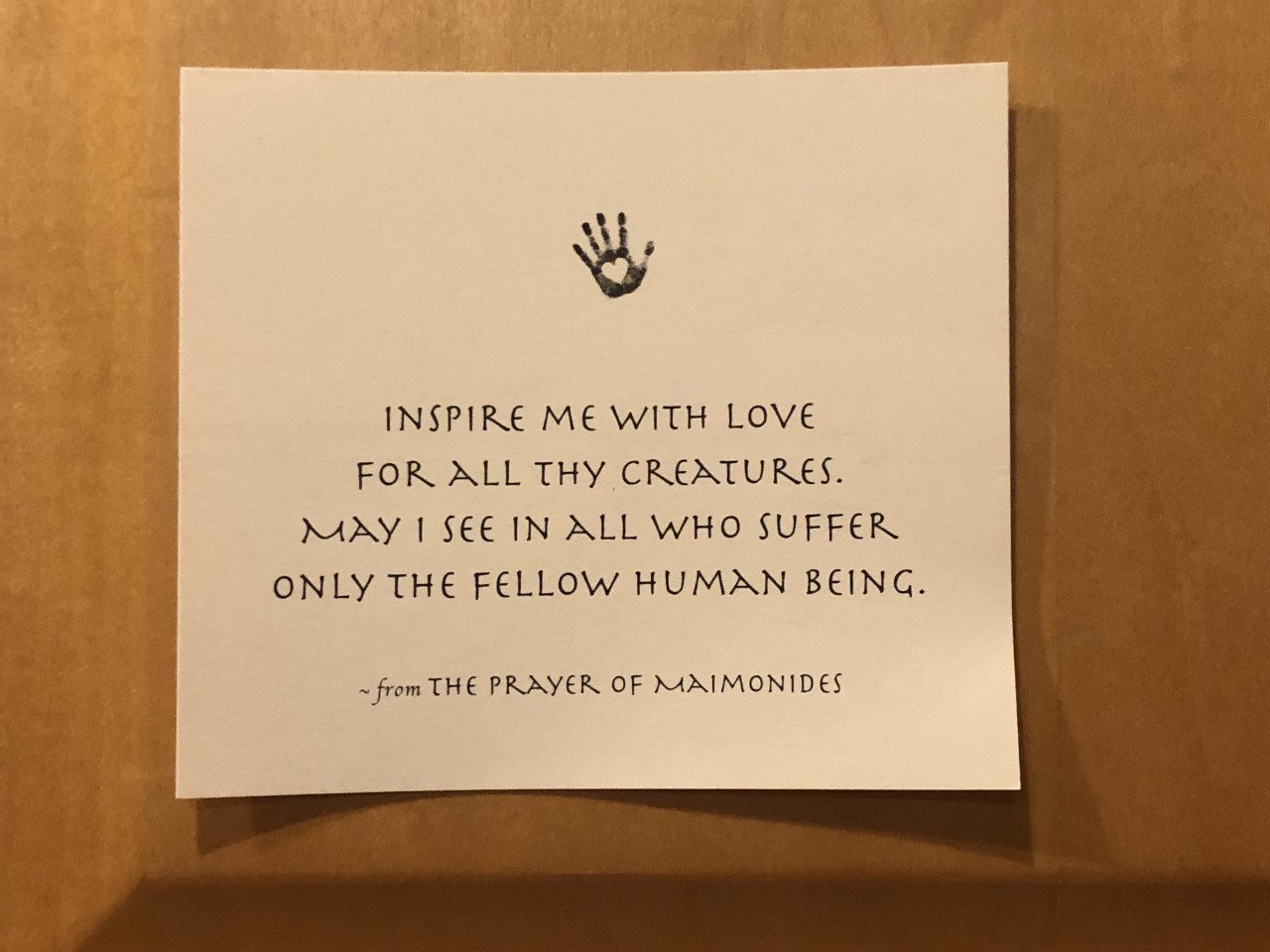
This card hangs on my kitchen cabinet.

This week my good friend Donna asked me to re-articulate my Why.  Again, I’m sure it was cosmic inspiration that moved her.  Have I ever written my Why statement here?  It was ‘to optimize relationships with and between all people I meet.’  And by optimize I meant to make more understanding, more connecting, and more meaningful.  Today, I think I have to be much more specific:  

My Why is to help us all see at least a part of ourselves in every person we meet. 

I intend to practice and model this first myself—to really internalize the truth that I am myself and also every other soul—that we are all born with the same needs, the same aspirations, the same set of possibilities.  Each of our unique, complex constellations of birth circumstance lottery, serial life experiences, and intrinsic wiring shapes us in ways we can only partially understand in our thinking brains.  What we have not the capacity to think or speak, often can only be felt.  And when we contact another soul who has also felt what we feel, or who can imagine, understand, or relate in some way, WOW, how healing is that?  I bet we can all recall at least a few instances when those deep, meaningful connections occurred across apparently wide gaps of background, class, or other social construct.  And why do we remember?  Because we were moved, alerted, and maybe a little alarmed?  Or maybe we have forgotten, because to come too close to someone’s experience that makes us uncomfortable can trigger a distancing reflex—self-image-protecting, perhaps.

In recent years I have internalized the admonishment to never say, or really even think, “What is wrong with you?”  Rather, I remind myself to ask, “What happened to you?”  In every context, this one switch opens the door to curiosity, imagination, understanding, relationship, and connection.  It allows space for our deeply shared humanity to surface and teach me what I need to know, or at least to prompt humility ahead of blind judgment and dismissal.  Substitute “them” for “you” in these sentences, and see how easily and willingly we throw away whole groups of people with our in- and out-group identities and ideologies.

May we all see a part of ourselves in every person we meet, especially the ones who make us say, “I can’t imagine, I can’t understand, I can’t relate, and I would never…”  Let that seeing move us to put down our judgments and take up empathy, compassion, and connection instead.  We will all be better for it.

Place Holder: Elizabeth Lesser’s Wisdom

From Elizabeth Lesser’s FB post

Hiya, friends! There’s a lot going on right now and my relationship with this blog is evolving… transforming? Not sure when I’ll be back with anything of my own that’s worth sharing. I’m confident it will all come in its own time.

Meanwhile, please enjoy Elizabeth Lesser’s Facebook post from today, which speaks directly to my soul. Maybe you’ll resonate as well, and it can bring you comfort and peace as it does to me.

ODOMOBaaT, my peeps. Until next time.

***

I still have abiding hope for our times. I have it because I am a student of history and I know that human communities have struggled through other desperate times: famines, disasters, droughts, floods, and plagues; the fires of war, genocide, slavery, despots, and dictators. Like the mythical phoenix bird, we have risen from the ashes many times before. Eras of destruction have been followed by those of recovery and peace, creativity and great leaps of ingenuity.

I was born in the 1950s, an era that came out of the global brokenness of World War II. To many, the 50s were a time of healing and rebuilding and stability. But to others, they were a time of racism, sexism, and stifling conformity. The 50s gave birth to the 60s which, on the one hand, brought freedom, justice, and liberating creativity, and on the other hand went too far and too fast for many. It has always been thus—cultures swinging back and forth between brokenness and breakthrough. Humanity winding its way through growth spurts and amnesia, destruction and advancement, but always moving, always changing, and, from my point of view, always being offered a choice: to languish or to rise, to perish or to mature into a more magnificent expression of life.

Can we rise? I am eternally optimistic that we can. I have seen people change; I have changed myself. I know it is possible. Even neuroscience is confirming this. Brain scientists once believed that by early adulthood the physical structure of the human brain was fixed. But newer research has revealed that our brains never stop changing—that from childhood on, new neural pathways are formed when we learn new information, change old patterns, or confront physical and emotional trauma. This is called neuroplasticity, and it confirms for me that we are equipped to respond creatively and constructively to stressful and difficult times—that it is possible for all of us, as a species, to create new pathways in our collective brain.

Sometimes it feels way too exhausting to keep carving those new pathways! But I like the way the poet Rumi gently chides me to keep on going, to stay optimistic, to head toward what’s possible:

Drum sounds rise on the air,

and with them, my heart.

A voice inside the beat says,

I know you are tired,

but come.

This is the way.

Mantras for 2022

What words encircle your consciousness this year?

Maybe you don’t roll with words?  What ideas, feelings, sounds, or other sensations, then? 

When you get still, where does your energy settle, and what aspirations arise?

I share some of mine here; I’d love to read some of yours in the comments!

“Stop Shoulding All Over Yourself”

As I get older, I reach for larger, stronger mental shovels to evict certain voices from my mind.  “New Year’s resolutions are useless, don’t bother” (see evidence to the contrary). “Get up early and write in the morning, it’s the only way.”  Do this, do that, think this, feel that.  I’ve internalized enough societal standards and constraints, some helpful, many not.  Every year of adulthood also solidifies my own core values and goals, which themselves drive me forcefully—not enough, never enough, must be better, always more.  In the end all the ‘Shoulds’, both external and internal, can feel heavy.  I know who I am, I know what’s important to me.  I’m a lifelong learner.  I progress because it’s my nature.  I do what I need to do and I’m good at it; I am enough.

Competence and Confidence

So many recurring challenges—this past year especially, but just generally in life, right?  When I look back only at the past weeks or months, it’s too easy to judge myself harshly and wonder, am I really enough?  Look at all the mistakes I keep making, over and again!  But when I breathe slowly and deeply, looking back farther on the long arc of learning, I see unequivocal progress.  “If it’s important, it will be repeated,” they always told us in medical school.  Life lessons always seem to come around again just when I need them.  With every iteration, when I can be fully present, tame my feral emotions, and call forth skills already learned, my ability deepens, even shines.  Every such instance prepares me for the next trial.  This is the benefit of mid-life: seeing clear evidence of advancing competence, and feeling the confidence to own it.

Transform the Story

The first and most important lesson I learned from coaching was to recognize the stories I tell.  All of our perceptions are, in very large proportion, formed in advance by our past experiences, biases, and expectations.  “Reality”, how we make meaning, is far more subjective than we realize (ha!) or admit, and I’m convinced that most human conflict arises when we deny awareness and acceptance of this.  I’ve gotten pretty good at noticing and moderating the stories I tell in new and low stakes encounters.  But in longstanding, intimate relationships and high stakes situations, I am often still chained to my deep, often negative, and ultimately self-defeating stories.  Ironically they are stories about others which, when I’m honest, are actually projections of my own concealed wounds.  How fascinating…and worthy of the work to disassemble, to free myself and my loved ones from these abstract cages of invented being.

Lightly, Lightly, Ever Lightly

*deep breath*

It’s all so much, this work, this drive, this constant striving in potential and possibility.  There is a role and a place for the Shoulds; the challenges all make me stronger; and the old stories all served a purpose once.  To grow is to shed, break, and deconstruct, and also to synthesize, integrate, and reform, ad infinitum.  It can and does often feel pretty heavy.  But now, this year, I choose lightness instead.  I have only this one life, yes, and it is finite.  There is only so much I can do…  And that’s still a lot, and I’m still young yet!  I’ got time, I’ got this; and even if I don’t, damn, I’ve done a fair bit already.  If it all ended today, of course I would have serious regrets.  And I’ve done my best; I’ve never stopped trying.  What more could I ask of myself?

Any and every moment can carry all hope, could make or break everything (really?), and could have nothing to do with anything–who knows in that moment?  I’m learning and doing every day anyway; why apply unnecessary pressure?  No, I’d rather have more fun in this time that I have.  So I’ll keep doing what needs doing.  I just don’t have to take it all (or myself) so damn seriously.

Oh and ODOMOBaaT, of course.  That just goes without saying.