

Former Nebraska senator Ben Sasse and his wife lived just up the road from Hubs and me in Evanston, Illinois in the summer of 1995. It was the deadliest heat wave in US history. Apparently they did the same as we that July–sat in front of the window AC unit as temperatures sat in the mid 100s for days on end. We were engaged and they had just been married a year. I like that I feel connected to them in this way, as I admired him while he was in office. I have just started listening to his 2018 book, Them: WhyWe Hate Each Other–And How to Heal.
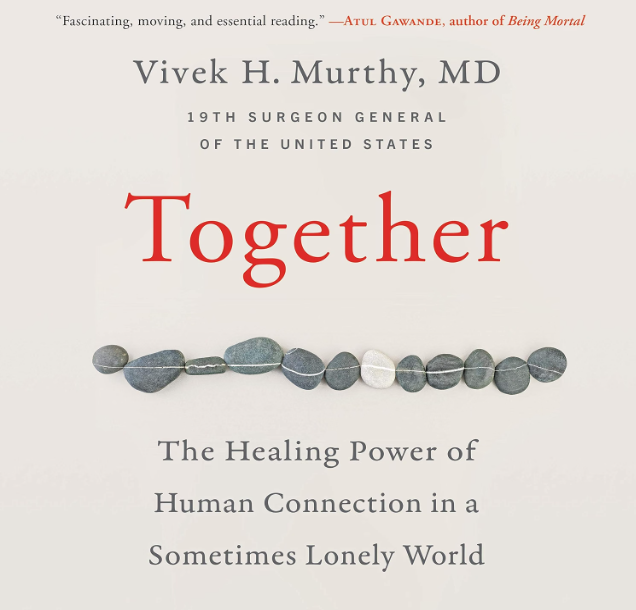
I spent this evening with dear friends (and thus not writing) and I really want to go to bed now, so I will just leave you with the descriptions of this book and another one with the same thesis, that loneliness is tearing us apart and killing us: Together: The Healing Power of Human Connection in a Sometimes Lonely World by Vivek Murthy.
I appreciate so much how these two people from either side of the political aisle and each with their own perspective and style of writing, recognize the same central problem in our current culture. Sasse even quotes Murthy in Chapter 3. I have listened to Together and am tempted to obtain print copies of both books to compare annotations. I imagine Sasse’s focus and conclusions will differ from Murthy’s, and I may well disagree with some of the them. But I respect him as a historian, educator, and former legislator. I could fairly think of these two works as companion books, ‘Them and Us’, worthy of shared space on the bookshelf.
I think of Sasse, Jeff Flake, and Olympia Snowe as conservative senators whom I respected and who left when Capitol Hill got too toxic. Who would their progressive counterparts be? How can we attract and elect more moderates to Congress, or at least people who have the wherewithal to engage with opponents civilly and professionally?
The best part of posting daily is that I can relax and continue today’s ideas tomorrow, if needed. Good night and back again soon!
Them by Ben Sasse
Something is wrong. We all know it.
American life expectancy is declining for a third straight year. Birth rates are dropping. Nearly half of us think the other political party isn’t just wrong; they’re evil. We’re the richest country in history, but we’ve never been more pessimistic.
What’s causing the despair?
In Them, bestselling author and U.S. senator Ben Sasse argues that, contrary to conventional wisdom, our crisis isn’t really about politics. It’s that we’re so lonely we can’t see straight—and it bubbles out as anger.
Local communities are collapsing. Across the nation, little leagues are disappearing, Rotary clubs are dwindling, and in all likelihood, we don’t know the neighbor two doors down. Work isn’t what we’d hoped: less certainty, few lifelong coworkers, shallow purpose. Stable families and enduring friendships—life’s fundamental pillars—are in statistical freefall.
As traditional tribes of place evaporate, we rally against common enemies so we can feel part of a team. No institutions command widespread public trust, enabling foreign intelligence agencies to use technology to pick the scabs on our toxic divisions. We’re in danger of half of us believing different facts than the other half, and the digital revolution throws gas on the fire.
There’s a path forward—but reversing our decline requires something radical: a rediscovery of real places and human-to-human relationships. Even as technology nudges us to become rootless, Sasse shows how only a recovery of rootedness can heal our lonely souls.
America wants you to be happy, but more urgently, America needs you to love your neighbor and connect with your community. Fixing what’s wrong with the country depends on it.
Together by Vivek Murthy
Humans are social creatures: In this simple and obvious fact lies both the problem and the solution to the current crisis of loneliness. In his groundbreaking book, the 19th surgeon general of the United States Dr. Vivek Murthy makes a case for loneliness as a public health concern: a root cause and contributor to many of the epidemics sweeping the world today from alcohol and drug addiction to violence to depression and anxiety. Loneliness, he argues, is affecting not only our health, but also how our children experience school, how we perform in the workplace, and the sense of division and polarization in our society.
But, at the center of our loneliness is our innate desire to connect. We have evolved to participate in community, to forge lasting bonds with others, to help one another, and to share life experiences. We are, simply, better together.
The lessons in Together have immediate relevance and application. These four key strategies will help us not only to weather this crisis, but also to heal our social world far into the future.
- Spend time each day with those you love. Devote at least 15 minutes each day to connecting with those you most care about.
- Focus on each other. Forget about multitasking and give the other person the gift of your full attention, making eye contact, if possible, and genuinely listening.
- Embrace solitude. The first step toward building stronger connections with others is to build a stronger connection with oneself. Meditation, prayer, art, music, and time spent outdoors can all be sources of solitary comfort and joy.
- Help and be helped. Service is a form of human connection that reminds us of our value and purpose in life. Checking on a neighbor, seeking advice, even just offering a smile to a stranger six feet away, all can make us stronger.
During Murthy’s tenure as Surgeon General and during the research for Together, he found that there were few issues that elicited as much enthusiastic interest from both very conservative and very liberal members of Congress, from young and old people, or from urban and rural residents alike. Loneliness was something so many people have known themselves or have seen in the people around them. In the book, Murthy also shares his own deeply personal experiences with the subject–from struggling with loneliness in school, to the devastating loss of his uncle who succumbed to his own loneliness, as well as the important example of community and connection that his parents modeled. Simply, it’s a universal condition that affects all of us directly or through the people we love—now more than ever.

